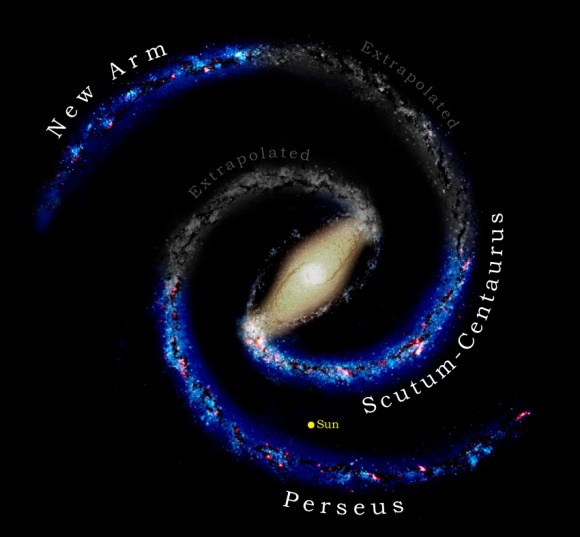
In several prior posts, I’ve written about the so-called Goldilocks Zone, a place on a planet where conditions are “just right” for human life to be sustained. Or for human-type live to have developed in the first place. with the deployment of powerful new telescopes in the last decade, astronomers are looking for and finding many more exoplanets, and astrobiologists are trying to figure out if any of these could sustain human life.
The Wikipedia article on this says:
The bounds of the HZ are based on Earth‘s position in the Solar System and the amount of radiant energy it receives from the Sun. Due to the importance of liquid water to Earth’s biosphere, the nature of the HZ and the objects within it may be instrumental in determining the scope and distribution of planets capable of supporting Earth-like extraterrestrial life and intelligence. As such, it is considered by many to be a major factor of planetary habitability, and the most likely place to find extraterrestrial liquid water and biosignatures elsewhere in the universe.
The habitable zone is also called the Goldilocks zone
But my way of thinking is it’s more than temperature that is needed to develop or sustain human life. In a recent post, I discussed gravity. Too much or too little—in other words, too different than the gravitational tug we have on earth—would, I think, make human life difficult or impossible. Too much gravity and we would crawl around like a bunch of slugs. Too little gravity and we would bound around with great leaps, except that muscle mass and tone might never develop. I think gravity is really important.
What about light? Does the amount of light that reaches Earth have an impact on our being able to live here? Did it have a factor in our developing in the first place? The graphical depiction above shows our solar system as being far away from the galactic center of the Milky Way. Thus, it is dark at night when we have rotated away from our sun’s direct rays. We get a little light from the thousands of stars we can see, and a little more from the moon, but obviously a whole lot less than during daylight. I think that, if we were located near the galactic center, we would have no night. The number or stars close enough that an exoplanet would not experience night, even when rotated away from its star.
What would perpetual daylight do to a person? Would the lack of a mostly dark period lead to some form of madness? I fear it would.
Or what if God used evolution as the way He made humans instead of creating them as a fully-formed and developed Adam and Eve? On an exoplanet with no night, could human-like life have evolved? How important is alternating periods of light and darkness to the development of the brain power we possess? I’m asking questions here about something I wonder about, and suspect is important, but in truth know nothing about.
This is the last of the factors I’ll write about that might have an impact on the habitable zone of any star. Actually, though, I wonder if there are more factors involved that I haven’t thought of.