Category Archives: Documenting America

A Fulfilling if Tiring Day

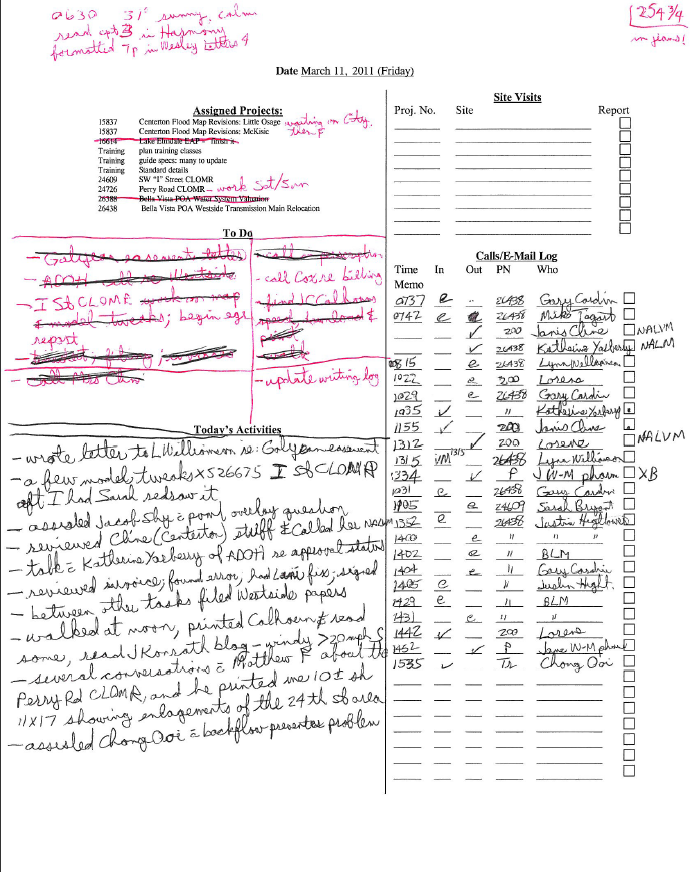
It’s only 5:15 PM as I start this post. My daily work log includes lots of items. I began the day with my Bella Vista water transmission main project, trying to do the work needed to tie down some remaining easements needed. I shifted to my Bentonville flood study, the bane of my existence. I’m on Revision 5, which will be the 5th submittal to FEMA. I then shifted to a citizen complaint in Centerton concerning drainage problems that have been hanging on for four years, and a floodplain issue from the last three months.

Through all this, I shifted back and forth to filing papers for the Bella Vista project. I thought another man was going to manage the project under my direction, so I was letting him file as he saw fit. That didn’t happen, however; he was assigned to other projects, and the papers mounted. Earlier this week I re-did the project filing system to my liking, and began to dribble a few papers into the notebooks. Today, any time I finished a pressing project task, I shifted to the filing. I must have stuffed a 150 pages in those notebooks. I’ve got double that yet to go, but I feel much, much better about it.

The usual parade of people needing senior engineer advice came by or called. A backflow prev enter problem, a paving overlay problem, and some floodplain issues in Rogers took up some time. Then there’s the project from almost nine years ago that wasn’t constructed per the approved drainage report: one storm sewer run was reduced in size. For lack of another body carrying a brain of adequate intelligence, I wound up doing the calculations and mini-report over three days this week. That came back with another request today.

And over all this was the Bentonville floodplain engineering. I’m going back and forth between the model and the map, seeing where they don’t agree, tweaking the model when that makes sense and marking up the map for changes when that makes sense. It’s getting close. Thirteen more cross-sections to go for the 500-year floodplain, then a recheck of the 100-year floodplain and the floodway to make sure they didn’t get out of whack due to the last changes. Then there will be a short engineering report, maybe four work hours to complete. That’s a Monday task.

I’m so sick of floodplains. If I never saw another one I wouldn’t mind. Yet I’ve got three more to do in the next year. In fact, I’m coming in to the office tomorrow and Sunday to try to get something done on the Rogers flood study that has been backed up due to the Bentonville flood study that was backed up due to the Centerton flood study. Then there’s another Rogers one to do and then another Bentonville one to do. I’m so sick of them, I feel like going out in the rain, standing in the worst portion of Tributary 2 to Little Osage Creek, and just ride the flood wave downstream.

But instead, I think I’ll review two more cross-sections then call it a day. With Lynda still in Oklahoma City, tending to grandbabies, I’ll head to Barnes & Noble, browse the remainders table, look at shelves where someday I might have a book, grab a couple of mags, drink a vente house blend, and just relax for two hours. Then home to write the last (or maybe next to last) chapter in Documenting America. Oh, yeah, before the work day began I found a document I needed, a full version of one of John C. Calhoun’s speeches. Of course, that led me to another speech of his, which I may use instead of the one I intended. Ah the tentacles of research.

Signing off. I’ll have this post in two hours, when I will be firmly b-i-c in the B&N cafe.

The Federalist Papers as Source Documents

I don’t remember much coverage of The Federalist Papers in my history classes. In fact, I guess I don’t remember my history classes much at all. But I’m reading these as possible source documents for my book Documenting America.

For those who don’t know or remember what this is, The Federalist Papers were a series of newspaper editorials written by Alexander Hamilton, John Jay, and James Madison, in 1787-1788 for the purpose of convincing the citizens of New York to approve the new constitution that had been proposed by the Constitutional Convention. They felt that New York was the key to getting the constitution approved as the law of the land, but they were concerned that New York would not approve it.

So these three founding fathers agreed to publish editorials/essays in the New York newspapers to convince the electorate to convince their legislature to approve the document. The essays were published under the name of Publius. History tells us, however, that who was writing the editorials was known at the time. Starting with reasons for having a stronger central government than they had under the Articles of Confederation, they moved on to each branch of government, and all the major provisions passed out of the Convention.

In a way these gentlemen failed in the task. New York the constitution in a timely manner. Yet, it still became the Constitution because enough other states ratified it. Eventually New York came through with a late ratification (not as late as little Rhode Island, which didn’t ratify it until two years after the other states, and then only through bullying). It turned out that New York was not as critical as everyone thought.

I haven’t read all of these yet. I read the first three, then jumped ahead to the chapters on the Judicial Branch, for another project. But what I’ve read has been outstanding. The case for a stronger central government was clearly made in the first three, IMHO. Government was essential, Publius said, to the securing of rights. Weak government, weak rights. Stronger government with adequate checks, balances, and separation of power, protected rights.

Should I be considering these as source documents for USA history? After all, they have no official standing as government documents. The three men were acting in official capacities in one way or another, but the editorials seem to be more private than public. I have decided that they are source documents. They are perhaps the clearest indication of what was in the Founding Father’s minds for our Constitution and the republic that it created. No doubt many of them also wrote letters that would reveal their minds, but these are scattered—and they are no less private than these. I could go through the minutes of the Constitutional Convention, presuming they are somewhere on-line, and I may do that. I have a book that gives the minutes of the ratifying convention for Massachusetts, and hope someday to glean something from that.

For now, The Federalist Papers form the basis of four chapters in volume 1 of Documenting America. I anticipate using a similar number in all subsequent volumes.

Ben Franklin in Paris

I first wrote Chapter 16 of the first volume of Documenting America five or six years ago. Well, it’s chapter 16 now that I added some before it. I think it was eleven or twelve originally. The documents of the chapter were two letters written by Benjamin Franklin from Paris on May 1, 1777. He was ambassador for the thirteen colonies, then fighting for their independence from Great Britain.

Franklin had been there less than three months, but he already had measured the political landscape and formed conclusions. England was having trouble recruiting troops. Mercenaries from Germany were available, but hard to come by. France, and her ally Spain, were preparing for war against England, but for the moment would not move. Since reports from America told him of improved prospects for Washington’s army, Franklin was optimistic that the American forces could hold off the British.

Franklin also concluded that continental Europe was on the side of the colonies. Even those nations and people who did not live in liberty were pulling for us. We were “the cause of all mankind.” If we won our liberty, formed a government, and stayed free among the roll call of nations, perhaps liberty for them was possible.

As I reviewed this chapter last night in preparation for expanding to full length this week, I knew I needed to see the Franklin letters again. So, through the miracle of Google Books, I found an 1818 volume that had them. They really weren’t much longer than the excerpts I had planned to use as a newspaper column, so I decided to use the full letters (minus salutations and closings). However, I saw in the old book that Franklin wrote a short letter to a third man that day. It was just as good as the other two, so into the chapter it went.

The longer amounts of letters, and some expansion of my commentary, brought the chapter up to 1478 words, and the book up to 35,447. I have one more chapter to expand, and I think two more to add, bringing the total chapters to thirty, and the word count to around 39,000. That doesn’t include an obligatory introduction, or table of contents, title page, copyright page, etc. Nor does it include some advance notice of volume two. I’ve learned recently that novelists who e-self-publish a series will add something of the plot of the next volume to the one at hand, creating some anticipation. Sounds like a good idea to me.

So, my first e-self-published book comes closer to completion. I project I’ll have it done by Saturday or Sunday. I’ll then print it and begin a couple of weeks of proofreading while waiting for my beta readers to review it and give me feedback. At least, I hope they do that. So far, no word.

It’s late, and I really need to get to bed. I want to read a little, however, and prepare for tomorrow’s writing work.

Still Working Hard on Documenting America

Last night I spent nearly three hours in The Dungeon, writing on Documenting America. Having just written and type two new chapters over previous days, I decided to spend last night expanding some chapters that were either newspaper column length or that I started years ago but never really completed.

The three I picked were chapters I drew out of a letter Thomas Jefferson wrote to his Virginia colleague Samuel Kercheval on July 12, 1816. [Note: A couple of transcriptions of this on the Internet erroneously have the date June 12, 1816.] Kercheval had written Jefferson, asking for his opinions on changing the Virginia constitution. Kercheval thought certain parts of it were not as good as they should be, and seems to have been one pushing for a constitutional convention. But, the Virginia constitution was Jefferson’s baby, having been based on his own work. Heck, he may have even written most of it. What would Jefferson think about his baby being revised?

Jefferson wrote back in detail, saying he agreed with most of what Kercheval did (which must have been based on something Kercheval wrote in his letter; haven’t seen it yet) and so he didn’t mind weighing in privately, but didn’t want his views showing up in the newspaper. In his letter, Jefferson threw his “baby” under the bus, saying it was indeed time to change it.

This is such a good letter that I was able to draw three chapters from it, on the following themes:
1. Constitutions might be good, but they are not perfect, and should be subject to change at regular intervals. Flaws in constitutions are overcome by active participation in government by an informed citizenry.

2. The best republican government is that which includes the broadest possible electorate, the most equitable representation, and fairly frequent elections.

3. Public debt is a bad thing, because it results in higher taxes, which results in citizens having to work so much to pay their taxes that they have no time to participate in government.

This letter is, in my opinion, one of the most important documents from United States history. Everyone should read it, internalize it, and remember what Jefferson was saying. A good transcription can be found here. A scan of the original letter starts here and continues for several pages. The same Library of Congress collection says it has the Kercheval letter, but I checked it and it was signed by a Thompkins. Perhaps Kercheval published under an alias the pamphlet he sent to Jefferson, but Jefferson knew who he was.

Close reading of the Jefferson letter last night and today convinced me that I have some more work to do on these three chapters, not so much my analysis but the quoted portions of the letter. I’ve got a lot of overlap between the three chapters, and I need to separate them a little more. I guess that’s part of tonight’s work.

Meanwhile, a little bit of easy browsing turned up more sources, outside the Annals of America. One of those is a collection of letters sent to Secretary of the Treasury Salmon P Chase at the outbreak of the civil war. I skimmed a couple of them, and found good fodder for other chapters. The other is a series of letters written by Ebenezer Huntington from 1774-1781, when he was first a law student and then an officer in the Revolutionary War. I skimmed some of these too. They seem kind of drab, simple reports of what’s going on where this soldier happened to be. But drab during a war for independence is historical, so maybe I’ll be able to use these as well.

So, the research continues apace. There’s so much out there it’s almost frightening.

Research for Documenting America

When I was on the working vacation recently, Moses Austin went with me. Moses wrote a journal on his trip through the Ohio Valley and on to Saint Louis. That trip took place during the bitterly cold and snowy winter of 1796-97. He started out from the mountains of Virginia, then into Kentucky, then territory that would eventually become Ohio, Indiana, Illinois, and Missouri (still under the control of Spain at that time). His return trip was by way of Kentucky and Tennessee.

An excerpt of this journal is the first item in Volume 4 of the Annals of America, an Encyclopedia Britannica publication. My analysis of that document, or rather of that excerpt, is a chapter in Documenting America. I took that volume with me for research reading material. Lynda drove some on the first day of the trip, so I pulled that out of my reading bag and started at the beginning. Later, at our hotel in Orlando, I was able to finish the excerpt and write two chapters in manuscript.

Now, a journal of a trip, even a trip through wilderness areas, may not be inspiring writing. When I began reading it I wasn’t sure it would be good material for a chapter, let alone two. But I did find it to contain information that I thought readers of Documenting America might want to know about. So I read the whole thing and wrote. After returning home I typed the two chapters, no. 27 and 28.

My research didn’t stop there. First I made a trip to Wikipedia for a brief bio. Now I know a lot of people moan about Wikipedia and inaccuracies. I’m sure they have some, maybe many. But for initial research and sources of information, I’ve found it to be a good place to go. Austin’s bio was brief, but certainly longer than the paragraph in my source. It gave me some good background, subject to confirmation if I used any of it.

As I said my source gave only an excerpt of the journal. Those ellipses that the Encyclopedia Britannica people use don’t tell me much. Was there good material in those left out sections or not? They took it from Vol 5 of The American Historical Review, which sounded like a publication. A search through Google Books turned up the volume. Talk about instant library loan, without the $2.00 search fee! Downloaded in five seconds, and the applicable pages printed in another hundred or so.

Before the journal was a biographical sketch of Moses Austin, written by his son, the famed Stephen F. Austin, and edited by one of Moses’ grandsons. Only a few pages long, it was an excellent short bio. It blew away the information given in the Annals and in Wikipedia. It’s tempting to join Wiki as a contributor, just to be able to flesh out Moses Austin’s biography. Maybe later.

The full journal, in all its glorious, archaic language full of long paragraphs, inconsistent spellings, and poor punctuation was there, having appeared in the April 1900 issue of the magazine. I scanned the full journal before typing the chapters. Some of the removed material was good, and I included it in the quote portion of the chapter. The except had been six or seven pages. The full journal was twenty. Should I read the whole thing? After all, the chapters were written, complete except for any editing I will do upon later contemplation. And having written two chapters from this document, I’m not likely to write another.

I was fascinated by this journal, however, and decided to read it all. I’m glad I did. Much of the removed material was of great interest to me. Austin described his route, including the towns he stayed in or the isolated farms he either found hospitality at or was rejected. I was able to trace his route on my road atlas. Some of the places still have the same names, such as Crab Orchard Kentucky.

Austin described the towns, and gave thoughts on their economic prospects. It’s interesting to see what he wrote about the prospects for places such as Louisville, and how he was correct about what it could become. I also found his constant bemoaning of the American government’s neglect of the areas he traveled through to be quite interesting (sorry, Joe F and Mrs. Rosen). The US government was busy trying to establish its place in the roll call of nations, develop governmental institutions, and figure out if a self-governing republic would really work. It was kind of to do all that and establish regional or civil governments in Cahoika or Kaskasia, or even Vincennes. I found in Austin’s words a third chapter, on the idea that even back in the late 1700s there were people who wanted the government to guarantee an outcome. But that chapter will have to wait for another volume.

The purpose of Austin’s trip was to see the lead mines in eastern Missouri. This was under Spanish dominion, so he needed certain letters and permissions to do this. I never knew that sixty miles south of Saint Louis, thirty or forty miles up from the Mississippi River, were rich lead deposits that were easily mined. But there was. The place names today reflect that: Leadwood, Irondale, Iron Mountain, Old Mines, Leadington. Missouri has an historic site there, called Missouri Mines State Historic Site. So I learned something in this extra research.

One other item of research to mention, something I haven’t done, and probably won’t. In The American Historical Review are many footnotes concerning journal entries. Mention is made of various original documents, such as American State Department papers, that would probably be good reading. Various secondary documents that further illustrate the points Austin makes are also cited. How wonderful it would be to find some of these documents and study further!

But, that would not make Documenting America a better book, I don’t think. I’m not writing a scholarly work, but a popular “history”, bringing lessons out of historical documents to see what lessons they hold for today’s America. Research for my own enjoyment won’t further that goal.

Posts in Real Time

I have been away on a working vacation from February 17 until today. I attended the annual conference of the International Erosion Control Association, where I delivered three papers, met a lot of the leadership, and attended my first meeting as a member of the Professional Development Committee. Monday, Tuesday, Wednesday were all business. The other days were driving and vacation.

Before leaving, I took time to write a few posts for the blog, and scheduled them to post about every two days. I also wrote one from there and posted it for later appearance. I like that feature of Blogspot, something I never used before, and which turned out to be incredibly easy. It lets me keep the blog fresh while being unable to write and post.

During the trip I had a fair amount of reading material with me, but found less time for reading than expected. I had volume 4 of the Annals of America, which is my first source for documents for Documenting America. I read the first item in the book, a report from 1797 by Moses Austin, father of Stephen F. Austin, of a trip he made from Virginia to the Ohio River valley and even to St. Louis and a little beyond. The document was fascinating, and I have written two chapters from it, one during the trip and one today, typing both of them this evening. The book is now up to 29, 275 words, so is still coming along.

I also had a notebook with various writings of John Wesley in it. I read some in that, both on the trip and today, but found it more difficult reading. Still, I have pretty well identified some material that will form the basis of a chapter in my Wesley small group study, so the reading, if limited, was profitable.

The week ahead looks very busy from a writing perspective. I have to prepare and send an invoice for some writing I did, the first of those I’ve had to do. That’s a tomorrow noon thing. The editor for Buildipedia asked me to try to move forward an article I thought I could take till next week to do. That’s a tomorrow evening thing. Despite some new troubles at Suite101 concerning changes Google recently made in their search engine algorithms, I’d like to write at least two articles this week for Suite. They will be Tuesday and Friday things.

And, while away on the trip I learned from Facebook posts that a woman in our church is a writer, excited about recently having sold some of her writing. I contacted her, and she is interested in seeing a writers group formed at church. I know of five others who in one way or another have either written things or have expressed an interest in doing so. This will be a Wednesday thing, I think, to see what can be done about organizing this group, with an eye to begin meeting maybe in April.

So the week looks full, and I hope on Saturday I can make a report of incredible productivity. Of course, I’ll be writing here before then.

My First Sale of "Mom’s Letter"

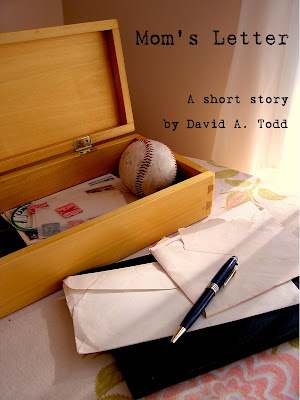
My e-short story, “Mom’s Letter“, has sold one copy since I listed it not quite two weeks ago. Yea! That sale was to someone I know, a former colleague in the poetry wars on Poem Kingdom, years ago when we were moderators together there. Poppy also wrote a nice review for it, an honest review, not a fake one. I’m grateful for that.

Due to having been away from home for an engineering conference, combined with a little vacation, I haven’t been able to do anything to create a buzz for the story, except for one post here, one on the Suite writer forums, and one post at Facebook. I need to get to a few other places and do some posts. A few more sales would be nice.

On this trip I’ve managed to write one chapter for Documenting America. The document I reviewed has also given me fodder for at least one more chapter, maybe two if I want to. Once I type that chapter in I should be at 28,000 words. So that’s edging ever closer, and publishing it before the end of March is possible, though possibly rushing it.

The sun is shining. I’m on vacation, and by the view through the windows it appears a gentle breeze is blowing. I should be outside, walking the campus or sitting by the pool, reading. Perhaps I will. I’ll set this to publish tomorrow, actually, and fool all my readers (all ten or so of you) as to my whereabouts.

Calling All Beta Readers

Documenting America, Volume 1, is coming along very well. I’m up to 26,300 words, en route to somewhere between 35,000-40,000. I have 26 or 27 chapters, planning on about 32 all together, though I may have my word count in just 30.

Before I decided to do this as an e-book, I was preparing it to be newspaper columns. In fact, as I’ve mentioned before, the first four were published by our local newspaper as part of a guest editorial program. I received good, if limited feedback. I stopped submitting them when the editor in charge of the program left, even though the program continued. I kept writing them for a while, accumulating eighteen separate columns, though a couple of them probably weren’t really done. When it was a newspaper column, I aimed to have 500-750 words.

Now that I’m doing it as an e-book, I have no restriction on word count. What was an individual column is now a chapter. The only limit is how many words I would consider to be “history in sound-bite sized chunks.” I consider that between 1000 to 1250 words. So I’m expanding those eighteen chapters to full length, as well as adding columns. I think I have seven or eight more to expand. I found, as I worked through many documents, that they deserved multiple columns/now chapters. I thought I’d do them widely separated, then decided to do them in pairs. So I’m adding chapters within the eighteen already written as well as at the end.

It’s time, I think, to get this in the hands of some beta readers. I’ve contacted some by e-mail, receiving positive responses, but I need a couple of more people. A beta reader could be another writer, or an industry pro who has a critical eye. Or, they could come from the target audience, the people I hope to sell books to. The things I’m interested in are:

  1. Is this a sound concept, i.e. the idea of breaking USA history down into small segments as the chapters do?
  2. Is it likely to have commercial success, i.e. would you want to buy something like this?
  3. Is the writing any good? I have a very thick skin. If someone says my writing is crap, I take that as useful criticism and attempt to do better.
  4. Does the chapter complete a thought, or is the reader left hanging wondering “why the heck did he bother to write that?”
  5. Any of what we call “in-line” comments are appreciated from a beta reader, but certainly not expected. This could be anything from: identifying grammar errors; catching typos; pointing out some bad writing in the midst of otherwise good writing; pointing out incomplete thoughts, where I might have meant to say something more, was interrupted while writing, then never came back to it.

So, if anyone has any desire to be a beta reader for this project, let me know by posting a comment, or e-mailing me at norman_d_gutter at yahoo dot com.

The Jury is IN on the Short Story Covers

Home again today. I could have made it to work, but a call to the office determined that I could stay home if I wanted. My pick-up is all cleaned off and dug out, ready to hit the plowed roads at 6:30 AM tomorrow. So I’ve had a pleasant day of exercising my body via shoveling, and my brain via reading and writing. I wrote one new chapter of Documenting America, and expanded one old one to full length. I also did some research for future chapters. The word count now stands at 23,300, so I’m edging close to done. I’ve done half of my daily Wesley research, read the couple of writing blogs I follow, followed stocks for a while. I’m ready for something else. Oh, yes, I’ve also begun research for my next Suite101 article.

A few days ago I posted two trial covers for my short story, “Mom’s Letter”, asking people to weigh in on which one looked better. I also posted a notice about this at the writer’s forums at Suite101. Not may people commented on the blog (only one, in fact), but many of my friend and colleagues from Suite101 dropped by, looked at the two, then went back to the Suite forums and posted comments. I also received comments from my wife and son. The verdict is…

…both covers are good (one Suite woman described both as “gorgeous”), but cover one was better than cover two. The comments were about 14:1 in favor of cover one. The only negatives about cover one concerned the font. Some thought the letters in the word “Mom’s” and my name seemed “squooshed” together. Some saw the font as “non-professional”. I must confess that I didn’t see the squooshing, and still don’t after the comments. When I first looked at the font it did look non-professional to me. However, after dwelling on it a bit, I think it’s the right font for the story. It looks like it came off a typewriter—an old typewriter—which fits the story with it’s span of forty years and attention to memories.

I was going to re-shoot the second one, see if I could do better with the lighting, but have changed my mind. With such a large margin between the two, it’s doubtful that better lighting on two will overturn the verdict in favor of one. Perhaps the cover designer might want to tweak the letter spacing, perhaps not. I’m pleased with it the way it is. All it needs, IMHO, is the words “a short story” added somewhere, so that potential buyers are not led astray, and it’s good to go.

One of my Suite commenters said she’d been in many editorial meetings where covers were discussed and had never seen such a lopsided agreement between competing covers. That may be due to the fact that the photographer for one is accomplished in that pursuit, while the photographer for two (meaning me) is not, and has no sense of artistic layout, lighting, spacing, etc.

The good thing is, with e-self-publishing, it’s easy to change the cover. Short story not selling? Early reviews say the cover stinks? Change it. If that doesn’t work change it again. If that doesn’t work change it again. Change it daily if you want. It’s not a question of pulling a print run; it’s a question of deleting a file and uploading a new one. How cool is that.

So, I’m inching closer to publishing this. Maybe I can get it done by the weekend. My schedule will require me to wait until early March if I don’t get it done by then. Must next see if the story needs any tweaking. Amazingly, I found one typo in it on Tuesday, and a “that” I think I can delete. Recent beta readers have suggested a tweak or two, which I’ll evaluate. Then, I have to finish research into how to upload the file and list it on Kindle. Then I’ll have to see about other publishing platforms. Nice, discrete tasks all in a row.

Another Snow Day, a Little Bit of Progress

The forecast was for 4 to 10 inches, then 4-9, then 4-8. Last night at 11 PM the storm was hanging out just north of us, and I wondered if it would pass by to the north. I set the alarm to get up at the normal time, in case the forecasters had it wrong. I was up at 3:45 AM and looked out. 1-2 inches had fallen; the snowfall right then was heavy. I turned off the alarm and went back to bed.
When I got up at 7:30 AM, we already had 7-8 inches, and the snow was still falling. I had my devotions, then went downstairs to lok at stocks on an unusual day at home. By the time the snow ended, around noon, we had 12 inches, maybe a little more than that.
On such a day as this I should write. And I did. I finished edits to my article for Safe Highway Matters, after calling the Michigan Department of Transportation to get additional info and quotes. I then wrapped up a Suite101 genealogy article. However, when I tried to upload it I was foiled by my old, old computer. The hard drive had been crunching forever, and it kept doing it and didn’t load the article publishing page at Suite. I gave up, went upstairs, then out to shovel the driveway. That took an hour, then back in for some soup and back downstairs. I decided to do a files cleaning of the computer. I figured at the same time I’d install updates and re-boot. This took forever.
So I came over to Lynda’s computer (which she almost never uses), much newer than mine and more powerful, and I began this post. Meanwhile the old computer finished all its crunching and deleting and uploading and restarting. I’ve been going back and forth between the two, typing on this post and starting Suite101 again and getting the article uploaded. That finally worked.
Meanwhile, as I’ve had to wait on web page loading, I’ve been able to do some research for Documenting America. I also began putting together my next brown bag presentation at work, this concerning floodplains.
It’s now 4:16 PM as I write this. Hours and hours remain in the day. I’ll spend a little more time on the floodplain presentation prep, then finish reading the document for my next DA chapter, then maybe go upstairs and read some in the John Wesley biography I’m most of the way through and enjoying immensely.
Another snow day is a productive day, perhaps helping me to see a little more what a writing life would be like. Now if I could just get these fool pictures to place correctly in my blog, I’ll be happy.