Tag Archives: exoplanets

The Goldilocks Zone – Part 4

What if Earth were in the center of the galaxy instead of a far away arm? How would gravity be different, and could human life be sustained or develop?

In several prior posts, I’ve written about the so-called Goldilocks Zone, a place on a planet where conditions are “just right” for human life to be sustained. Or for human-type live to have developed in the first place. with the deployment of powerful new telescopes in the last decade, astronomers are looking for and finding many more exoplanets, and astrobiologists are trying to figure out if any of these could sustain human life.

The Wikipedia article on this says:

The bounds of the HZ are based on Earth‘s position in the Solar System and the amount of radiant energy it receives from the Sun. Due to the importance of liquid water to Earth’s biosphere, the nature of the HZ and the objects within it may be instrumental in determining the scope and distribution of planets capable of supporting Earth-like extraterrestrial life and intelligence. As such, it is considered by many to be a major factor of planetary habitability, and the most likely place to find extraterrestrial liquid water and biosignatures elsewhere in the universe.

The habitable zone is also called the Goldilocks zone

But my way of thinking is it’s more than temperature that is needed to develop or sustain human life. In a recent post, I discussed gravity. Too much or too little—in other words, too different than the gravitational tug we have on earth—would, I think, make human life difficult or impossible. Too much gravity and we would crawl around like a bunch of slugs. Too little gravity and we would bound around with great leaps, except that muscle mass and tone might never develop. I think gravity is really important.

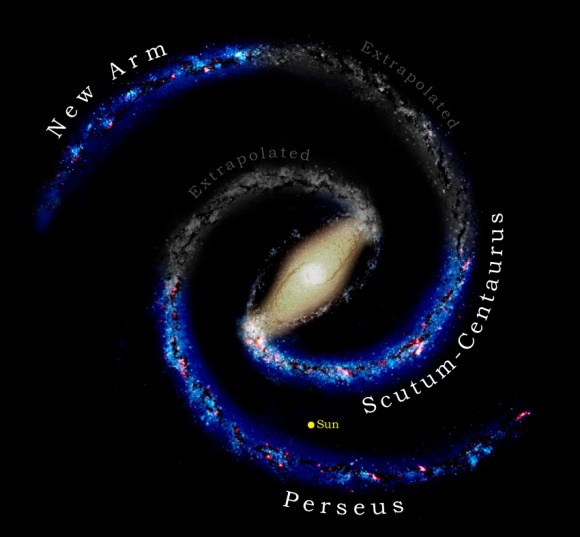
What about light? Does the amount of light that reaches Earth have an impact on our being able to live here? Did it have a factor in our developing in the first place? The graphical depiction above shows our solar system as being far away from the galactic center of the Milky Way. Thus, it is dark at night when we have rotated away from our sun’s direct rays. We get a little light from the thousands of stars we can see, and a little more from the moon, but obviously a whole lot less than during daylight. I think that, if we were located near the galactic center, we would have no night. The number or stars close enough that an exoplanet would not experience night, even when rotated away from its star.

What would perpetual daylight do to a person? Would the lack of a mostly dark period lead to some form of madness? I fear it would.

Or what if God used evolution as the way He made humans instead of creating them as a fully-formed and developed Adam and Eve? On an exoplanet with no night, could human-like life have evolved? How important is alternating periods of light and darkness to the development of the brain power we possess? I’m asking questions here about something I wonder about, and suspect is important, but in truth know nothing about.

This is the last of the factors I’ll write about that might have an impact on the habitable zone of any star. Actually, though, I wonder if there are more factors involved that I haven’t thought of.
 

The Goldilocks Zone—Part 3

What if Earth were in the center of the galaxy instead of a far away arm? How would gravity be different, and could human life be sustained or develop?

Continuing our discussion about the Goldilocks Zone—that area of a planet where conditions are just right to sustain life, especially human-like life—I move now from conditions on the planet itself to things in the planet’s neighborhood. I’ve already discussed the general concept of a Goldilocks Zone and factors affecting the temperature, which must be just right for human life to thrive.

The first of two things off the planet to discuss is gravity. Gravity? you say. Isn’t that on the planet? Well, yes, it is. Perhaps “off the planet” is not the best term. Anyone who has taken fundamental science in school has learned about gravity: the pull two objects exert on each other. It holds air close to Earth, creating the atmosphere we need for life. It’s what keeps our feet firmly planted on Earth, and why we can’t jump off of it. It’s why we fall if we lose our balance.

But we know it takes two bodies to gravitationally tango. This is demonstrated by the tides, which have been shown to be related to the moon’s gravitational tug on earth. Those tides are variable based on the lunar cycles.

I’m not saying we need a moon-ocean connection for human life to form but simply using the moon as an example of something in the neighborhood that affects our gravity. I’m trying to talk through the likelihood of another planet being out there somewhere in the Milky Way or another galaxy being able to sustain human life. Some people believe, given the number of galaxies and stars out there, the existence of finding other life-sustaining planets is a virtual certainty, including planets where human-like life could have developed. I’m simply talking through that scenario.

The Goldilocks Zone concept, as I’ve seen it presented, is usually posed as a question of temperature and nothing else. But could gravity play a factor? What if you had a planet with the moon’s gravity. If it could hold an atmosphere in place, could humans live in only that little gravity? Could human life have developed in only that little gravity? I sort of doubt it. Some different kind of life would have developed. You wouldn’t see a bunch of Armstrongs and Aldrins bounding around. But will wait for scientific experts to weigh in.

What about other celestial objects, such as the sun and other planets? Obviously the sun plays a big roll, its gravity holding Earth in orbit. Could you find a planet with a sun, say, three times the mass of ours, and place a planet in orbit around it so that a Goldilocks temperature could exist, would the gravity properties be such that human life could exist? Or what if the planet were twice as big as Earth? Same question. Would that planet hold so much air in place that the atmospheric pressure would be too great for humans to live in it?

Let’s go a little farther afield in the celestial neighborhood. What about a planet rotating around a star near the center of our galaxy. Would all the other stars around it combined exert so much gravitational force that it would be so different from ours that human life couldn’t exist? or not develop in the first place? I realize we are talking about four or five light years between stars. But what if you had bunches and bunches of stars?

I’m asking questions I don’t know the answers to. I suspect scientists, somewhere on Earth, understand gravity so much they can tell what conditions are an a supposed planet twice Earth’s size rotating a sun thrice our sun’s size in a celestial neighborhood 100 times more cluttered than ours. What are the “G” forces on a human at that equator, and could they exist there in that gravity if the temperature were right?

We have learned from long-term periods in space that it’s almost impossible for humans to maintain muscle mass and tone in Zero G, even with lots of exercise. What will happen on a theoretical exoplanet with G forces so foreign to our bodies? A biologist might—or might not—be able to answer that question.

The next post in this series will discuss one more celestial neighborhood factor in the presence of a Goldilocks Zone.

The Goldilocks Zone—Part 1

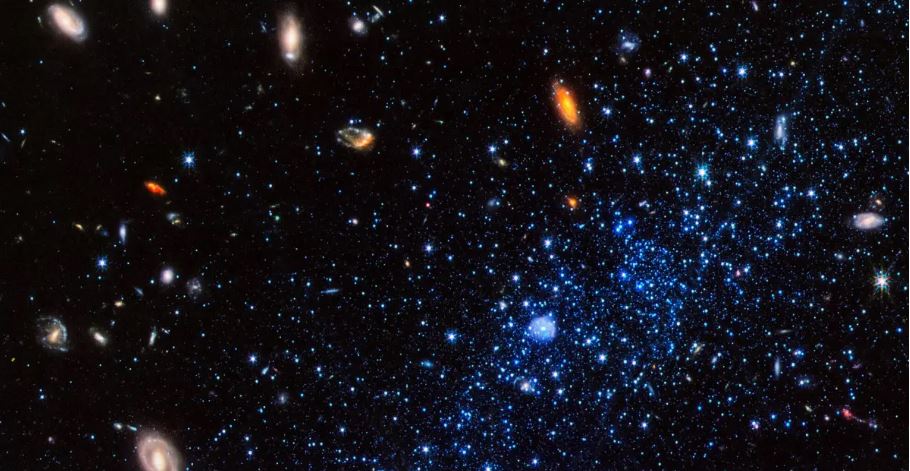
Images from the James Webb telescope are fascinating.

New telescopes, positioned in earth orbit and not hampered by earth’s atmosphere, have shown amazing pictures of space, both far and near. We now see further and further into space and, based on how long light takes to travel, closer and closer to the beginning of the universe, with greatly clearer images. Hubbell and Webb are creating quite a stir.

This once again has resulted in a discussion of what’s out there. Is there any kind of life on other planets, planets we now know exist outside our solar system? What about human-ish life, with human constitution, mobility, and ability to think, reason, and build, to refashion their environment to better suit who they are?

Or looked at another way: is there a planet out there, somewhere in space, to which mankind can flee should we despoil out planet to such an extent—or if natural processes proceed to a point—that earth becomes unlivable? That’s assuming, of course, that we overcome the time-based limitations of space travel and get to the point where humans can physically travel to that planet and arrive there not only alive but also healthy enough to set up their new habitation.

What do we need in another planet to be able to live there? Scientists talk about a planet needing a so-called “Goldilocks Zone”—that is, a part of the planet where the climate is just right: not too hot and not too cold. For example, life can’t exist on Venus, as it’s too hot and we would all fry. Nor can it exist on Mars, which is too far away from the sun, hence too cold and we would all freeze. Oh, I know some say we could adapt the Martian environment sufficiently to  create a source of heat and thus develop a suitable habitation. Maybe. I’d have to study that one more.

Science fiction books talk a lot about terraforming other planets: the hypothetical process of modifying another planet’s or moon’s environment to make it suitable for supporting human life, transforming it into an Earth-like world. Check out a discussion of that here: https://en.wikipedia.org/wiki/Terraforming.

But just how rigid or flexible is the Goldilocks Zone? To look at how well humans have done in adapting to the wide range of climates Earth has, from the frigid polar regions to hot, humid tropics and hot, dry deserts, it seems we ought to be able to live on any planet that comes close to the conditions on Earth.

And, given the number of stars out there, and the number of galaxies, and the number of exoplanets we have already seen using our new telescopes, surely there’s a new earth for us. Heck, given the billions or maybe trillions of stars we can see, finding an exoplanet with a Goldilocks Zone is virtually assured. So the experts say.

Or maybe it’s the dreamers, not the experts, who are saying that.

In this series or posts, I’m going to explore the concept of a Goldilocks Zone, and talk through what it would have to include to support a transplanted human existence—or to have supported life in a way that resulted in another intelligent existence parallel to ours,