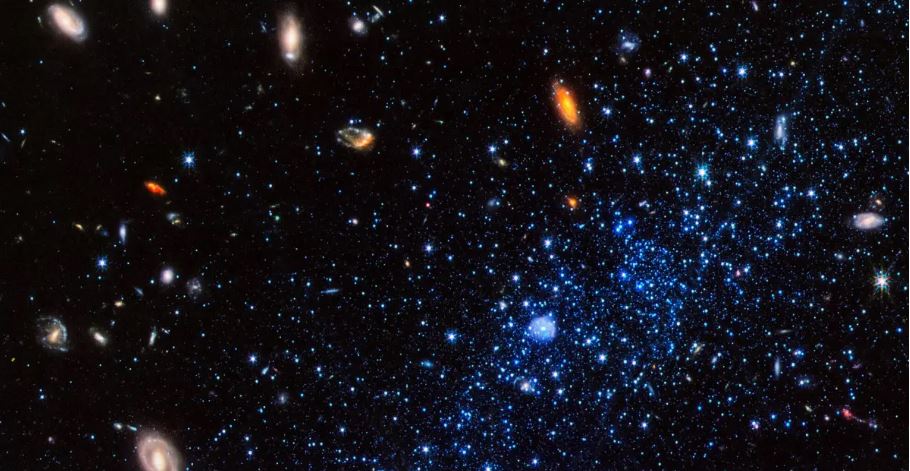
New telescopes, positioned in earth orbit and not hampered by earth’s atmosphere, have shown amazing pictures of space, both far and near. We now see further and further into space and, based on how long light takes to travel, closer and closer to the beginning of the universe, with greatly clearer images. Hubbell and Webb are creating quite a stir.
This once again has resulted in a discussion of what’s out there. Is there any kind of life on other planets, planets we now know exist outside our solar system? What about human-ish life, with human constitution, mobility, and ability to think, reason, and build, to refashion their environment to better suit who they are?
Or looked at another way: is there a planet out there, somewhere in space, to which mankind can flee should we despoil out planet to such an extent—or if natural processes proceed to a point—that earth becomes unlivable? That’s assuming, of course, that we overcome the time-based limitations of space travel and get to the point where humans can physically travel to that planet and arrive there not only alive but also healthy enough to set up their new habitation.
What do we need in another planet to be able to live there? Scientists talk about a planet needing a so-called “Goldilocks Zone”—that is, a part of the planet where the climate is just right: not too hot and not too cold. For example, life can’t exist on Venus, as it’s too hot and we would all fry. Nor can it exist on Mars, which is too far away from the sun, hence too cold and we would all freeze. Oh, I know some say we could adapt the Martian environment sufficiently to create a source of heat and thus develop a suitable habitation. Maybe. I’d have to study that one more.
Science fiction books talk a lot about terraforming other planets: the hypothetical process of modifying another planet’s or moon’s environment to make it suitable for supporting human life, transforming it into an Earth-like world. Check out a discussion of that here: https://en.wikipedia.org/wiki/Terraforming.
But just how rigid or flexible is the Goldilocks Zone? To look at how well humans have done in adapting to the wide range of climates Earth has, from the frigid polar regions to hot, humid tropics and hot, dry deserts, it seems we ought to be able to live on any planet that comes close to the conditions on Earth.
And, given the number of stars out there, and the number of galaxies, and the number of exoplanets we have already seen using our new telescopes, surely there’s a new earth for us. Heck, given the billions or maybe trillions of stars we can see, finding an exoplanet with a Goldilocks Zone is virtually assured. So the experts say.
Or maybe it’s the dreamers, not the experts, who are saying that.
In this series or posts, I’m going to explore the concept of a Goldilocks Zone, and talk through what it would have to include to support a transplanted human existence—or to have supported life in a way that resulted in another intelligent existence parallel to ours,