Snow Day Writing Report

It’s 4 PM. I’m at home, at my dinosaur computer in The Dungeon, writing away. Yesterday the forecast was for snow starting around 11:00 PM, 3-5 inches accumulation, or maybe 4-7 inches, depending on who you believe. I e-mailed my boss to say I wasn’t going to be in on Thursday, and I reported on Facebook that I was going to read, research, and write till my fingers were raw, my arms and shoulders tight, my butt numb, my eyes blurry, and my head hurt. Okay, I didn’t actually mention the butt numb part on FB, but I was thinking that.

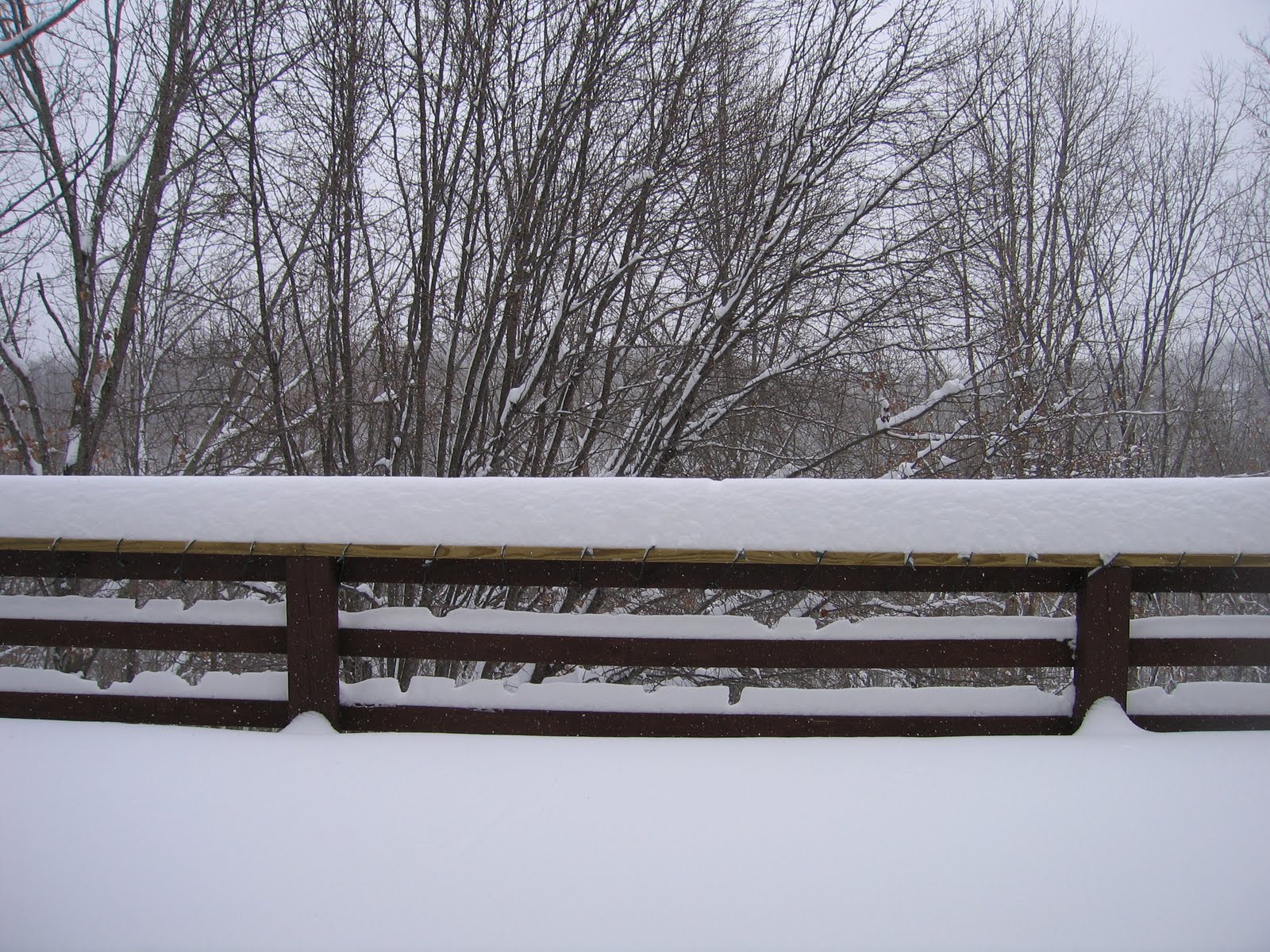
The storm gave us only a little over 3 inches; it was over by 11 AM. With that little, I probably could have driven the 15.6 miles to work with no problem, so possibly I wasted a vacation day. But I get plenty of vacation after 20 years with the company, so I don’t mind. And it wasn’t wasted at all. It was kind of a dry run for what a day might be like if I had a real writing career, where I wrote full time. Now, it wasn’t a true dry run, because knowing I have the day job to go back to tomorrow, I didn’t stick to writing quite as faithfully as I should have.

But write I did. And research. The day began with a couple of chapters in Ezra. Devotional, yes, but also part of my research for To Exile and Back. From my reading chair, I discussed stocks with Lynda, and I began to draft a genealogy article for Suite101.com. Then I came to The Dungeon. First I proof-read and reconsidered the Documenting America chapter that I wrote yesterday. It still seems good. I polished it a little and consider it done. Then I wrote and posted the article on Suite101.com. That brings me up to 120 articles there.

Upon publishing, I saw an e-mail in my Suite inbox. It was from an editor of a transportation newsletter. They need a writer with a civil engineering background to work on the feature article for their next newsletter issue. Would I be interested? I quickly said e-mailed her yes, and suggested a phone call. Then I went upstairs to listen to the weekly conference call Lynda joins each Thursday noon for stock trading. During the call I worked in ideas for new articles for Buildipedia.com. After the call and lunch I returned to The Dungeon and fired off an e-mail to the Buildipedia editor. He quickly replied that he’s interested, and asked for a phone call next week.

About that time my computer bad stuff protection program decided to do something, so I pulled out a volume of The Annals of America and chose the next subject for Documenting America, read it, and began to formulate a chapter about it. I next went to the daily writing blogs I follow, and found a great new post on Jon Konrath’s blog.

During all this activity, I came upon about six ideas for posts to this blog. I think the next step will be do get those down on paper so I don’t lose them. I might be posting here with greater frequency for a while. The internal but public debate about e-self-publishing continues, along with some other subjects.

For the rest of the day, I’ll finish reading a couple of blogs, plan and perhaps draft the Documenting America chapter, maybe work some on either the harmony of the gospels of on my baseball novel. Oh, I need to prepare for teaching Sunday school, and write some student sheets. I don’t know if I’ll look to do any recreational reading or not, but perhaps.

Two Nights of Research and Writing – What a Concept!

After my post from work on Monday, about needing to have writing available worthy of eSP, I came home and took the evening to research and write. I had already done some research into my next genealogy article at Suite101.com, so I decided to write the article. I did so, it taking less than an hour after the research was done. I’m not up to 119 articles at that site.

Having finished that, I went to my book set Annals of America to look for something to write for my Documenting America series. I pulled out the volume covering 1895-1904, mainly because I hadn’t yet done anything after the Civil War and I want the series to cover much more than that. I found a good article, by Senator Henry Cabot Lodge of Massachusetts (the first one, not the second). I read the article and found lots of good material for my article. By the time 11:00 PM rolled around I had the quotes identified (if not yet condensed), the introduction written, and a fair couple of paragraphs. Tonight I’ve been working on the actual chapter, and it now stands at 950 words, on its way to 1000 to 1200. This writing took me longer than expected, because I haven’t written this kind of piece for a while.

It all felt good. I’ve written very little since mid-December, except a Suite article and a couple of articles for Buildipedia. The reading I’ve done to research To Exile and Back was fine, as was my reading of Eudora Welty’s short memoir. But there’s just something about writing new material from original research. Kind of like home-grown tomatoes vs. store bought, if you get my drift.

I can’t abandon market research, or eSP research. Actually, I did some of the latter today by reading two writers’ blogs. But I have to say that carving out some writing time was really satisfying. After I check stocks, I’ll head upstairs, turning back down the thermostat in The Dungeon, sit in my reading chair—perhaps with coffee—and try to complete on paper the ending of my Documenting America piece. The title of it: “We Have Lost Sight of These Vast Interests”. Fitting for a writer on two days he sets aside for pure writing.

Something to E-Self-Publish

The beginning of the work week resulted in my again considering whether I should e-self-publish or not. Over the weekend, I kind of forgot about it. I used the time to finish the Eudora Welty memoir I started in December and to blog about it. I did a little research for the Bible study To Exile and Back, which has turned out to be much more research-intensive than I first thought. I planned out a series of articles for Suite 101, and wrote the first one, which I hope to proof and publish tonight. I set up statistical spreadsheets for 2011. All in all, it was a profitable weekend for my writing career.

Now, back to consideration of e-self-publishing (I think I’ll abbreviate that as eSP from here on out). As I read Joe Konrath’s blog, and other testimonies and advice I find from following links I find on it, it seems I can’t go wrong by choosing to eSP. It will take some time (as in man-hours), but probably less than following the traditional publishing route. Probably? Almost certainly. eSP will burn up less clock than will traditional publishing. You can tell I watched some football this weekend.

All that aside, to make sense to eSP I’ve got to have some completed work to eSP. It seems the people who are making the most success at this have multiple titles out there in the e-book world. The examples on Konrath’s blog are all novelists, so I’d naturally be thinking novels. The only one I have available is Doctor Luke’s Assistant, which is a good candidate. Unfortunately In Front of Fifty Thousand Screaming People is a long way from being finished, and my other novels are dreams and outlines at this point.

But in terms of non-fiction, I’ve got a couple of things close to being ready. Documenting America, which I first planned as a self-syndicated newspaper column, could easily be adapted to e-book format, probably 30,000 to 45,000 words. In fact, it might be better as an e-book. Some of the columns I wrote were squeezed into newspaper word limits, and I felt they were choppy. The ability to marginally lengthen those would be a good thing. If I dropped other writing projects, I could have one of those volumes ready to go in a month, including proof-reading. I think I could then produce one of those every three months or so, giving me multiple volumes within a year.

I also have a couple of Bible studies reasonably far along. Life on a Yo Yo, The Dynamic Duo, and Sacred Moments are candidates. Each of them could be fleshed out into a small book, say 20,000 to 30,000 words each, in a month or a little more. Is there a market for such as these? Only one way to find out. Related to Bible studies is my small group study guide to C.S. Lewis’ The Screwtape Letters, which I have tentatively titled, Screwtape’s Good Advice. That one is fully planned, but only about 10 percent written. That would take a couple of months, or maybe three, to do a decent job on.

From what I’ve been able to gather from my study, poetry is difficult to eSP. Because the Kindle platform allows readers to increase or decrease text size, the fixed line breaks of poetry can easily be messed up. It’s not impossible, but poetry will probably have to wait for the next round of e-book reader technology. So Father Daughter Day, fully finished and as polished as I know how to make it, is not a candidate right now. Of course, it’s still not illustrated either.

So the answer to “Do I have anything ready to eSP?” is yes, but not a whole lot. Time to get busy writing, to put dreaming aside, to buckle down and find out what I can produce when under a deadline, even if self-imposed.

I’m edging closer, closer….

Book Review – One Writer’s Beginning by Eudora Welty

Eudora Welty is one writer I don’t remember reading. Possibly in an English class somewhere we were assigned one of her stories and I read it. I know I haven’t read any of her novels. Yet, when I saw the small paperback One Writer’s Beginning at a thrift store for 50 cents, I bought it. I was pretty sure I would gain something from it.

The book was assembled from lectures Welty gave at Harvard University in 1983. She was from Jackson, Mississippi, to parents who moved there from Ohio and West Virginia when they were married in 1904. Welty was born the next year, to be joined by two brothers over the next five years. In the first part of the book, titled “Listening”, Welty tells how her earliest childhood years, and how they fed her imagination. She doesn’t talk about writing at all.

In the next section, “Learning To See”, she tells of family vacations back to Ohio and West Virginia, and spending time with the extended family. Train trips and road trips are part of this section. A road trip in 1917 was quite an adventure. Each set of grandparents, uncles, aunts, and cousins had an impact on Eudora. From abundant story telling on her mom’s side to an absolute ignoring of the past for sake of looking toward the future on her dad’s, she learned to look to the past and the future.

The third section, “Finding A Voice,” is where Welty tells how the events of her life became scenes in stories, and neighbors and teachers became characters. Welty even says how she put some of herself into one character.

All in all, the book didn’t give a lot of information for writing help. It was not inspirational, or motivational. It didn’t really provide hints on the writing craft. it’s a straight memoir. If it had anything to help a writer it was: Use the events and people in your life to populate your stories. That’s not exactly an earth-shattering revelation. Despite the lack of immediate benefit, I’m going to keep the book, and possibly re-read it in a few years.

The previous owner of this book made a note here and there. Inside the back was written, “Purchased at University of Arkansas Fayetteville, Ark June 1987”. Most of the marginalia was a single word, such as “genealogy,” “scenes,” “library,” “Latin”. Many words or phrases are underlined. But, what caught my eye was the single word written on the introductory page: “Interesting”. Ah ha, Dr. Farina, former high school English classmate. I’m not the only one who find that an acceptable word to characterize reaction to a composition.

Editorial Silence

In the seven (almost eight, actually) years I’ve been trying to be published, I think my biggest gripe against the publishing industry is what I call editorial silence. Let me think, though, if you include submittals to literary magazines I’ve actually been submitting for about ten years. There’s always a time lag between submittal and answer. Magazines, agents, and book acquisitions editors almost all state what their response time is: 6 weeks, 2 months, 3 months, 6 months, whatever. It’s a little different if you meet an agent or editor at a conference and they ask you to submit something. That’s a little less formal, though I suspect their posted response times could be considered to apply.

From my perspective, I don’t mind the slow response. What I mind is non-response, or responses so long after the stated response time that it might as well be a non-response. That’s the way this business works. A non-response most likely means a no. Most editors say to send them a reminder e-mail once you’re a little past their stated response time. When you do you’ll get a no.

Some examples. I met with an agent at a conference in Kansas City in November 2007. He asked me to send him the complete manuscript of Doctor Luke’s Assistant, as he was planning to represent more fiction in the coming years. I did so about a week later, and heard nothing. The following April I learned this same agent was going to be at a conference I was hoping to attend the next month in North Carolina. I thought we could meet then to discuss my manuscript, if warranted, so I e-mailed him, now five months after he requested the material, and asked for a status report. He said he couldn’t find my mss and would I send it again. I did, and talked to him briefly at the next conference. He said, “Your writing is strong, but I don’t know if I can sell it. I’m still reading it. Send me a reminder e-mail every week until I respond.”

That sounded strange, but I did as he asked. About two weeks later he passed on my book. Looking back, I now suspect he hadn’t even looked at the book when I saw him the second time, and he was just giving me “agent-speak”.

Another example. At that same North Carolina conference in May 2008, I met with another agent and pitched In Front of Fifty Thousand Screaming People. She asked me to send her a partial (30 or so pages) and a proposal. I did so promptly, and heard nothing for four months. I sent a reminder e-mail, and heard nothing for two months. I sent another reminder e-mail, and she responded, passing on my book because she already represented something similar.

How strange that these two agents, who I met with and who requested me to send them some material, should totally fail to respond. Add to that about thirty magazine submittals where I’ve either never heard back or heard back up to a year after submittal, and I’ve concluded that the submittal process is broken across the board. Some writers call it the “query-go-round”. Others have a less complimentary term for it.

It’s enough to drive an unpublished author to self-publishing. For now, I guess I’ll go do something that will make me some money.

Reality in Big Doses

Yesterday I closed my post by saying today I would discuss why I’m waiting to e-self-publish my work. The main things I was going to say were:

– Time needed to learn how to self-publish

– Probable upgrade of a computer in order to support the software needed to self-publish

– Cost to self-publish.

But now I have one to add, provided to me by a writer I corresponded with. In an e-mail she said, “Your best bet is to get a traditional contract before you self publish.” She’s a NY Time bestselling author, so should know a thing or two. She went on to say that the success with e-publishing experienced by Joe Konrath should be considered in knowing he was a multi-published author with a large backlist long before he ever e-self-published; an aggressive marketer/promoter with a fairly large fan base. Yes, he points to successful e-self-published authors who do not have his prior publishing background who have been successful at it.

Still, this author-correspondent in the know seems to think differently. I only know what I read in the blogosphere and elsewhere.

It’s all so confusing.

Are There Really any Negatives to E-Self-Publishing?

Maybe I’ll cut my internal debate a little short, or at least the part of it I post to the blog. I’ll think through a few “negatives” often expressed about self-publishing, which can also be applied to the electronic version of it.

Most self-publishers sell only a few copies of the book, to friends and family.
That’s true, but not if the book is a good one and not if the author does some promotion. The chance of doing well with a self-published e-book is perhaps more likely than with a paper version, for the e-book is cheaper. More unknown readers are likely to pay $3.00 or less than are likely to pay $15.00 or so.

Self-publishing only makes sense if the author has a platform—a ready made audience.
Guess what? That’s what the traditional publishers are saying about traditionally published books, and to get published now if you don’t have a platform is, well, very rare.

The self-published author has to be their own marketer and aggressively promote their book(s).
Again guess what? That’s what you hear traditional publishers are interested in with their new, untried authors. There’s really no difference in the amount of promotion needed between the newly author traditionally published and the self-published author.

Only those who can’t get accepted by a traditional publisher self-publish.
Quite a few people have successfully countered this, especially where e-self-publishing is concerned. People with prior publishing background, but who were dissatisfied with that experience, have self-published and done fantastic.

Once you self-publish, the chances of you ever getting a book contract with a traditional publisher drop.
Those who have successfully self-published say, “So what?” Since author earnings are greater per book sold, even at the steep discount that seems to be the norm in e-self-publishing, authors are earning more. And at cheaper prices for e-books they are selling more units than they would have with a traditional publisher. So successful e-self-publishers seem to feel the traditional publisher has nothing to offer them, and so aren’t looking for an offer from them.

The quality of the book, both the words written and (in the case of a printed book) the bound product, are less with a self-published book. Thus readers tend to stay away from them.
That is changing, or has already changed. Many print self-publishing companies have improved the bound product. The quality of the words, phrases, sentences, paragraphs, and chapters that make up the book is totally within the hands of the author. You don’t have the benefit of the publishers line editors and copy editors. But there are other ways to obtain these services, so the product can be made quite good, as good as something coming from a traditional publisher.

So are there any negatives to self-publishing, especially e-self-publishing? I suppose distribution is one. You are at the mercy of people finding your product on line and ordering on-line, as opposed to seeing it in a physical bookstore. Fewer books are found and ordered on-line than bought in a bookstore. That is changing, however. E-shopping for books and e-books is about the only segment of the book industry that’s growing. Growth hasn’t slowed, and doesn’t look to. Right now few people own a device for reading electronic books, but that is changing. Projected sales of the Kindle and similar platforms suggest incredible growth in e-book sales over the next 6 to 12 months, based on the number of e-book readers alone.

So why am I waiting? I’ll discuss that tomorrow.

Evaluating My Enthusiasm for e-Book Self-Publishing

Back to my internal debate about whether to self-publish my writing, primarily with e-books, rather than continue the quest for a traditional, royalty paying, print-based publisher via an agent.

Okay, I admit it, when I first came upon the new data about e-books last week I got excited. Really excited. Me, who has eschewed the very idea of self-publishing. The sales numbers reported by those who have released a number of books this way are very exciting for an author.

Then, in the comments to an older post on Joe Konrath’s blog, I read this:

If you’re thinking you have a chance to break through, or start a indie career, or even be able to call yourself a published writer after uploading your manuscript to the kindle, they you’re delusional. The opportunity to break into traditional publishing through the kindle has passed. Youre indie career will be limited to moving a few thousand copies of your manuscript at the most.

Well, nothing like throwing cold water on a hot dream. This is just one person’s opinion, of course, but the study I’m doing has to be realistic, not just take the successes of others while ignoring the true status of the market. But wait, he said a writer who now decides to e-self-publish “will be limited to moving a few thousand copies of your manuscript at the most.”

A few thousand copies? Why, to be able to claim your print novel is a best seller requires sales of only 5,000 copies; 7,500 copies for non-fiction. A few thousand copies? Most self-published books through POD publishers such as LuLu, Publish America, Tate, and others sell less than a hundred copies. So, if the prospect is to sell a only few thousand e-copies, well, that sounds pretty good. Maybe I should keep my growing enthusiasm. Heck, that would be a few thousand copies e-sold, whereas no matter how good my work is the chances of being traditionally published are still next to nil.

But of course, I’m a nobody to the readers of the world, or more specifically, to the e-book buyers of the world. There’s still the issue of writing something so good that people will want to pay $3 to $5 dollars for it in Kindle format. There’s the issue of publicising your work, developing some kind of buzz so that it gets noticed.

At a minimum this means having a good cover (of the quality of a traditional publisher release), because buyers still make buying decisions based on the book cover. Then, once the cover draws them in, you need a great marketing paragraph to hook them. Then, once they download the first chapter as a free sample, that chapter better be so good they say, “I think I’ll spend $2.99 on this one.”

The post today on Konrath’s blog is about how most of those having success with e-self-publishing were in my exact situation, with no prior publishing history and no name recognition. They are having success despite that, so maybe I could too. I still need to curb my enthusiasm for e-self-publishing, at least until I finish the study (still need to know if I’m tech savvy enough to do the uploads, and there’s still the issue of the cover). But all signs seem to be pointing me in that direction.

Movie Review: Voyage of the Dawn Treader

Today after church, Lynda suggested we drive past the Carmike 6 Cinema that we pass and see what time The Voyage of the Dawn Treader would be playing. Unfortunately, we were already past the drive to the shopping center when she suggested it. So I turned around in the Dairy Queen parking lot up the road, went back, and we learned it was to start at 12:15 PM. It was 12:20, which meant all we had missed was dancing hot dogs or previews of movies we will never watch. I paid for two senior tickets at matinee prices, and we arrived in the theatre before all the previews were done, but not too much before.

The Dawn Treader was good, much better than Prince Caspian (which we saw on TV only). We missed The Lion, The Witch, and the Wardrobe both at the cinema and on TV. Of all the Narnia books, which I never read until adulthood, I liked The Dawn Treader best. It had the best imagery of them all, and seemed to have the least fill in stuff. The wall of water at the end of the book has often crossed my mind, as has the city of people underwater. I had forgotten all about poor Eustace Scrubbs—not the name, but his becoming a dragon. After seeing the movie, the cleansing of his dragon nature by Aslan came immediately to mind.

But back to the movie. Obviously it was not totally faithful to the book, but it did a good job of putting into pictures what C.S. Lewis must have been trying to paint with words. The details of the ship, and of ship life, and of sailing on open seas were quite good. The different islands they went to and the quest to find the seven missing lords. The island with the gold dump was quite well depicted. Oh, and the mansion that Lucy goes into and finding the book of spells to read from, that was great.

But I do have a little fault to find. It’s been about ten years since I read VotDT, and obviously I don’t remember it all that well (except the great imagery). But one difference in the message of the book doesn’t seem to come through. Or rather, one message I get from the movie I don’t remember in the book. And I may be reading too much into it. Narnia is overcome by evil, or at least the island realm of Narnia is. To break evil’s hold, they must find the seven swords of the seven lost lords and lay them on Aslan’s table. Only then will the spell of evil be broken.

To find the swords, they must go where the lords went, to this island and that one, and overcome evil along the way. Part of the journey of the three children of Adam and Eve is overcoming their own obsessions: beauty for Lucy, power for Edmund, and I guess greed (or maybe self-indulgence) for Eustace. This they do, and they fight evil, but none of that overcomes the evil. The evil is overcome by the magic of the swords, once they touch each other on the table. It seems to me that is the wrong message to send. Evil is not overcome by magic, but by the constant application of good.

As I say, maybe I’m trying too hard to figure out a message from the movie, rather than be entertained. The three children are faithful to the task laid before them, and only through their faithfulness can the magic be applied. Eustace goes through the biggest character arc, from a sniveling twit worthy of his name to a boy one might want to know and be with. The removal of his dragon nature in the movie was much less dramatic than in the book, and seems much less of a metaphor for Christian conversion. I seem to remember that the book included Aslan ripping at the dragon flesh with his claws, and the cleansing thereby was much more significant in the book than in the movie.

This review is late relative to the movie’s appearance in theatres. At many places it’s already been removed and replaced by various banal comedies that appear designed to entertain our sexual nature rather than our intellect. But, if you haven’t seen it, and can find it, by all means go see it. Then read the book soon after. I may do so this week.

The Time Factor in Traditional vs E-Self-Publishing

Forget about whether you will be accepted by a traditional, royalty paying publisher. For the sake of argument, assume you will. It will take a lot of work, maybe conference attendance, networking, querying, submitting, seeking an agent, etc. But assume someday it will happen.

The day you are accepted by an agent for representation, with a completed manuscript, it will likely take at least six months before you have a contract in hand from a publisher. At that point the clock is ticking for publication. Deadlines are set. If you don’t shoot yourself in the foot, your book will be published—in 24 months.

Yes, that’s right. Two years is the approximate time from manuscript acceptance to the completed book hitting the bookstores. That’s the time for cover design, jacket design, jacket text generation, copy editing, line editing, sales meeting, pub house strategizing for marketing they won’t actually do, printing, warehousing, distribution. So today, if an agent told me, “I’d like to represent you” (which isn’t going to happen, since I don’t have any queries out with agents at the moment), My book would be in bookstores around July 2013.

But, if I took the plunge and decided to e-self-publish, my novel Doctor Luke’s Assistant could be available to readers somewhere around March 1. Now I’d have to move pretty quickly to make that happen. I’d need to find a cover artist and pay some money. I’d have to write dust jacket text, and catalogue text. I’d have to figure out how to format a .doc file for Kindle and other e-reader platforms. But all I’m reading suggest this is not rocket science, and that it’s all do-able in the stated time frame.

That, in and of itself, is a good reason to go the e-self-pub route. When you add in the infinitesimal chance of being accepted by a print publisher, it seems like a no brainer to choose e-self-pub. You might say how small the sales would likely be for the e-book. Agreed; most likely the sales will be small. But they’d still be more than they would be never being in print at all with a traditional publisher.

More internal debate coming…stay tuned.

Author | Engineer