So Many Writing & Publishing Tasks

The temperature outside right now is about 11o F. I’m not making that up. It was almost that hot yesterday and Saturday, and should be the same for the next two days. I have some yard work to do. I need to get some walking in. But you know what? I’m staying inside until the high temps get back below 100.

So it’s a good time to have lots of writing and publishing tasks to do. I have all kinds of inside time to get them done. Unfortunately, I’m having trouble prioritizing and remembering all that I have to do.

For example, Friday I saw that Smashwords found something in the home school edition of Documenting America that prevented it from being added to the premium catalog. It’s a simple change I need to make to the MS Word file and re-upload it. I saw that at work, but I’m keeping all my official submittal files at home. This was a simple 10 minute task, including the uploading. Unfortunately, all weekend I forgot to do it, and never checked in to my Smashwords dashboard and saw that I needed to do it. I saw it today, at work, which is not where my files are. So this is a to-do item for tonight, if I can remember it.

So what did I do this weekend? Here’s the rundown.

  • Read through the last third of In Front of Fifty Thousand Screaming People on Friday night and Saturday morning, looking for an inconsistency in the days of the week during the playoffs. I first edited and reprinted the season/playoff schedule I had created, to make sure of what the right days were. I found the inconsistency and did a mark-up. Then I typed the corrections. That took me up to about 1:30 p.m. on Saturday.

  • Scanned the proof copy of The Candy Store Generation, which arrived in the mail on Friday. I found no formatting problems, so it’s just a matter of getting any errors corrected. Lynda found one on the back cover copy, so I need to get that to the cover designer. I didn’t actually proof-read it at all over the weekend, leaving that for today and the next couple of days.
  • Wrote/typed about 15 chapters of instructor material for the home school edition of Documenting America. I now have only four to go.
  • Wrote and published two blog posts for my other blog, An Arrow Through the Air.
  • Wrote my Goodreads review of Trial by Ordeal by Craig Parshall.
  • Began reading The Eye of the Story by Eudora Welty. I consider this a book dealing with writing art and craft.

This sounds like a lot. Unfortunately I had much, much more I needed to accomplish. I should have done some proof-reading of TCSG. I should have completed all of the instructor material for DA-HS Ed. I should have worked on my next short story, or typed some plotting issues on the sequel to FTSP. Or done some formatting for the print version of DLA. Or done those changes to my writer’s website.

Well, it’s not unusual to have a larger to do list, written or unwritten, than can be accomplished in a limited time.

The Learning Curve, Step by Step

I’m not any further along on understanding how to work with digital graphic files than I was last time I wrote about it. I consulted with some people who are in the know, and the consensus was that CreateSpace was being overly picky on the requirement of 300 dpi when the graphics were not photographs. So I went ahead and ordered the proof copy. I’m hoping it will be here today, and I can finalize the book within two days.

But beyond the graphics issue, I’m still traveling the learning curve on all this self-publishing stuff, not just the mechanics of layout and publishing but also the necessity and tasks of promotion. I have a similar situation at work. We use two different computer programs in our floodplain simulations. One we use on every project; the other we use infrequently. The one we use all the time had a steep learning curve. If I used it in 2002 then didn’t have another project with it until 2003, I had to learn the program all over again. Finally, after a project every year, I think I have mastered the basic use of it, though I don’t think anyone would call me a power user.

The other program I’ve used three times since 2009. If I had to use it now, I wouldn’t be able to without some significant re-study of how to do it. It wouldn’t be as bad as the first time, when I learned how to use it from reading manuals and trial and error, but it would still be a slow process.

Right now it’s the same with the three self-publishing platforms I’m dealing with: Kindle, Smashwords, and CreateSpace (for print). The interior formatting requirements are so different for e-books and print books that I still have difficulty switching between them. I’ve now uploaded six items to both Kindle and Smashwords, and am starting to feel comfortable with them. Next time I upload something, which I hope will be in less than two weeks, I think it will go smoothly.

But with the print layout I’m still far down on the learning curve. I’ve done the layout of three books, two uploaded and one ready to go once I get the cover. I have one more to do: Doctor Luke’s Assistant. That’s so big at 155,000 words that I’m somewhat intimidated by it. I think it will be such an expensive book that it won’t sell at POD prices, so I don’t mind putting off the formatting. Plus, I’ve had plenty of other things to do on my writing and publishing to-do lists.

I’ll work through it all. I feel good about my progress. Someday I might even get to the point where I don’t fear clicking the “submit” button. It might take three or four more e-book items, and at least that many print, but I’ll get there.

A Day of Accomplishment

It’s 6:09 p.m. as I begin to write this, on Saturday afternoon. While there are still hours left in the day, I can look back on what I have done so far and say this was a day of accomplishment.

I should have written down what I did. I’m very sleepy right now, and the list of things done would help me recount them. Maybe I can work backwards. I spent the afternoon working on layout of the print version of Documenting America – the Homeschool Edition. That is done, sitting on my computer. I’ll want to give it one more go, and maybe play with the margins a little. It’s up to 234 pages long, a little longer than I expected. I think I indented some quoted items too much, but can easily play with that and finalize it in less than an hour. I’m still waiting on the cover, so I’m ahead of where I need to be on this one.

Earlier I formatted the same book for Smashwords and uploaded it. It seems I did everything right, because it generated no error messages. It’s already listed for sale on Smashwords, though I have to wait and see how it does with premium catalog distributions.

Before that I re-did some of the interior of the print version of The Candy Store Generation, and uploaded it to CreateSpace. Or maybe I did that last night. Whatever. I received back an error message saying that the cover didn’t work because it didn’t have any bleed around the edges. I contacted the cover designer and she said she’d make that correction this weekend.

Before that, maybe last night, I completed a look through Doctor Luke’s Assistant to see what kind of marks Lynda made on her recent read-through/edit. They aren’t too bad, requiring less than one evening of typing. I may do that in a couple of days, then re-upload it to Kindle and add it to Smashwords. I’ll even look at a print version, but I’m afraid it’s too long to be economical at POD book costs.

I started the day reading in a couple of psalms and praying, then reading 15 pages in a novel I’m reading for pleasure. I’m only 1/3 of the way through it, so I need to be reading more.

For tonight, I have a Sunday School lesson to preview for tomorrow, and will have to fix my own supper with Lynda gone. Then I may do the first typing on the short story I’ve been playing around with on paper. It will be good to be doing the work or a writer for a couple of hours, rather than of a publisher.

So Much To Learn

Two weeks ago I set most writing tasks aside to concentrate on publishing The Candy Store Generation. Working with Rik Hall, a book designer, on some interior design elements, I was able to upload the e-book to Kindle a week ago today and it went live last Saturday. A couple of days later I had the Smashwords file and uploaded that.

That left the print book to work on. I was waiting on the print book cover, but that didn’t stop me from formatting the inside of the book. I was determined to do the best I could with this before sending it on to Rik. I figured this wasn’t my first print book to format. I did Documenting America by myself. The main difference with CSG is the many graphics.

So I set to the formatting, completed it on Tuesday, and sent it off. On Wednesday Rik said it looked pretty good, though he had some suggestions for improvement. I made the changes and sent it on Wednesday. On Thursday he told me he thought it was ready to go. Also on Thursday I received the print book cover from Vicki. So Thursday night was upload night.

The cover uploaded fine. The book interior uploaded fine. But CreateSpace has a new feature. Some software on their end cruches for a couple of minutes, checking your interior. It then gives you a report on whether it finds any problems with the layout of the interior. In my case, it found 12 problems, most dealing with the graphics. Those relating to the size of the graphics (inches or pixels) I can handle fairly easily. But two are proving difficult.

One was that the fonts are not “embedded.” The message is a warning. It says CS can pick the fonts, but that it would be better if they are embedded. The problem is, both my MS Word and my Adobe Acrobat are set up to automatically embed fonts. So when I created and saved the document in Word, the fonts should have been embedded. Then when I used Acrobat to create the PDF file, the fonts should have been embedded. So why weren’t they? A check of Adobe help forums suggests that the plug-ins used with Word to create a PDF are the problem. While Acrobat is the program I used, I did it by clicking a simple button within Word. Maybe that’s the problem.

The other problem is that all my graphics are not of the quality they suggest for print. The are in the 100-200 dpi range, whereas CS suggests using 300 dpi or better. I’m using Word 2003, and it automattically resizes imported images to be 200 dpi. I spent two to three hours in Word help and on-line help and forums and I haven’t found anything yet to tell me how to get around this. A writer friend said she got the same error message about photo quality, decided to print anyway, and it worked fine.

Today I went ahead and completed the upload. It’s now in a 48 hour period where someone or something is further checking the book to make sure it can be printed as uploaded. After that I’ll order the proof copy, and see how it looks. Perhaps the graphs will be fine. Or perhaps I’ll have to get a graphics editor, something better than Paint, and learn how to use it.

Which brings me to the learning part. When I was querying agents and editors, and pitching to them, and submitting proposals and partial or full manuscripts, there was much to learn about that whole process. Now that I’m self-publishing, both e- and print, I have a whole new batch of things to learn. I can’t say that I’m looking forward to the learning process, but know I will be the better for it.

THE CANDY STORE GENERATION

I have been quite busy with publishing tasks lately, a consequence of which is I’ve neglected my blogs. The end is not yet, however. Today, I hope, I will finish all the work required for the print book and perhaps upload it tonight. That depends on getting the cover for the print book. I think it will come today.

The official publication date for The Candy Store Generation: How the Baby Boomers are Screwing Up America is July 14, 2012. Bastille Day. I didn’t think about that at the time. That’s the fifth work I’ve self-published, with two more to come within a month, and maybe two or three more short items after that. At least, that’s the plan. I may be sick of publishing business after the first couple and find it difficult to do the rest without a break first.

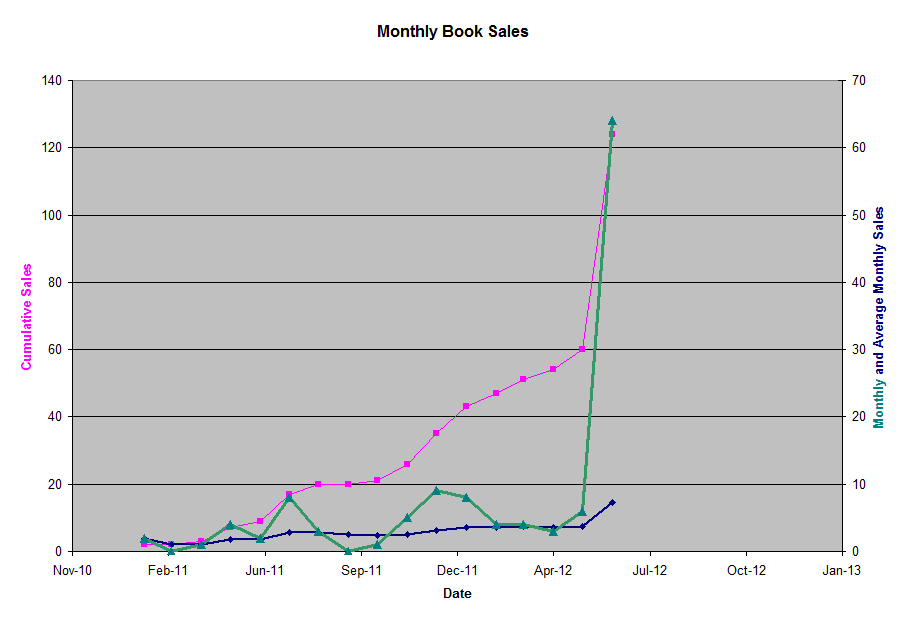
As of this writing I have three sales of TCSG. Amazon algorithms seem to have gone haywire, because those three sales put it at #14 and #16 on its genre bestseller listings. Doesn’t seem possible, but I’ll enjoy it while it lasts.

Should an author respond to reviews?

Good morning readers. If any of you have time, would you click on over to this thread at Amazon for my book Doctor Luke’s Assistant. This was the one negative review (so far) of the book, a 2-star review. Actually, it wasn’t all that negative. I thought it was a good review.

The reviewer modified his/her original review based on the comment made by another reader that he/she had mixed up the two main characters as to who was a Christian and who wasn’t. The reviewer acknowledged that mistake, and modified the review. I decided to join in and speak to the issues the reviewer raised, agreeing with them as valid criticisms of the book.

I have a thread about my self-publishing journey at the Absolute Write forums. Someone posted this in that forum:

You’ve got some good reviews though, and I’m impressed with the way you handled the one negative review. Very professional and, if I may say so, very Christian. A good example set.

To which a moderator responded with this:

I’ve just read your comments on the review and while it ended with the person who gave your book a negative review agreeing to give your book a second chance, I really don’t think it was a good thing for you to have done.

The impression I got from the exchange was that the reviewer felt a little cowed by your comments, and was embarrassed when you responded. I don’t think you meant any harm by responding in the way that you did: but if I were considering your book and came upon that discussion, your response would put me off buying and reading it.

If you have to explain to a reviewer what your book is about then your book hasn’t done the job you’d hoped. The reviewer hasn’t missed the point; your writing has.

I’m sorry to be so blunt, Norman, but there’s a reason responding to reviews is called The Author’s Big Mistake.

Is responding to reviews “The Author’s Big Mistake”? What do you think? Possibly I need to go back in and say thank you to those who gave good reviews, to show I’m engaging readers, not brow-beating a negative reviewer.

I wish I knew what was right.

“Doctor Luke’s Assistant”: Early Steps Toward Publication

As stated in a previous post, it was the first Sunday of January 2003 that I finished the first draft of Doctor Luke’s Assistant. It was around 151,000 words. Although I was completely unknowledgeable of the publishing industry, and of writing in general (except for poetry, which I had been studying), I knew I needed to go through the book. As I had worked through it I added some sub-plot lines, and knew they weren’t accounted for in early chapters.

So I printed the book and began reading it, and typed the edits when I finished a chapter. I learned that sometimes I didn’t write my edits clearly, so as I typed I edited some more. Despite the length of the book, I was able to complete these edits around the first of March 2003. I was satisfied that all plot lines were complete, and any foreshadowing was there. The length after this editing was a little over 155,000 words.

At the same time I had begun studying how to get a book published. Now some people would say this was backwards. Study what makes a good book first, then write it. What can I say? I did it backwards. In the creative rush of getting the book out, I wrote the story that was on my heart, blissfully unaware that it was too long for commercial purposes, in the wrong voice for a rookie writer, and in a dead genre. Three strikes at the start.

I’m usually a fairly quick study on things, and immediately learned that I needed to attend a writers conference. I didn’t know much about what went on at such conferences, but I knew I needed to go. I picked a relatively small, regional, Christian conference in Oklahoma City, a conference billed as for beginners. Perfect. I re-printed the edited manuscript, registered for the conference, took the foster kids to the Children’s Shelter for the weekend (the preferred place to go when foster parents needed a break), and we pointed the minivan westward and drove the four hours.

The two day conference was an eye opener. This was a craft-building and contact-making conference. It didn’t include editors or agents on the faculty, only writers. They said I could sign up for two appointments, so I chose the two writers who taught the first class.

That first class was full of news, mostly bad. I learned the publisher wouldn’t do much to promote my book; I would have to do it. I learned the publisher expected manuscripts to be error free and essentially ready for publishing; I would have to be my own editor or hire one. I learned about query letters, proposals, summaries, etc. Lots of information.

My first appointment was with a veteran writer, an older man who had been a full-time writer for twenty years and who taught the opening class. I gave him my manuscript, which is what I figured I was supposed to do. He looked at the cover for all of two seconds, or maybe three, set it aside and proceeded to lecture me on something. I don’t remember much of what he said.

My second appointment was with Renee Gutteridge, who was early in her writing career, with two novels published and a couple more under contract. She asked what she could do for me. I said this was my first conference, I didn’t really know what these appointments were for, but I had my novel manuscript with me. She took it and read for about five minutes, getting several pages in. She then gave me pointers about dialog, saying I was doing some things wrong, and showing me how to correct it. She spoke about the writing process and editing. It was a good meeting. Must have been, for after more than nine years it has stayed with me.

Overall, the conference was a letdown. I learned that writing the book was not necessarily the hardest part of the publishing process. Just finding a publisher was equally hard if not harder. Somewhere in that conference I learned the difference in the general market (A.B.A.) and the Christian market (C.B.A.) I learned that only one major publisher in the C.B.A. still accepted submittals from un-agented authors. I wrote a query letter, using whatever techniques I had picked up at the conference. I faxed it (allowed, per their web site), and waited.

Not long it turned out. I think it was 48 hours later when the rejection came through, either by return fax or e-mail. My first rejection from a publisher. I was officially a wannabe writer!