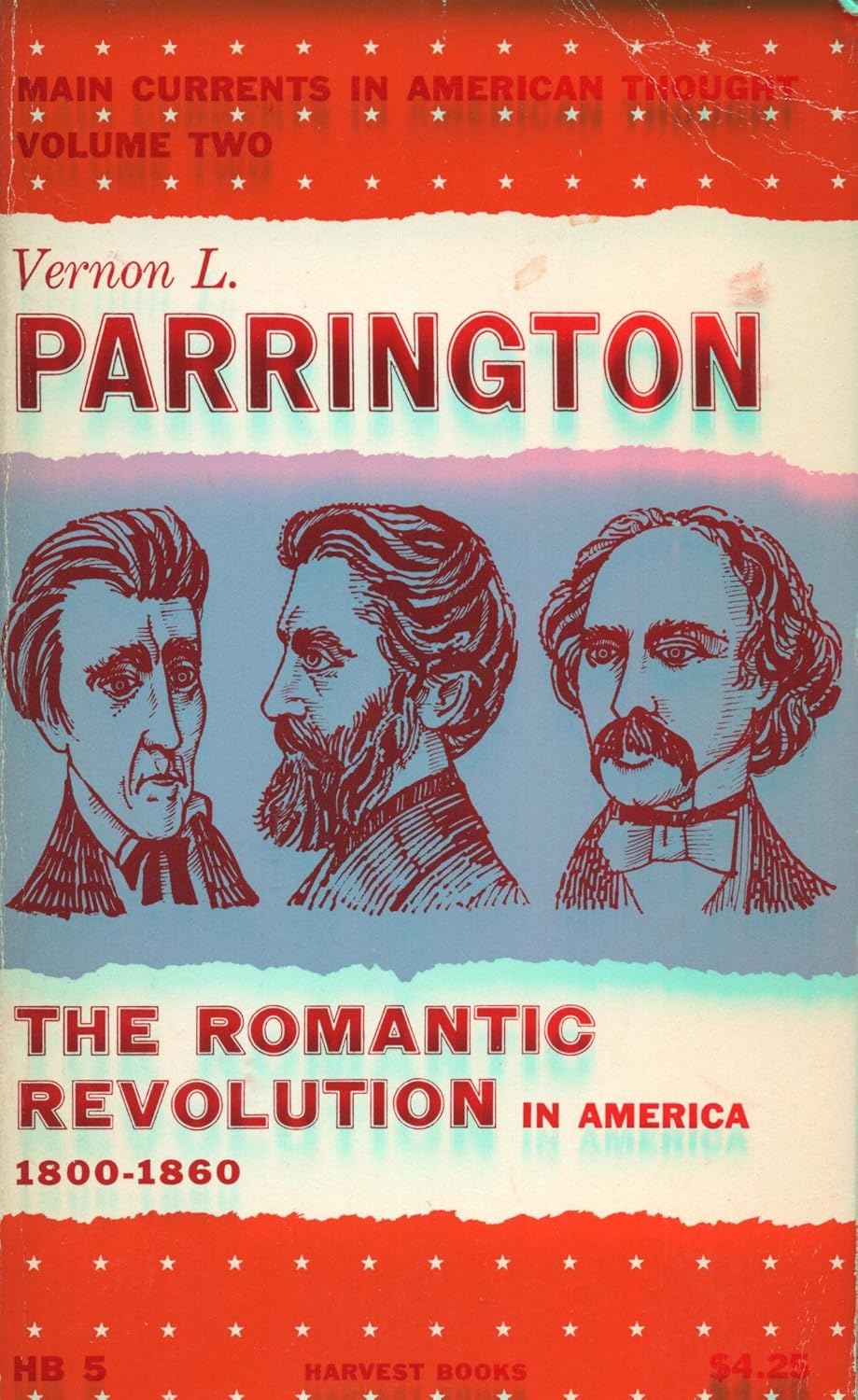
After finishing a couple of books a while ago, I looked for something to read next. I saw, on my worktable in The Dungeon, a book by Vernon Louis Parrington, The Romantic Revolution in America. This is volume 2 in a three-volume work, Main Currents in American Thought.
Where did this come from? I wondered, and how long had it been sitting in plain sight? I had no idea how I got the book, why it wasn’t on a shelf, who Parrington was. My book, published in 1954, was a mass-market paperback in poor condition of a book originally published in 1927. I knew it wouldn’t hold together as I read through its 460-odd pages. The print was exceedingly small, I think a 9 or 10 point font, with quotes a size smaller. I knew a little about the Romantic period in England and some of the main authors, but nothing about its American counterpart.
Perfect, I thought. As an author who avoided learning literature in English classes that I hated, I figured I needed to know this. Despite the poor condition of this volume, the small typeface, and the length of the book, I dove in. I decided to shoot for reading ten pages a day. But I was finishing another book at the same time and trying to get through a backlog of magazines, so I wasn’t sure I could get through it as quickly at my goal.
I also found the subject matter and writing style as, how shall I say it, not conducive to rapid reading progress. As to his writing, Parrington seems more interested in impressing his readers with his writing ability rather than informing them about his subject. I had to slow down and take time to understand what Parrington was trying to get across. Here’s an example, from late in the book, of some of his obtuse writing.
As a Beacon Street Victorian Holmes was as full of virtuous prejudices as an egg is full of meat; but as a rationalist, with a modest scientific equipment that came from his professional training, he kept the windows of his mind open to the winds of scientific inquiry that were blowing briskly to the concern of orthodox souls. Many a barnacled craft was foundering in those gales, and Holmes watched their going – down with visible satisfaction.
That was the type of language you had to slog through from beginning to end.
Then, his subject matter was almost a joke. He covered a lot of writers, but it seemed like most of them were politicians. Few were strictly creative writers as we tend to see them today. From Thomas Jefferson to Henry Clay to Daniel Wesbster, Parrington spends most of his time discussing the writers’ childhood influences and politics and religion, and how they were shaped by them, either positively or negatively. The main thing I got from this book is a good list of new references to possibly use in future volumes of my Documenting America series, should I decide to expand it.
He spent a lot of time explaining how the writers had to overcome the rigid legacy of Puritan Calvinism and embrace the individualism encouraged by Unitarianism. I could sense, as Parrington found major faults in every writer he mentioned, that he was leading up to a positive image of Emerson and the transcendental movement in the Boston area. I was somewhat wrong, however. Emerson he found fault with. But Thoreau, alone among the fifty or so writers analyzed, is the only one who Parrington found positive, who did no wrong.
Should you go out and buy this book? No. But late in the reading, I discovered it’s out of copyright and I got it for free as a Google Play book download. The reading went much easier then. It might be worthwhile for you if you can get it for free. But, if you find it at a garage sale for 50¢, save your money to buy something else you don’t need. 1-star. And, as the book is now in three pieces with a separated cover, it’s going in the recycling bin.
At least I freed up a little space on my worktable.
I have said it before, but I’ll repeat my admiration for you chipping away at all these things! I share many of the thoughts you mentioned: trying my best to read a book in my possession before getting rid of it in some way, figuring I can learn something that would be good for me, etc. I’d say you can now get rid of this one with a sense of peace 🙂 It served its purpose!
Thanks Susan. The alternative is to sit around and do little or nothing. See my next post for a discussion of my schedule.