All posts by David Todd

Things that are Important

Has it really been ten days since I posted here? On several days I had good intentions, and ideas in mind. But they came to me at a moment when I couldn’t post, and when I did post they didn’t come to me.

But much has happened in the interim. Mostly good things. Here’s a summary.

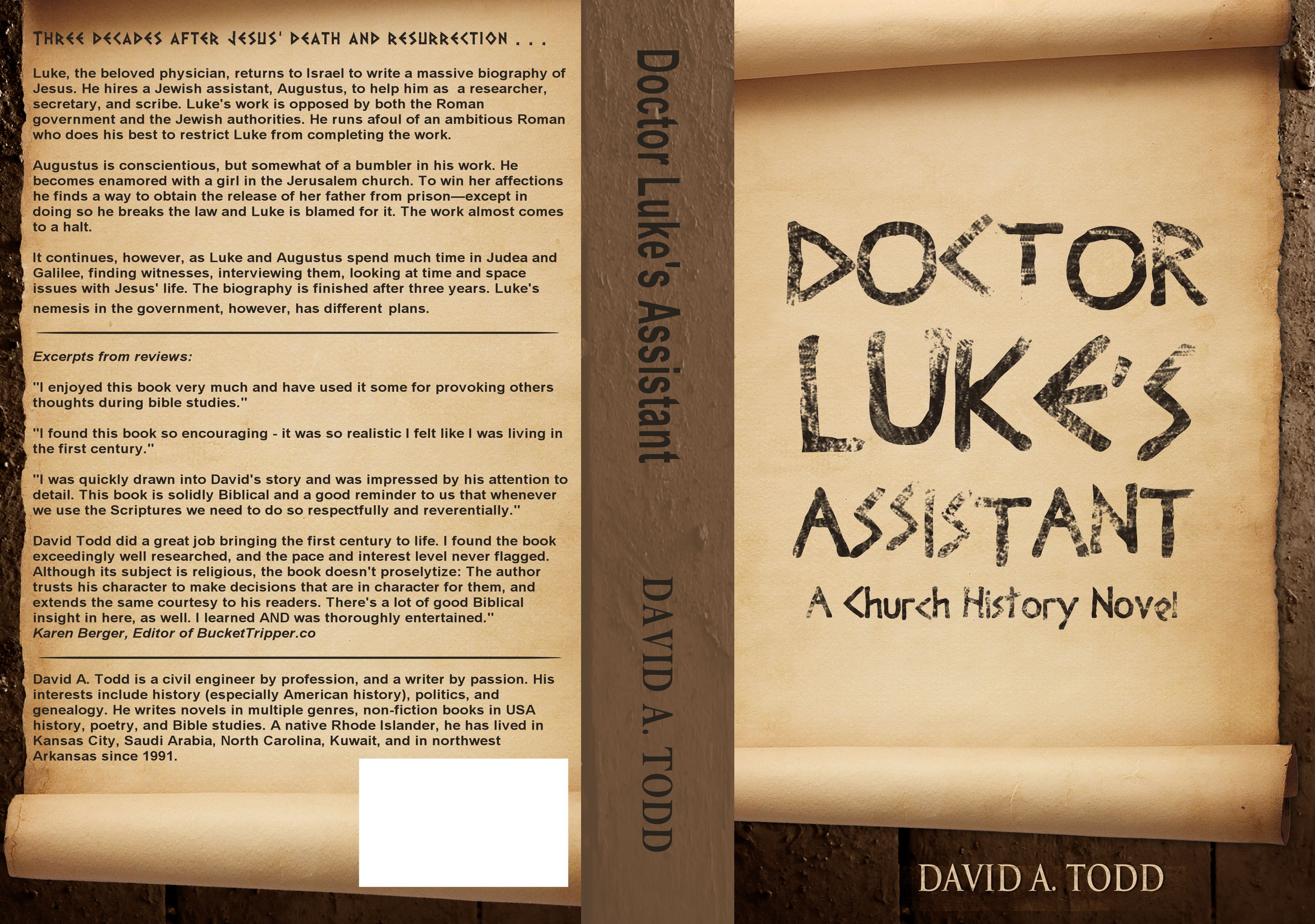
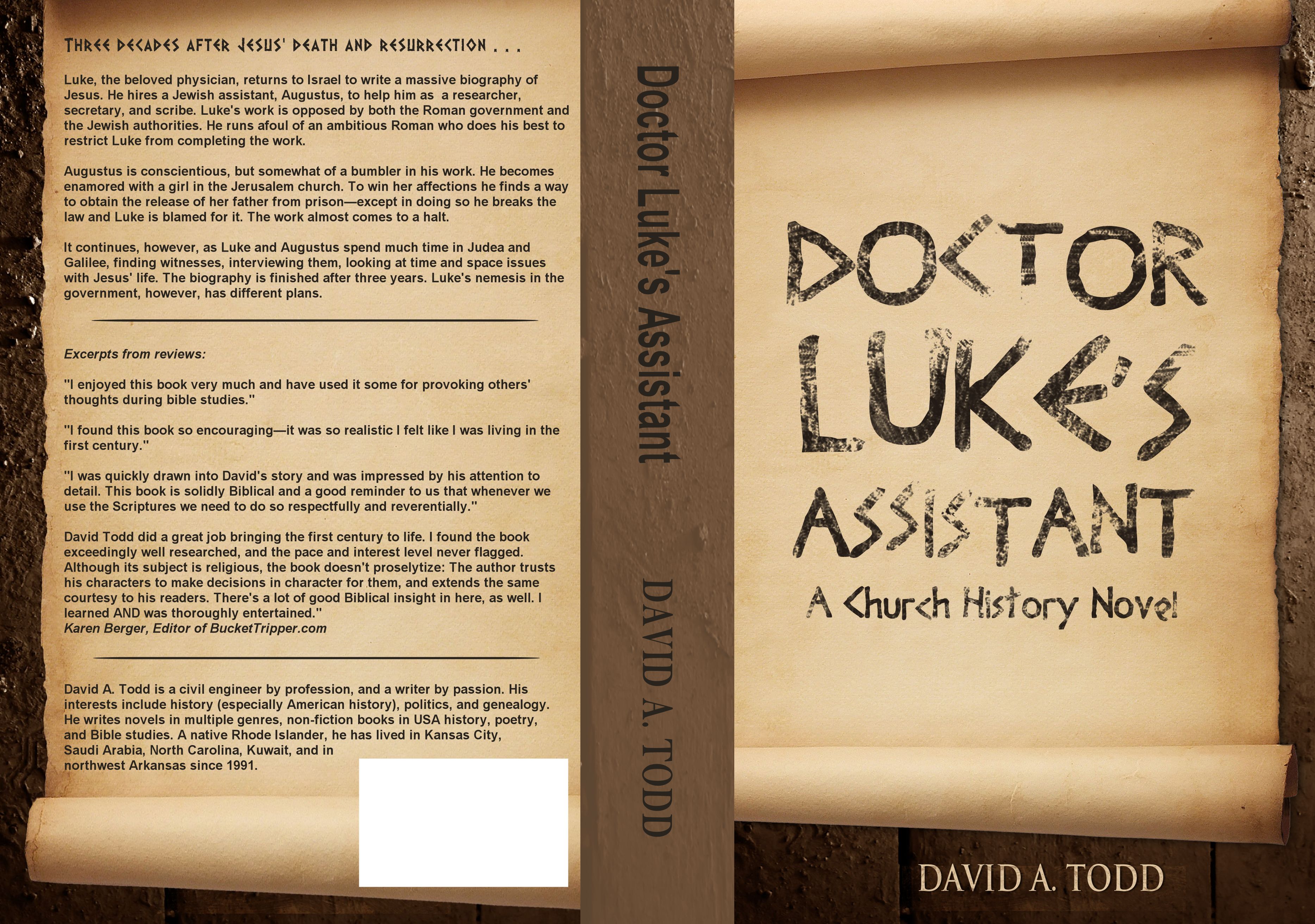
  • The print edition of Doctor Luke’s Assistant is officially published. And the listing on Amazon is consolidated, with the e- and print editions showing on the same page and on the summary listing.
  • My third grandbaby, Elise Marie Schneberger, was born on May 10, weighing in at 8 lbs. 8 oz. Today I head west to spend the weekend with her, and with other members of the family. This is my first granddaughter.
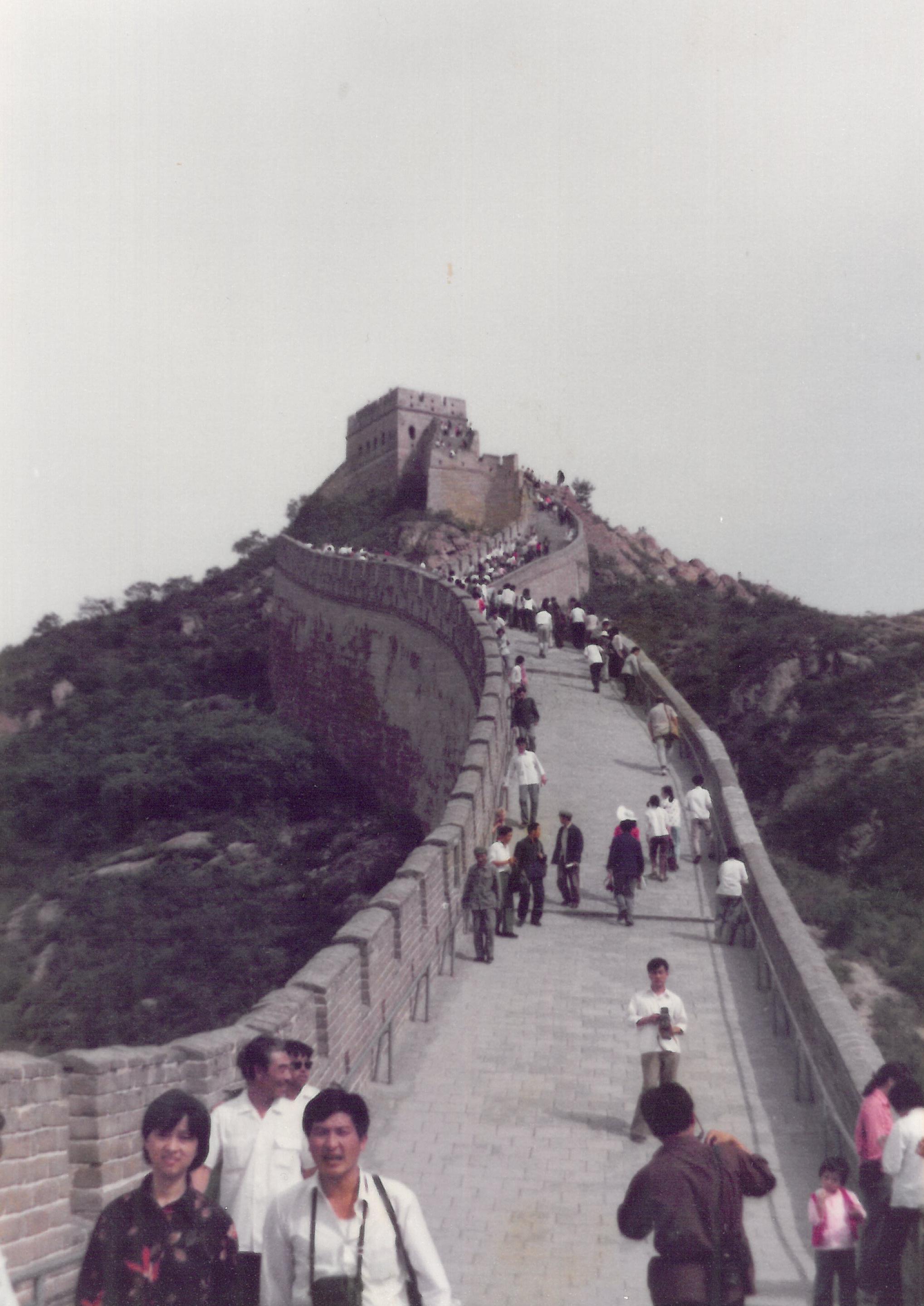
  • Found the missing pictures from our China trip in 1983. I wanted some of these for the cover of China Tour. Plus, who wants to lose photos of such a momentous event? I knew they had to be in the house somewhere and had spent a couple of hours looking. As typical of when you look for something packed away, I was looking for the wrong kind of box. I finally began going through the shelves in the storage room in the basement, marking all boxes on the shelves, and found then in about a half hour of looking. Found a good one to use for the main illustration, which I may add to this post.
  • Completed round two of edits of China Tour, and began round 3 (the final round), which is really just proofreading. Or maybe I should say if all I find is proofreading type changes it will be the last round. If I find any substantive changes needed, then I’ll need another round of edits.
  • My launch team is giving me reports on the book. I’ve heard from 5 out of 12 who have read it completely, and from several others who are some way into it. So far everyone likes it enough to stay on the team. Even my wife read it and said it was good, that she couldn’t guess ahead to what was going to happen.
  • The cover designer has begun production. It’s a somewhat simple cover (said the man who can’t do that kind of work at all) using photos from our China trip. I’m not quite sure when it will be done, but it seems likely before I actually finish all edits for the book.
  • The title will be changing, probably to Lotus Sunday or perhaps Operation Lotus Sunday. One other possibility I’m mulling over is Saving Dragonfly.
  • Yesterday I sold the first paperback copy of Doctor Luke’s Assistant. That earns me $1.17 in royalty, because I kept the price low. It sure feels good to sell one. That’s also my first sale of anything in May.

So there you have the news from Bentonville/Bella Vista, Arkansas. If I had to guess I’d say Lotus Sunday will launch around June 1st. I’ll keep you all posted.

Progress on Two Books

After a week long hiatus, I’m back. Actually it was a little more than a week. What have I been doing to further my writing career, you ask?

A few things. I put out three or four calls for launch team members for China Tour. Twelve people responded. I e-mailed them the book, and outlined the tasks for them. Most of that happened before my week away. Over this week I’ve been getting comments back. So far five from the team have told me they finished the book and given me comments. Based on those comments I’ve been brainstorming and editing.

One common criticism was that the book starts slowly. Those who coach writers say at the very start of the book you should introduce your protagonist and plunge him/her into conflict. The Brownwell’s conflict at that point is marital difficulty. The start seems slow, I agree. Yesterday I may have come across a way to overcome that. While the Brownwells are on the ferry returning from Hong Kong to Kowloon, a meeting of key players in the Taipei office of the CIA is meeting, explaining the need to get the dissident out of China. Hopefully this will stir things up a bit more at the beginning.

Beyond that, on China Tour, I’m working through the book from beginning to end, looking for inconsistencies in the plot, places where the wording can be better, typos, or just any improvements I can think of. I have about 70 pages left. I’m also looking for photos to use on the cover, though in truth I haven’t done a whole lot of that.

Also on the table this last week was completing what was needed for the print edition of Doctor Luke’s Assistant. Veronica completed the cover, sent the file to me, and I uploaded it. It was accepted with no problem. Thanks, Ronnie, you did a good job. So I ordered the proof, reviewed it, and found one mistake in a font size of a running header. I fixed that last night and uploaded the new file.

Today the e-mail came saying the book is acceptable per CreateSpace standards, and was ready to either order another proof or publish it. I decided to publish it. It’s available to purchase right now at CreateSpace, for $14.00. Here’s the link: https://www.createspace.com/4213834. It should be available on Amazon proper within a few days. However, I make a significantly higher royalty on CreateSpace, so if you’re thinking about buying it….

So, now you know why I was absent for a week. China Tour will be my main writing focus until it’s published. I still don’t know when that will be, but I’ll keep you all posted here.


To Justify or Not

One website/blog I monitor with some degree of regularity is Joel Friedlander’s The Book Designer. Joel is very big on taking great care in the interior design of a book. He encourages people to use a high-end program, such as InDesign, to create the interior. He does acknowledge, however, that the standard Microsoft Word is going to be used by many or most self-publishers, and so he has done some work with that.

One thing Joel encourages is that the book text be fully justified—that is, that the text be flush against both the left and right margins. This leads to decisions and action needed to avoid the odd spacing that comes from justification. When my dad set type for The Providence Journal, he would handle this with hyphenation and spaces of different size, all with a hot-lead typesetting machine. Today Word does a lot of that. You can set hyphenation zones, and you can even tell it, to some extent, how to adjust spaces.

Another caution Joel warns about is eliminating “rivers” of text, often called “ladders.” You probably know what I mean. This is when the white space between words aligns in a mostly vertical pattern between lines. It tends to capture your eyes and pulls you away from reading. This can be solved, says Joel, with careful attention to typesetting techniques, including adjusting word spacing, changing hyphenation from what may be optimum, and in some cases kerning or compressed type on a word or two.

Along the way Joel also talks about widows and orphans—not the people, but the single lines of text at the bottom or tops of pages that are cut off from the rest of the paragraph. You can fix those easy enough, but then you might have a “spread” (i.e. two pages of a book facing each other) with the last lines not aligned with each other. Again, techniques are available to solve the widows and orphans problem without creating the spread problem.

It seems to me, however, that all of these (except maybe widows, orphans, and spreads) are solved by simply not right justifying the text. Let it be a ragged right edge. What’s so awful about that? The spacing between words is constant, as it is between letters. This is the most comfortable reading. When spaces vary between words to allow the right side of the text to be all at the same vertical line, reading can be more difficult. It takes a very skilled typesetter to adjust those spaces and hyphens so that the text justifies and the comfort of reading is not diminished.

It further seems to me that the most important thing in laying out a book is to make the reading easy. Margins, text size and spacing, the presence of page numbers and running heads—all of these make reading the book easier. Right justification makes it harder. So why do we right justify?

My three print books so far [Documenting America, The Candy Store Generation, and Documenting America, Homeschool Edition), are all left justified, ragged right text. I did it that way because it was easier to typeset and because it is the most comfortable reading, with the latter reason being the main one. Full justification is possible with Word, but I decided against it. I don’t even hyphenate words with the ragged right text, which is possible, because I think hyphenated words detract from the comfort of reading. Joel would not approve.

When I was first making my decision concerning this, I made trips to both the library and Barnes & Noble to randomly check books for justification vs. ragged right. I found almost none that were ragged right. I found many that, with full justification, had awkward words spacing, hyper-hyphenation, and rivers of white space. They were distracting to read. The few that I found with ragged right were easy to read. And, to my eye, the text looked as attractive as fully justified.

So my question is why does anyone do justified text? My conclusion is that someone, possibly readers, probably printers, for sure typesetters, thinks is looks better that way on the page. Joel did a guest post at a blog and I asked that question. His answer: reader expectations. I’m not sure about that, however. I kind of think the readers don’t care all that much. Will they go to the bookstore, pick out a book for browsing, find the text ragged right, and put it down as something less than professional? Maybe, but I kind of doubt it. I doubt most readers will even notice.

This weekend I spent a couple of hours reading in Not A Fan, by Kyle Idleman. This is a book were are doing an all-church study in right now, with sermons and life group classes all using the book. I was well into my second or third hour of reading when I suddenly realized that the text was not justified: it was ragged right! With no hyphenation! I’m very attuned to that, and yet I was more than 50 pages into the book before I noticed it. If I didn’t notice it, I doubt anyone else did. This is published by Zondervan; it’s not a self-published book.

So how did Zondervan manage to typeset a book with ragged right, non-hyphenated text, and do it so well that it took someone looking for it over 50 pages of reading to notice? Why is this book selling tens of thousands of copies when it has what some would call an unprofessional layout? You can be sure I’m going to spend some time studying the layout and seeing what I can glean from it. I think I know what it is, but want to study some more before saying anything. The print version of Doctor Luke’s Assistant is in the mail to me right now, and the print version of China Tour is only about two weeks away from beginning production.
Virtual Book Launch Team

The time has come to begin generating pre-publication buzz for my newest book. As I’ve reported on these pages before, it’s my latest novel, “China Tour”. Here’s what I put on my Facebook author page, and on a Facebook writer page I’m a member of. I’ll slowly be adding it other places.

I finished the first round of edits on my latest novel, and am ready to begin putting a virtual book launch team together. My tentative title for the novel has been “China Tour”. However, I’m thinking of changing that to “Smugglers and Spies”. The title is very much up in the air. The one-sentence description is: An American couple’s troubled marriage is put in greater danger when they become embroiled in a CIA operation while touring China. The book is about 73,000 words, or about 255 pages when formatted for editing. It’s set in 1983.

This is the first time I’ve tried to put a virtual book launch team together, so I’m feeling my way. What I thought I would ask of my team:

– Read the book. I’ll supply a Word or PDF copy ASAP. I’d ask that you read it within two weeks, if possible, and give me some feedback.

– Give me feedback about the title.

– Obviously, if you find the book is something you couldn’t associate with, you could back out.

– Within the first month of publication, make three posts about it on-line. This could be at Facebook, Twitter, a blog, or even through an e-mail to friends, the goal being to get some buzz started.

– Once the book publishes, post a review on Amazon and/or Goodreads.

– After publication, I’ll give everyone on the launch team an official copy, either paper or electronic at your choice. I’m hoping to do the paperback version almost simultaneous with the print version, but the cover will dictate that.

Anyone want in on the launch team? Message me here at Facebook, or e-mail me at norman_d_gutter AT yahoo DOT com. I’ll have the file to you within a few hours.

The offer is also available to the few readers of this blog. Post a comment here if you’re interested, and indicate what type file you want (if I already have your e-mail). Otherwise just e-mail me. If you don’t specify file type I’ll send a PDF. I’d like to get about 20 people on the team.

The Amazon Love-Hate Affair

I’m wondering if my writing website has been hacked. I can’t login to the admin page. Lately I’ve been getting a lot of spam comments, somehow getting past the captcha code, and have been deleting them all. I’ll see when I get home tonight and try logging in with a different browser. For now I’ll type the post I was going to make in another medium and hope I can paste it in later.

The on-line writing community is having a huge debate right now about an op-ed piece in the NY Times by author Scott Turow. Scott is also president of the author’s guild. The gist of his piece, which is titled “The Slow Death of the American Author” is that the Internet and yahoo and pirates, all facilitated by technology is killing the American author, and the government better do something about it. It seems every author/publisher/agent/editor with a blog is writing about it (me included now). Here’s a link to Turow’s piece.

On the one end of the spectrum, Turow (whom I’ve never read) is being hailed as a hero. Yes, piracy will kill the American author. Amazon will kill Barnes & Noble and with it the big six (now five) American publishers, which will kill the American author. Technology enables Amazon, so technology will kill the American author. To these people, Amazon is the biggest evil to hit the world since the slave trade.

On the other end of the spectrum are the Amazon lovers. Amazon can do no wrong. They may be a monopoly, but that’s because they were the ones who saw the market need and created the business model to serve it. No one else is restricted from entering. Indeed, Amazon’s share of the e-book market has shrunk from 90 percent to something below 70 percent. They have empowered the self-published author and done much to attract and keep them. If they put Barnes and Noble or the big publishers out of business, so what? Let them go the way of the buggy whip manufacturers. Those companies had adequate time to develop business models that would have embraced technology and taken market share from Amazon.

So it really seems we have an Amazon divide in the country. Love it or hate it. This is just within the writing/publishing community, and maybe not even all of that. Maybe it’s just the blogging world I take part in that’s all up in arms over this. Perhaps the writing/publishing community at large doesn’t even know this is going on. Perhaps they are all blissfully about their writing and publishing tasks and not worrying whether they’ll be dead soon from a painful and slow death.

I haven’t seen many balanced approaches to this. Kristen Lamb did one, I think, here. The comments are quite interesting.

So long as readers seek material to read, publishers and writers will have work. I probably need to quit reading those blogs and just concentrate on writing, editing, and publishing. Off now to take my own advice.

A Conan Doyle about to break-through

This past Sunday, the weather being pleasant and our getting home from church with fair promptness, I fixed a cottage cheese and lunchmeat lunch and took it to the sun porch to read. Or maybe this is more of a Florida room, except it’s elevated—an appendage to the house fitted with some expensive heating units (that we never use) and without air conditioning. I decided I would get back to reading in the letters of A. Conan Doyle (http://www.goodreads.com/book/show/359482.Arthur_Conan_Doyle).

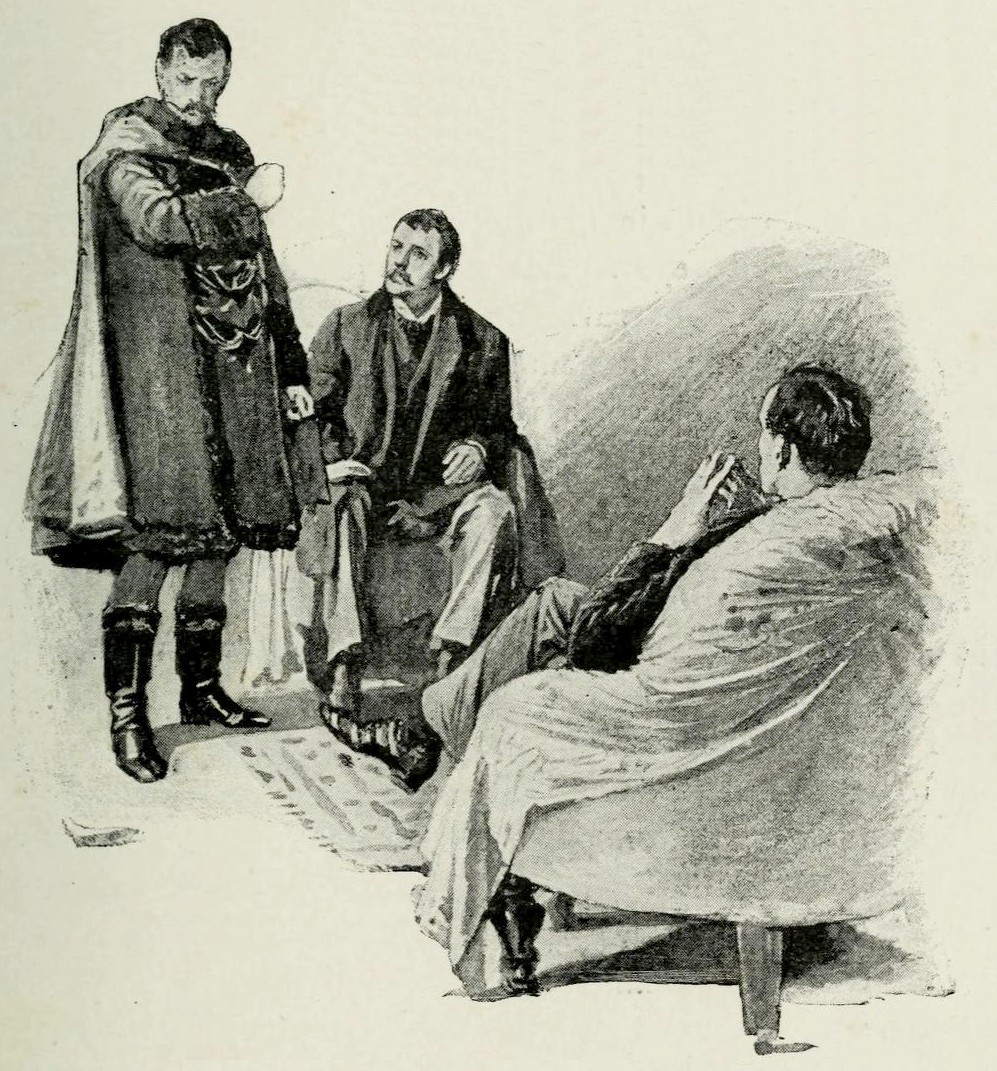
It probably helped that the last time I went to Barnes & Noble I bought, from the discount table, a two-volume set of the Sherlock Holmes stories, arranged chronologically. The first, A Study in Scarlett, was published in 1887. When last I read in this book I was somewhere around 1885 or 1886, so I knew I was getting close to that momentous occasion.

Unfortunately, the editor wrote that not many of Doyle’s letters between 1885 and 1890 survived. For some reason his correspondents didn’t keep them, I guess. So in the book I moved into this period with mainly editorial comments and brief, and sometimes unattributed, references to the various autobiographical works of Doyle.

At this time he had three novels circulating among publishers, with one of them A Study in Scarlett. He stated he had high hopes for the novel, but he also thought another was better. But all of his novels received rejections, and went off to another place. Doyle bemoaned that sometimes they weren’t even read. If only the editors would read them they would like them.

Finally a publisher offered him £25 for the copyright, with no royalties. Doyle held out; he wanted royalties. The publisher didn’t budge. Nothing else was selling. His medical practice was paying most of the bills, but literature was where he really wanted to be. Finally he took the offer, and Scarlett was published in December 1887, not as a stand-alone book first but in an annual.

Reviews initially weren’t great. The normal number of copies of that annual were printed. That’s as far as I got with my reading on Sunday. Sherlock Holmes had seen the light of day, but was still mostly unknown. This coming Sunday, hopefully, I’ll move into the period of 1888 and beyond when Holmes became the most famous fictional detective, and Doyle practically a household name.

Is this encouraging me to at all while I’m in a very dry period of my publishing career, dry in terms of sales, not of ideas and production. Not really. If publishers and initial readers can’t see genius in the work of A Conan Doyle, what hope is there for me? Twenty years later a copy of that annual sold at auction for more than £150,000. That offers some encouragement.

Though in twenty years I’ll be 81. Alas.

Change of Writing Plans for the next Two Weeks

I had a meeting to go to this morning at the City of Bentonville Planning Office. As expected it lasted about 45 minutes. The City library is pretty close, and since my colleagues and I took separate vehicles (because they both had other meetings to go to afterwards), I went to the library.

A library is almost as good as a used book store. In some ways it’s better, because it will be better organized. Rarely do I visit a library and wind up disappointed. Today was no exception.

I had two purposes I wanted to accomplish there: 1) see if my inter-library loan books had arrived; and 2) see if they had the index to National Geographic magazine that included the 1970s and 1980s. I went straight to the reference desk, where the lady was alternating her gaze between books and her computer. On her desk were several books that looked like inter-library loan books, and, though most of the covers were obscured by the paperwork wrapper on each book, one looked like the cover of a book I was expecting.

They were indeed both of my books. She had just processed them and only needed to scan the bar code before she could give them to me. It took less than a minute. The books are harmonies of the gospels published in 1988 and 1996. I haven’t done much research into modern harmonies, relying instead on harmonies from the 1700s, 1800s, and early 1900s that I could access on-line. These two will help to flesh out my research.

At the reference desk I also learned they had the exact NG Index I was looking for. One more minute and I was at a table, with the index open, looking at the entries for China. Perhaps I should explain more.

We have a ton of NG mags in our basement storage room. When we moved to this house in 2002 I tied them up for transport, and haven’t looked at them since. From time to time I’ve bought a few newer ones, or had them given to me, and put them loose on the shelf. I have a recollection of one or two articles in NG in the late 1970s or early 1980s about the terracotta soldiers buried in Xian, China. We visited those in 1983, and I have a fairly vivid memory of them. One of the characters in China Tour, the tourist husband Roger Brownwell, mentions this NG article and has it with him. I figured, as some last minute research, I should re-read the article. It’s been thirty or so years since I first read it.

Last night I went to the shelves with the mags. Kn0wing only that it would be somewhere between 1974 and 1983, I began looking. What I found was that: many of the strings I tied them with eleven years ago had come loose, making handling difficult; they were stacked two-deep on two shelves, making for 10 feet worth of shelves to go through; the lighting was so bad I couldn’t read the words on the binder (except for the date); and the bundles of mags, such as they were, were not necessarily all of one year—except I found duplicates, so maybe other bundles were all of one year, and I just couldn’t find them in the poor light on the ten feet of shelves. I gave up.

Thirty minutes of on-line searching revealed that the National Geographic Society does not have an on-line index, and it seems no one else had created one. Hence, knowing I would be near the library today, I decided I would see if they had the index I needed. I knew if I could just find the month and year of the magazine I needed I could find it in the storeroom.

Sure enough, I found it in the index: April 1978, with an earlier, briefer article in December 1974 that I should also look at. As well, I found articles in 1982 and 1983 for two of the cities we visited and which are scenes in the book. Tonight, God willing, I should be able to find them and set them aside for reading.

I may not learn anything new in these articles, but it’s absolutely essential that I not include in the book anything that wasn’t true in 1983, which is when the events in China Tour took place. Plus, in these articles I may find a few ideas I can use to enhance the authenticity of the book.

So, since I have a way to find specific NG issues needed, and since I have these two books for only two weeks from inter-library loan, I figure my reading and writing priorities have changed. Tonight I will:

  1. first find the NG issues on the storeroom shelves and bring them upstairs.
  2. second begin reading in one of the two harmonies.
  3. edit at least 40 pages of China Tour. I’m currently through 78 pages of the 250 page book.
  4. if time allows, begin reading the key NG article.

This may be too much for one night, even with leftovers needing only a generous dose of micro-waves before eating, and even dessert prepared. But we’ll see. For sure most other writing projects, either in the works or on the mental to-do list, will be shoved aside for the two weeks that I have these two books.

How great is a library?

March 2013 Sales

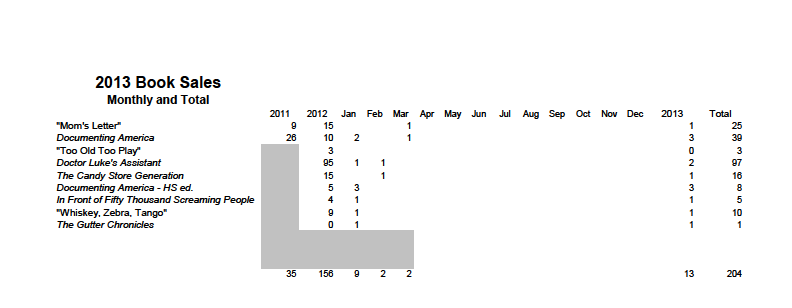
March was just as dismal as February in terms of sales. I don’t know that I officially posted February’s sales. I sold two whole books in February. In March I again sold two books. That actually made March more dismal than February, since it had three more days in it. That gives me 13 sales for the year, which is three less than I had at this time last year with only three publications out instead of nine.

Here’s my sales table. I’m not going to post a graph. Interestingly those two sales were of my first two self-published works.

So, I guess I need to re-think going with the Dean Wesley Smith strategy of ignoring promotion and putting all my effort into adding new titles. It seems I can’t get my new titles out fast enough to keep the interest of readers. That, plus my Genre Identity Disorder, seem to be working against sales.

But I don’t really like promotion, so for now I’ll keep writing and trying to bring new works to the market. China Tour is probably two months away at the rate I’m editing (which is very slow). I have nothing else in the works, though I’m thinking of taking some items I’ve written for work and turning them into generic professional engineering publications and putting them out there. It won’t help much with those who have bought my other works, but maybe it will bring in a few sales.

And, adding a smaller version of the table to upload to Absolute Write.

Not Enough Time for the Books

Lately I’ve fallen into a little better routine, at least as far as my reading is concerned. I have a small book in the pick-up that I read a little in at traffic lights, or just before I get out to go somewhere. Or it’s there when I head into the doctor’s office, like yesterday.

In the evening at home, around 10 p.m., after whatever writing I’ve accomplished or chores I finished, after I tend to family finances and the paperwork that produces, I take up my current book and read. It could be any one of a number of books, though for the last five or six nights I’ve read in my primary book, Letters from an American Farmer, about the status of colonial life right around the American Revolution. I suppose you could call this research for a future volume of Documenting America.

As I sit in my reading chair, I look around the living room. To my right is the built-in bookcase, holding a couple of hundred books, mostly still to be read. Many of them are antique books, handed down through my family. Others are contemporary, mostly Christian topics. To my left, behind the couch, is an antique table with about twenty books on it. These are mainly smaller ones, all modern. Some are devotional, some are small group studies, others similar.

In the bedroom, on the dresser, is another batch of perhaps thirty books of a similar mix to the last described batch. In the secretary in our bedroom are another four shelves of books. Almost all of these are to be read.

Should I describe the lower floor? With it’s twelve book cases, it’s six-foot table with forty books waiting to be shelved? Or the store-room with boxes of books on the utility shelves, and boxes more on the floor, waiting to be donated. For the books downstairs, some have been read, but then kept for our library. Lynda’s read more of her novels than I have of my classics, novels, and non-fiction.

This morning the moon was large in the west, just above the horizon as I pulled away from the house for the 15.6 mile drive to the office. Admiring the moon made me think of the universe, which got me to thinking about science fiction. So far I haven’t written any science fiction—not because I don’t want to, but because the demands of it are so different from what I write now. Plus I don’t need to expand my Genre Identity Disorder any more than it already is.

Years ago, I suppose before I began writing creatively, I thought about the first steps our species would have to take if we were going to leave earth. I actually thought through a couple of series of sci-fi books. I never wrote anything about them, because I didn’t consider myself a writer at the time, and had no ambition to be one. I suppose that was the earliest appearance of those desires.

But the beautiful moon made me once again think of writing sci-fi. That, if it ever happens, would be after the sequel to In Front of Fifty Thousands Screaming People, after the sequel to Doctor Luke’s Assistant. It would be after my series of cozy mysteries, The Alfred Cottage Mysteries. And after the series of books I have brainstormed and somewhat captured on stock trading. And after I turned DLA and its sequel into a series of early church history books. For sure it will be after I edit and publish China Tour.

It would probably be after the six Christian non-fiction books I’ve programmed to write in future years, after the few more books I’ve thought of for the Documenting America series. And certainly after I somehow get my poetry book, Father Daughter Day, illustrated and published. And I’m not even sure about the short story series I’ve started. Or the professional essays I’d like to publish.

So where am I the worse basket-case? In my accumulated books reading or my dreamed-of books for writing? Between the two I’m for sure quite busy.