Category Archives: Fowler

Letters, Letters, Letters

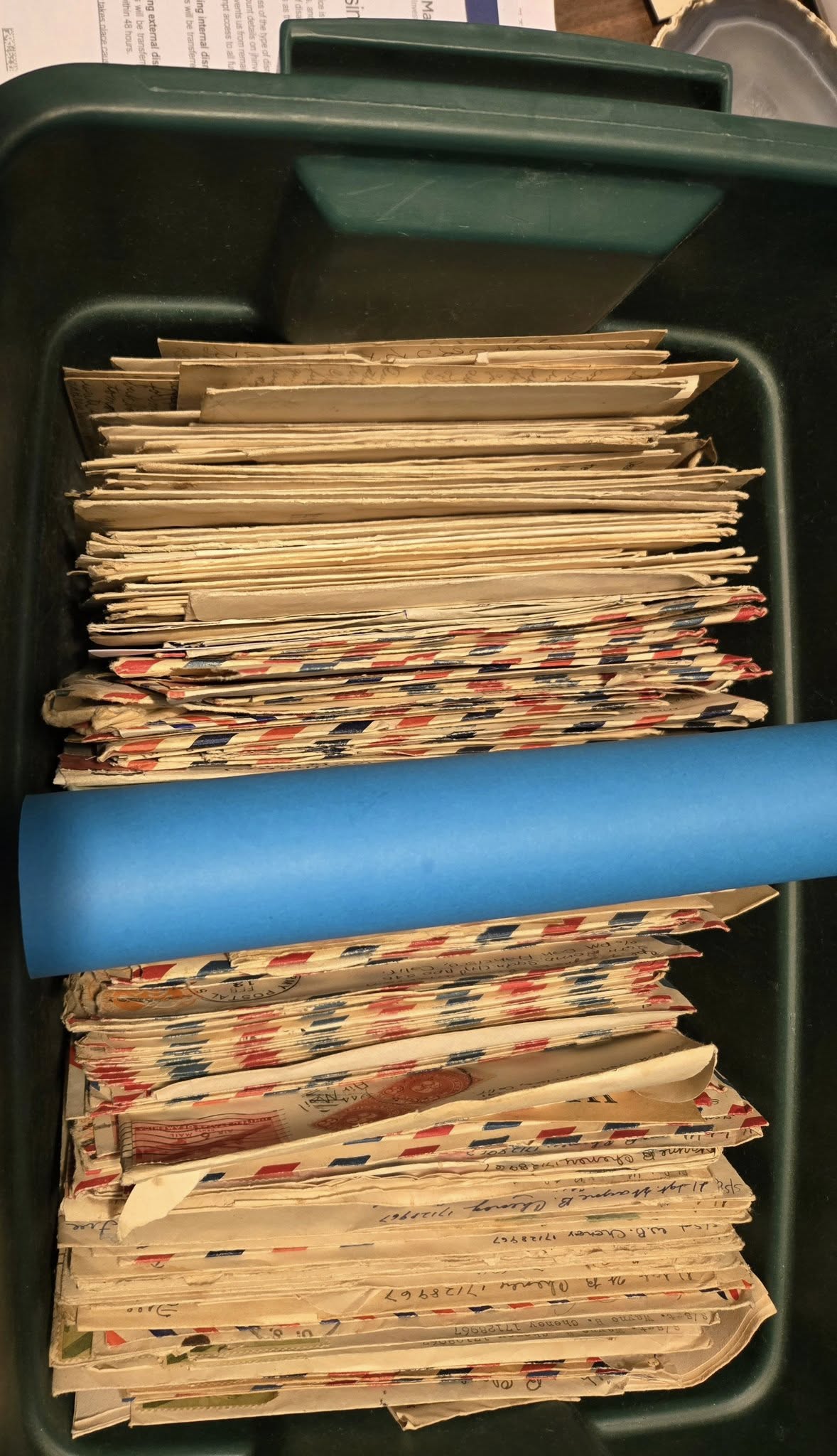
One side of the blue sheet is letters already transcribed, the other side is yet to be done. I still have a long way to go.

Having completed (more or less) my project of reviewing, organizing, and deleting redundant scan files (originally numbering around 3,400, currently less than 100), and having completed transcribing my great-grand uncle’s diary of his 1921 trip to St. Lucia (in preparation for my trip there in the next few months), I have now only one remaining active special project: transcribing my late father-in-law’s World War 2 letters.

I have made progress on this; yet I’m not close enough to the end to know when that will come. At the end of my transcribing on Saturday, I had finished exactly 100 letters. Each has been pulled from the green plastic bin it sat in for at least 30 years, been dusted off, unfolded, deciphered, and the words and other key information added to an electronic file created especially for it, one file for each letter. Then it was put back in the bin in correct chronological order based on date of writing, not on the postmark. At the same time, I entered the letter into an index file formatted for eventual inclusion in a book of these letters.
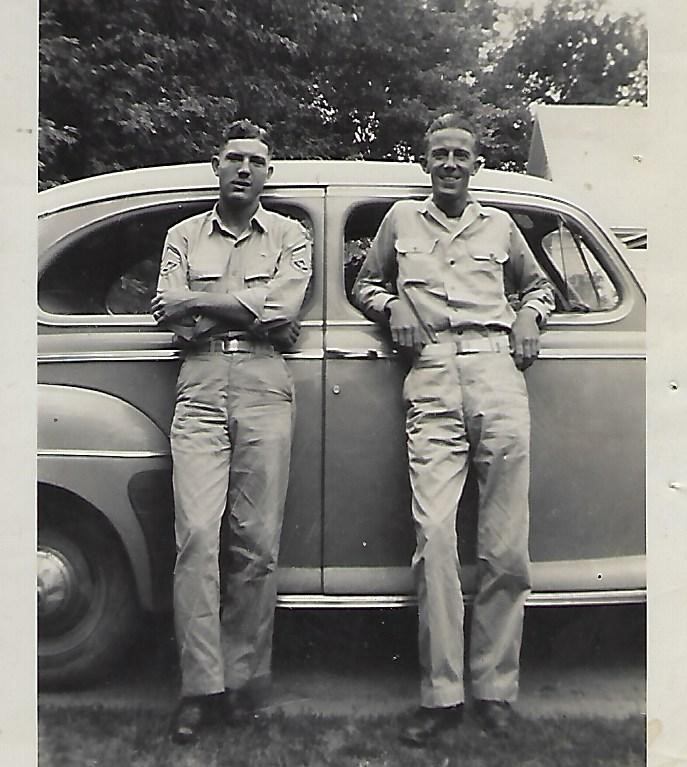
I have only a few wartime photos of Wayne, this one of him on the left and his brother Ray on the right,

They trace the life of Wayne Cheney from his graduation from high school in 1942 through his leaving home for work/school, his enlistment as an 18-year-old, until his discharge from the army air corps in late 1945. So far, most of the letters are those written by Wayne to his family (dad, mother, two sisters) back in little Fowler, Kansas. Many of the envelopes include a “censor’s stamp” when he was located at a forward base overseas. A few have words excised with a razor blade as the censor removed something he thought inappropriate. A few of the letters are from his mother, a few from his older brother who was also in the army, and a few from his sisters.

That’s based on the 100 letters transcribed so far. I haven’t counted the ones not yet transcribed. Such counting seemed like a waste of time. But based on the thickness of the letters not yet done compared to those done, I estimate I have 120 to 150 more to go. I find I can only do so much of this work in a given day before I hit a wall of fatigue and have to shift to something else. Three letters a day is about my limit. At that rate, it will take me the rest of the year to complete the transcribing, accounting for trips and holidays.

Once that’s done, my plan is to take Wayne’s war diary/journal and integrate it with the letters. Before his death, Wayne typed his WW2 journal, adding a post-war supplement to it, and printed it in multiple copies. I gave one copy to his son, kept one, and trashed a number of duplicates. The electronic version is somewhere on a diskette in an old Word Perfect file. I think I will scan the printed file to text and work with that.

I don’t have a lot of photos from Wayne’s service year, but what few I have I’ll add in.

I have no idea how long this book will be. If the letters average 500 words and there are, say, 240 of them, that’s a 120,000 word book not including the diary/journal. That would be a sizable undertaking, and is possibly biting off quite a bit more than I can chew.

But there’s nothing to do but continue, and make this unfiltered history a little more accessible for the few who will be interested. If I’m able to complete the project, I’ll give a copy of the book to the Meade County Historical Museum, the Fowler Library, and give a copy to each near relative, I suppose. I’ll make it available on Amazon should there be a cousin or two interested.

Road Trip No. 2 is Over

We returned last night from southwest Kansas, 1067 miles after starting. The main purpose for the trip was my wife’s high school reunion, but I scheduled much more around that. We had time with aunts and cousins. We visited two family cemeteries. We attended the old home church. We went to the county fair. We took late evening walks of more than a mile, after the temperature dropped below 90, and marveled at the clarity of the Milky way. We visited the hometown museum, which is much changed since I last went in it thirty years ago.

And we visited the old homestead where Charles and Zippy Thompson lived for thirty years. No, Zippy is not a nickname. I’ve often wondered why Isaac and Sarah Chappell named their second daughter Zippy Ellen Chappell, but they died about a hundred years before I knew her name was Zippy, who herself died in 1962, fourteen years before I married in. Lynda’s mom was with us for the homestead tour. In fact, she’s the main reason I wanted to make the trip. Well, I wanted to see it too. Thirty-four years of trips to Meade and no one ever suggested we try to find the place where the sod house was built into a hillside, and the spring house kept the meat and produce cool. No, the fixation was always on the Cheney family and the last stop of the wandering 49er.

But Esther had spent much time at her grandparent’s farm/ranch on the Finney/Haskell county line. She helped tend the vegetable garden, pick flowers, slept on a mat on the earthen floor, used the outhouse, and spent a rustic week of enjoyment with grandma and grandpa. Esther enjoyed the visit most of all, carefully stepping over a variety of critter holes, abandoned farm equipment, and building debris with her 85 year-old legs, and getting Texas tacks on her slacks, recalling what she experienced seven or eight decades previously. Lynda enjoyed it too. Her cousin Trish carried off a souvenier, an old over cover.

We also visited a scene of less happy memories, where my wife’s two aunts perished in the blizzard of 1948, the year before my wife was born. Esther and Faye, the two remaining sisters who were not with the others for that fateful car ride, showed where the car got stuck, where Louise’s body was found three days later at the bottom of a ravine, where Phyllis died, and where their friend Marvin apparently tried to make it back to the car but failed in hie attempt. That visit was harder than the other, which is likely the reason we never did that tour before. We drove that road maybe thirty years ago, but no one asked, “Where exactly did the girls die?”

One other unhappy but necessary visit was with Lynda’s cousin Bobby, from Cimarron. His 33 year-old daughter committed suicide a year ago. We talked with him a couple of months after it happened, but this was the first time to see him. He explained how nothing helped with the healing. I hope something we said did, though. Bobby keeps up the Cheney plot in Fowler Cemetery, and was driving down on Sunday to do so when we suggested we drive up to see him. So we met at Aunt Rosa’s house in Fowler and again at the cemetery. One lighter moment came when he pointed out that a man buried right next to the Cheneys was named Jerry Garcia. Bobby says he has a lot of fun telling people he mows Jerry Garcia’s grave, and they think him a celebrity of sorts. Not being a Grateful Dead fan that went over my head until Bobby explained it.

Many memories made, and recalled, on a good six-day trip, concluded by meeting up with other cousins at Baxter Springs, Kansas, as we returned home yesterday, and dining on old Route 66. May there be many more such times and trips.