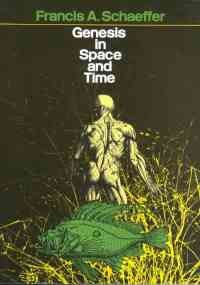
I’ll call this the Disappearing Book. I remembered having bought Francis A. Schaffer’s Genesis in Space and Time many years ago, sticking it on the shelf, and waiting for it to pop to the top of my reading list. It popped up a couple of years ago, and…I couldn’t find it.
I was sure we hadn’t gotten rid of it in a book purge, but it was nowhere on my Bible study shelf. Ah well, I thought. I picked another book that I had on the Biblical book of Genesis, read about half of it and gave up and donated the book. It appears I never reviewed it on the blog.
Ah, but then, when I was packing books to move to Texas, I found it! Right where I though it should be. I put it at the top of the current reading pile. That was in early December. We got to Texas in February, and early this month I was ready to read it and…couldn’t find it! What was going on with this book? I knew where all the books were from our partial move in December, so I went through my bookshelves book by book. I finally fund it, and realized the fact that the text on the spine not quite matching the book title was what through me off this whole time.
I finished the book on Saturday. While it not being quite what I thought it would be, I have to say it was enjoyable and well worth reading. Schaffer didn’t get into a lot of details on items long debated by scholars, such as: old earth vs. young earth, were Adam and Eve read people, did the flood really happen, or the tower of Babel. He stated positions on these, summarized what we can know from secular scholarship, and didn’t get into the two sides of the debates.
If you’re looking for a book that will summarize the evidence for an old earth and compare that to why many Bible scholars believe in a young earth, this is not your book. Look elsewhere. But if you want a well-reasoned discussion of what Genesis stated in chapters 1-11, giving the implications of those chapters for humanity, by all means seek out this short book (160 paperback pages) and read it Here’s an example of type of discussion you’ll find in it.
As I said in regard to the use of the Hebrew word day in Genesis 1, it is not that we have to accept the concept of the long periods of time modern science postulates, but rather that there are really no clearly defined terms upon which at this time to base a final debate.
Thus, the answers to the questions I ask in each book review: I give this a solid 4-stars, with no temptation to go higher. It’s unlikely I will ever read it again. It is not a keep, but will be donated after I pull a few more quotes from it.