Category Archives: Christianity

Book Review: The Rise of Babylon

Or interest due to our time living in the region, but not a keeper.

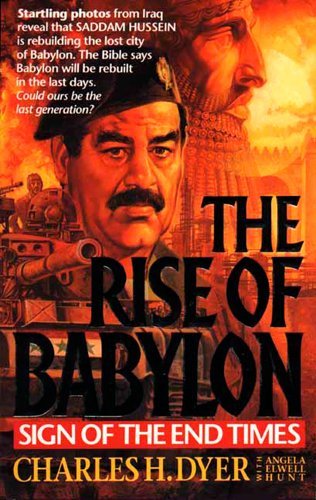
As I mentioned in a prior post, my wife and I don’t read many of the same books. I rarely recommend a book I’ve read to her, and when I do, she rarely reads it. She recommends books to me more often, and when she does, I seldom read it. One she did recently and that I read was The Rise of Babylon: Signs of the End Times by Charles H. Dyer with Angela Elwell Hunt (1991, updated 2003). First, a little about how we happened to have this book.

My sister Norma sent this to our dad in March 1991. It was one her church in Indiana was studying. Lynda and I were relatively newly returned from Kuwait (in July 1990), Iraq had invaded Kuwait (Aug 2, 1990), and the USA had led the coalition that liberated Kuwait (Jan-Feb 1991). Hence, the book had family interest. We must have taken this from Dad’s house upon his death in 1997, but tucked inside it was a letter from Norma to Dad transmitting the book, along with a photo of Norma. I have no way of knowing if Dad ever read the book or not. Since Lynda read the paperback before me, it had the signs of having been used.

I read this over about a 10-15 day period ending a week or so ago. I found it to be an easy read, helped along by excellent layout and typesetting. Dyer wrote this between the waning days of the Iran-Iraq war (which was 1980-88) and the invasion of Kuwait on 2 Aug 1990, although with a few changes to reflect its publication in Jan 1991. Dyer had, on several occasions, been in Iraq in the second half of the 80s as a guest of the government to witness how Iraq, at the instigation of then-leader Sadaam Hussein, was working on rebuilding the ancient city of Babylon. I believe Dyer’s intention was to demonstrate how Hussein’s intentions for Babylon were a movement to the end times as predicted in the Bible.

While the book is informative and interesting, I don’t think Dyer achieved that aim. He tried to do too much in one small-ish book. He started with the pre-biblical history of Babylon from various extra-biblical sources. That was well done, though a bit short of detail for my historically minded mind. He also failed to give a simple list of the ancient sources, forcing his readers to make their own list from the handful of footnotes and other research. But what the book contains, assuming it is a faithful extraction from the ancient chronicles, is good.

Dyer then gets into the Old Testament era, dealing with people groups and mentions in the historical and prophetic books. Once again, there is almost too much there for a book of this length. I felt that the treatment was shallower than I wanted.

The last part of the book was based on mentions in Revelation, and how judgment will yet fall on Babylon, how the ancient ruins Hussein was desperately wanting to rebuild to his own glory, touting himself to be the new Nebuchadnezzar, would be annihilated before the return of Jesus foretold in Revelation. Once again, I felt that this part of the book was shallow. Dyer presents his case (interpretation of the prophecies) well, but not in enough depth to allow me to really sink my teeth into it.

I read the 1991 version of the book, which must have been written mostly before the events of 1990. The 2003 updates might be interesting to read. But, I repeat that the book is trying to accomplish too much in too little space. Either a larger book or two volumes or more references to other sources would have been most helpful. I must say though that the book has spurred me on to want to do more research, so in this sense it succeeds.

Yet, from me it has earned only 3-stars. It is already in the donation box, and our over-stuffed bookshelves are just a little thinner.


Not Useful

Trying to remember why I started spot-reading this.

I have e-books on my cell phone to read at odd moments, such as waiting rooms. I have them as Kindle books, Nook books, and Google Books. Different books on each service, more books than I’ll ever to be able to read in this lifetime.

Document one of four in this discussion.

I recently had one of those odd moments and went looking for something to read. My choices at the top of the Nook and Google  reading stacks didn’t excite me. I had just finished a book on Kindle in the previous odd moment. The next book in line was titled WTJ+53.2. What the heck is that? I wondered. Opening it, I found it was an issue of the Wesleyan Theological Journal, probably Vol. 53 No. 2. You might wonder what I, a layman, is doing with a theological journal on my phone. I actually scan that journal’s archives about once a year, and once in a while have found nuggets applicable to what I was teaching in adult Sunday school class or to support something in one of my books. So it’s a good thing to have to browse or read in one of my odd moments.

Document three in the chain.

I opened the book. I had previously opened Vol 53 No 2 to an article and read approximately 1/3 through it. The article was “Miracles, Theodicy, and Essential Kenosis: A Response to John Sanders” by Thomas J. Oord, [Oord 2018]. I had/have never heard of Sanders, but I recognized Oord’s name from a news story, so must have decided to download and read this article. I finished the 21-page article about a week ago, and am just now setting down my thoughts.

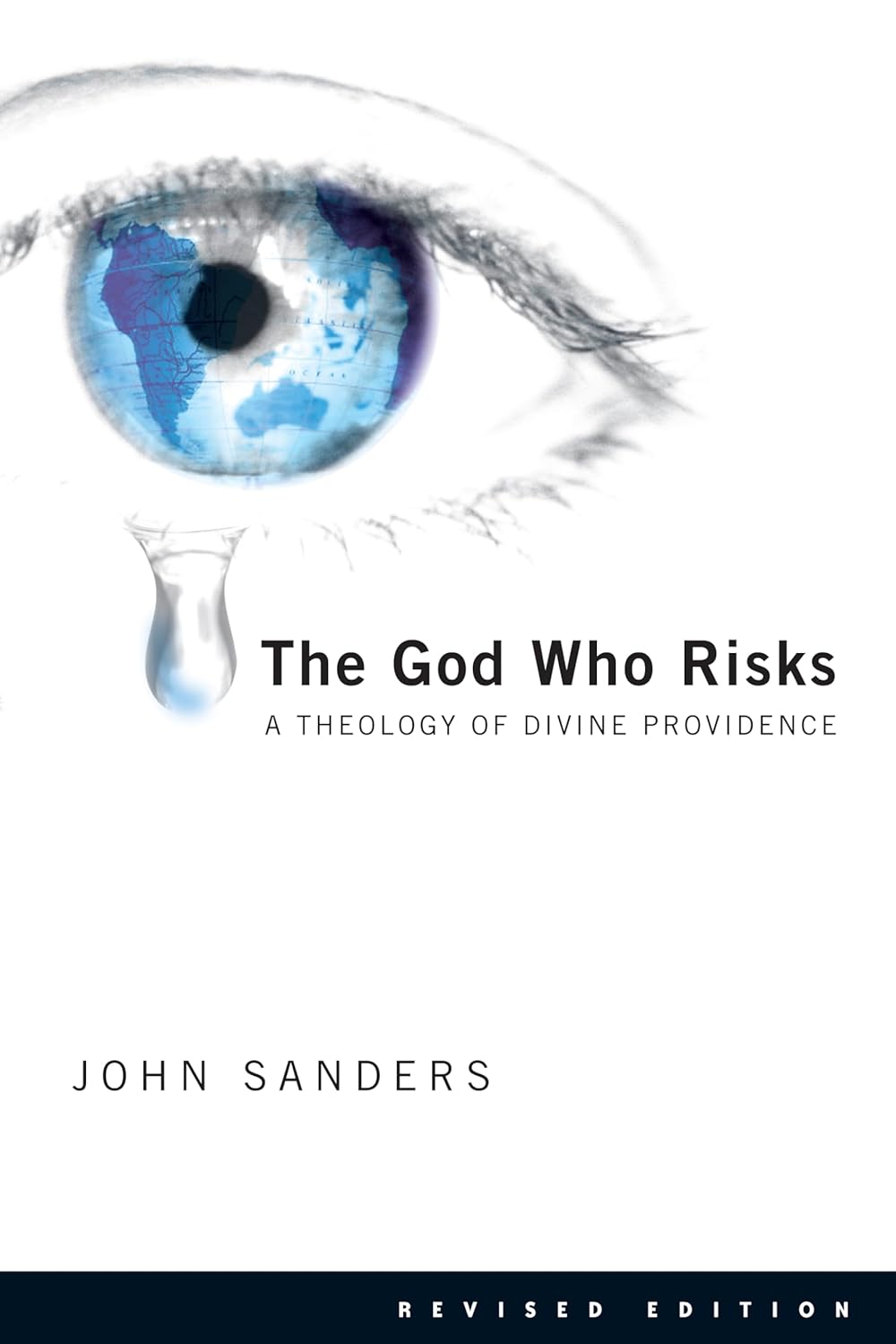
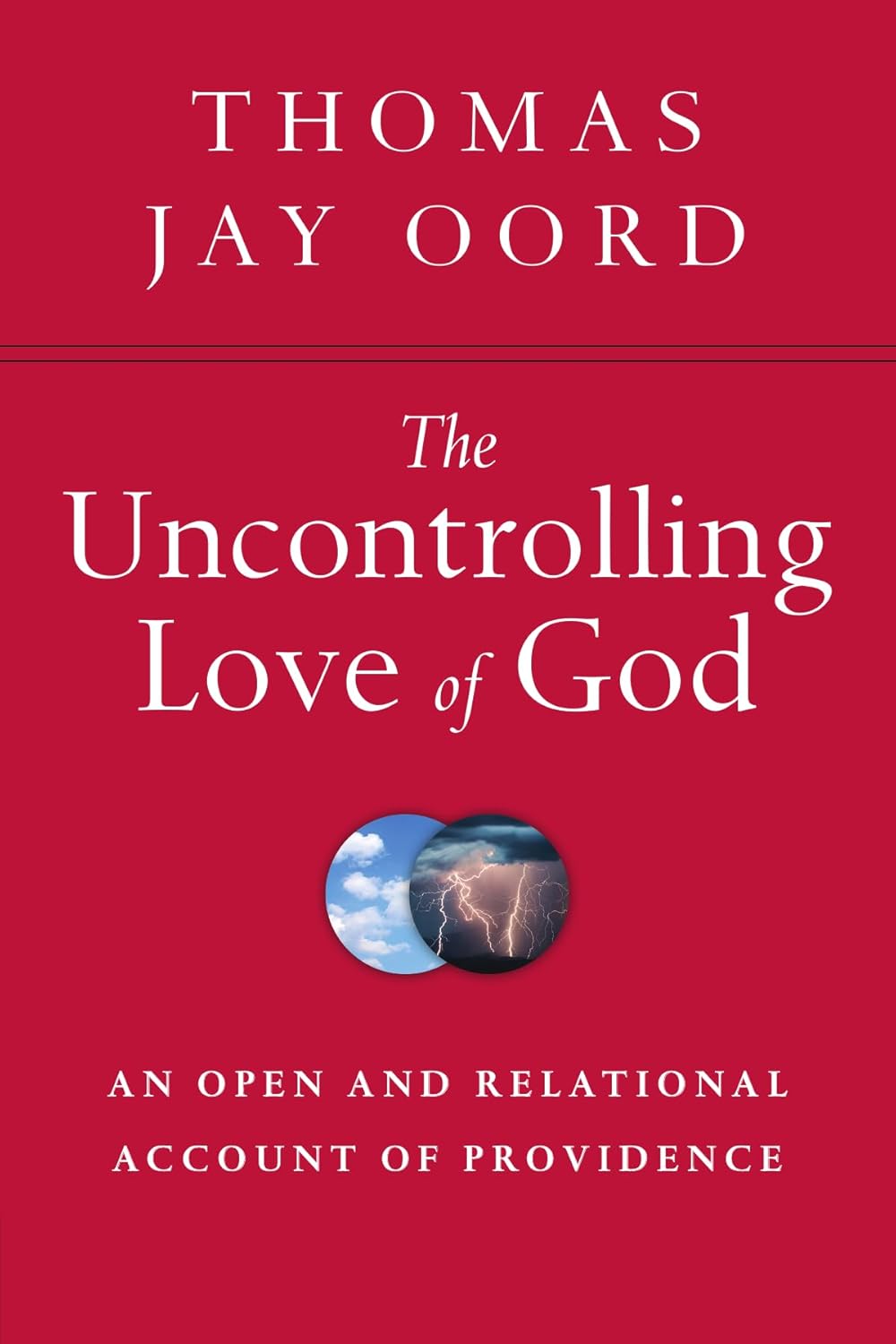
It is Oord’s response to an article by Sanders titled “Why Oord’s Essential Kenosis Model Fails to Solve the Problem of Evil While Retaining Miracles” in Vol. 51 No. 2 [Sanders 2016] of the same journal. Sanders had critiqued Oord’s book The Uncontrolling Love of God: An Open and Relational Account of Providence [Oord 2015]. Oord says in his 2018 article that in his 2015 book he referred to Sanders’ 2007 book, The God Who Risks [Sanders 2007]. Oord doesn’t say his book is in response to Sanders but does mention devoting a chapter to Sanders 2007. So this is the progression of documents being discussed:

  • Sanders 2007: The God Who Risks (book)
  • Oord 2015: The Uncontrolling Love of God (book)
  • Sanders 2016: Oord’s Essential Kenosis (article)
  • Oord 2018: Miracles, Theodicy, etc. (article)

This reminded me of engineering journals and how they did things. They would publish an article and invite discussions. People would write in discussions (either criticism or agreement), then the author would have a “closure”, which was a refutation of the various discussions or once in a while acknowledgement that the writer (of a discussion) had something valuable to say. I participated in that process once, in the late 1970s, early in my career. A journal published an article on wastewater treatment processes that seemed off the mark. I wrote a discussion on it, but, due to my relatively junior status, elected to mail it directly to the author rather than to the journal for publishing. The author called me, was very angry that someone would dare to question him, and kept saying, “You don’t know sh— from Shinola.” I let the matter drop. Somehow my boss got wind of it and gave a copy of the original article and my discussion to our chief process engineer. He said my discussion was spot on, that the author didn’t know what he was talking about, that he would handle this, and that the journal he had previously respected and published in had obviously gone downhill.

All I’ve read in this progression is Oord 2018. On the first page were the words ontological, epistemic, theodicy, and of course kenosis. Not one of those words was ever defined in my engineering classes. I doubted that I would ever have to use one of them teaching adult Sunday school. I doubt they’ve been used in the SS teacher’s books I’ve studied from. I should have abandoned the article and closed the book right there. But I read on, struggling all the way with the concepts I barely understood and through Oord’s many uses of the current buzzword “I affirm…” I even re-read the first third of Oord 2018, since there had been a long time lag between my initial and final reading of the article.

I have no expertise in the areas of Oord’s and Sanders’ back and forth, so obviously can’t engage in polite discussion of them as I tried to with the s–S guy. But after 35 years of adult Sunday school teaching and administration, I think I have a little expertise in churchmanship and my own Christian walk. Here are my conclusions, for what they are worth.

  • I find nothing in Oord 2018 that will help me live a better Christian life.
  • I find nothing in Oord 2018 that will help me teach others to live a better Christian life.
  • I find nothing in Oord 2018 that is the least bit encouraging or uplifting.
  • Based on this one article, I conclude WTJ obviously isn’t intended for a layman like me and will look for some other scholarly journal to fill my odd reading moments. I also wonder, though haven’t yet so concluded, if those involved in WTS aren’t wasting their time. To be fair, the world they live in, move in, and have their being in doesn’t seem to be my world. Most likely someone gets good help from reading this.
  • While kenosis might be essential (or unessential, taking it to the opposite logical conclusion), it is most likely none of these four documents are and I won’t be looking for the three I’ve not read.

I’m not an idiot. BS and MS degrees. Nine Bible study books written and self-published. A dozen other Bible studies developed and taught. Close to two dozen engineering articles presented at conferences or published. But I’ll be danged if I can see any reason to waste time on the stuff of this article.

Book Review: Genesis in Space and Time

A good read, solid biblical scholarship. I’m glad I read it.

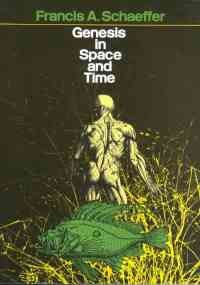
I’ll call this the Disappearing Book. I remembered having bought Francis A. Schaffer’s Genesis in Space and Time many years ago, sticking it on the shelf, and waiting for it to pop to the top of my reading list. It popped up a couple of years ago, and…I couldn’t find it.

I was sure we hadn’t gotten rid of it in a book purge, but it was nowhere on my Bible study shelf. Ah well, I thought. I picked another book that I had on the Biblical book of Genesis, read about half of it and gave up and donated the book. It appears I never reviewed it on the blog.

Ah, but then, when I was packing books to move to Texas, I found it! Right where I thought it should be. I put it at the top of the current reading pile. That was in early December. We got to Texas in February, and early this month I was ready to read it and…couldn’t find it! What was going on with this book? I knew where all the books were from our partial move in December, so I went through my bookshelves book by book. I finally found it, and realized the fact that the text on the spine not quite matching the book title was what threw me off this whole time.

I finished the book on Saturday. While it not being quite what I thought it would be, I have to say it was enjoyable and well worth reading. Schaffer didn’t get into a lot of details on items long debated by scholars, such as: old earth vs. young earth, were Adam and Eve real people, did the flood really happen, or the tower of Babel. He stated positions on these, summarized what we can know from secular scholarship, and didn’t get into the two sides of the debates.

If you’re looking for a book that will summarize the evidence for an old earth and compare that to why many Bible scholars believe in a young earth, this is not your book. Look elsewhere. But if you want a well-reasoned discussion of what Genesis stated in chapters 1-11, giving the implications of those chapters for humanity, by all means seek out this short book (160 paperback pages) and read it. Here’s an example of the type of discussion you’ll find in it.

As I said in regard to the use of the Hebrew word day in Genesis 1, it is not that we have to accept the concept of the long periods of time modern science postulates, but rather that there are really no clearly defined terms upon which at this time to base a final debate.

Thus, the answers to the questions I ask in each book review: I give this a solid 4-stars, with no temptation to go higher. It’s unlikely I will ever read it again. It is not a keeper, but will be donated after I pull a few more quotes from it.

Published: A Walk Through Holy Week, Vol. 6

Volumes 1 through 6 are now published.

I continue to make progress on editing and publishing my Bible study series, A Walk Through Holy Week. All eight volumes have been written for a while, awaiting me to do the required rounds of editing. Slowly, as other pressures of life allow, I pull of the files of the unpublished volumes and do the rounds of editing required, then move on to publishing.

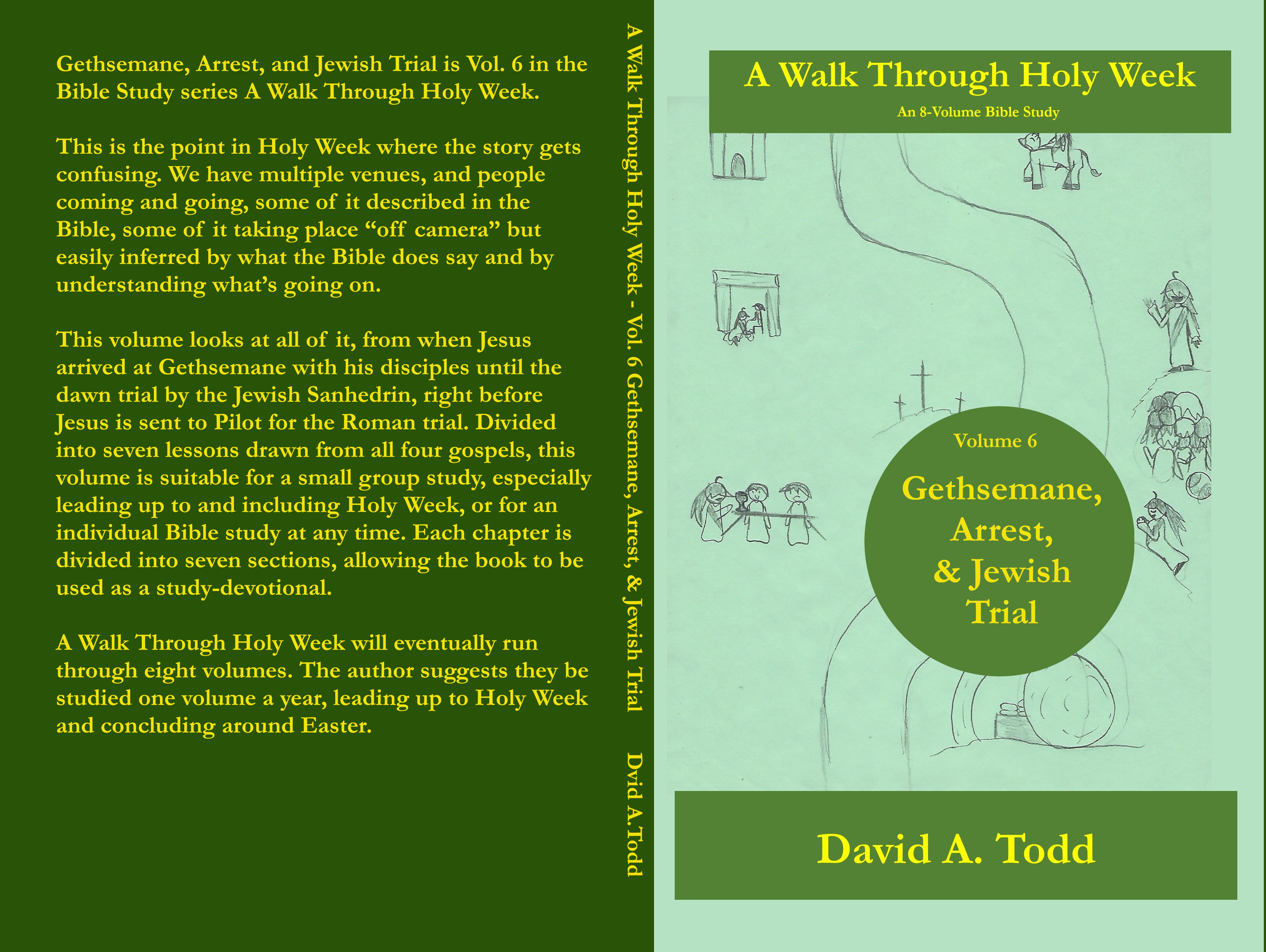
Last week I completed that for Volume 6Gethsemane, Arrest, and Jewish Trial. It covers the period between the Last Supper (and Vol 4 and 5) and the Roman trial and crucifixion (the future Vol 7). He’s what I say on the back cover:

Gethsemane, Arrest, and Jewish Trial is Vol. 6 in the Bible Study series A Walk Through Holy Week.

This is the point in Holy Week where the story gets confusing. We have multiple venues, and people coming and going, some of it described in the Bible, some of it taking place “off camera” but easily inferred by what the Bible does say and by understanding what’s going on.

This volume looks at all of it, from when Jesus arrived at Gethsemane with his disciples until the dawn trial by the Jewish Sanhedrin, right before Jesus is sent to Pilot for the Roman trial. Divided into seven lessons drawn from all four gospels, this volume is suitable for a small group study, especially leading up to and including Holy Week, or for an individual Bible study at any time. Each chapter is divided into seven sections, allowing the book to be used as a study-devotional.

A Walk Through Holy Week will eventually run through eight volumes. The author suggests they be studied one volume a year, leading up to Holy Week and concluding around Easter.

The book is available as both an e-book and paperback at Amazon, as are the other published volumes.

It Is Well With My Soul

Written by Horatio Spafford after most of his family died in a shipwreck, “It Is Well With My Soul” has blessed Christians for 150 years.

In mid-October, we visited our daughter’s family in Lake Jackson, TX. On Sunday we attended their church. One of the songs we sung was “It Is Well With My Soul”. What a wonderful throwback for me. Let me set this up, as neutrally as I can.

There’s no doubt I live in another culture than most of the people around me, than most of the people in the church I attend. Modern music leaves me flat, both popular music and church music. As far as popular music is concerned, with few exceptions I’m stuck in a world that ended in 1974. That was the year of my religious conversion, senior year in college. Right after it came my move from Rhode Island to Kansas City. More or less simultaneously I made the move from the liturgical church to the evangelical church, and from popular music to church music. But to be honest, popular music had already moved away from my preferred tastes. Give me the songs of 1961-1965 and you can have the songs from 1974 on. How far am I removed from the music of pop culture? When Tom Petty died in 2017 and there were huge headlines, I said “Who’s Tom Petty”, and ignored the story thereafter. It took me another five years to learn who Tom Petty was and what he meant to pop music.

When I entered the evangelical church world, I fell in love with that music, mainly what was popular in the 1970s and into the 1980s. Bill Gaither. The Imperials. Lanny Wolfe Trio. Doug Oldham. Andre Crouch. Now I’m stuck there, again with some exceptions. But added to the music mix for me was all the wonderful hymns of earlier decades. I found the music moving and uplifting. Give me the hymns of 1840 to the gospel songs of 1980, and I’ll be happy.

I suppose I’m stuck in the 1970s with my church music preferences. Almost all the songs sung in the evangelical church since then leave me flat. Oh, I can sing them with gusto, my stroke-and seizure-altered voice now drowned out by the loudness of the instruments. The songs of today give me a momentary lift. I suppose the message they tell is good, but the music style mostly leaves me unmoved, especially with the similarity of form (verse-chorus-verse-chorus-bridge-bridge-bridge-verse-chorus-chorus-chorus seemingly ad infinitum).

So anyway, I’m a guest in this church service on Oct. 12. The worship team consisted of three women singers, a keyboard, rhythm guitar, flute, and drums. They all mixed well. The third song (I think it was the third one) was “It Is Well With My Soul”. This was one of those songs I was introduced to in the evangelical church in the 1970s. I for sure never heard it growing up in the liturgical church.

On this day they played it “straight”. No chorus added as a bridge section, no endless repetition. No overly modern instrumentation. Just the simple verses and chorus, played into the sanctuary at a volume that let me hear my own voice. The third verse, which is always my favorite, moved me to tears as it always does.

My sin, oh the bliss, of this glorious thought!

My sin, not in part but the whole

is nailed to His cross and I bear it no more

Praise the Lord, praise the Lord oh my soul.

Needless to say, I was transported back in time five decades. I don’t expect that to happen very much in the future. But I had a chance to think back to the mid-1970s, when my life changed, and the music changed for me as well.

And Miles To Go Before I Sleep

This dates from around 1906. I hope it transports ok.

Perhaps a few readers will recognize the title of this post at the last two lines of Robert Frost’s poem “Stopping by Woods on a Snowy Evening”. It was a poem I hated all through secondary school, as a progression of English teachers tried to convince us it was a suicide poem. I just couldn’t see it.

Still can’t.

But I can see how it is a near-end-of-life poem, as the poet-narrator contemplates he has miles to go yet that snowy evening, and miles yet to go in his life, yet is tired, both physically and socially tired.

I’m feeling that tiredness. No, I’m not suicidal nor am I longing for the end of life. But I know I have many fewer miles to go than I used to, especially after the health challenges of the last year and a half.

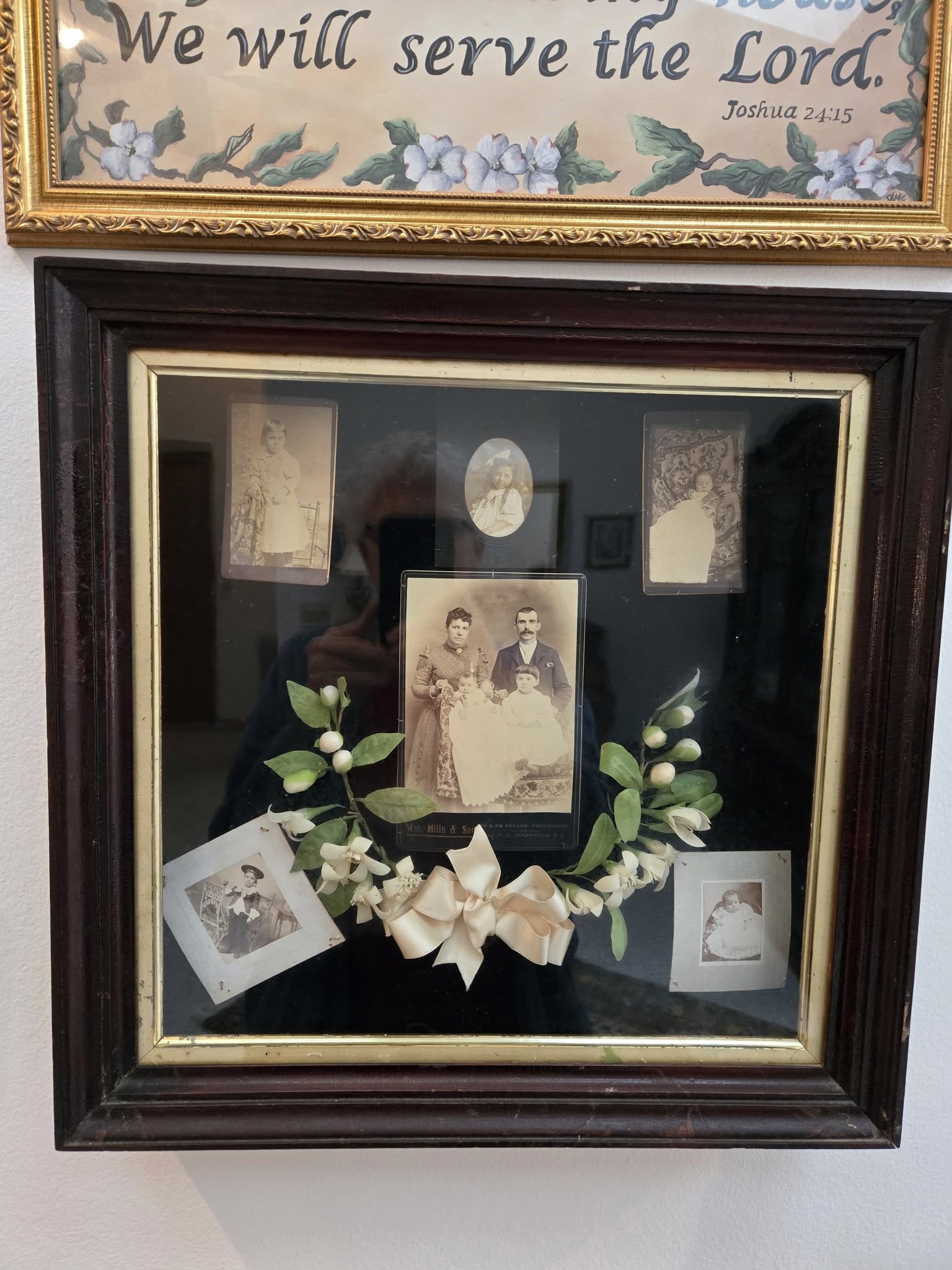
Two things brought this home to me recently. One is related to our ongoing efforts to decumulate. When we returned from our road trip to the East, I contacted a nearby cousin to whom I promised to give the old shadow box (pictured above) handed down to me from my paternal grandmother and dad. It displays photos of my great-grandparents, their five children who lived to adulthood, and a hairpiece, perhaps from the gr-grandparents wedding day. If so, the hairpiece is about 140 years old, and the shadow box was put together around 1905.

This has been in our possession since 1997 and displayed on our wall since 2002. I think it looks good there, but it’s time to pass it down to someone who will enjoy it for many more years than I have left.

May God bless these girls in what I hope will be a long life before them.

The second thing that made me once again realize the miles I have to go before I sleep are many fewer now than they once were happened in church Sunday. It was a special service with our English and Hispanic churches combined, and with elementary-aged kids in adult church with us. We took in new members, dedicated babies, and baptized new believers. I sat in the second row, and five elementary aged girls sat right in front of me.

Two families joined the church, people I haven’t met yet. Two families, each with two children who looked to be pre-school age. Seeing that made me think: these are the upcoming leaders of the church. Then I looked at the girls in front of me and thought: and these girls will be in the next group of leaders. That gave me both happiness and sadness. It’s kind of difficult to explain.

I withdrew from church leadership over twenty years ago, deciding it was time to allow others to step forward. In the ensuing years, I’ve refused a couple of invitations to step back in to leadership. At the same time, in the world at large, I more or less withdrew from modern culture. I watch almost no modern TV, don’t go to modern movies or listen to modern music. Don’t know the current stars of either except a few, by name and sight but not by performance, who are too ubiquitous to miss.

Out of church leadership. Out of modern culture. Both by choice. There’s a bit of sadness that brings, but also relief. It’s sad to get rid of that 120-year-old shadow box, but also a relief to be unburdened from one family heirloom, knowing it’s going to someone who will likely cherish it.

These two things made me think of the fewer miles I have to go. I suppose I’m a little sad about that but now awfully so. Time to enjoy the woods filling up with snow, and not worry about the miles.

Editing Almost Done

Volume 5 is close to done.

My summer schedule continues, though knee and balance troubles have prevented me from walking as much as I would like.

My special projects continue. I’m transcribing one WW2 letter a day, handling 50 scan files a day, getting rid of most of them, and doing a few other odd things. Though I’m falling behind a little on my correspondence, and on family finances. Maybe I’ll get to them before the week is out.

A morning rainstorm is preventing me from going out to pick blackberries. The vines will be loaded tomorrow—or this evening if I can get out then.

One thing I got a little ahead on is editing my latest book, A Walk Through Holy Week Vol. 5. I knuckled down yesterday and finished it, which was one of the reasons I didn’t get a blog post written. I also wrote the Introduction, though it still needs a bit of work.

Leaving The Dungeon in a minute for a mug full, and reading in the sunroom.

In my first editorial pass through the book, which was mainly for proofreading, I was concerned that I had been repetitive in places. In the second editorial pass, just finished, I was able to make corrections to eliminate the most blatant redundancies. However, I’m not sure I caught them all. Thus, I will make a third editorial pass through it, reading it quickly as would someone who bought it and couldn’t put it down. I hope in this manner any more obvious repetition will stand out. I’m going to do this pass via an e-reader, marking any edits needed, I hope the reading takes only two or three days, and that I’ll find nothing more is needed, except for minor things.

My expectations now are that I’ll do the publishing tasks next week, July 14 to 18, and have it up for sale right after that.

I’ll then wait until September to tackle the remaining books in the series.

It’s now 11 AM and still raining. Time to get a little reading done—with a fresh mug of coffee.

July Goals

  1. Have a meet-up to deliver batch 1 of family photos to the one who has been clamoring to have them. Good riddance.
  2. Somehow, carve out enough time to finish editing my book-in-progress. Down to 3 chapters, but was unable to do any editing today, nor will tomorrow.
  3. Continue transcribing one letter a day of my father-in-law’s war letters.
  4. Continue to dispose of unneeded scan files on my computer and One Drive. Down to less than 1,450 now.
  5. Keep up with yardwork.
  6. Handle various financial matters and travel bookings.

My Own Writing Helped Me

Editing the 5th volume of this series helped me through a difficult day.

So this week just passed I completed editing Vol 5 of A Walk Through Holy Week. That is, I completed the first editorial pass through the book. At least one, and possibly two more editorial passes are needed.

Although this is Vol. 5, I think it was the first one written. I put it on the shelf about three years ago as I tried to decide if I would write the whole series, and if I did, what shape would it take. I eventually decided I would write the whole series, changed it from six volumes to eight with a better organization, and finished Vol 8 last year. At that point I started editing and publishing the series beginning with Vol 1. I’ve completed publishing tasks through Vol. 4, putting that one up for sale on Amazon last month.

In Vol. 5, I found a lot of stuff wrong in the first few chapters, which is why I think two more editorial passes can be expected. But the last several chapters were better. And, as I read them in the first pass, three years after I first wrote them and last read them, I found some things to help with a number of concerns I have today. Here it is.

What About The Game Plan?

Remember the Game Plan we were working on? That list of encouragements, cautions, and commands? I haven’t mentioned it for a few chapters. I left it when it was beginning to burgeon into an unwieldy list. Too many things to think about, to constantly read over and implement.

Afterall, the Christian walk ought to be a kind of automatic thing. If Jesus is in us, and if we have walked with him for a while, we ought to naturally do the things that result in our being stronger Christians who are building the kingdom of God. We ought not have to think about every action and wonder if we are doing the right thing, the devout Christian thing.

So how do we do this? Do we even need a game plan? For me, I still like a list of things—I won’t call them rules—that I should review from time to time to help me live a more productive Christian life, fully devoted to my Savior. Not something to obsess over, but something to give me help when I need help.

The game plan from a few chapters ago doesn’t quite do this. I don’t mean to say it’s bad. It’s just…it’s just…too unwieldy. Sorry, but I can’t think of a better word to describe it. So I want something simpler.

A few things have come to mind. One is that this section of the Bible, John 14-17, is worth reading over every year. I’m not one who reads the entire Bible yearly, so without some kind of intentionality, I might not read this for several years. That’s not good enough. Henceforth, I’ll read this every year, perhaps a couple of times. I want to dwell on it, not rush through. I want to think about what it says about Christian living. What have I forgotten over the last year? What do I need to think a little more about as I go about daily tasks? That’s something I must add to the game plan.

What else? Obviously, something more about prayer needs to go in, but what? In the last two chapters, I can see at least a dozen statements of Jesus that would form encouragements, commands, or cautions concerning prayer. Alas, that’s too many to add to the Game Plan.

So I’ve been thinking as I wrote the last two chapters that I need some simple items to add to the lists, perhaps as a preface—a few things I can say every morning, or a couple of times a day if needed, as reminders of what my Christian walk ought to look like.

I was reminded of the three simple rules John Wesley wrote about finances that would serve as overarching guidance for his parishioners.

Earn all you can.

Save all you can.

Give all you can.

Surely I can come up with something like that—except I need four “rules”, not three. Here they are.

Love all you can.

Pray all you can.

Learn all you can.

Serve all you can.

I like that. I can say those every morning, and at other times during the day, as reminders of how I should live.

I wrote those words, then life got in the way and I forgot about them. Reading then again gave me new inspiration to re-establish some of those priorities.

Book Review: Night Hunt in Kisumu

A good, solid read: enlightening, encouraging, entertaining.

I’m reading a literature book. Well, now close to 2/3rds of the way through it, I’m not sure if it’s about literature or politics or sociology or philosophy. It’s proving to be a tedious read, made more so by the typographical style built around 10 point font and smaller on the lengthy quotes.  I’m not going to be finished with it and ready for writing a review (or perhaps two) for a couple of weeks at least.

But I found myself wanting to read something simultaneously that wasn’t so tedious. I settled on Night Hunt in Kisumu: and Other Unforgettable Stories from Africa by Dr. Richard Zanner. He’s originally from Germany, but spent twenty years in Africa in an administrative position over our denomination’s missions work there. It wasn’t strictly administrative, however, as wherever he went he was called upon to preach and do other assorted ministerial things such as baptisms, church dedications, etc.

Here’s another book about Zanner I’ll be looking for.

The book consists of 136 pages of stories about the situations Zanner went through. Frequently he piloted a small prop plane that the church owned. Frequently he was in a barely operating hired car. He tracked across unmarked territory from Djibouti to Somalia, through the bush in Mozambique, confronted the legacy of the slave trade in Senegal, and more.

I set a goal of reading ten pages a day, mostly in the late evening or a few times when I couldn’t sleep at night, and was able to read that much or more. Zanner’s writing style is easy reading. I won’t say light, because his stories include tense moments as he went through territory where revolutions and wars were either in progress or had just ended as he sought to strengthen and encourage existing churches and  seek out places to start new ones.

This was definitely a 5-star read for me. But it’s not a keeper, as I don’t think I’ll read it again given the number of books in my reading piles. We will place it on a shelf in our adult Sunday school classroom at church and let others know it’s there.