All posts by David Todd

One reason for “The Candy Store Generation”

A colleague posted this on Facebook:

…we have the Tea party types…people with stunted
social consciousness and the need to find a mouthpiece that justifies their
greed.

Let me get this straight. “Tea party types” are people with stunted social consciousness who are greedy. That’s their motivation for holding the government to account for following the highest law of the land (a.k.a. The Constitution) and for being fiscally responsible with money the populace has entrusts them with. This is what qualifies as greed? As stunted social consciousness?

No. I think it’s greedy to demand a check from the government, a.k.a. your neighbors, when you are able to work. Recent television shorts have shown people who brag about scamming the welfare system. I realize that’s not a scientific sampling of those on welfare, but it’s an indications.

I know people who have physical or mental disabilities who can’t work. They would like to work, but the hand they were dealt in life prevents them from doing so. Their families are not financially able to support them. For these, a safety net is required. And we provide that, both a public safety net and private charities.

But we have a huge mass of people who are able-bodied, and smart enough, who choose not to work. They have learned that the government will give them a check if only they can convince the government that they can’t work. I don’t know how large a group this is, but I think it is as large as those who have a legitimate need of a safety net.

America is quickly dividing into two nations: those who receive a check from the government, and those who pay taxes so that others can receive a check from the government. A long time ago, when maybe 1 percent of the population needed a safety net and 99 percent paid the taxes, this was easy. But recently it has been reported that close to half the population receives a check from the government. Is this true?

If so, it means 50 percent are paying the taxes so that 50 percent can receive a check. If this is true, it is not sustainable for a long period of time. I’m not sure it’s sustainable for a short period of time. And while I believe that those who don’t pay income taxes because of law income actually do pay taxes through the goods and services they purchase, I don’t see how any clear thinking person can believe it’s a good thing for 50 percent of the people in the United States to be receiving a check from the government.

So I’m writing The Candy Store Generation to address some of these points. I personally feel a big part of the problem is the Baby Boomers, who are currently in charge of the government, business, and institutions. We seem to think ourselves privileged, and haven’t a clue as to what good government is. I don’t know if America can survive us.

Novel Published: “Doctor Luke’s Assistant”

Sunday I decided to put other work aside and complete the tasks needed to e-self-publish Doctor Luke’s Assistant. This is my fourth e-published item. I had completed all the text changes I wanted to make back in December last year, but knew I had a few formatting issues for Kindle and Smashwords. I also wanted to build an interactive Table of Contents.

I did all that on Sunday afternoon, after my simple lunch, a 40 minute walk, some pleasure reading (well, writing-related pleasure reading), and a short nap. I checked each chapter and paragraph for consistency of font and indent, and make sure I wasn’t indenting via tabs. I also had to take out one diagram, since it wouldn’t format correctly for an e-reader. This required a small text change. I had all that done by 5:00 PM.

I then began the Kindle uploading process. I hadn’t done that since December, and found I once again had to scale the learning curve. One thing I did differently. In the past I finalized the MS Word .doc file, then saved as a filtered web page, as per Kindle instructions. In the past I then uploaded that into MobiPocket creator and created a .prc file. That’s the file I then uploaded to Kindle. This time, I read the instructions and it said to upload the filtered web page file, so that’s what I did.

I’ve had the cover since early February, created my Jami Gardner Design. It’s not necessarily final, as Jami is working on an alternate I requested, and we may tweak this one. But I think it’s somewhat close to what the final will be, and it works for now, so I decided to use it for the moment.

I set the e-book price at $4.99. I did this because it’s a long novel (155,000 words, which works out to 500 print pages or so). This may be too high of a price to get any sales, but I’ll leave it there for a while.

You can buy it here at the Amazon Kindle store. I don’t know when I’ll get to the print edition, or the Smashwords edition. I’m thinking of trying it out on the Kindle Select program, which gives Kindle a 90 day exclusive on it.

That done, it’s on to finish The Candy Store Generation, do a few more edits of In Front of Fifty Thousand Screaming People, then maybe work on a couple of short things.

Profile in my alumni magazine

Sometime this week, they say by Wednesday March 28, I will receive the URI alumni magazine, Quad Angles. In it will be a short, 300 word profile of me.

I sent in a notice of what I’m doing nowadays, including my writing on the side and having published Documenting America. I intended for this to go in the short notices of the listing of people arranged by class and what’s going on in their lives. The editor thought it was cool that an engineer would write a book and have literary aspirations, so she decided to have it be one of the short profiles.

The freelance writer they assigned it to looked over my website, saw that I wrote poetry, and so decided to focus more on that than on my prose pieces. So she gave it the title, “Engineer by Day, Poet by Night.” It’s a good profile, and it does mention DA. We’ll see what it does for sales.

As I’m writing this the profile is not yet up on the e-zine version of Quad Angles, but I assume it will be soon. Here’s the link, which should soon have it if it doesn’t when you click it.

A.C. Doyle – Starting Out

Arthur Conan Doyle didn’t figure on being a writer from the start. He studied to be a doctor. It was a different system in England in the 1870s and 1880s than it is in present day America. A doctor studied, a combination of class work and internship with a doctor in private practice. Eventually the young doc had to strike out on his own. Finding employment was not all that easy, not like it is today.

Doyle graduated his studies and had trouble finding work. He was writing stories for a couple of magazines, getting fairly good money for them, and sending most of it home to his mother. To try to make a little extra, he left a temporary job and took another—on a ship bound for Africa. Apparently ships at that time took a doctor along, to treat the passengers, and perhaps to treat those in African ports-of-call. He had been on a ship previously, and he would again.

However, this time the journey didn’t turn out as planned. He didn’t like Africa. He didn’t make the money he’d hoped for. A fire broke out on the return voyage and they almost had to abandon ship. He arrived in Liverpool in January 1882, and wrote this to his mother.

I don’t intend to go to africa again. The pay is less than I could make by my pen in the same time, and the climate is attrocious. The only inducement to go to sea is that you may make some fees out of passengers, but these boats have hardly any passengers—we had only one coming back. You can’t write at sea, either, and particularly you can’t write in the topics. If I can’t get a S. American boat, I will apply for a house surgeoncy I think. I want to improve myself in my profession and get more practical experience before I launch out for myself. I have written a couple of articles which will do, I think, and I have the germs of several in my head, which only need a literary atmosphere to make them hatch. [Arthur Conan Doyle: A Life In Letters, p. 147]

I see here a man who is torn between two worlds, two careers: medicine and writing. It turns out they are somewhat incompatible in that time and place. He has ideas for writing, and is producing some works, but can’t seem to make his money as a doctor and at the same time pursue writing as a sideline.

That seems to be the situation with many writers. A career in something else puts bread on the table, and writing happens in odd hours, stealing time away from something else that needs to be done. At some point we find a little success in writing, and the career seems old hat. Yet, the writing doesn’t support us, while the whatever career does.

So in A.C. Doyle’s circumstances at this point in his career, I find some inspiration and encouragement. Sure, he was a young man whereas I’m on the old side of middle age now. He had a long time ahead of him to write; I’ve got much less. But if I have to keep on doing civil engineering and corporate training therein for the next 5 years, 9 months, and 6 days, all the while carving out time to write, I guess that won’t be so bad.

Legitimate or Illegitimate?

Last night, after trying to balance the checkbook and finding it $52.13 off in an undiscoverable place, I went back to working on my income taxes. Most everything is calculated, with the help of spreadsheets, and I’m at the point of filling out forms. My writing business Schedule C is done, ready to print. On our stock trading business partnership return I had only depreciation to calc then I was ready to fill out the forms.

Last night I did the depreciation—really easy. I filled out most of the form 1065 (for partnerships), but came to a place in the form I’ve skipped over before, but which I decided this year I’d better read the instructions and see if I’m supposed to be filling it out. It has to do with capitalization and balance sheet sorts of things. Since this is just a partnership between me and the wife, I’ve never worried about that. I didn’t feel like reading the instructions last night, so decided to pull off of it, and hopefully do it tonight.

Looking for something to do, I started looking at my Yahoo inbox, and discovered I’d never listened to a webinar I signed up for. It was a free webinar back in January, an interview of Jerry B. Jenkins by Terry Whalin. I found that the links were still good, and since I signed up for it I had access. In less than a minute I had the speakers cranked up and was listening.

Most people know that Jerry Jenkins was author, along with Tim Lahaye, of the Left Behind series. Those books sold over 60 million copies (I think 14 books in the series). Jenkins has written many other books, and claims over 175 to his credit.

Part of the reason for the seminar, and its being free, was to promote Jenkins’ The Christian Writer’s Market Guide for 2012, which he took over from Sally Stuart. I’ve had a copy of this in the past, and it is an excellent resource. I’m not buying it anymore since I’m not submitting books to publishers or agents, and I’m not actively seeking freelance assignments in the Christian market, but anyone who is doing those things in an active way should probably buy a copy of the book.

About 25 percent of the 70 minutes was essentially ads for the book, though they weren’t distasteful. The rest of the time was responding to questions that readers had sent in. Whalin read the questions and Jenkins gave answers from his vast knowledge of writing and publishing. I’m not sure I learned anything new, but it was interesting to listen.

One problem was how Jenkins described the self-publishing business, or rather how he described the “traditional” publishing business, and the implication for what that meant for self-publishing. He encouraged writers to not rush to self-publish, but try long and hard to be published with “a legitimate publisher”.

The writing world has been in a bit of a struggle of what to call publishers who publish most of the books in this country, the kind that you have to submit to and hope they select your work. Some call them “royalty paying” publishers. But that doesn’t really work, because even self-publishing companies pay royalties. Some call them “traditional” publishers. But that doesn’t really work, because what is “traditional” now wasn’t many years ago. In the days of Wordsworth, Burns, Lamb, Irving, and even up to Mark Twain, most writers were self-publishers, paying for the publication through pre-sales as subscriptions. So what is traditional? It changes all the time.

Some have settled on the term “legacy” publishers, I suppose thinking that these companies help a writer to build a legacy. I don’t care for that much, but I suppose it’s not too bad. You could call them “advance-paying” publishers. But advances are starting to go away, so that might not work. You can’t call them “commercial” publishers, because self-publishing companies are also commercial publishers. So, the writing world has a terminology dilemma.

Jenkins called them “legitimate” publishers. Since he said that while trying to steer writers away from self-publishing, that means he must thing self-publishing is “illegitimate” publishing. That stuck in my craw. Jenkins is essentially saying that self-publishing is illegitimate. Maybe that’s not what he means, but that’s what he said.

I don’t view self-publishing as being illegitimate. Sure, for a long time I resisted self-publishing, but I think that was as much a cost thing as it was a stigma thing. Since so many self-published books are poorly written, un-edited, poorly designed, and badly assembled (in the print versions), many people shun self-published books. And rightly so. I’ve read some self-published books that were awful. The story-telling was good, but the writing craft lacked, and the printing quality was certainly sub-par. But I’ve read books published by “legitimate” publishers that had too many typos and had less than stellar story-telling.

I’m not sure where I’m going with this post, other than to tell what happened. Despite this unfortunate use of terms, Jenkins is obviously a successful writer, and to be that you have to be a good writer. Maybe with time he will come to see that self-publishing is not illegitimate. At the Between the Lines blog last week, when the self-publishing vs. whateveryouwantocallit publishing debate came up, one commenter said,

After sending a hundred queries and waiting for months to get back rejections of our work, self-publishing seems the last hope. We do it, not because our work was rejected, but because it was never looked at. A huge wall appears that says, “Keep Out! We have too many queries already!”

Self-publishing is a salvage mission for the disheartened looking for some tiny oasis of hope. Unfortunately, the oasis is most often a mud puddle on a drying sidewalk.

Unfortunately, to some extent I concur with those sentiments. Meanwhile, I’m going to try to think of a name for that other publishing path.

Time to Back Off

Yesterday I had great plans for my evening. I was hoping to add between 1,000 and 1,500 words to In Front of Fifty Thousand Screaming People, as well as write several blog posts and do a little research reading.

However, yesterday was not the best day for work. I had a couple of hits against my ego and professional practices. They festered all day long, and even almost continuous rain couldn’t pull me out of my developing funk. After work I ate supper with my mother-in-law, got home by 7:00 PM and was in The Dungeon ready to work before 7:30 PM.

But I just didn’t feel like writing. Not anything. Not in the book, not blog posts. Nor did I feel like reading for research. I played a string of mindless computer games, read a few writing related blogs (and made a post on one), but got little done.

At some point I began working on TCSG, re-reading some recent additions, completing previously uncompleted thoughts, adding a little here, deleting some there, improving the wording in a few other spots. Eventually I began adding some new material to one chapter that was barely started. Throughout all this, I’d write for two minutes, read a blog for five, and play games for fifteen, then cycle back.

By the end of the evening I had just short of 600 words added. I was surprised at the amount. The total stands somewhere around 22,800 (I think; hard to remember after a sound sleep). The chapter I’m working on needs another thousand to be complete, but I’m not sure exactly what the direction I’m taking it in.

By the time this morning came around I came to a decision: I’ll back off writing for a little while and concentrate on other things, such as income taxes, filing, clean-up piles of stuff, etc. Perhaps by then I’ll have worked through some things, and will be better able to focus on the writing stuff. I’ll keep making blog posts, here and at An Arrow Through the Air. I might even work a little on editing In Front of Fifty Thousand Screaming People. But TCSG is shelved for the moment.

Miscellaneous Monday Musings – On Tuesday

I had great intentions to blog yesterday. I did so over at An Arrow Through the Air, but didn’t get back here. We had quite the storm yesterday and last night, and actually it’s not over. Radar shows another storm wave is about to come over us, probably more potent than the last couple.

I’m batching it again, Lynda having gone to OKC to help Richard and Sara with grandkids and other things. It’s a busy time for a young pastor and his wife, and it’s good to be close enough that Lynda can go up there from time to time and help out.

So in my temporary bachelorhood, I should make good progress on a number of fronts. I should get the income taxes done—except I haven’t even touched them the last few days. I should get caught up on the family budget—except that has gone the way of the income taxes. I should maybe clean somewhat in the house, and use this opportunity to throw out some things that Lynda’s saving, but which she will never actually miss—I’ve ignored all that.

What I have done over the last two days is write. I added over 4,000 words to The Candy Store Generation between Sunday and Monday. I wrote all of chapter 4, Boomer Congress, and most of chapter 14 (the last chapter), Had Enough. At the same time I completed some good research on Saturday, did some more on Sunday and Monday [the rain just started again], and outlined the remaining research for the book. I don’t have a lot more to do.

I can now see an end to this project. I at first thought it would be around 40,000 words, but the chapters are completed in fewer words than what would make up the 40 thousand. That tells me I’m more likely to be around 35,000, maybe even a little less. I don’t want to pad the book and make an arbitrary word count. I feel already that I’m more repetitive than I want to be.

All other writing is on hold, except for articles for Buildipedia.com. My last one went up Friday March 16. As of a few minutes ago it had been read 132 times, but remained unrated and without comments. That’s how all of them are. These are informational pieces, not subject to controversy and not likely to generate comments.

Meanwhile, over at Suite101.com, I haven’t written an article since February 2011. Changes in the Google algorithm in February, May, and October of last year pretty much killed the site. Page views and revenues (which had never been much) dried up, and continuing to write didn’t seem to make much sense. Except lately page views are trending upward, and revenue has somewhat recovered. So far this month I’ve earned $5.29 for my 127 articles. That’s not much, of course. For the full month it might come out to between $8 and $9 dollars. But every little bit of revenue helps.

A few days ago I received this comment on my article on George Washington’s cabinet:

Mr. Todd,  Thank you for your article and your work. It gave me a nice insight into the workings of the early government which I needed for a class. I made sure you received credit!  Mark I.

It’s not exactly fan mail, and doesn’t make me a rock star among writers, but it’s a nice comment. I’m glad I was able to help a student out.

I haven’t yet pulled the trigger on writing for Decoded Science. I may do so after I finish TCSG.

Interspersed with all of this, I should be preparing Doctor Luke’s Assistant for Kindle and Smashwords, and making one last round of edits on In Front of Fifty Thousand Screaming People before also e-self-publishing it. I think, though, I need to get two to three thousand more words done on TCSG before I pull off for a short while and tend to these other books.

Well, these musings have certainly been miscellaneous. This week I may blog a few times about TCSG, or at least about the premises behind it. They say that a blog, to attract visitors, needs to be about something more than yourself. It needs to give value to a reader. I don’t want my blog to become a political blog, but since TCSG is about a political topic, a few political posts will be necessary. Hopefully I’m going to post all the rest of this week on that.

End of the Legacy Deal Dream?

As I alluded in my last post, I don’t have any submittals out with a traditional publisher right now, nor with any agent. I say that based on information given on an agent’s website.

Back in January I submitted In Front of Fifty Thousand Screaming People to a literary agent. I had pretty much decided this would be may last attempt at a legacy deal for this work, and probably for any work. I never met this agent, but we’ve interacted some on-line via blogs and e-mails. Based on these contacts and on her statement of what she represents, I felt that she would be the best agent for this work and for my career in general.

Alas, more than sixty days have passed since I submitted my query letter, and I have not received a response. The agent’s website says that no answer within sixty days means “we aren’t interested”. So it appears she isn’t interested. Maybe my query was poorly written. Maybe her representation needs aren’t what I thought they were. Maybe she has a similar book and author she’s already representing. No problem; a tacit no is a no.

I’m not going to send her an e-mail and withdraw my submittal. If I receive an e-mail in a few days saying she’s interested, I won’t stand on a sixty day statement. But I know that’s highly unlikely.

So I’ve made up my mind: I’m not going to submit it again. I’ve submitted it to one editor and five agents, each saying no. The traditional publishing route says I’ve only just started. I should gather a basket full of rejections, continuing to seek an acceptance. After all, many best sellers have had fifty or more rejections (e.g. Harry Potter, the Chicken Soup series). I’ve only just started. Persevere! Don’t give up so quickly.

I’m not giving up. I’ve just decided to seek a different path to success. The traditional path is broken for most writers. Success that way is still possible, but highly improbable. Recent (last two years) events have shown that alternate paths are available. E-books are quickly overwhelming print books, Internet purchasing grows while brick & mortar store sales stagnate. The ease of self-publishing, both e- and print, causes a writer to more carefully consider all options.

I’m rambling. I’ve said all this before, as have many proponents of self-publishing, and you all are tired of it. I hope to have Fifty Thousand Screaming People self-published by May.

An Interesting Post About the Current State of the Publishing Industry

Leave it to Joe Konrath and Barry Eisler to take on the titans of the publishing industry without fear. In a recent blog at A Newbies’ Guide to Publishing, Joe and Barry take apart a post made elsewhere by Scott Turow. Scott is the president of the Author’s Guild (I guess; so say Joe and Barry). His post was against the recent lawsuit threats made by the Department of Justice against Apple and five of the Big Six publishers.

The lawsuit is about price-fixing between Apple and the five, based on Apple’s “agency model” for e-book sales via Apple’s iTunes store. I’m not sure I fully understand what the agency model is, but that’s probably not germane to this post. Suffice to say that DoJ considers it price-fixing, and are in the process of taking the perpetrators to task.

Warning: Joe and Barry are not shy about the language they use. You will have to wade through a few four letter words, though not too many.

The writers basically say that Turow and the Author’s Guild are supposed to represent authors, but the post appears to be one in favor of publishers at author’s expense. Turow argues that the actions by the five were justified because Amazon is taking too much market share. This is bad for the literary world in that it will restrict consumer choices and reduce author income.

This is clearly ridiculous. Amazon’s e-publishing platform and store have busted wide open the stranglehold that the Big Six previously held on book distribution. Consumers now have a much greater range of choices, and authors have a distribution outlet that doesn’t require a Big Six or Little Seventy-Five (or however many other publishers there are) contract.

One wonders why Turow and the Author’s Guild aren’t sticking up for authors. I’m working through the comments on Konrath’s blog. It will be interesting to see if Turow himself leaves a comment, or if anyone defends him.

I have no stake in the traditional publishing industry (or legacy publishing, as Konrath calls them). So far they haven’t deemed my work worthy of inclusion in their publishing plans. Then again, the world isn’t beating a path to the door of on-line publishers to buy my stuff either. As I’ll report in the next post to this blog, I currently have no submittals pending to any traditional publishing outlet, neither agent nor publisher/editor. I think I’m pretty much locked in to independent publishing from this point on.

But I have nothing against the traditional publishing world (other than they don’t recognize my obvious genius :), but I’m going another way. This lawsuit, if it comes to that, will be an interesting development. If the Five lose, it seems that will hasten the day when they will be obsolete.

Kindle Sales of “Documenting America”

Last week I posted about sales of “Mom’s Letter,” and how I had some in early March. Since then I had one more, making 3 in March, 6 in 2012, and 15 over all. My total royalties for it are $5.65, some paid, some accrued and waiting for the next payout. So that’s less than I would have received had I placed the short story in a literary journal, but more than I would have earned if it never placed at all. In fact, I don’t know if I’ve earned enough to cover the postage to the places I mailed it to, all of whom rejected it.

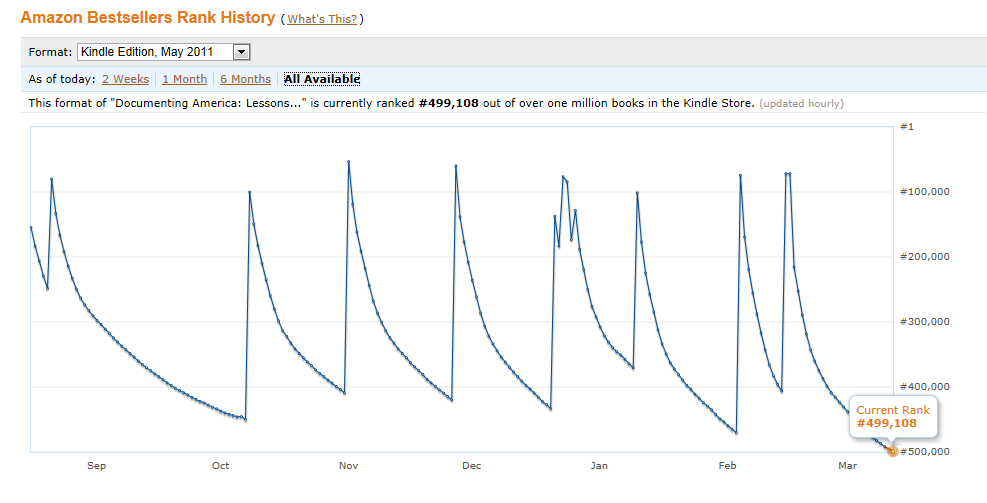
But the subject of this post is really Documenting America. I ran the sales graph for it this morning from Amazon Author Central, for all available data. Here it is.

As I hope shows on this graph, the most recent sale was in mid-February; the highest ranking was 53,121 in early November, and the current rank (as of the hour in which I pulled this chart; it’s updated hourly) is 499,108.

As I mentioned before, I’m not all that concerned about ranking. I’m more interested in sales and royalties. This chart does show, however, the power of a single sale when you’re way down the list.

Someday I’ll have enough sales that I won’t worry about this stuff, or at least won’t bore you, my faithful readers, with it. But it’s new enough to me that I want to do it at the moment.

News Flash: A fellow author just contacted me to say she bought a copy of “Mom’s Letter” today, which isn’t yet showing on the charts. Woohoo!