Or, perhaps I should title this post “Blog Interrupted”. Life is fine, just busy. We are keeping the grandkids for 11 days, and I find myself, while my wife is still convalescing from her surgeries in April, having little time to do such trivial things as writing and preparing blog posts. I’ll try to do another interim post on Monday, but won’t be back to my recent series until probably June 26.
All posts by David Todd
Racism and Racist Acts
My last post was a start to a discussion about racism in America. This is the second. I’m not yet sure how many posts I’ll have in this series. For sure one more after today and perhaps two, depending on how prolix I become and how my interest and energy goes.
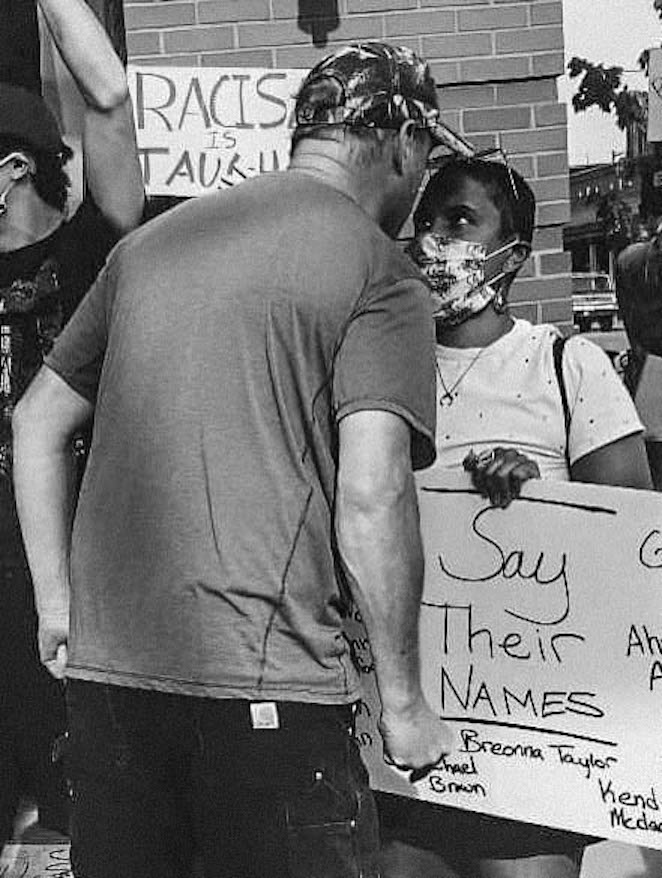
I used two terms in my last post: racism and racist acts, but I didn’t define them. Actually, I’m not sure I need to define them. Racist acts are actions taken against a person because of the color of their skin, or against an entire people for the same reason. Acts include words spoken or written. Racism is a condition of hate or belittlement that resides inside a person. It’s what gives rise to racist acts.
Examples of some racist acts:
- refusing to rent an apartment to someone because they are black.
- denying seating on a bus or at a lunch counter because someone is black.
- enacting laws saying blacks and whites can’t marry, or college rules that say they can’t date.
- enacting laws and practices that make it difficult for people of color to vote.
- saying derogatory words against someone because of their skin color.
- writing a piece that slams an entire race that’s different than yours.
- erecting a statue that glorifies a slaveholder.
I could go on and on. Many are the racist acts that have taken place in the USA over the years.
But many, also, are the laws and court decisions which have set aside those racist laws and practices. Court decisions beginning in the 1950s and civil rights legislation beginning in the 1960s went a long way to correcting these racist wrongs in our nation. In addition to court decisions and laws, policies were changed at institutions (such as university) that corrected much.
Racist acts still happen. When they do, and when they are brought to the attention of authorities, corrections are made. Or should be made. A constant diligence is required to make sure the laws are faithfully executed and rights of people of color are not denied them by racist acts. The fact that many civil rights claims are brought before the courts indicates we are not perfect in this regard. Our administrators must figure out how to better and more faithfully implement the law, and our legislators must be looking at unintended holes in the law and find ways to plug them of otherwise strengthen them.
That’s my summary of what racist acts are. Now to tackle racism.
Racism is what gives rise to racist acts. Racism is what’s inside a person that causes them to commit racist acts. Racist acts are seen or heard out in the open. Racism is concealed inside a person. It may be concealed for a long time until it spills out in a racist act. Some people, I am convinced, are racists without realizing it, a condition I call latent racism (to be covered in a future post). When it does spill out, if it does so in a way that the racist act is against the law or policy, the law enforcement and judicial system can be called in to counteract the racist act.
But the racism, being inside the person, cannot be countered by any law or policy. How can the law say, “Don’t hate blacks, don’t look down on blacks, don’t think your race is better than blacks”? The law can’t deal with that, with what’s in a person’s mind and heart.
Racism is a terrible thing. How does it seep into a person’s mind and heart? Are people born racists? I covered that in my last post. I don’t believe anyone is born a racist. They become racists through education, example, and persuasion. Of these three, perhaps example is the largest contributing factor. A father doesn’t say to his son, “Son, come here and let me teach you to be a racist.” No, a son watches and listens to his father, and from observing racist acts (which, remember, includes speech), the son becomes a racist.
The father may never say anything to his son directly, but the son will learn from his father’s example. When we moved to North Carolina in the mid-1980s, we were invited to a neighbor’s house. The neighbors had moved there from New York. In the party were a number of local families they had befriended. I was 32 or 33 at the time, and I’d say most of the local folks were younger than that. The women were inside and the men were out on the front porch. One of the local men said, “If the Whites would just band together we could deal with the Blacks more effectively.”
I was shocked. That man was less than 30 years old. By 1984 the major civil rights legislation had been in force for about 20 years. Yet here were racists acts being committed by men who were 10 years old when those public policies were enacted. Why were they committing racist acts? Obviously they were racists, and they must have learned it from the examples of parents, grandparents, and others in the community. They were also taking part in persuasion, either trying to convince these newly moved-in northerners that they should become racists, or perhaps reinforcing the racism within themselves. This was one of the times I didn’t speak up, but I remember thinking how sad it was that these men were burdened with the scourge of racism.
Why is all of this important? Why do I separate racist acts from racism. I do that because of what I will highlight in my next post, that many different approaches are needed to combat racism. One person’s approach may tackle one small part of the problem while others tackle other parts of the problem. For this subject, look for my next post, on Friday.
Racism Must Be Wiped Out By Many Means
Dateline 2 June 2020, for posting Friday 5 June 2020
I may write this post over several days, as I’m starting it on Tuesday and it’s scheduled to go live on Friday. Events are moving quickly.
My post on Monday addressed how the U.S.A. has been a lawful country because of voluntary compliance with the law. We have been, for the most part, a moral people. The average person has voluntarily complied with the law. No police force was necessary to make this happen. That seems to be changing around us.
The rage being expressed is due to racism in America. Are we a racist nation? Do whites hate blacks? Are whites trying to “keep the blacks down”? Is the socio-economic-political-judicial system we live in skewed to favor whites over other races? By the way, I use the term black rather than African-American because a person’s black skin can come from ancestries other than from Africa.
That many white people in our nation are racists is true. I can think of instances in my life where I have encountered racists. Two of those times I remained silent in the face of what others were saying. Two other times—the last two—I spoke out against what they were saying. One of those times was one-on-one with the person. The other time was with another family member present. Looking back, my failure to speak out at the one incident in 1984 and the other around 2010 were just that: failures on my part. I should have spoken out.
I say all this because I believe many methods are needed to combat racism. Back in the 1960s, laws were needed to curb racist acts. These were passed once the protests led by Rev. Martin Luther King Jr. and others moved the nation to see the wrongs that were being done. From time to time those laws have had to be renewed and strengthened. Pressure was kept on government for that purpose, though I don’t think a lot of pressure was needed. Once the nation woke up to how local and state laws were used to suppress people because of the color of their skin, few people in government saw a reason to go backwards.
Are the laws protecting people against racism perfect? Probably not, but I think they are close to exactly what is necessary. We should keep them, extend them, and strengthen them where needed.
So if the laws are right, or close to right, where is there racism in America? Where does it show up in our society?
It is in the sinful hearts of our people. It shows up in anything and everything people do. For a police officer it’s when he’s enforcing the law. For an engineer it’s as he deals with coworkers and clients. For a shopper it’s as you’re dealing with other shoppers, stockers, and check-out clerks in the store. For pastors it’s as they counsel and admonish parishioners and cooperate with community leaders. For nurses it’s how they provide health care. For patients it’s as they respond to the very people who are providing that care.
How do we combat that? Because no law will change a person’s heart.
How do we change the hearts of people so that they are no longer racists? Or, perhaps I should ask can you change the heart of a person so he/she is no longer a racist? I believe you can. I’m not saying it will be easy, but it is possible. A meme you frequently see posted on social media is “No one is born a racist.” That is true.
Racism is learned. How is it learned? From example, education, and persuasion. Children learn from the example of their parents, grandparents, and others in their lives. If those adults are racists, the child will learn to be a racist. The child may not even realize it. They may become latent racists (my phrase for unrealized racism; perhaps there’s a better term others use, but that’s my term for it). I’ve met some of those.
How does a person un-learn being a racist? I believe it happens the same way: through education, example, and persuasion.
I’m pretty sure it doesn’t come from throwing stones off overpasses onto oncoming cars below near Fall River Massachusetts. I’m pretty sure it doesn’t come from a handful of agitators stirring up a peaceful protest in Bentonville Arkansas by yelling “f*** cops”. I’m pretty sure it doesn’t come from looting jewelry stores in the Buena Park neighborhood of Chicago.
So, if racism won’t be stamped out by these means—because they don’t address the sinful, evil heart—what’s to be done? Unfortunately, I’ve run this post on a bit long. I’ll have to cover my proposal in my next post.
Voluntary Lawfulness
Dateline 31 May 2020, 4:18 p.m. to 6:42 p.m.
With great sadness, I’m watching the news coverage of the looting, burning, stealing, and destruction of property that is going on in the U.S.A. right now. This was after watching the news coverage and video of a black man being killed by a white policeman. George Floyd was killed by that policeman even though he gave no cause for the use of such force. It looks like murder, or at the least depraved indifference by up to four policemen. A man’s life snuffed out by policemen who acted as police, judge, and jury.
But what we are seeing is only in part protests. Much of it is simple lawlessness. It’s either pent-up rage that has spilled over into lawlessness or it’s deliberate taking advantage of the situation. Either way, a flashpoint has been reached. It’s now happening in, it seems, 50 cities. Police seem unable to keep the peace. Some of it is their unwillingness to take violent action against the criminals. Some of it might include not recognizing the difference between protestors and criminals. Some of it might simply be lack of sufficient officers.
The police are tied up with seeing that the protests remain peaceful. I suspect all police days off have been cancelled in just about every city of 50,000 people or larger, yet there still aren’t enough. While the police are in one place, looters and destroyers do their dirty work in another. It’s a desperate game of whack-a-mole.
What this is showing me is that a peaceful America depends on voluntary compliance with the law. This has been oft noted concerning paying income taxes, which to a large extent depends on people voluntarily complying with the law requiring them to pay income taxes. If a hundred million people suddenly decided to not voluntarily pay their taxes, our national government will collapse.
So it is with honoring property and people. We live in peace because people want to live in peace so they don’t go killing their neighbor or breaking into houses, stores, institutions, or vehicles. A handful of people do that all the time. But what if a hundred million people suddenly decided to act unlawfully? Same thing: the USA would collapse as a civilized society. We can’t have enough police, enough national guard, enough military to maintain the internal peace if we, as a populace, decided we were not going to respect life and property.
It’s likely that what we seeing is the activity of two different peoples. One is a group fed up with instance after instance of black men being killed by white police, with nothing seeming to change, and are protesting that. Another is a group of opportunists making hay while the sun doesn’t shine. But there might also be a third group of people who are trying to incite a race war or a general state of lawlessness as a way of damaging our nation. We hear anecdotal evidence that this third group is at work, both left wing and right wing extremists. I personally think they are “no-wing” extremists, simply wanting to see America harmed.
I have no solution. I will continue to voluntarily obey the law and encourage others to do the same. I will continue to encourage local police forces to get rid of the racists, realizing as I say this that it’s easier said than done. I will continue to speak out against lawlessness. I will be an army of one, and see if I can somehow enlarge my regiment.
A Few More Small Steps
I won’t go into a lot of detail, but over the last four days I have seen much progress in tackling my to-do list. One huge task is done—huge, not because of the amount of work involves (though there was some work), but huge because of the load off my mind. And, the way is paved for part 2 of that particular task, for which the hard work is done, to be finished early next week.
A second item, small in work but big in sense of accomplishment was sending letters back to the family from which they came to my wife’s grandmother back in the early 1960s. They are mailed, and will possibly arrive today. Hopefully they will enjoy seeing them.
Today I will begin to break down empty boxes for taking to recycling. I’ve been bringing them from the basement to the garage, which is somewhat overflowing with them at present. Next Friday we’ll get rid of the accumulated Styrofoam at a certain re-use center. At that point we’ll have our garage back again.
In the spirit of de-cluttering, I placed a box of my old engineering books on my work table in The Dungeon, and will go through them later today. I anticipate putting most of them in a pile for donation. I have several other boxes of work things to go through, and can now see my way clear to be doing that next week, maybe even a little on the weekend.
Oh, yes, the other big thing off my mind was getting our taxes turned in. I finished them on Sunday, printed them on Monday, made copies on Tuesday, and mailed them on Wednesday. That’s always a huge load to be done with every year, this year more than in others.
So, now it’s on to other special tasks: getting the tree service to come and give an estimate to see how far our stimulus money will go; getting the roofer to give an estimate on some minor roof and siding repairs; get the recyclables taken care of; repair a book shelf that prior repairs weren’t sufficient; re-shelve books on two other shelves that are fixed and can’t be repairs without complete disassembly of the entire bookcase. I’m sure I’m forgetting a few. Oh, yes, find out why our health insurance refused a certain dental claim. That’s a next week task for sure.
Okay, enough for now. Time to go outside and get some yardwork done.
Staying Busy in the Covid Pandemic
Today I feel like a logjam broke. A logjam of busyness. This morning I put the final touches on our 2019 income taxes, printed and signed them. Tomorrow (or the next day, perhaps), I’ll take care of mailing them. I had them done about two weeks ago but let them sit. I did some searching/organizing in papers and found an interest statement I hadn’t put into my spreadsheet. I entered that this morning, updated the forms, reprinted two pages of the Federal and two pages of the State, and now it’s done. Again.
Then, my wife and I can finally take care of the final distribution of her mom’s estate. It was waiting on the taxes to be figured, since some of our taxes this year were really estate taxes. That’s done. Today we’ll write the next to last checks from the estate account, and next week we’ll write the last. Then we can close those accounts, bundle up the statements, and tuck them away in an archive-type file.
Having done a fair amount on de-cluttering, I’m putting some of that on hold for a time. Oh, I’ll get the now-empty boxes from the basement to the garage, consolidate the electronics for recycling, and get the boxes to the AARP recycling center. That alone will clear a lot out. But I’m going to leaf off from sorting my mother-in-law’s papers for now. Maybe I’ll get back to that in a month or two.
So, the checkbook is up-to-date, the budget is up-to-date. I caught up on filing on Saturday—though immediately generated more items for filing. I paid the bills on Saturday and will mail them today.
My outlook is much, much better than it was when I posted this. Perhaps I’ll see my way clear to resume writing this week, something I haven’t been able to do lately. Reading is also on the Memorial Day menu.
Oh, I haven’t mentioned the pandemic, have I? For us, being retired, with Lynda much better but still convalescing, the pandemic isn’t having a huge effect. I go to the grocery store a little less frequently, planning my trips better to keep from having to go back for that item missed. We can’t go to the bank lobby, but the drive-through windows work for our purposes. Doctor appointments are mostly on-screen, though Lynda did go to the eye doc week before last, and will have her cataract surgery in July. I’m schedule for lab work in late June, but have no appointments until September.
But I still walk for exercise. I still go to construction sites and do my observations, keeping my distance from the workers on site as I do. I still went to the office last week for a meeting (though all training meetings and the recent annual stockholders meeting was virtual). Our church and Life Group meetings have been virtual, or course. That’s allowed me to learn some new skills.
I think we will still mostly isolate at least until July. Except for going to Texas and getting the grandkids in just under two weeks, keeping them for nine or ten days, then taking them back. Their county has only 6 confirmed cases of the virus. We will practice isolation for the few days we are there, and once we get back here.
This too shall pass. What will life be like on the other side? I have no prediction.
Busy
Hello friends.
Almost let Friday go by without posting. Except I’m only posting to say I’m extremely busy. Yesterday and today, as well as a little on Thursday, I have been tied up with engineering work for my former company. 9.5 hours yesterday, 3 so far today and not done.
I have several special projects around the house that are not getting done. Well, I did one today. I fixed a small computer cabinet of which the front fascia/support member broke off. I figured out how to fix it, though I couldn’t find the hardware that had broken off. Fifteen minutes of searching in my mix-up hardware repository in the garage and I found what I needed. The cabinet is fixed, the area it occupied vacuumed, the cabinet back in place and re-loaded. Only a little clean-up remains.
I also went by the post office and the bank to get a couple of things done. The P.O. stop especially took a great load off my mind. I might now be able to think clearly enough about the remaining tasks. I would love to get through this weekend having many things checked off my to-do list, and Monday be able to say I see both the trees and the forest. Right now the trees are overwhelming the forest.
Book Review: “Love Is Eternal”
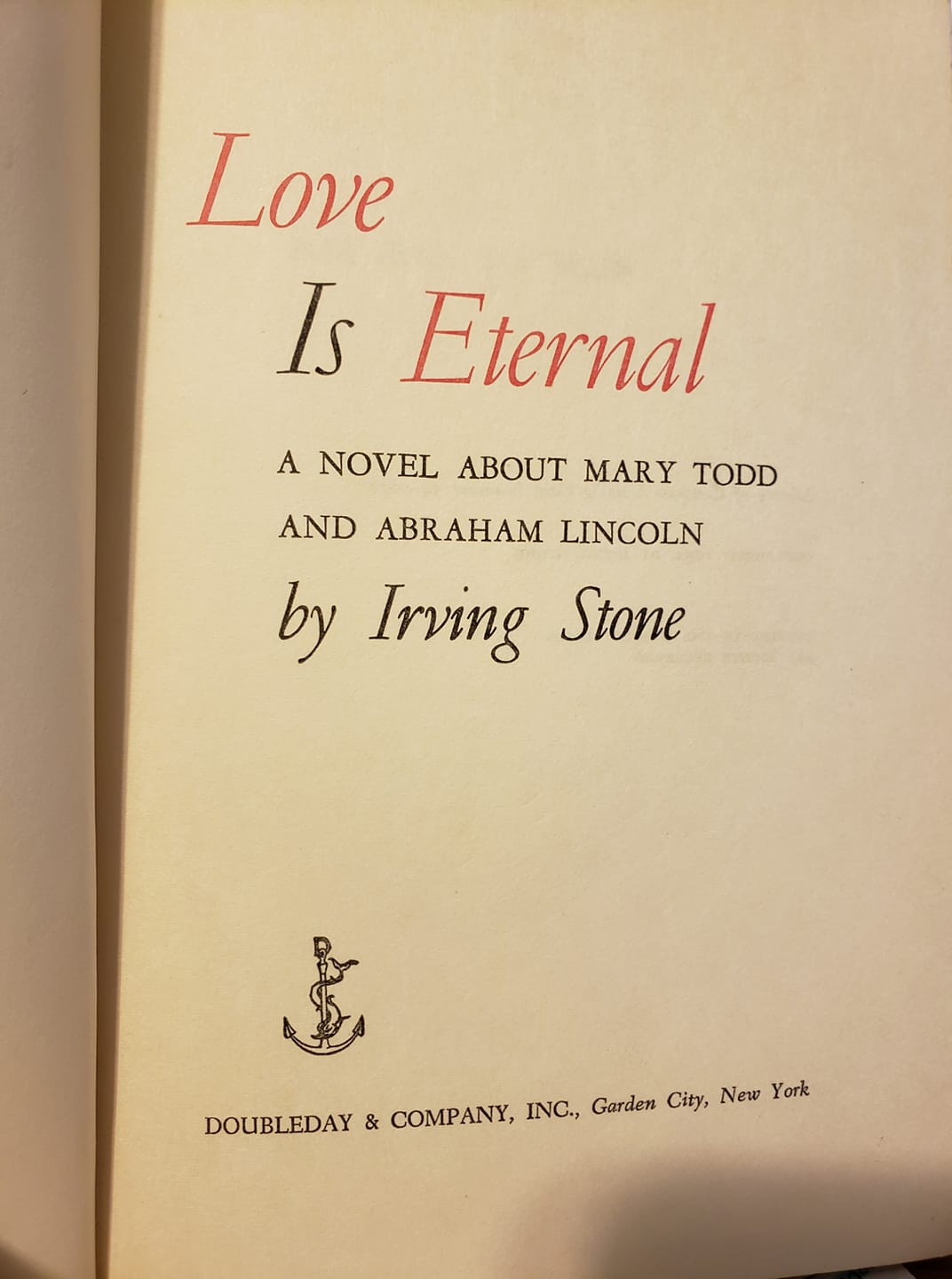
Having finished a book back in March, and taking a lot of time working my way through my magazine pile, I also began glancing on my shelves for what to read next. I found two different non-fiction books that looked good and moved them from bookshelf to reading pile. It was really time for reading a novel, however, so I went back to the shelves.
In the garage, on a shelf that contains hundreds of books slated for donation or sale, I found a volume that looked intriguing. It’s Love Is Eternal by Irving Stone. The spine is worn on this 1954 print and I could hardly read the title on it. Opening to the title page I saw the subtitle is “A Novel About Mary Todd and Abraham Lincoln”. Now that sounded interesting. Lincoln is my favorite president; he naturally featured prominently in my non-fiction Civil War book. So I took this from the shelf and decided it would be my next read.
I must interject here that I am not related to Mary Todd, at least not that I know. If I am, it’s more than eight generations back someplace in the Old World. I’ve never looked for a connection back there. I probably should.
464 pages and 36 sittings later and the book is read. Wow, that’s a long time you say. Yes, just under 13 pages per sitting. That was about all the time I felt like I could devote to reading during this period, as it included my intense research and writing of a family history book, my wife’s hospitalization, and a period much devoted to decluttering. It wasn’t due to the book itself, but to life circumstances.
What a good book! Stone goes to great lengths to be faithful to the historical record. Based on the title I was expecting it to alternate between Abraham’s and Mary’s point of view, but it was all from Mary’s. That’s good, though unexpected. It shows Mary as a pampered southern belle, her daddy’s favorite. She socializes with all the important Kentucky politicians. She follows two sisters from Lexington KY to Springfield IL, where she will perhaps find a husband. She meets Stephen Douglas and other important men, but then meets Abraham Lincoln and others fade from her view.
Stone spends a lot of time on the early years, and progressively less on later years. All major events of Lincoln’s political career are covered, but in fewer words for the presidential years. I suspect Stone thought Lincoln’s presidency has been covered in great depth and that the early years needed more coverage. The book ends with Mary leaving the White House a few weeks after Lincoln’s death.
If I had to pick at some things that I didn’t like, I can find only two. First, I would have liked to have some data provided, perhaps a listing of the parents, siblings, and perhaps the grandparents of Abraham and Mary. What with parents, step-parents, siblings, half-siblings, step-siblings, etc, I sometimes was confused. For Mary, especially, being one of 16 siblings, I couldn’t keep them straight. A timeline for each of them would have helped, as would have a couple of simple maps, of Lexington and Springfield.
Second, I wish Stone hadn’t spent so much time on Mary’s clothes. He constantly talked about the gowns she wore, giving color and style. Who cares? I suppose that helped to develop her character and the situations she lived in, but it got kind of tiring after a while.
So, I pulled this book from the sale/donation pile, but is it really a keeper? I think my wife would enjoy it and I’m going to encourage her to read it. Meanwhile, from my deculttering and organizing work, I found two other Irving Stone books in my library about president’s wives: Those Who Love (Abigail Adams) and The President’s Lady (Rachel Jackson). I also have a first edition of his book They Also Ran, about those who ran for the presidency as nominees of their party but never won, which I read decades ago and remember it as being excellent. I also read (from a library copy) Stone’s 1980 book The Origin about Charles Darwin, also excellent. So, I think I’ll keep this and have a mini-collection of Irving Stone books. Whether I get to read them or not is another question.
De-Cluttering Can Be A Win-Win
I’ve written before about my efforts on de-cluttering. We have a large house, with a lot of storage space. When we moved here from our less-large house (I won’t say smaller; it was, but it wasn’t exactly small), we made no effort to sort through stuff. We had no space to lay things out. So everything went in truck, car, and trailer. There it remained for the last 18 years.
From time to time I organized things or made decisions on what to throw out. When my mother-in-law moved in with us in 2015, we suddenly had a room of extra furniture. I moved that into her room, moved the furniture that had been in there to the basement, and found a place for it. But the storeroom was an absolute mess. I bought one more utility shelf unit and filled it. That let me see what we had. Clogging up the room was an old computer desk, both lower and upper units. It had been water damaged in transit back in 1996. We used it while our children lived with us, but with them gone, why were we keeping it? It wasn’t even worth giving away. I managed to haul it out the back and up to the street and arranged for the trash company to get it. And, thus, my first de-cluttering happened.
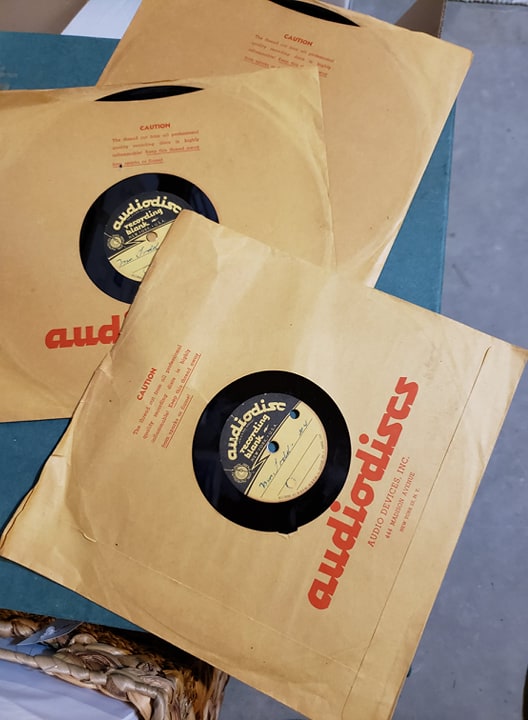
Somewhere around that same year, 2015, I re-found some old audio recordings on vinyl records. They had come from my dad’s house, and turned out to be songs recorded by Uncle Frank Reed, who married my father’s sister. He sang semi-professionally in his youth. These came to us from cleaning out Dad’s house in 1998, went into the crammed garage, got moved to the new house in 2002, and sat somewhere in the storeroom. In the 2015 clean-up I found them and put them on a shelf, lying horizontally and properly supported on the bottom, as recommended for vinyl. They were in a place where I knew I would remember where they were.
Over the next couple of years I began going through photographs and sent some to Frank Reed’s grandson, Frank Reed 3rd, in New Jersey. Frank was close to his grandfather. It occurred to me that he might want those recordings of his grandfather. He said yes, absolutely. So I went to the storeroom to get them and…they weren’t where I expected them to be. I looked and looked for them and they just weren’t there.
Where did they go? Over the last three years, just about every time I did any work in the storeroom, I looked for them. I decided I must have put them elsewhere. I couldn’t find them. Last Saturday, during a time of some major sorting and discarding, I looked in places where they weren’t supposed to be. Sure enough, they weren’t there. I decided I needed to just quit. Someday they would show up. Meanwhile, in every message to or phone call with Frank I assured him I hadn’t forgotten my promise to find them and send them to him.
Then, Tuesday night, I went to the basement to find a certain book that I wanted to read. It wasn’t in any of the family room bookshelves. It wasn’t on my “literary” bookshelf in the storeroom. It wasn’t in three boxes of books awaiting sorting and shelving. I knew it wasn’t in one of the 20 or 30 boxes on the utility shelves, for I bought it after those boxes were filled and placed. But, on a couple of shelves were some loose books sitting on the boxes. I didn’t think the book would be there, and it wasn’t.
But, as I picked up a couple of those loose books, to my surprise, underneath them were Uncle Frank’s recordings! Exactly where I had put them five or so years ago. Apparently, after putting the records there, I put the loose books on top of them to help keep them from buckling, or to keep them from being jostled.
I immediately snapped a picture and sent it to Frank. He was elated and wondered when they might be winging his way. I was not very specific on when I would send them. Then I remembered I would be at a UPS store the next day to have a document notarized (the bank lobbies being close for that service right now). I already had the shipping box, sent to me years ago by Frank, so I could send them the next day.
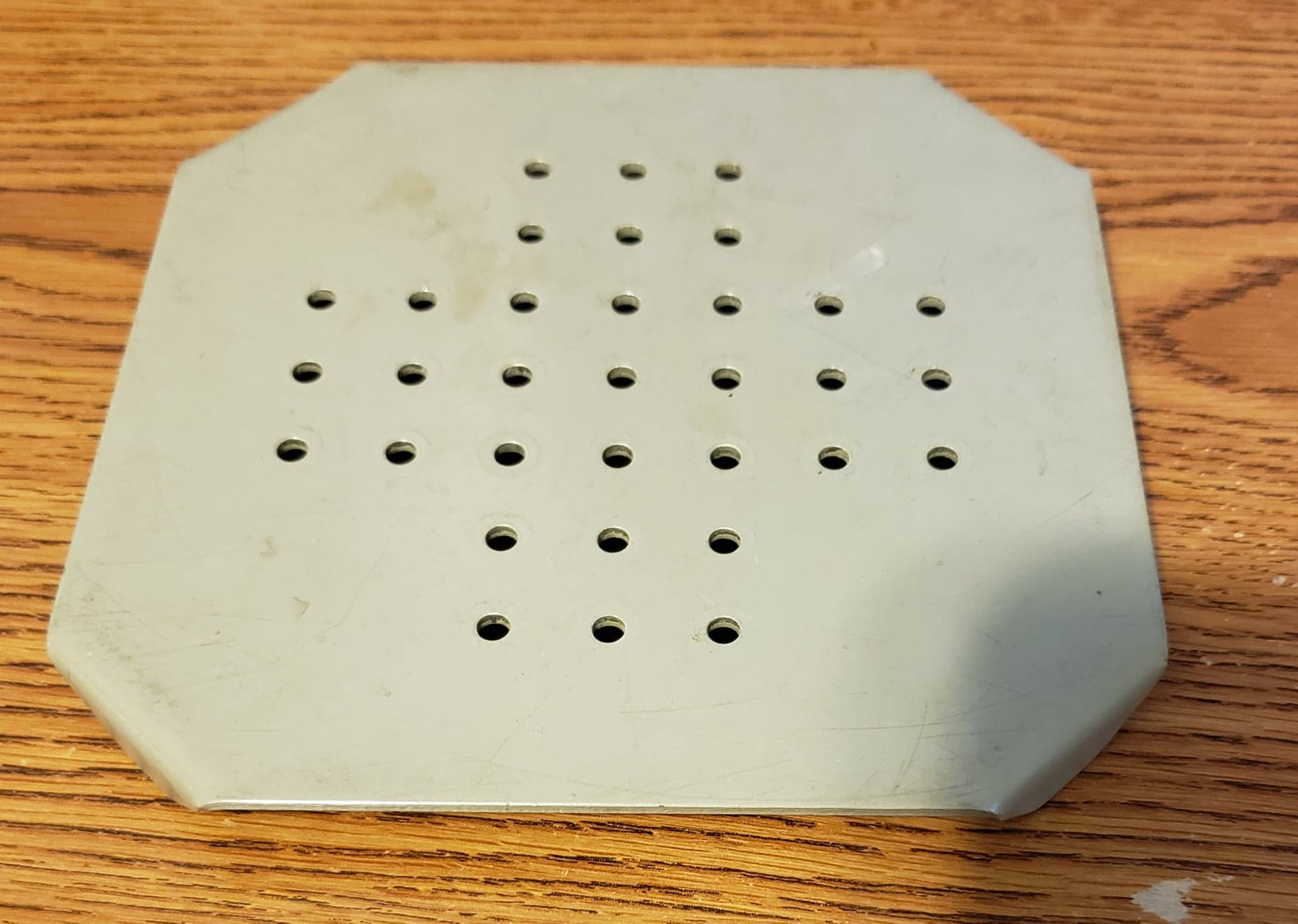
Then, I remembered the peg game that Frank’s grandfather made in his commercial machine shop in New Jersey. It was, if I remembered correctly, sitting in a file cabinet drawer. It wasn’t doing anyone any good there. I went to the file cabinet and, to my surprise, the game was exactly where I remembered. The pegs seem to have been separated. Once I find them they will go to the UPS store and wing their way to Pennsylvania.
Neither of these items are big; they don’t take up much space. I won’t be able to get rid of even one box, or off-load one shelf. But these are items my children won’t have to mess with when they clean out our house some years from now. They won’t have to wonder, “Who’s on these recordings?” or “What the heck is this metal thing?” They won’t get thrown out in the confusion of going through many things.
Instead, they will have been in my cousin’s family, giving them pleasure, remembering the grandfather and great-grandfather who was talented with a guitar and song, who made unique things in his shop, and was a mentor and friend to his progeny.
It was truly a win-win situation. Hopefully, I haven’t simply added to Frank’s clutter.
Getting Back Into Focus
The to-do list remains as big as ever. I chipped away at it over the last three days, but didn’t get as far as I wanted to.
I fixed a bookshelf that was overloaded. It seems that bookshelves are always built cheap. Fully load the shelf and it begins to sag. I discovered this only after loading a few of them and, after a few years, seeing them sagging. I unloaded several and put additional supports where the front bar attaches to the shelf. This generally is enough. However, I recently noticed one shelf sagging again despite having been fixed. I unloaded it last weekend, took it to the garage, and put weight on it to straighten it. Yesterday I tried an experimental method to strengthen it. Tomorrow I’ll put it back in place. One item checked off.
I did some reading in magazines and in a book. I think I finished three mags and put them in the recycling box. I’ve made a lot of progress on this and my mag basket is no longer overflowing.
In yardwork I had weeding of the rock yard (progress made) and moving an old wood pile from the backyard into the woods (progress made). I have lots more to do, but I’m pleased, at this point in the season, with where the yardwork stands.
I did other typical weekend chores, including checkbook, budgeting, filing (well, a little). On decluttering I mainly consolidated things. I found an underused plastic bin, combined the contents of the two, thus freeing one bin. I used that to put our old letters and cards in. I need to go through them some day, but at least they are all in one place now.
Which brings me to my writing career. My novel-in-progress, The Teachings, has been languishing for a month and a half while I expended writing and research energy on other things. Last weekend I read-through a print-out of it (close to 100 pages double-spaced, making edits along the way. I found that I barely remembered where I had left off and where I planned to go.
So around Tuesday I went back to reading for research in the 66 a.d. Jewish War. I re-read a chapter dealing with where I left off in the narrative. Then I went on to the next chapter. Josephus included a couple of dates in his account. When I checked that against my timeline I discovered I have events taking place in the wrong season of the year. So I have to work on getting that right.
Yesterday, after a 2.4 mile walk on one of our new trails in Bella Vista, I took Josephus, my manuscript, a mug of coffee, and some paper out on the deck. The temperature was about 69, a nice breeze made it quite pleasant on our eastward-facing deck. I began to write what my next few scenes will be. My two main characters, Adam ben Zechariah and his son Augustus, are moving from place to place in Israel, each hoping to see the other but just missing each other.
After less than an hour’s work, I had the next five scenes identified. These will be fairly easy to write.
But first I have to fix the timeline. For that I have to go back to Doctor Luke’s Assistant again and see what month and year I left off in. I know I was at the right time at the end of DLA. I hope to start on that tonight, and to have the five scenes written by the end of the week.