All posts by David Todd

Acquiring an Editor’s Eye

MEditing Illustration 03y time in the poetry wars, as I call the days I spent at Poem Kingdom, was my first time to begin to acquire what I recently termed an “editor’s eye”. At that site I critiqued hundreds of poems, first as a participant, later as a moderator and still later as an administrator. That actually wasn’t my first time and place to do that. I had already been critiquing at Sonnet Central for a few months, and had been in a writing critique group for a couple of years.

After Poem Kingdom there was Poem Train (with it’s critique forum Café Poetica), Poem 911 (which died in the whole EZ Boards hacking fiasco), and Absolute Write’s Poetry Critique Forum. In all of these I’d estimate that I critiqued somewhere around 1,000 poems. No, I don’t think I’m exaggerating. I copied off a bunch of them, but not all I’m sure, and have them in notebooks, preserved for posterity and research, should I become a famous author who someone ever wants to research.
Editing Illustration 02A thousand critiques at an average of perhaps 300 words each is 300,000 words. If anything I’m probably short with that. That’s a lot of time and effort given to critiquing. What I did was analyze the poem as a work-in-progress. Literary criticism—whatever that is exactly—was not the goal, but rather helping the poet bring the poem to a state of completion as the best poem possible for the subject matter and desires of the poet. In short, it was to be an editor. Not a cheerleader. Not a critic. But an editor.

During the years, ever since around 1998, I’ve also been in writers critique groups in real life, and one time on-line. It was the same thing: look at works in progress and consider how they might be made better in the writer’s quest for publication. These weren’t written, or at least not type-written and posted for all the world to see. A handful of us sat around a table and marked manuscripts in pen/pencil and gave oral crits. Still, it was the same type of editing, it seems to me. Sometimes I was most concerned with what is essentially proofreading. At other times it was line edits: looking at grammar and sentence structure to see how the writer’s intent can be better communicated. Still other times it was structural edits. I remember critiquing one piece at an e-mail critique group where the woman described a character as timid. Then she had the girl go up to a fellow student she knew of but didn’t know and offer help to her. It was completely out of character. I pointed that out; I’d call it a structural edit. Still other times I’d do a big picture edit, such as is the plot interesting? Are there holes or conflicts in the plot? Those kinds of things. Different types of edits as the situation arose.

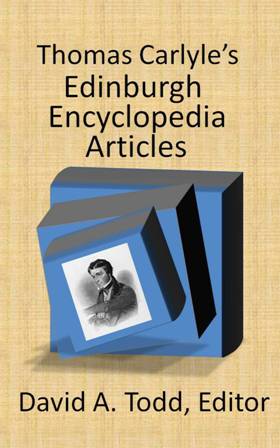
Now I’m editing my next publishing project, a book titled Thomas Carlyle’s Edinburgh Encyclopedia Articles. These are public domain articles that I found in five different places, plus a few notes that others have written about them (explanatory notes, not critique). I know I’ve written about this project before. These twenty-one articles have never been gathered before, so I decided to do so and add it to the Carlyle bibliography. I pulled the publisher’s note and editor’s introduction from the 1897 re-printing of sixteen of them, and pulled some references to them that Carlyle made in his own letters. But I knew I needed to write an introduction of my own. So I did. Last night I sent the much-critiqued Intro to my critique group, which meets next Tuesday. We’ll see what they say.
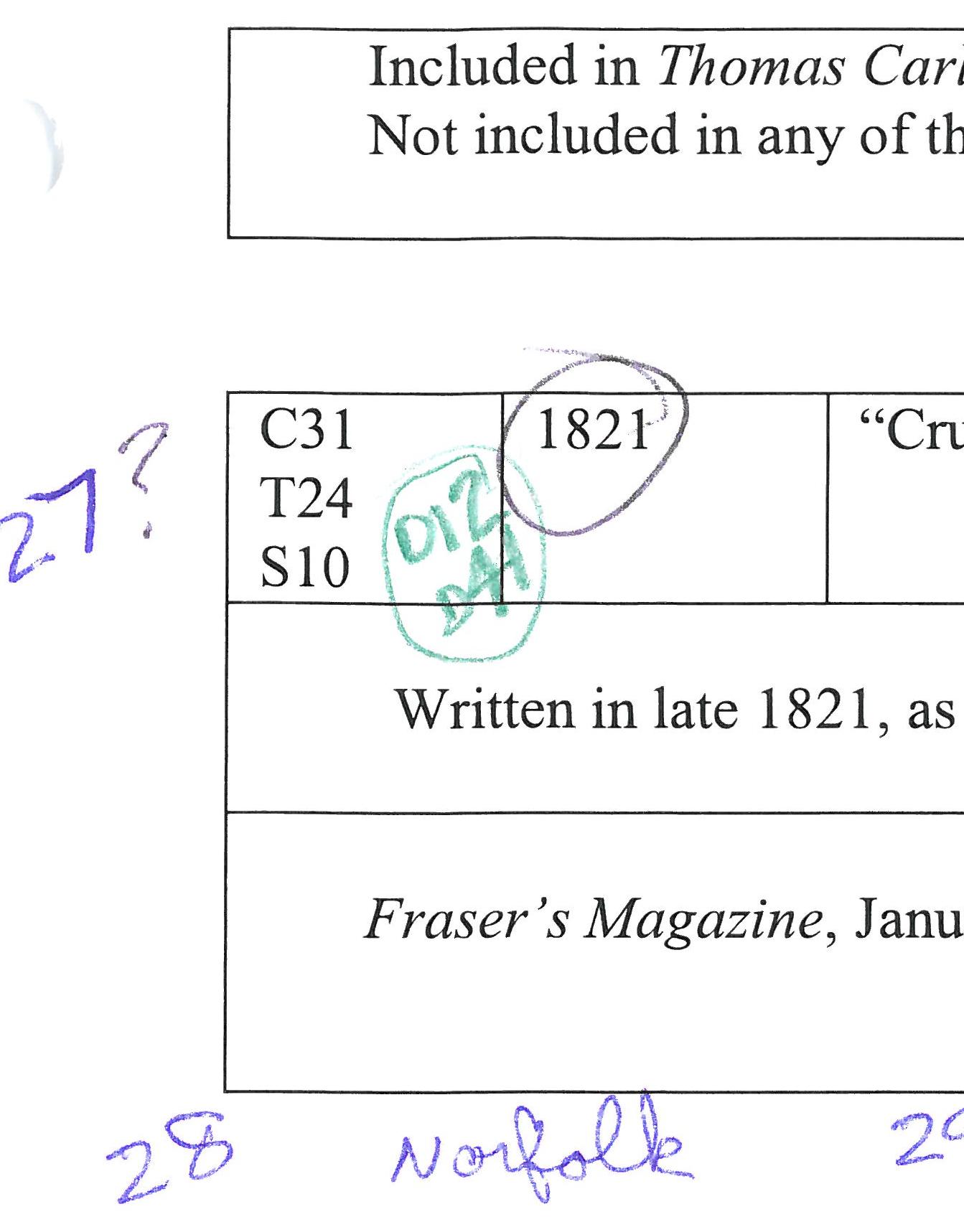
Editing Illustration 01But I’ve had other things to do as well, things that an editor would do. Such trivial things as deciding how much info to give about each article. How the text should appear on the page. Whether to break up long paragraphs (I didn’t), whether to modernize archaic punctuation techniques (I did). How to make lists and tables work best in modern typesetting and e-book formats. I suppose some of this is book production, but it feels like editing to me.

So through all of this I’ve been acquiring my editor’s eye. They (that is, various experts and claimed-to-be experts) advise that one who self publishes should hire an editor before ever publishing their works. I think that’s good advice, in general, but a very expensive practice. Simple line editing for an average length probably costs $300 dollars. Add proofreading, structural edit, and big picture edit, and you will have a large editing bill. I don’t know about others, but I don’t have $500 or $1000 to pay for editing. Therefore I just have to do the best job of producing the book with the skills I have.

So maybe all my editing work through the years, even that from before I realized I was editing, is helping me with my self publishing. I’d like to think so.
Haiku and me

Poetry has escaped me for some time. When I post about it at a place like Absolute Write I’ll say that poetry no longer comes to by either by inspiration or perspiration. However, that’s not completely true. To some extent I’m avoiding poetry so that I can concentrate on my prose works. I think I could write poetry again if I put my mind to it.

The only type of poetry that currently comes to me is haiku. You know what I mean: those pesky, three-line poems of certain syllable count and subject, including nature and a season of the year. We worked on them, I remember, in 8th grade English. I even remember one I wrote, and it being criticized in class, not for how it agreed with the form requirements, but rather that people didn’t like the conclusions the haiku drew. I even remember the main critic: Linda B——. I know nowadays they have students write them at an even earlier age. After all, it should be easy to do. Three lines, 5-7-5 syllables. What could be simpler.

Well, to some extent it is simple, as far as the mechanics go. But to have a haiku transcend being mere prose broken into lines takes some doing. I don’t know that I’m really there yet.

Part of the problem is trying to force a form that worked in Japanese to work in English. What we call syllables is different than how the Japanese language works. Their sounds are called “ohns”, and they are shorter than syllables. So while they may have a 5-7-5 structure, that would would be shorter than our 5-7-5 syllables. So the syllable count for English haiku should be seen as a maximum, not a fixed requirement.

Then there’s the issue of subject matter. Is it just simply about nature and a season, or is there more to it? Lee Gurga thinks there’s more, much more. He was once president (or maybe it was executive director) of one of the main haiku societies in America and editor of a haiku magazine. In a series of posts a number of years ago at eratosphere.com, he explained what it is the Japanese try to do with their haiku. Along with the length requirement, the subject matter is critical.

– It must include something about nature.

– It must include something about a season of the year.

– It should be two images, separate, and yet linked together simply by the words. He calls this the “syntactical cut”. Syntax should both link and divide the two images.

These are fairly exacting requirements. And, these are not requirements necessarily followed by most people who write haiku. To most people, the seasonal and/or nature reference is sufficient. A similar poem, the senryu, is the same length as the haiku, but can be about almost anything.

For myself, I took up the challenge of the two images divided by the syntactical cut. Only I decided to take it a step further. I decided make the images be in the first and third lines, and make the middle line able to apply to either image. Each image should be complete and natural when read with the middle line or read by itself. As a result, the middle line will have to include a preposition or conjunction.

My normal place to “write” haiku is on my weekday noon walks, or when commuting to work in the morning. Cloud patterns often inspire me, or other conditions of weather. For some reason my evening and weekend walks in our neighborhood don’t provide me with inspiration, nor does the commute home at the end of the workday.

Driving to work Friday morning in the pre-dawn, I saw a particularly large star in the east. Except then I remembered someone said that the planet Venus was rising ahead of the sun these days. That caused me to think of a haiku that would begin “Venus rising”. This stuck with me as I drove the last six miles to work. By the time I arrived I had the haiku finished. However, on the walk from my truck to the office I forgot that I had to write it down quickly. Thankfully by mid-morning it came back to me. Here it is.

Venus rising
ahead of a cloudy dawn
cold office beckons

The middle line will go with either of the others as a complete image, and the first and last lines stand alone as images of their own. I don’t know that that’s the final version yet, but I think it’s close.

So today, as I’m writing this to post tomorrow, I’m in The Dungeon.  Outside a mid-March snow storm is raging. The temperature is now in the 20s, the wind is howling, and snow is about at 2 inches accumulated and still coming down. This is the latest it has snowed in the 23 years I’ve lived in the Bentonville-Bella Vista area. It has inspired another haiku.

wind, cold, snow
five days before equinox
no spring in sight

Again, I don’t know if that’s any good, nor if it’s the final version. But it fits the rules I use, based on Gurga’s teaching. I’ll keep it, I think, and add it to the mix of my poetic works.

Two poems in one week. I don’t think I’ve done that for two years. They’re only haiku, but…what am I saying? Only haiku? No, haiku aren’t simple, and shouldn’t be labeled as only anything.

World-Building Trumps Everything

In writing classes, you learn lots of “rules.” Be consistent with point of view. Avoid or at least minimize the use of adjectives and especially adverbs. Keep sentences short. Watch out for plot gaps and gaffs. Mind your sentence length. Etc, etc. These things are drilled in, over and over, in every writing techniques class in every conference, book on writing craft, and writing webinar.

Breaking “the rules” is possible, or course, for a skilled writer who is already published. But a writer starting out should avoid these rules. The rules are what good writing is all about. “Get a copy of Strunk and White, learn it, embrace it, apply it.” So the experts say.

Another factor that comes into play in writing, apart from the quality of the words as they are strung together into sentences, at least for novels, is to create the fictional dream for the reader to get lost in. Or, as they would call this in science fiction and fantasy, build your fictional world carefully, expansively, and invite you reader to inhabit that world for a time. It’s called world building.

As I read books or watch movies, I’ve come to realize that world building is more important than the quality of the writing (in the case of books) or production (in the case of movies). This came home to me twice recently. We went to the theater and saw Saving Mr. Banks, the story of Walt Disney obtaining the rights to the Mary Poppins stories and making the movies. The difficulty of the author in letting go of the rights, and why, was the key element in the story.

As we were at this movie, I found myself lost in the story. The scenes switching between early 1960s Los Angeles and the author’s childhood in rural Australia was easy to follow. As you saw the girl’s relationship with her dad, the problems he had with alcohol, you immediately began to wonder how this tied in with Mr. Banks, the father in the Mary Poppins story. Was Mr. Banks the girl’s dad? If so, how did saving Mr. Banks tie in with the real life dad’s story?

As I say, I was lost in the story. For ninety minutes I forgot about books I wasn’t writing, blog posts I should be planning, specs I should be developing at work, wondering how I will be able to retire on schedule, and a host of problems that seem to consume life. The developers of the movie had created the perfect fictional dream, and I was lost in it.

The second thing to bring world building to mind as the most important element in fiction is the Harry Potter books. As I explained in my last post, the wife and I are reading these. I want to be careful here, because it’s very common for an unsuccessful writer to criticize the writing of a successful writer and have it appear as sour grapes. I assure you my criticism of Rowling isn’t in that category. But, in fact, while she does well with some of the rules, she violates many of the them that I mentioned at the beginning of this post.

She uses adverbs to the point where it become sickening, especially on speaker tags. “said Ron hesitantly.” “Hermione said emphatically.” “said Snape snarkily.” “asked Harry cautiously.” More often than not, the speaker tag comes with an adverb. Three or more in a row might have the adverb with the tag. And, she way overuses speaker tags. When the speaker is clearly identified by the context, why include a speaker tag? It’s redundant and slows down the story. But she does it over and over.

And then, some of her sentences are awkward, with subordinate clauses modifying/referring to the wrong reference, based on the rules of grammar. These are typically long sentences, with the properly referred-to item and the descriptive clause so far removed from each other that it’s a mental struggle to understand what’s being said. These aren’t excessive, but there are enough of them to be noticeable.

Since the books are wildly successful, who am I to criticize the writing style? It smacks of sour grapes. Yet, I’m not making up what is taught in writing classes. I’ve heard the same things over and over. Why then is the Harry Potter series so successful? Are the experts wrong? Is there a separate set of “rules” for children’s books? Or is it possible that readers don’t care as much about the quality of the writing as the experts say? And that, what the readers want more than stellar writing is…

…an outstanding story? One that gives them the fictional dream, and puts them into a different world for a time. That’s what I think. There’s nothing wrong with stellar writing. But it shouldn’t come at the expense of world building or creating the fictional dream.

I have more to say about that, but unfortunately I’m at the end of my post, and shall have to cover it in the next post. See you all then.

Reading Harry Potter

Having seen all the Harry Potter movies, I have always had in mind to read the books. However, they never seemed to get any closer to the top of my reading pile. Indeed, they never really made it into my reading pile, but rather remained on the shelves, gathering dust, wondering if I would ever get to them.

Well, I finally did, at the wife’s insistence. More of a suggestion, really. She said, “Why don’t we read the Harry Potter books out loud?” We don’t do a lot together, the wife and me, except eat meals and watch television. And I’m fairly sick of television these days. This would give us a chance to do something together. So even though it would cut into my writing time, I said okay.

I believe it was after the first of the year that we began with The Sorcerer’s Stone. That’s a fairly short book, I think around 300 pages. Lynda has read them all before, but at least ten years ago, and she really didn’t remember the details of the books. We’ve seen the movies multiple times over the last year, as we watched them in rounds. But finally, I was reading Harry Potter.

At first we read around five pages, then passed the book to the other and they read five pages. Back and forth. Eventually we read longer sections, around a chapter each. I’m sure we were done with The Sorcerer’s Stone in less than a week. One of the main things I noticed was the different beginning in the book than in the movie. The basics were there in both: one-year-old Harry is taken to the Dursley’s to grow up away from the wizarding world. In the movie it’s a fairly short scene with only Dumbledore, McGonagal, and Hagred, told from Dumbledore’s point of view. It serves as a nice prologue to the story. In the book it is much more elaborate, and is told from either Vernon Dursley’s point of view or by an omniscient narrator. I don’t know that either is better.

The it was on to The Chamber of Secrets. A little bit longer book, it begins to flesh out some of Harry’s back story. At least it tells how he comes to be a prisoner in the Privet Drive house. His rescue by the Weasley brothers is much less dramatic in the book than it is in the movie. I think, on the whole, I’m going to remember this one less than the others.

Next was The Prisoner of Azkaban. Longer still, it was good to see Harry, Ron, and Hermione start to grow up. In this book we learn something more about their schoolwork. The book does a better job of explaining things such as the Marauder’s Map, and the secret passageway to the Shrieking Shack. The friendship of Moody, Wormtail, Padfoot, and Prongs is explained much better in the book, as it to be expected. On the other hand, the dramatic scene in the movie where Harry goes into the corridors at night in search of Peter Pettigrew, who he saw on the map, is much better in the movie.

The Goblet of Fire is the one, so far, where the book and the movie diverge the greatest. The interaction between the students of the three schools is significantly different between the two. The movie excels in showing the Yule Ball, with the women in all their finery. The book does a better job of explaining what becomes of Rita Skeeter, what Fleur is like, how the tasks take place, and many more things.

Which brings us to The Order of the Phoenix, which we finished on Saturday. This is the longest of the books (so I understand); thus the movie is much condensed. It’s hard to know whether the movie is better or the book is better. The book explains a lot that the movie doesn’t. The book tells more about the Order of the Phoenix, whereas the movie seems to focus more on Dumbledore’s Army. My only negative comment is that the book seems over-long. It probably needed to be to flesh out the remaining back story on the encounter of baby Harry and Voldemort, but it seemed to take forever to get through it. By the end, had I been reading silently instead of aloud with Lynda, I would have found myself skipping or skimming sections.

The Half-Blood Prince and The Deathly Hallows remain. I need to take a break from this reading every evening. It’s taking an hour or two every night away from my writing. It’s not bad time spent, but I need to make progress on my novel if I’m ever going to get it published. So I’m not sure when we’ll finish the last two.

In my next post, however, I’m going to make some comments on the story line of the Harry Potter books, and what has made them a success.

Book Sales, Jan-Feb 2014

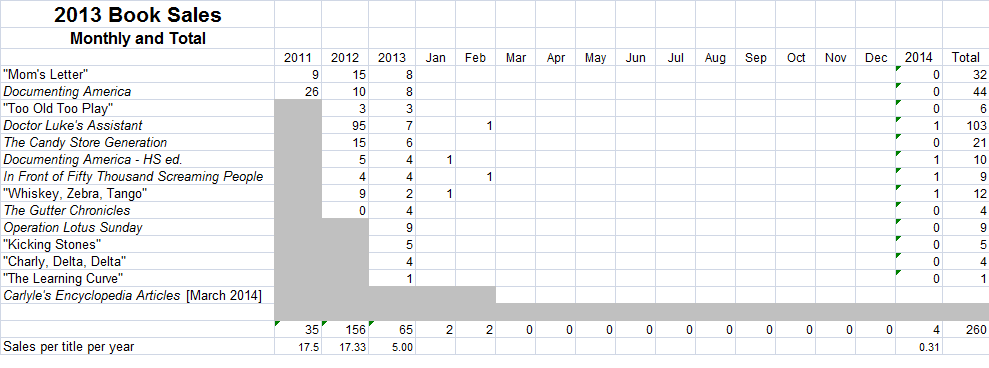
I didn’t report my book sales in January. There wasn’t much to report. Nor is there much more to report in February. But I don’t want to hide this information, so here I’ll post it, and comment after.

2014-02 Book Sales Table 989x368


Yes, that’s right. Two sales in January and another two sales in February, four all together. The best news is they are of four different books. One was a print book, the other three e-books.

I still don’t do much by way of marketing. Occasionally I make a post on FB, or tell someone individually (online or in real life) that I have books for sale. At some point, perhaps next year, I’ll have to quite taking all of my writing life time for writing and instead use some of it for marketing.

Below is a smaller size of the table, for linking to from the Absolute Write forums.

2014-02 Book Sales Table 396x147


Progress on Headshots

Last week I was in Nashville for most of the week, attending the IECA annual conference and presenting a paper there, “Who Pays the Fine?” It was a great trip, and I’m writing a detailed trip diary about it. It’s not something that I’ll publish, though possibly I might take some of it for a blog post. It’s just something I want to do, something I have to get out of my system before returning to work on Headshots.

And, that’s the subject of this blog post. I last worked on Headshots on February 23. I left for the trip on February 25 and came back just before midnight on the 28th. March 1 was moving day for my mother-in-law, with tiredness overcoming me and having no mind or energy to write, little enough to read.

Today is the day I planned to have a blog post here, but my blog post planning record is at work, and I’m at home on a snow day. Having shoveled the drive this morning, I came down here, uncertain of what to write. I just finished a travel log of my trip to Nashville, running on to seven typed pages. Next is this post, which I have decided will be on Headshots.

As I mentioned in a previous post, I’m slogging through the sagging middle. The idea came to me to make this mostly about baseball, since I had very little baseball action in the early chapters. The timeframe has moved into during the season, so I’ve written about Ronny’s comeback attempt. This has taken me through Chapter 18, and 56,222 words. Since I’m heading for around 80,000, and I think the ending action will take close to 20,000 words, that means I’m almost through the sagging middle.

But, I have other things to add to it. I have to add that Sarah gets kind of stir-crazy, hiding out at the farm, not being able to go anywhere without Federal protective agents going with her. I need for her to do something stupid to make her situation worse. I also haven’t touched on any Mafia/gang actions for a while. I can’t forget them in the midst of the baseball action. Some ideas have come to me for both of these problems. One is to give back story on the four main mobsters: Mancini, Russo, Cerelli, and Washburn. In both books I’ve said very little about what motivates them. Washburn and Mancini got a paragraph each in FTSP, and I think I gave some of Mancini’s back story earlier in this book.

Once I add those things in to the sagging middle, I suspect I’ll be somewhere around 65,000 words. So either the book will be a little longer than I thought, or perhaps the end game will be shorter. Either way, I’ll try to get back to this in a few days, or perhaps next weekend.

The end is in sight.

The Sagging Middle

My blog has become impossible to use. For whatever reason, whether I access it using Internet Explorer from work or Chrome at home, the entering visual window doesn’t work, especially on the first paragraph, and I have to type in the html window. That works fine, except entering line breaks in the html window doesn’t work, so I have to switch back to the visual window to hit [enter] then back to the html window to type. As I’m at the end of a paragraph, I’ll do that now.

Back, with a code included in the html window that I assume is a line break code. Excuse me while I go back to visual and see what gives…. Well, something looks funny in the visual window, but it doesn’t appear when I preview the document, so I’ll keep going. Part of the problem is I installed this theme (or more precisely my son did) back in 2011 using the then-current Wordpress 3.1.3. The now-current version is 3.8.1. Maybe that’s the problem, that older versions of WordPress don’t work with current browsers. I’ve hesitated doing the upgrade because, being a technophobe, I’m scared of what will happen. Will my blog disappear? Or will everything from before the upgrade be messed up? Those who know more than I do say no, that won’t happen. Alas, when I finish this post, I’ll do the upgrade. If you never hear from me again….

But my post today is supposed to be about something different. There comes a point in the writing of just about every novel where the writer encounters and must overcome…the Sagging Middle. Most advice about novel writing is that there are three parts to a novel. The beginning is a period wherein the main characters are introduced, conflict is established, and the protagonist moves through a point where there is no going back.

The ending action begins with another point of no return, typically caused by the protagonist him or herself, something that causes the protagonist to have to save the day. From that point on is the rising action to the end and eventual denouement.

Between these two is the long middle part of the novel. It’s a place where, if the novelist isn’t careful enough or good enough, the action will sag, causing the middle and thus the novel to fail. It should be a series of actions that pit the protagonist against whatever evil he’s facing. But keeping the interest up during this time is difficult. How do you keep coming up with events that move the action along? How do you keep raising the stakes, getting the protagonist into new kinds of trouble, yet leaving room for the major conflict at the end?

This has proved difficult for me in Headshots. Ronny Thompson begins this book lying on the mound at Yankee Stadium, severely injured and bleeding. The possibility of him never pitching again is on everyone’s mind. He was just estranged from his girlfriend, Sarah, and had been barely speaking to his parents. Meanwhile two groups of Mafia figures have been crossed, and are out to get that person. I have a hard time saying much about it without revealing the plot, but it turns out that it’s Sarah that the Mafia is after.

The thing I turned to last week and weekend to prop up my sagging middle is baseball. That was lacking in the first part of the book, as the action then takes place in the off season, when there’s not much baseball going on. I need to see if there’s a way I can work more baseball into that, maybe have Ronny watch films of the World Series. But the last writing I’ve done is of baseball scenes: pitchers throwing bean balls, batters making outs or driving in runs, strategy with pitchers and pinch hitters. The baseball fans that read the book should, I hope, be pleased with this section.

I’m not through with the mid-book baseball action yet, but another plot line that’s helping prop up the sagging middle is the three Cubs who had been bribed to throw the World Series in the first book. The Mafia feels the three double crossed them, just as Sarah has, and they must pay the consequences. This has given me several scenes of good action.

At this point I’m almost through writing the middle section. I’m not sure how long the book will be, but I think around 80,000 words. This weekend I crossed 54,000 words. I’m thinking that the end action will take 20,000 words or so, so if my estimate is correct on how many words it will take to tell this story, I haven only 5000 to 6000 words left in the middle. I have enough action planned for the rest of that middle to finish it out in, hopefully, good shape.

So maybe my middle isn’t sagging too badly after all. I won’t know till the entire book is finished, I’ve let it sit for a while, and then come back and read it as a whole. But I’m reasonably pleased with it at this point. That’s better than the alternative.

Now, I’m off to upgrade. Hopefully I’ll be back….

3 Years of Self-Publishing

Today is the third anniversary of when I put my first self-published item up for people to buy. It’s been a wild ride. Not exactly successful, nor can I say, I suppose, unsuccessful. I have another year to go on this experiment before I make some hard decisions.

Also, I’m going to insert here a small image of the draft cover of my Thomas Carlyle book, so that I can link it at the Absolute Write forums and get some critique on it.


Progress on the Carlyle Book

Good heavens! The Internet is down at the office! How will anyone get anything done? Monday it was slow. Tuesday it was still slow, though seemed a little better than Monday. Now, Wednesday morning before the workday is to start, our intranet is working fine, but not the connection to the outside world.

Actually, most of our work is done off of our intranet, so most people should be good. Anyone planning to research something via the Internet is out of luck, for now.

Today I have scheduled to report on the progress I’m making on my Thomas Carlyle book. It is tentatively titled Carlyle Articles in the Edinburgh Encyclopedia. Except for the Introduction, it’s all public domain material. Carlyle wrote twenty articles for this work, from 1820 to 1823, plus translated one long article, for a total of twenty-one contributions. Sixteen of these were attributed to him in the encyclopedia. The others were identified by researchers over the years (the last in 1963) as belonging to him, based on references in his correspondence.

In 1897, seventeen of these were republished in Montaigne and Other Essays, Chiefly Biographical. The other four articles have never been republished, except in later editions of the Encyclopedia.

At the Absolute Write forums, one of the moderators has suggested that a way to gain knowledge and experience in formatting self-published books is to take some book in the public domain and republish it. She has encouraged people to do that on multiple occasions. While I’ve already formatted and published thirteen items as e-books, five of those also as print books, I’m not exactly inexperienced. But I can always improve, and the moderator’s suggestion seemed to be a good one.

I decided to throw a twist into it, however. Since all twenty-one of Carlyle’s encyclopedia articles do not seem to have ever been gathered into one volume, I decided to be the one to do it. They are all available on-line, so gathering them wasn’t too difficult. Text of the ones reprinted in 1897 was in good shape. Putting them into a word processing document was easy, and they formatted quite nicely.

The other four, however, turned out to be a major headache. These four include the two longest, “Persia” and “Political Economy” (the translation), which account for almost half of the total encyclopedia article material by Carlyle. The problems stemmed partly from having to bring the text into the word processor document in batches rather than as a whole. This was time consuming, and I made mistakes and had to do much over.

The other problem is that these four articles were optically scanned, not typeset as the other seventeen were. Optical scanning then converted to text is usually rife with errors: e becomes c, h becomes b, w becomes Av, etc. So all of this material, almost half of the total book, had to be proofread with great care. I finished the third round of proofreading about a week ago. I’m sure I didn’t catch everything, but I believe I did a good job.

Now I’m typing the corrections, taking about twenty to thirty minutes a night for it. After that will come a spell check of the entire document, just to see if I missed a “his” that became “bis” in the optical scan and conversion. That won’t catch a “are” that became “arc”, but to look for those I may do some search and replace and hope to catch the worst of them. Also I’m finding a few places where I entered a note that said something like [<<<<<>>>>>]. However, checking those places against the on-line documents I can access now, I find all those places have clear text. Whatever I saw originally that caused me to insert those notes is no longer a problem, and I was able to get rid of them. However, I’ll do a search for those characters and make sure I haven’t overlooked any.

That brings me down to the Introduction. I’m including the introduction from the 1897 book, along with the printer’s notice. However, the book needs an Introduction. Having read many books with introductions that seem endless, I’m determined to keep it short. The one I’ve written is four 8.5×11 pages, or maybe as many as eight pages in a print book. That’s plenty long in my opinion. I ran this by a reader-friend for an evaluation. He suggested some changes, which I’ve already made, but I’m not quite done. Some info on each article that I was going to prepend to the articles I’m now thinking about putting in a table in the Introduction. In fact, I’ll do that, then run it by my friend again to see how it reads. I expect to do that tomorrow evening.

So tonight’s work will be to finish typing the proofreading edits. Tomorrow’s work will be completing the Introduction and firing that off. Friday night will include tidying up the file to get rid of stray formats. Assuming I hear back from my friend on the Introduction, Saturday will be the day that I save the document out to e-book and print book files, and begin formatting each. The print book will be essentially already formatted and mainly require setting up a Table of Contents and whatever size page and margins I chose. The e-book formatting will be a matter of stripping headers and footers and creating an interactive TOC.

For both books I’ll have to add an about the author section and list of other works. For the e-books that goes at the end, for the print book at the beginning. Also for the e-book I’ll have to create some tables that I’ll import as graphic files, since most e-book readers don’t support tables based on cells and tab spacing.

Then it will be on to the covers. The e-book cover is done, unless I decide to tweak it a little. I may. The print book cover is another story. I’ve written the back cover copy (subject to edit), but creating a print book cover is something I haven’t learned to do yet. I have some software I can use to do it if I can just learn it. I’m not going for fancy on this one; utilitarian will do nicely.

So that’s the status. If I had to guess I’d say I’ll be publishing in mid-March. I have a business trip the end of February that will cause me to lose close to a week. Thus I’m within my publishing plan.
Sorry for the long, dryasdust post, but I wanted to get this all down.

Why go on writing?

They say never to compare yourself to someone else, but it’s difficult not to. Consider the following excerpt from a post to a blog made in the last couple of days.

With only 3 indie titles in the last 2 years, I’ve been able to leave my day job and support my family with my writing income—as our sole provider.

I have put up thirteen items in the last three years, and have had 257 sales and am so far away from doing anything except buy a cup of coffee now and then that I struggle to decide why to go on. I’m not quitting, not yet, just venting frustrations. Short of sinking a bunch of money in advertising, I really don’t know what to do.

In January 2014, so far I’ve had one sale, a paperback copy of the homeschool edition of Documenting America. Not one e-book sale. But let me go check. Maybe I’ve had one since I last looked five hours ago…nope, no sales. In most of 2013 I thought five sales a month was a low number. At this point that seems positively high compared to Nov-Dec-Jan.

I’m forging ahead. I recently completed a one-off short story and decided to submit it to a magazine before self-publishing it. I’m 3/8 through Headshots, and will continue with that through finishing and publication. I’ll work through other things on my 2014 publishing plan, all of which (well, almost all) are follow-ups to things already published.

Friends tell me my writing is good and my books and stories deserve to be read. Here’s hoping the world discovers that some time before I assume room temperature.