I used to sing this song as I walked on my noon hours while still working, and worked on the changes in the lyrics as I walked and sang.
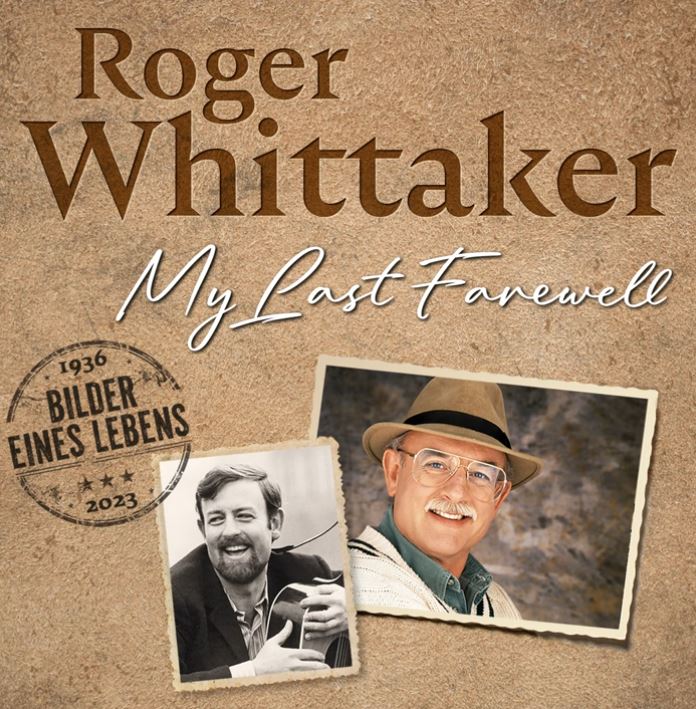
Quite a few years ago, I came to associate Roger Whittaker’s song “The Last Farewell” with the West Indies. Since my visit to St. Lucia last November, I’ve been associating it with my ancestors’ homeland.
Here’s a link to the song, after which I’ll paste in changes I made to the lyrics (which I not so humbly think are an improvement), along with a fourth verse that I wrote. I stumbled on the paper I wrote them on today. I hope the changes to the lyrics are enough that this doesn’t violate copyright. Unfortunately, WordPress is not letting get the spacing I want between stanzas.
The Last Farewell
A ship lies rigged and ready in the harbor
Tomorrow for old England she sails,
far away from you land of endless sunshine
to my homeland with its rainy skies and gales.
And I must be aboard that ship tomorrow,
though my heart breaks as we come to this farewell.
For you are beautiful
and I have loved you dearly
more dearly than the spoken word can tell.
[repeat refrain]
I hear that there’s a wicked war a blazing,
And the taste of war I know so very well.
Even now I see the foreign flags a-raising. Our guns are aimed as we sail into hell.
I have no fear of death, it holds no sorrow,
yet how bitter do I find this last farewell.
For you are beautiful
and I have loved you dearly
more dearly than the spoken word can tell.
[repeat]
Though death and darkness gather all about me,
and my ship be torn apart upon the sea,
I shall smell again the fragrance of these islands
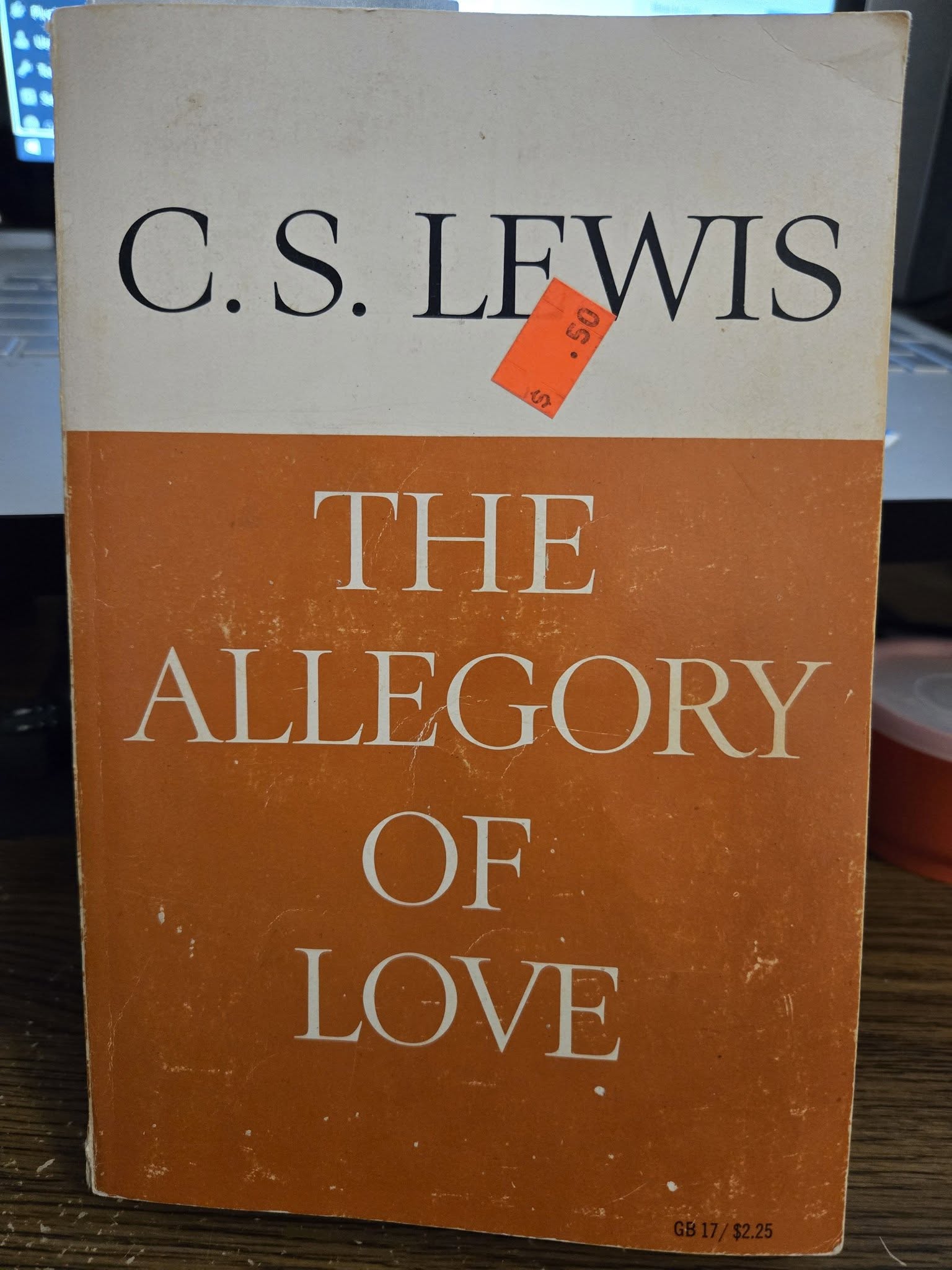
One of my goals is to read all of C.S. Lewis’s works: books, magazine articles, and misc. stuff. I’d like to do this more or less in order written, the same as I’m doing to the works of Thomas Carlyle. Except prior to deciding to read them in order, I read The Screwtape Letters back in 1975 when I hardly knew who he was. Then I read several of his later works.
Then I decided to start at the beginning of his adult writing career. Except I decide to skip his first two early poetry books, Spirits in Bondage (1919) and Dymer (1926). That got me to Pilgrim’s Regress (1933), which I read a few years ago. Next in line is his 1936 academic treatise The Allegory of Love. Written while he was building his academic career as an Oxford don and tutor, it is considered a masterpiece.
I approached it with trepidation, however, since I am far from a scholar. Would Lewis be speaking to me at all? Would I understand him. Let me answer that by inserting a quote from the second chapter.
It is true, as I said before, that the Psychomachia is not a good poem: if it were indeed the result of some purely unpoetic purpose it could hardly be worse. But there are many ways in which poetry can go wrong and an impurity in the intention is only one of them. The Psychomachia fails, partly because Prudentius is naturally a lyrical and reflective poet—that is some fine, cloudy grandeur in the Hamartigenia—to whom the epic manner comes with difficulty, and partly for a deeper reason.
I have no idea who Prudentius is, never heard of him until reading this section, never heard of the two poems mentioned, so obviously can’t understand what Lewis is talking about.
At this point, 70 pages into this 360-page book, I don’t expect to finish this. I’d like to get 1/3 of the way in before I decide to quit. That will take me four or five days to get to that point at the rate I’m reading it.
My preliminary conclusion: unless you can get this book for 50¢ as I did at a garage sale/thrift store, or unless you are a dedicated C.S. Lewis scholar, don’t waste your money and time on this.
I’ll come back with final conclusions when I either finish or abandon it.
This dates from around 1906. I hope it transports ok.
Perhaps a few readers will recognize the title of this post at the last two lines of Robert Frost’s poem “Stopping by Woods on a Snowy Evening”. It was a poem I hated all through secondary school, as a progression of English teachers tried to convince us it was a suicide poem. I just couldn’t see it.
Still can’t.
But I can see how it is a near-end-of-life poem, as the poet-narrator contemplates he has miles to go yet that snowy evening, and miles yet to go in his life, yet is tired, both physically and socially tired.
I’m feeling that tiredness. No, I’m not suicidal nor am I longing for the end of life. But I know I have many fewer miles to go than I used to, especially after the health challenges of the last year and a half.
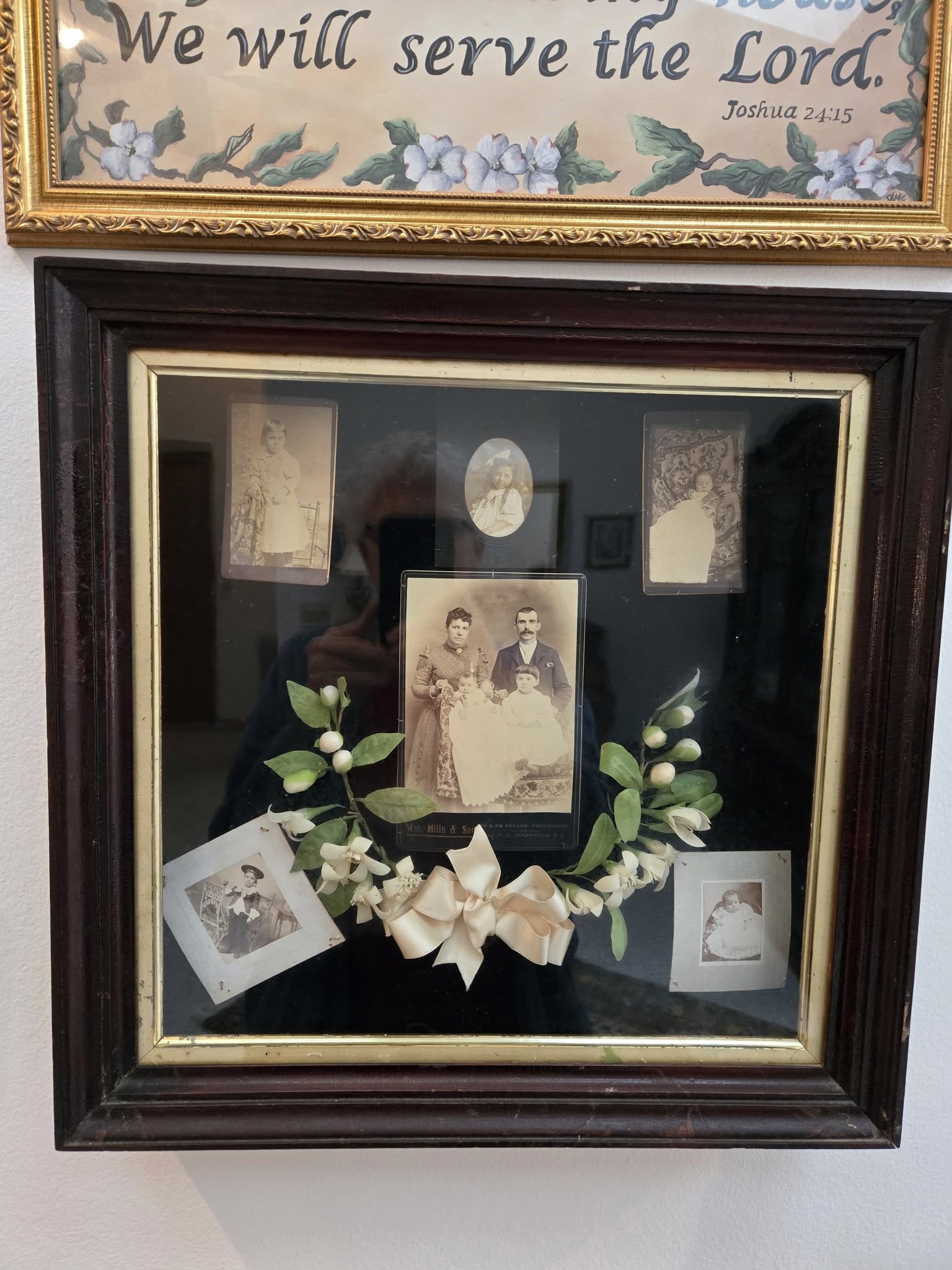
Two things brought this home to me recently. One is related to our ongoing efforts to decumulate. When we returned from our road trip to the East, I contacted a nearby cousin to whom I promised to give the old shadow box (pictured above) handed down to me from my paternal grandmother and dad. It displays photos of my great-grandparents, their five children who lived to adulthood, and a hairpiece, perhaps from the gr-grandparents wedding day. If so, the hairpiece is about 140 years old, and the shadow box was put together around 1905.
This has been in our possession since 1997 and displayed on our wall since 2002. I think it looks good there, but it’s time to pass it down to someone who will enjoy it for many more years than I have left.
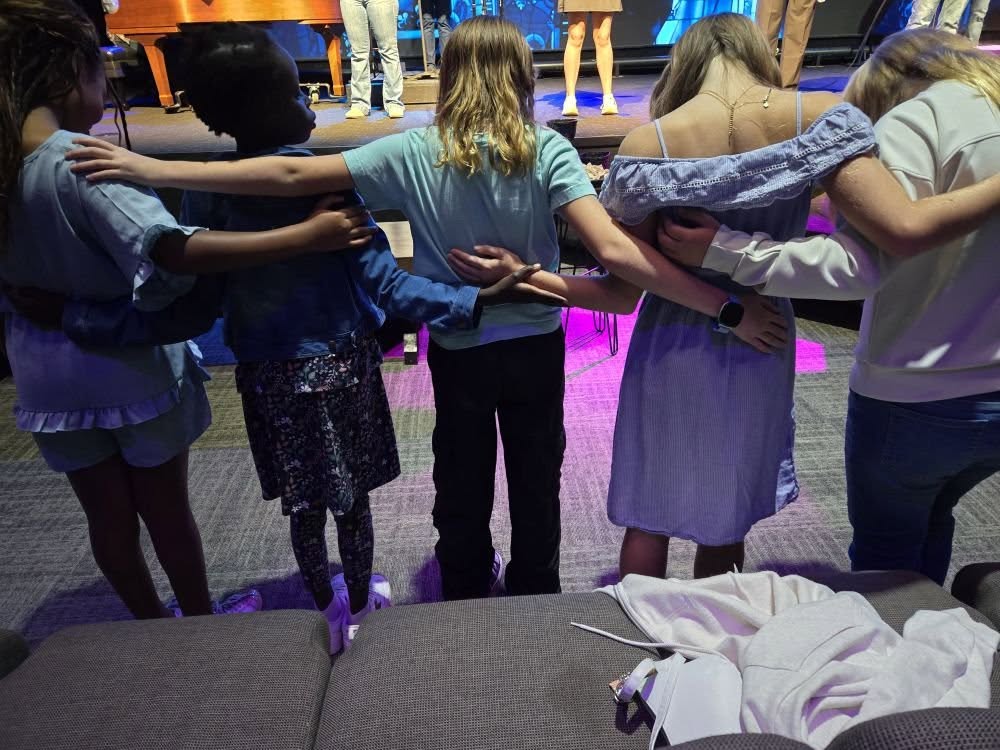
May God bless these girls in what I hope will be a long life before them.
The second thing that made me once again realize the miles I have to go before I sleep are many fewer now than they once were happened in church Sunday. It was a special service with our English and Hispanic churches combined, and with elementary-aged kids in adult church with us. We took in new members, dedicated babies, and baptized new believers. I sat in the second row, and five elementary aged girls sat right in front of me.
Two families joined the church, people I haven’t met yet. Two families, each with two children who looked to be pre-school age. Seeing that made me think: these are the upcoming leaders of the church. Then I looked at the girls in front of me and thought: and these girls will be in the next group of leaders. That gave me both happiness and sadness. It’s kind of difficult to explain.
I withdrew from church leadership over twenty years ago, deciding it was time to allow others to step forward. In the ensuing years, I’ve refused a couple of invitations to step back in to leadership. At the same time, in the world at large, I more or less withdrew from modern culture. I watch almost no modern TV, don’t go to modern movies or listen to modern music. Don’t know the current stars of either except a few, by name and sight but not by performance, who are too ubiquitous to miss.
Out of church leadership. Out of modern culture. Both by choice. There’s a bit of sadness that brings, but also relief. It’s sad to get rid of that 120-year-old shadow box, but also a relief to be unburdened from one family heirloom, knowing it’s going to someone who will likely cherish it.
These two things made me think of the fewer miles I have to go. I suppose I’m a little sad about that but now awfully so. Time to enjoy the woods filling up with snow, and not worry about the miles.
This not a keeper. I kept falling asleep as I read it.
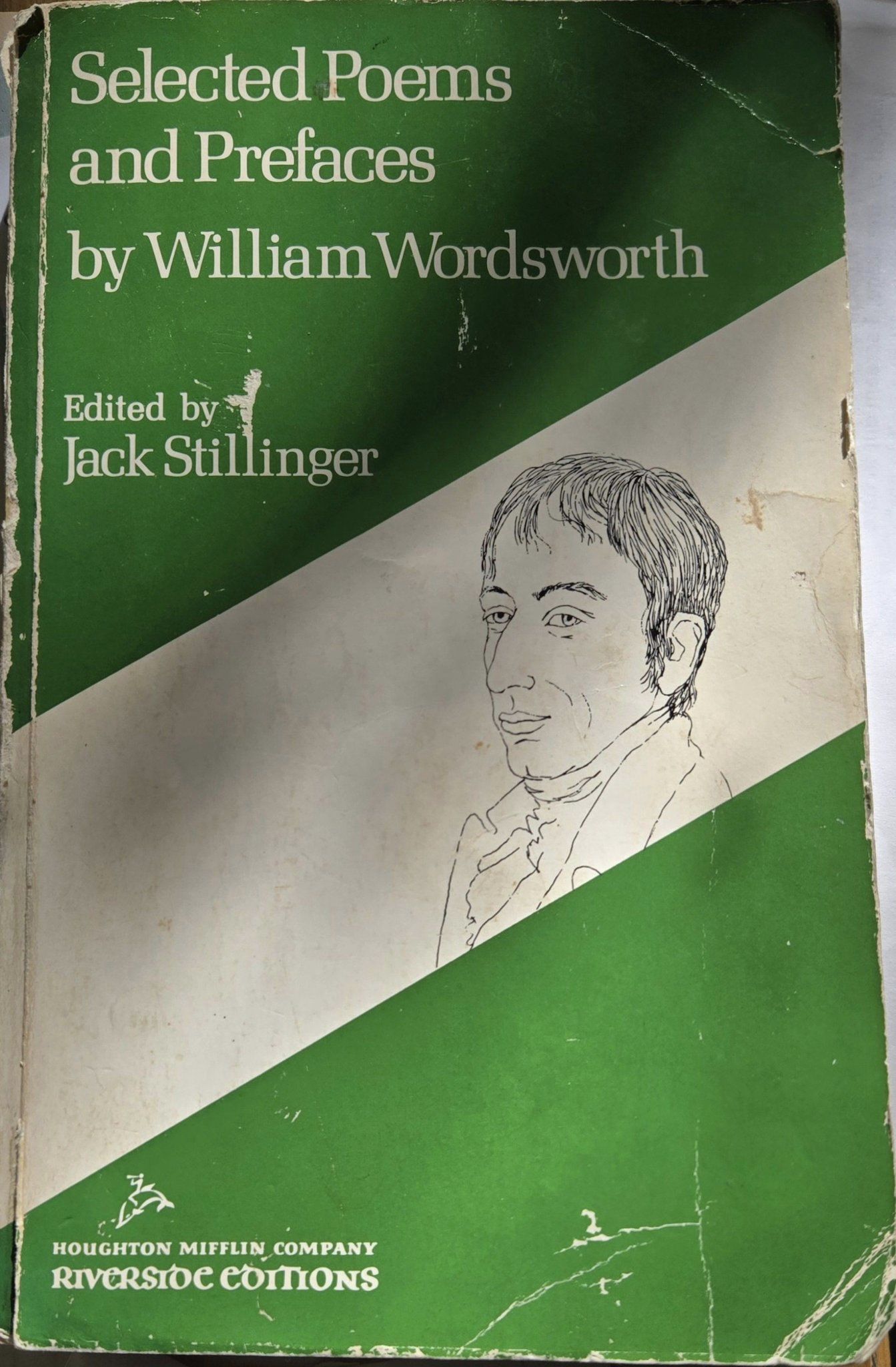
Some time ago, I pulled out Dorothy Wordsworth’s Grasmere Journals, read them, and reviewed them on the blog. I knew I had a book of William Wordworth’s Poetry, and thought it would be a good time to find and read it. I was pretty sure it was in a certain place, my bookshelf in the storeroom, and sure enough it was there.
So I dusted it off, brought it up to the sunroom for my noon reading, began reading it every day, and promptly fell asleep. The book was boring! Boring in the extreme.
I’ve another poetry book I found I couldn’t read. It wasn’t boring, but it just wasn’t enjoyable. It wasn’t my kind of poetry. But Wordsworth’s was closer to what I wrote and the type I like to read. So I can’t really explain my aversion to Wordsworth’s poems.
Or maybe I can. In the preface to Lyrical Ballads, Wordsworth explained his philosophy of poetry: that it should in the common language of the day, with meter added. I guess that’s what he did. His poetry is in very plain language, heavy on scene description, short on words that want to keep me reading.
The book of poetry that I didn’t like, I was determined to stick with it until I had read 20 percent of the book. I tried to do that with Wordsworth’s but couldn’t. I stopped at about 12 percent. No, I’m not going to pick this book up again and finish it. In fact, I plan on taking it to the next meeting of my critique group and see if anyone there wants it. If they don’t, it goes straight into donation pile.
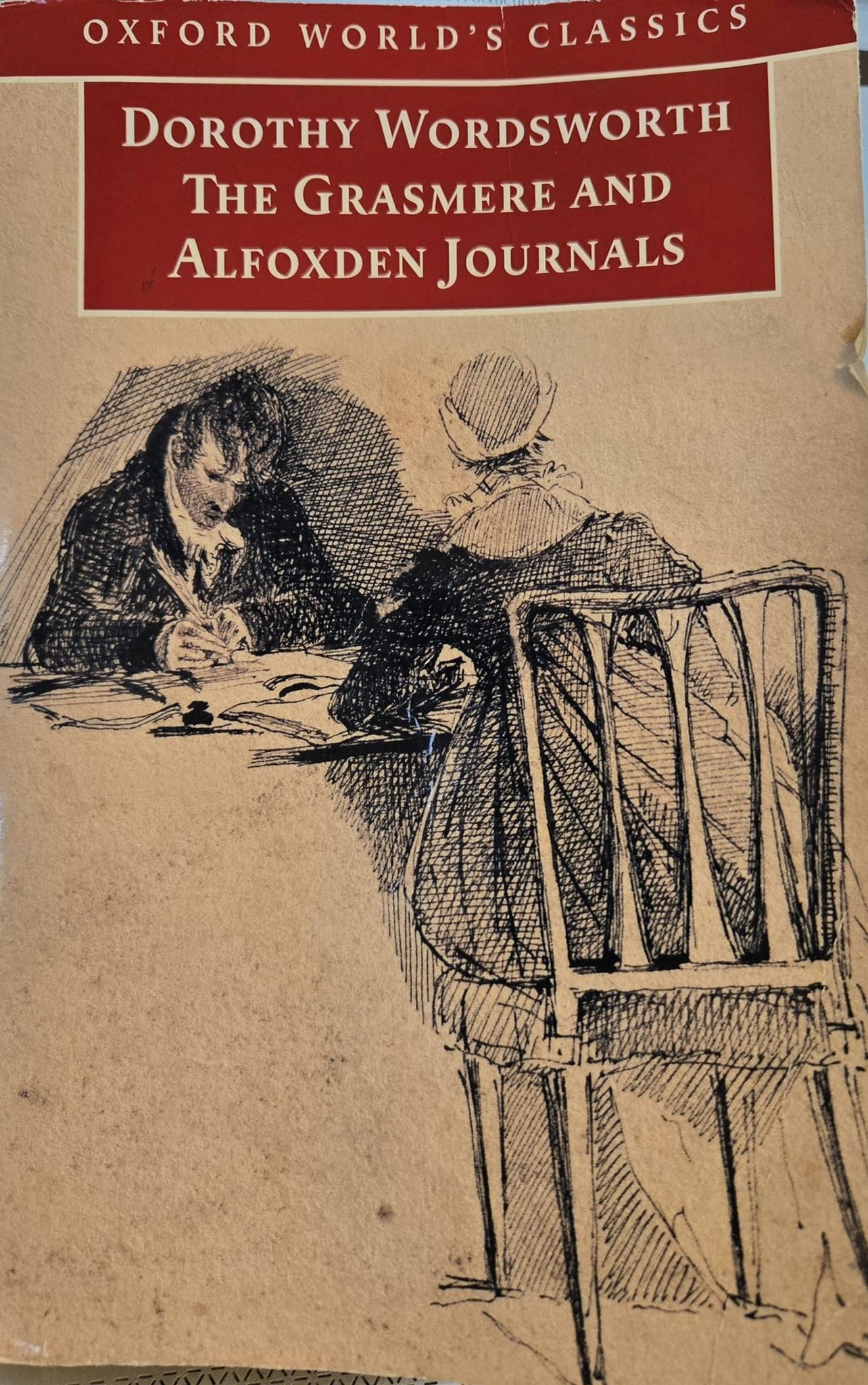
A couple of month ago, I posted that I was reading The Grasmere and Alfoxden Journals of Dorothy Wordsworth, sister of poet William Wordsworth. These are famous journals in the world of poetry, specifically in the British romantic movement era. I read this slowly, about five or six pages a day at my noon reading time, either in the sunroom or at my reading spot in the woods.
I must admit to having a difficult time concentrating on this book. Dorothy’s main entries had to do with the weather, where they walked and who they saw, what letters they received and who she wrote to. Sometimes she wrote about household items, such as making pies and bread, doing laundry. Many entries had to do with health issues. Both Dorothy and William were frequently ill and spent much of their days in bed, to rise at supper time then be up most of the night.
William’s poetry does figures in the journal, which is what most interested me. Dorothy sometimes wrote, “W is working on an ode” or “W is working on a sonnet.” Sometimes she would give the name of a poem. “Peter Bell” is mentioned quite often at one stretch. It makes me want to pull out my Wordsworth poems books (I think I have two) and read them.
Place names feature in terms of where they walked or rode to. The book included two maps, but so many of the places mentioned weren’t shown on the maps that I gave up referring to them. Coleridge also features in the journal. He came and went frequently, went away from his wife right when she was about to give birth. The impression Dorothy gives of Coleridge is not flattering.
The book included 140 pages of notes, printed as end notes tied to a page and a journal date. I started out reading the journal entry then flipping back to the notes. I gave up on that when I came to realize the notes more often than not compared this edition of the journal (2002, edited by Pamela Wolf) to earlier editions (stretching back over 130 years). That kind of information would be of great interest to a researcher, but not so much to a casual reader such as me.
So, on to my usual questions. How do rate this? Will I read it again? What will I do with the book? The extensive notes and lack of an adequate map cause me to rate this 3-stars. No, I don’t think I will ever read it again; thus I don’t plan on keeping it. It is already put in the donation pile.
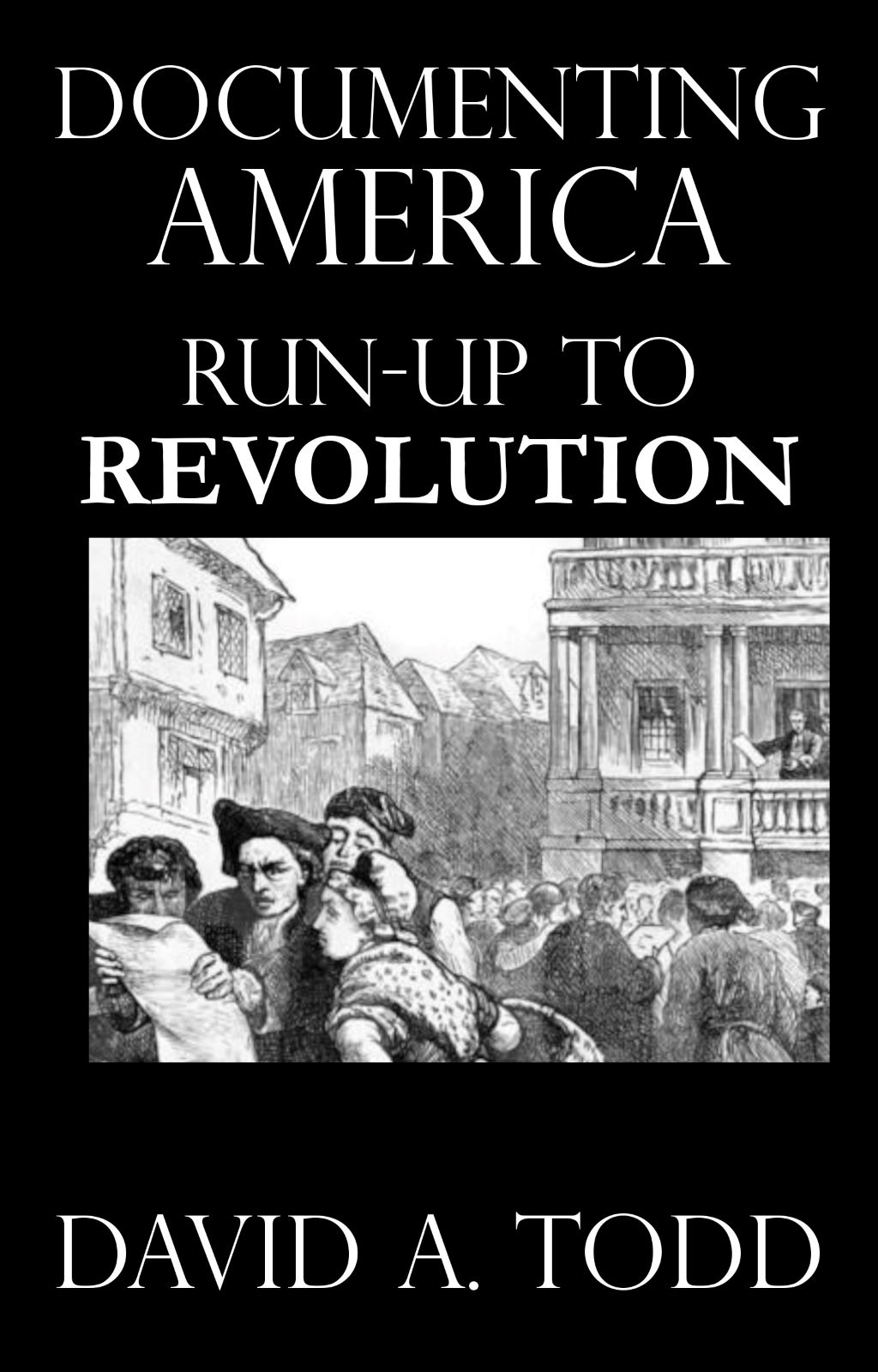
Initial sales of Run Up To Revolution are not bad. That’s not bad for me. Which means next to nothing as opposed to nothing.
Last week was busy. Two medical tests. Three doctor appointments. Two writer meetings. Plus a private meeting with a writer in one group. All of these appointments save one were in Rogers, a twenty mile drive each way. A couple of appointments I was able to have somewhat close together, but with some “layover” time between them. I had time to spend in Barnes and Noble and the Rogers Library.
I did almost no writing last week. Instead, I worked on the two special projects I have going on. That took up much of my time, but I made major progress on both the letters transcription and the critiques scanning and saving. I can see light at the end of both of those tunnels.
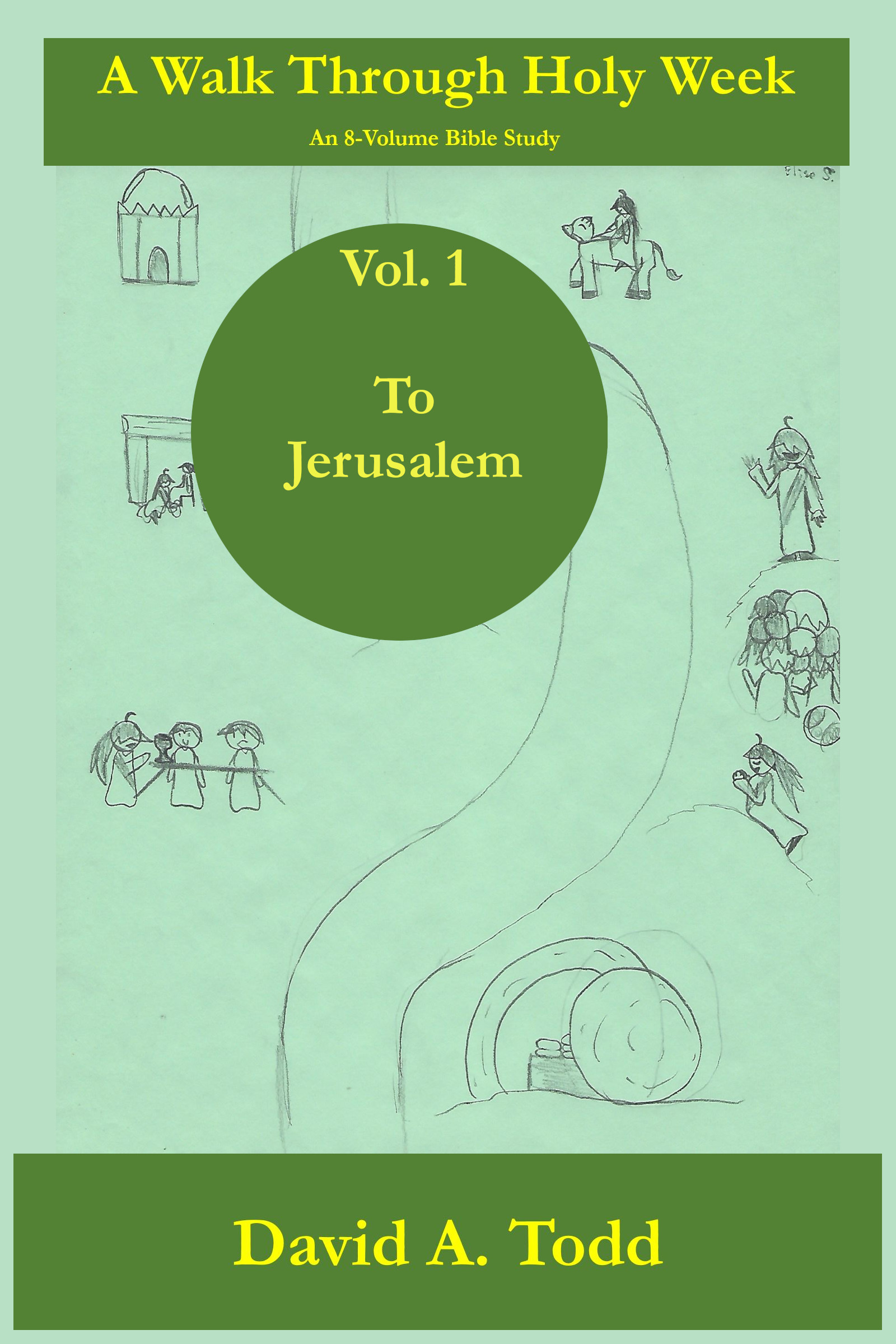
But on Friday I did some editing of A Walk Through Holy Week, Vol. 8. Just the first chapter, through Word’s text-to-speech function. After having left this alone for a while, it felt good to be back at it. I’d like to edit a chapter a day using this word processor feature. That would have me finishing the editing pass during the first few days of May.
Then, what? I’ll either have finished of just be finishing my two special projects at that time. It will be the start of another busy time, something I’ll explain later. My plan has been to start on Volume 2 of A Walk Through Holy Week, hoping to finish it (first draft) in about ten weeks. That would be followed by editing and publishing Vol 2 and moving on to Vol. 3. Completing Vol 3 will let me move ahead with publishing all eight volumes.
But I’ve started to brainstorm what to do with the Documenting America series. This is my highest selling series (can’t say best-selling, because it’s not even close to that level). Perhaps it makes sense to write the next book in that series.
But what will it be? I had intended to write next about the abolition movement in America—something I’ve read some on, but which I’d like to know much more about. I have plenty of documents available to read, but I believe I’ll have to find more than I have to make a full book.
Lately, however, I’ve been reading in Thomas Paine’s writing. I already read Common Sense, which is about the American Revolution. A couple if shorter writings dealt with America under the Articles of Confederation. I’ve now moved into his Rights Of Man. To my surprise, the first twenty pages are all about Paine’s thoughts on the French Revolution and his countering the arguments of Edmund Burke. It’s not, so far, a treatise on the rights of man.
But this got me to thinking. Maybe the next volume I write in this series should be on the government of the colonies before the adopting of the Constitution. This was the time of the chaos of the Articles of Confederation, which defined our government during the Revolution and the six years after it. I have some sources for this period, though I think that, just as with abolition, I would have to find others.
Which would be better? Abolition captures my interest, but the Articles of Confederation, what I’m tempted to call the First American Government, seems to be something that has been written about much written about it. If I can find enough source material, it might be something that will stand out and will be more interesting than writing about the Revolution.
If I stick with my writing plans, I won’t wrote the next DA book until sometime in 2025. But that means I should start now to identify and start reading sources. I know that for Abolition I will have plenty of sources to choose from, but I’m not sure that will be he case for the Articles. So I think some of my work this week, if the time materializes, if to start listing sources for both of these.
Why both? Because whichever of these is next, the other will be after that, Therefore none of my research and reading will be lost. It might just be delayed for writing a book.
Vol 1 is published, Vols. 4, 5, 6, and 7 are written and edited. Vol. 8 is written and asking to be edited. When it will happen if somewhat of a mystery to me.
I finished writing A Walk Through Holy Week, Vol. 8 on April 1st. That’s the first draft. I need to do at least two editing passes before “putting it on the shelf” to await my writing Vols. 2 and 3. In the past I’ve found getting a little distance from the first draft to help the editing to go better. Normally I would start on the next writing project, but given that it’s another Bible study in the same series I decided not to rush into it. I did, however, take an hour or two one morning to do a little planning and programming on Vol. 2.
Meanwhile, during the last two weeks of Life Group lessons, which my co-teacher taught, I got some ideas that I need to work into the last two chapters. I think I may incorporate those either tonight or tomorrow.
My time has been taken up with my two special projects. I think I wrote about these before. One is transcription of letters from our years in Saudi Arabia. I try to complete two or three letters a day. After a slow start, I’m in a groove this. Letters from 1981-1982 are done, and I’m four months into 1983, the last year. It looks as if I have another 40 letters to go. That means I will likely finish this around early May, so long as interruptions are minimal.
The other special project is scanning and e-filing the many poetry critiques I did at various poetry boards around 2001-2009. I printed a lot of these and saved them in 3-ring binders. Most of these were at the now-defunct Poem Kingdom, but I also hung out at several other sites and critiqued. My estimate has been that I critiqued somewhere between 500 and 1,000 poems. No, that’s not an exaggeration. I saved many, but not all, of the critiques I made.
So far, I’ve scanned, formatted, checked for accuracy of the scan, and saved 106 poetry critiques. These came out of a 1-inch binder. My estimate is that I have 75 sheets left to process in this notebook, which will probably be 70 critiques—meaning 175 critiques. When I finish that, next to tackle is a 2.5-inch binder stuffed with critiques. That means I’ll be well over 500 critiques. What I can’t remember is if there is a third notebook or if this is it.
If I don’t have another notebook, I will likely finish this project some time in the fall. If in fact there’s a third notebook hiding somewhere on my shelves, then the project will likely continue into 2025.
So the question I’m dealing with whether I can get some book editing done while also maintaining my pace on the special projects. I won’t be able to test that until later this week. I have medical appointments today and Tuesday and two writer meetings on Thursday. I’m sure I’ll make a report on this in a future blog.
In my last post, recapping my 2023 writing work, I said that my next post would be goals for 2024. But before I set those goals, I want to take a moment to think through all the writing projects I have going. Some are actually in progress, some are close to the surface, others were started and buried in the past. Still others are nascent, just starting to come together in my mind. They may never get beyond the idea stage, but they are there. I need to talk through this, think about what I can accomplish given life constraints. Bear with me though this thinking-out-loud post.
So here are the projects worth putting in the mix for actual goals for 2024.
Finish editing A Walk Through Holy Week, Part 1. I’m almost there right now.
Write Parts 2, 3, and 8 of A Walk Through Holy Week. Publish Part 2.
Pull Documenting America: Run-Up To Revolution into book form and publish it as a stand-alone book.
Reasearch (and possibly write) the next book in the Documenting America series. I have two possibilities for what the next one will be. Both need reading for research.
The next book in the Church History Novels series. I’ve identified what it will be and have brainstormed the plot. But nothing is yet on paper.
Transcribe the letters from our years in Saudi Arabia—maybe just half of them this year.
Next book in The Forest Throne series. I have made a minor start on it and discussed the plot with my granddaughter, who is my consultant on this volume. But this is unlikely to happen in 2024, unless it’s late in the year and after much other work is completed.
Begin the Alfred Cottage mysteries. I have made a minor start on the first volume and have planned out the series.
Update The Candy Store Generation for recent data and republish. I think this is about a two-week project.
Flesh out One Of My Wishes, a hoped-for poetry book. I made a start on this and have it half done. But the hard part remains.
A genealogy book. I’m torn between two books in the Cheney family. One has much research done and is mainly writing left. The other requires research from scratch.
One of the two books about Thomas Carlyle I’ve started. One I think I could have done with a month of intense work. The other I started and laid aside so many years ago, I’m not sure where I was on it, though possibly 60 percent done.
And last, take some time to decide what to do about a tentative project, Nature, The Artwork Of God. I’ve been thinking about this for a few months. It seems like it would be a good book. In some ways it’s a bit scary to think I could write a book that blends science and religion, so I’m going to take a long time to ponder this. I think that at most this year I’ll complete some reading research and flesh out a table of contents.
I’m not saying all of these are things I’ll work on in 2024. I’m just trying to figure out what are real prospects for this year. For sure I’ll be pondering these projects over the next few days, as I have been for nearly two weeks, and will have some firm goals for the year set in my next post.
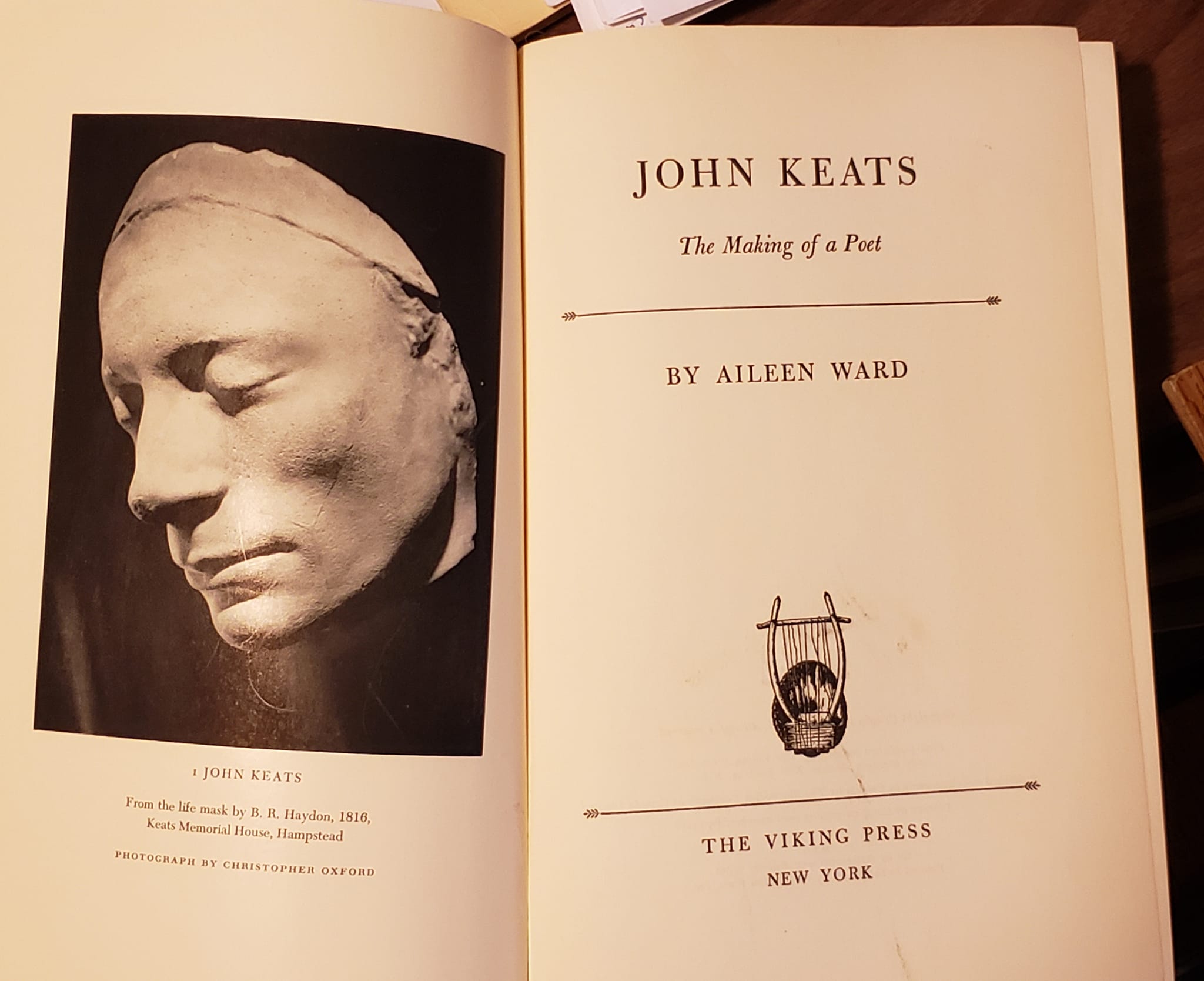
The book title page and the frontispiece: a “Life mask” from 1816
In July, while looking around for a book to read—a book I would find interesting yet wouldn’t want to keep after reading, I saw on my bookshelves in the storeroom John Keats: The Making of a Poet. By Aileen Ward, published in 1963, this was perfect. It looked like serious biography, the subject of poetry still holds my interest, and I didn’t think it would be a book I’d like to read twice.
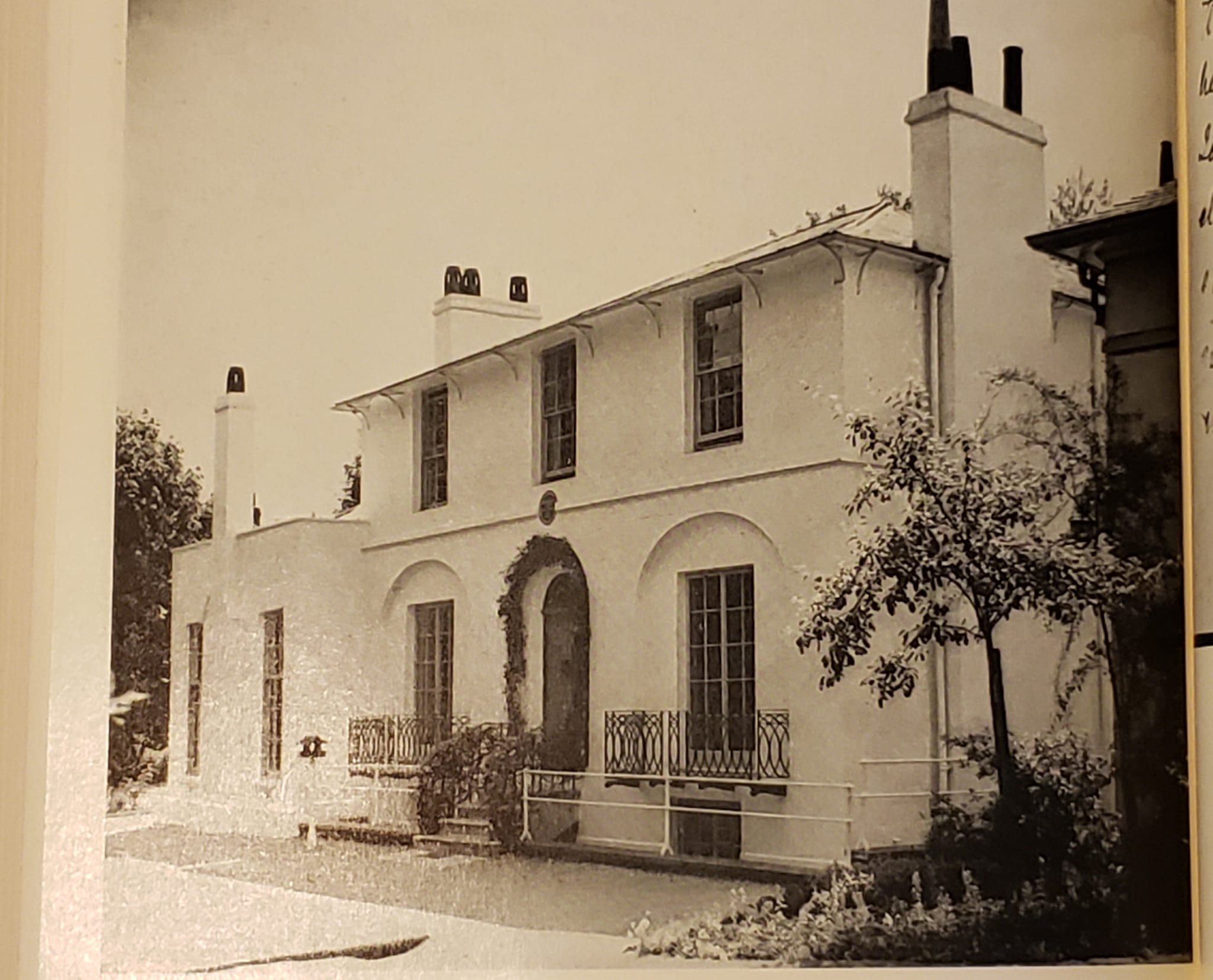
Wentworth Place, where much of Keats writing took place.
Born in 1795 in London, son of a groom/stableman, Keats was one of the “Romantic era” poets. The last major one to be born and the first to die. Before reading this, I knew his poetry and read some of it. I have, somewhere upon my over-stuffed bookshelves, a small volume that someone pulled together of best-known works, and a volume of his complete poems.
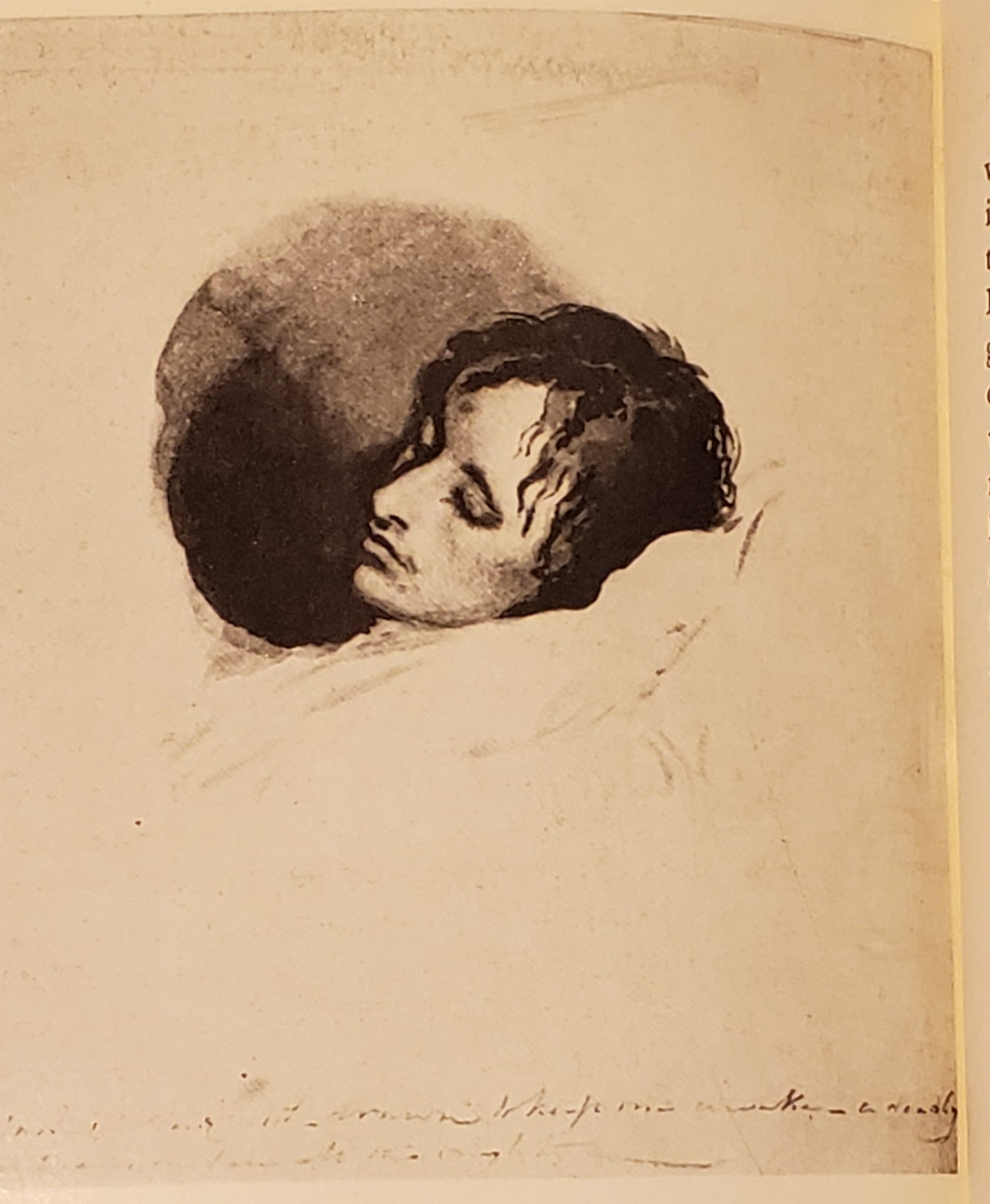
But I knew little about the man except about his tragic death from consumption at age 25. This book told me much about him. His father was a hard worker who opened a business for stabling the horses of travelers; he died when Keats was 9 and away at boarding school. His mother was a gadfly who quickly remarried upon her husband’s death, left the family for a few years, then returned in time to have Keats nurse her through the final stages of consumption when he was a teenager.
A sketch of Keats on his deathbed, 1821.
Keats took up the study of medicine and seemed to do well with it. He was at the point of launching into one of the lower-level medical sub-professions when poetry became his main interest. He began to write it and found he could do it. Alas, he fell under the influence of Leigh Hunt, who was roundly disliked by the better known literary critics. Hence Keat’s first poetry book, published in 1817 while he was still planning on a career in medicine, was also denounced by those same critics.
Despite this, Keats laid aside the medical field and took up poetry as his vocation. His long poem, “Endymion,” published and panned by the critics, is not considered a classic. According to Ward, many of his shorter poems were autobiographical, written about this or that person, or place, or event. The most famous of these is “On First Reading Chapman’s Homer”.
But Keats struggled financially, as well as in his health. He never received his full inheritances from his parents and grandparents, never earned much from his published poems, and lived without extravagance.
This biography does a good job of telling all of this, sometimes in almost too much detail. But it does keep moving and did keep my reading. I read about 10 pages a day in my noon reading time, in the sunroom our outside in the woods when the weather cooperated, and finished it in a little over a month.
I found the sources used by Ward and her way of spinning them into the story particularly impressive. Despite how old this is relative to our modern times (Keats died in 1821), it seems she was able to document close to every day of his life: when he wrote which poem and why; where he traveled; who he dined with; what his health was like at the moment. It helped that Keats left an extensive correspondence behind at his death.
I am so glad I saw this book on the shelf and read it. I rate it the full 5-stars. I’ll not read it again and it’s not a keeper. But learning about this little piece of poetic history has acted like a tonic in my reading life.
It is very cold today, two years before Christmas day. Perhaps some of the snow will stick around and we’ll have our first white Christmas in over ten years.
Last night was cold, probably -6°F, with the wind chill around -25°F. That’s a little colder than the coldest day here in the average winter season, which is more like 5°F. And it’s only December. Lots of winter days and nights to come.
Despite that, the house felt warm last night. Our new (as of August) heat pump kept cranking. Once I turned the heat down to 65° for nighttime, it kept the temperature there without having to resort to emergency heat. When I got up this morning just before 7 a.m., I walked around the house a little before dressing for the day and felt warm.
Our Christmas cacti are all blooming, both upstairs and down. They know the season even without us doing much with them except occasional watering.
Then again, for some reason I was hot last night. It’s -6° out and I’m hot. I got up and sat in my reading chair with a light blanket over me until I cooled down a little, then went back to bed. Now, down in The Dungeon, where I keep the basement thermostat cooler than upstairs, I feel just a little chilly, as I like it. I can just see a little of outside through the blinds, where the one vertical slat is missing. Tree branches are not swaying, so it appears the wind has tapered off. I see snow on the ground on the far side of the hollow from the 2 inches we got yesterday. And, just off to the right, I see the bright horizon where the sun is about to break over. We haven’t seen much of the sun for three days or so.
The tree may not be fully decorated, but at least the Christmas village is up. But only because after last Christmas we left it up, toys added by the grandkids and all.
Upstairs, our artificial Christmas tree is up and the lights are on. Today, Lynda and I will work together to add the ornaments, then clean up the boxes and storage bin. Might even vacuum, though that is more likely a tomorrow task. I wouldn’t even have put it up except for the family coming in a couple of days after Christmas.
In all of this, I’ve been searching for a metaphor about Christmas and life and maybe writing, but no metaphor comes to me. Alas, just as poetry no longer comes to me. Maybe that’s because I’ve been working mainly on prose for the last 18 years. Or maybe it’s because I wasn’t much of a poet to begin with.
A metaphor of the Christmas season, a metaphor of the start of winter, a metaphor about writing. Seems like something should come to me.
Well, I will end this, my last post before Christmas. Be safe everyone. Remember Jesus on this celebration of his birth. And as Tiny Tim said, “God bless us, everyone.”