Category Archives: letters

January Progress, February Goals

UPDATE: Everything below I wrote last Friday, in anticipation of where I would be at the end of the month. I didn’t know I was going to have a stroke on Saturday. More on that in a future post.

I didn’t really set goals for January. It took me so long to think through what my goals for all of 2024 would be that it was well into the month before I could even think about monthly goals. So I’ll state some goals as if I had made them, or pull them from my annual goals.

  • Attend two writers group meetings. One meeting was cancelled due to weather. I attended the other.
  • Blog twice a week, on Mondays and Fridays. I accomplished this, with a meaningful blog on all days.
  • Get to work on A Walk Through Holy Week, Volume 8I started this on Jan. 22, a little earlier than expected. As of the end of the month, I’m more than 50 percent done with it. So far the writing has flowed easily. UPDATE: I’m not 50 % donel
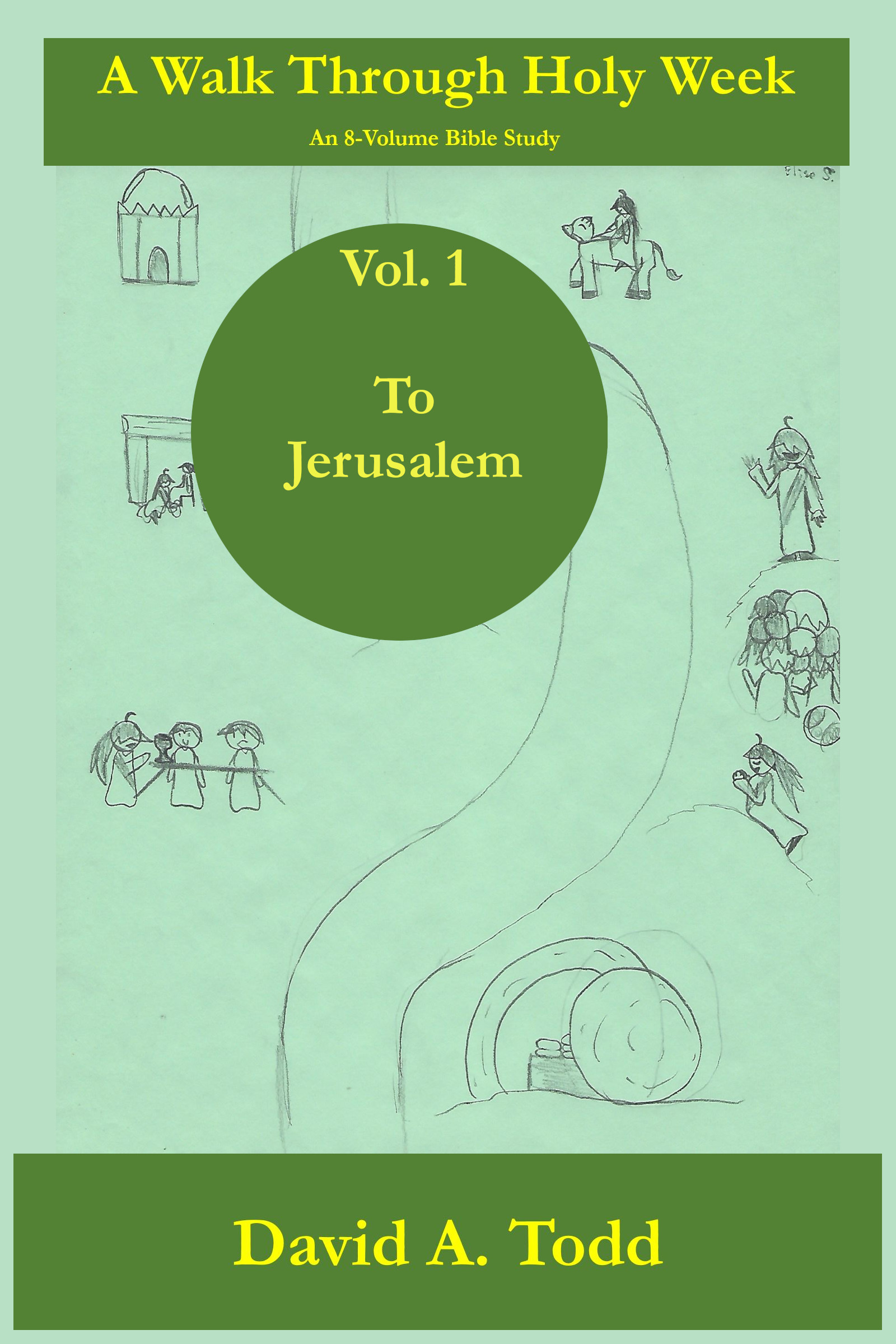
  • Finish editing and publish A Walk Through Holy Week, Volume 1. I finished the editing around Jan. 10th and got to work on formatting for publication. Bogged down a little on the cover, as I had to first create a template for the whole series. The e-book template was done on Jan. 26. 
  • Begin reading in a source for the next Documenting America book. I did only a little of this. I enjoyed what I was reading—about debates in the Boston newspapers in 1774-75. But I wasn’t sure, from the little I read, that this was the right subject for the next volume.
  • Finalize and publish the latest short story in the Danny Tompkins series. Nothing done on this.
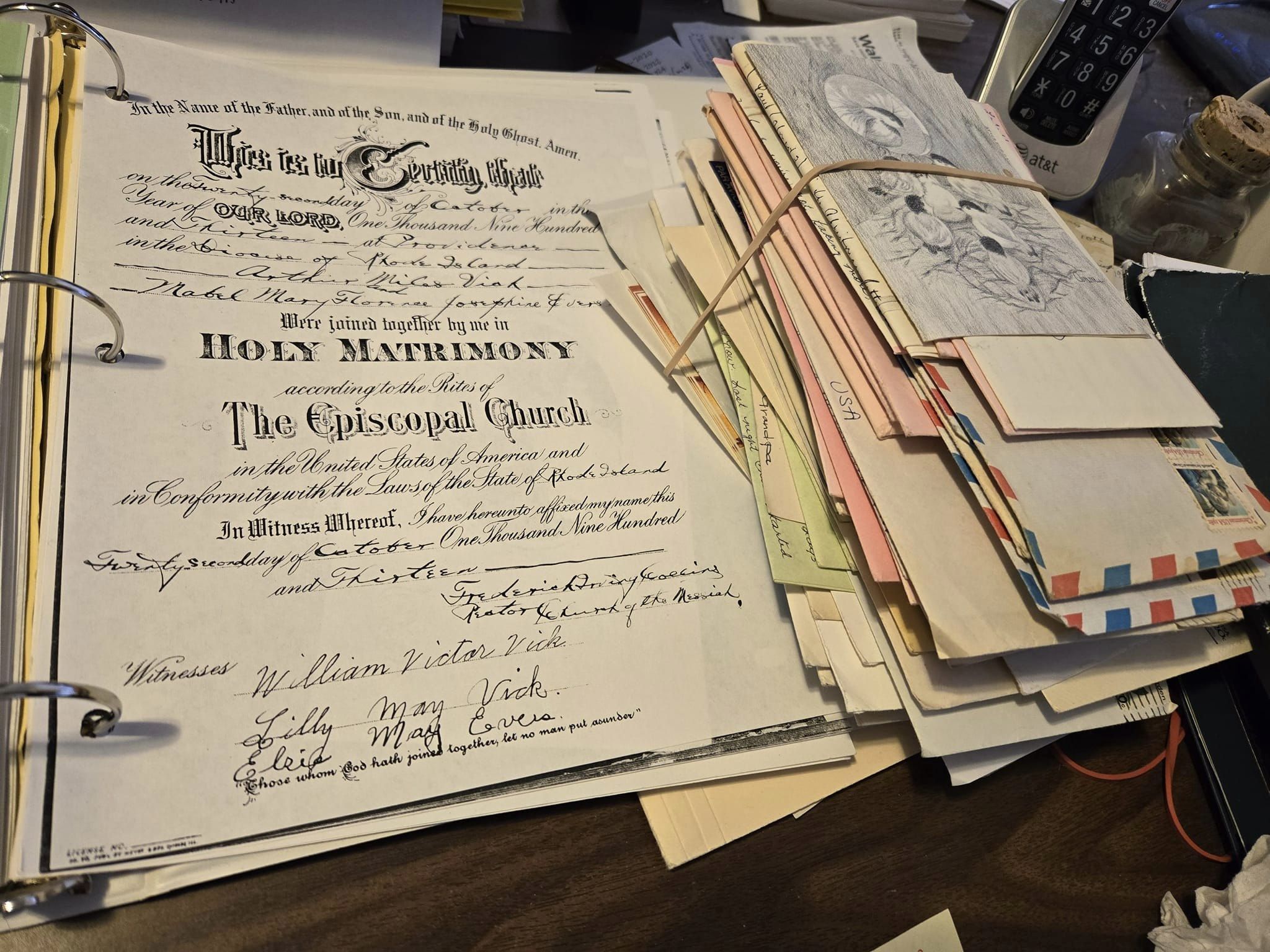
  • Begin transcribing the letters from our years in Saudi Arabia. I’m hoping to start this in February. I started this in January, around the 15th. I’m not sure why; it just seemed right. As of now, I have completed all the letters for 1981 (a partial year), and made a small start on 1982. Lots more to go. UPDATE: I still have 6 or 7 letters to go.

So, all in all a good month. What about February? Here’s what it looks like to me.

  • Blog twice a week, on Mondays and Fridays.
  • Attend two writers meetings.
  • Make major progress on Volume 8 of A Walk Through Holy Week. Based on January progress, I might be able to complete the first draft in February. UPDATE: Probably only 60 percent.
  • Finish all publishing tasks for Vol. 1 of AWTHW, both e-book and print version.
  • Make a couple of new ads on Amazon. Maybe one for There’s No Such Thing As Time Travel and one for A Walk Through Holy Week, Volume 1.
  • Continue transcribing our letters from Saudi Arabia.
  • Continue reading in some source for the next Documenting America book.

And that will do it. My typing is impaired by the stroke. Still not ready to pound the keys at a rapid pace.

Writing Goals for 2024

If you’ve been reading my last few posts, you know I’ve been hesitant to set goals for 2024. My problem is having too many projects in different stages to work on all of them. So I laid out all the projects I’d like to work on if I had infinite time. This is just projects that have taken up some of my brain power in the last two years, not things that are in my writing ideas folder, actually folders, both paper and computer folders.

I’m still not sure of this, but I need to set goals. So here they are. I’m dividing them into two sections: Realistic Goals, and Wouldn’t-It-Be-Wonderful Goals.

Realistic Goals

  • Finish editing A Walk Through Holy Week, Part 1 and publish it. I’m targeting the end of January for completing this.
  • Pull Documenting America: Run-Up To Revolution from Kindle Vella, and publish it as a print book and e-book. This will not be a large project. I’m targeting February for completing this.
  • Write A Walk Through Holy Week, Part 8, simultaneously with teaching it. That should be February through April. Publishing will be delayed until the rest of the series is published.
  • Write A Walk Through Holy Week, Part 2 and publish it. This, I hope, is a four-month project, or maybe a little more. This should be a fairly easy project to complete, because I’ve thought much about it and done a fair amount of planning.
  • Get to work on A Walk Through Holy Week, Part 3. I’d like to say “and finish and publish it,” but I’m not yet sure if my other projects will be completed on schedule.
  • Make final edits to my short story, “To Laugh Again”, and publish it. I suspect this will happen in odd moments during other projects. This should be in the first half of the year.
  • Write and publish the next book in the Documenting America series. I hope to decide what the subject of the book will be by the end of March, and to write the book the second half of the year.
  • Begin transcribing the letters from our years in Saudi Arabia. I’m hoping to start this in February, though more realistic is in the second half of the year. Part of the problem is I don’t really know how many letters there are, so I don’t know how big the project is. That’s why I can’t plan on when I will finish it.

So those are the Realistic Goals. Now for the Wouldn’t-It-Be-Wonderful Goals.

  • Update The Candy Store Generation for the last several election cycles, and re-publish. I’d like to do this by July.
  • Work on the John Cheney book. By the end of2024, I’d like to have the full structure of the book known, and several chapters written. If I do work on this, it will be in odd moments, multi-tasking while watching TV. I have no goal for when to publish it.
  • Work on the Thomas Carlyle bibliography. As with the John Cheney book, this is for off hours, multi-tasking. Again, I have no goal regarding publishing.
  • Work on One Of My Wishes, a new poetry book. Since at present I have no inspiration for writing new poetry, I’m not sure if this will ever happen.
  • Outline the next book in my Church History Novels series. I won’t say any more about that right now.

So that’s it. Lots of plans, lots of hopes, lots of effort and efficiency needed to come close to all of this.

Book Review: The Letters of Abelard and Heloise

Abelard and Heloise, publishers may think your letters are interesting enough to publish, but I’m not going to waste any more time on them.

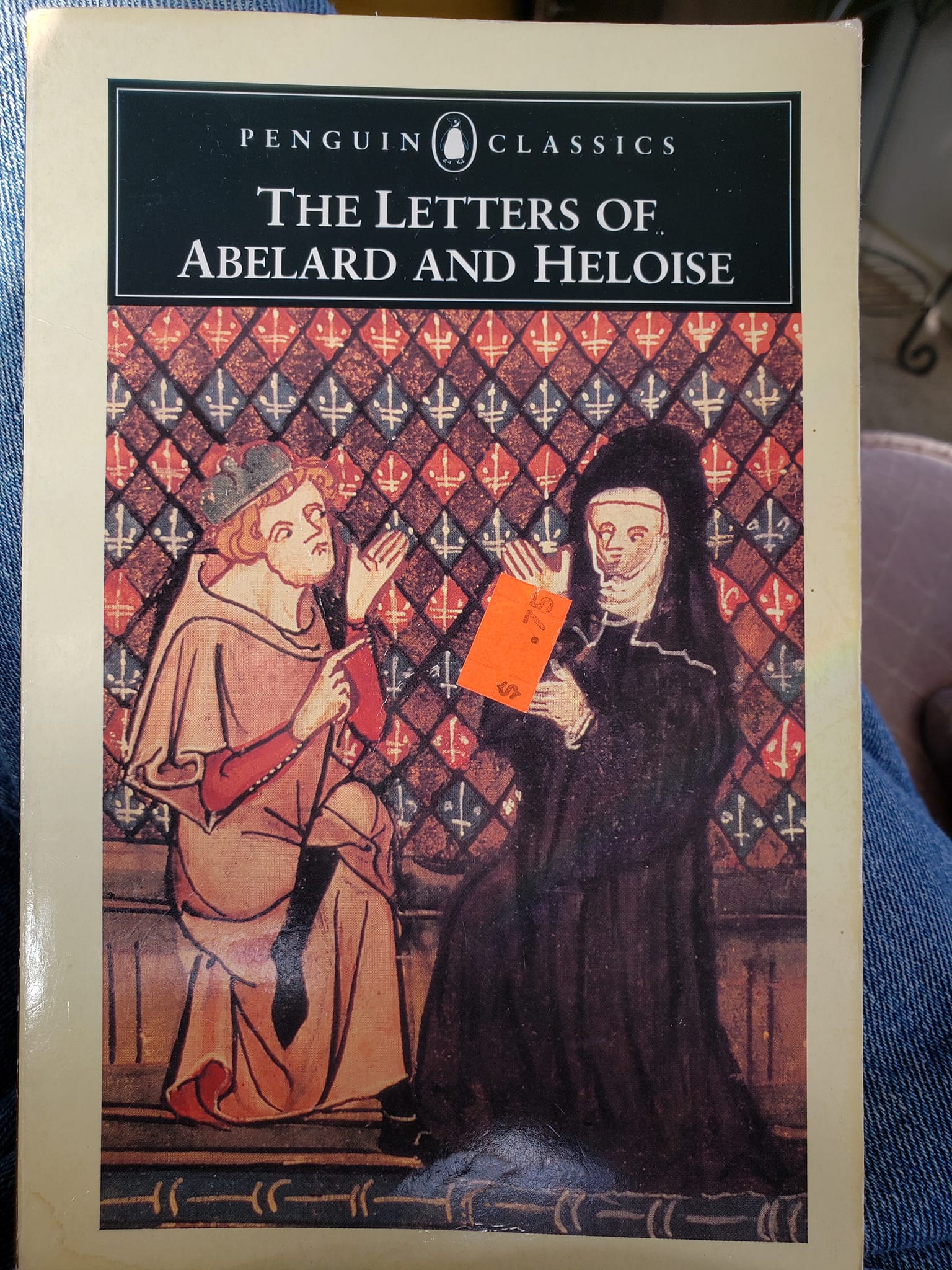
Given my love of reading letters, it should surprise none of my readers to know that I picked up The Letters of Abelard and Heloise for my reading enjoyment. I bought it used for 75¢. Good thing, too, given how the book turned out.

I had never heard of these two. Peter Abelard, b. around 1079, was a French philosopher. Schooled in the liberal arts, he fell in love with Heloise. She was from Paris. Somehow they met and had an intimate relationship. Surviving letters suggest he wanted to marry her, but she refused. Believing that marriage amounted to legal slavery or the wife, or that the wife was essentially nothing more than a gold digger, she wrote to Abelard:

God is my witness that if Augustus, Emperor of the whole world, thought fit to honour me with marriage and conferred all the earth on me to possess for ever, it would be dearer and more honourable to me to be called not his Empress but your whore.

That’s quite a statement to put in print, but that’s how she felt. His reward for her being his mistress was castration by a mob employed by her uncle. Before that, they had a child together. After his mutilation, he became a monk and she a nun. For the rest of their lives they lived apart. Abelard established a convent and put Heloise in charge of it. They rarely met after their going into religious orders, but exchanged a number of letters. These have been passed down to us.

My copy of this book, a Penguin Classic, includes a lengthy introduction, which was good to read, but was about twice as long as I would have liked.  Before the letters was an item Abelard wrote about his trials and tribulations. That item wore me out. The English translation from the original Latin was okay, but I didn’t find the story engaging.

Then I got to the letters. One from Heloise was first, the one with the quote above. Abelard responded, the Heloise to him—all long letters—and by that time my mind couldn’t take any more of it. I rarely give up on a book, but I did this one. I quit on page 139 of 295.

I’m not going to hang onto this book in hopes I’ll read it in the future. I have too many books, and too few years left, to keep reading books that don’t hold my interest. 2-stars for this one.

Book Review: Carlyle Letters Online

Regular readers of this blog (all two or three of you) know that I love letters. Not just to receive them, or write them, but to read them in historical collections. Some years ago, I acquired electronic files of Carlyle’s letters with Ralph Waldo Emerson. Somewhere I picked up a print copy of one of the two volumes, and then a print copy of other letters of his.

The Carlyle Letters Online is a project I’ve used frequently, with many hours of pleasurable reading and research.

From an internet search, I learned about the Carlyle Letters Online. This is a project to put all of the letters of Thomas and Jane Carlyle online in a searchable and highly usable database. This followed the print edition of the letters, which took place from 1970 to 2023, is composed of 50 volumes.

The online version began in 1999. By that time, many letters by the Carlyles that had escaped earlier detection and collection had been found. The number of letters in the online collection is over 9,000 in all, more by Thomas than by Jane.

This review is really only over the first ten volumes of the online collection. which cover the period from 1812 to 1838. I have no idea if I will ever get to the other 40 volumes. In fact, I confess to not having read every letter in Volumes 1, 2, and 3. At that time, I was trying to find letters about specific topics. Beginning with Volume 4, I have read every letter in each volume. It’s taken me a few years to do this, reading one or two letters many nights right before going to bed.

Many of the letters are to family members. Though Carlyle was a man of letters, in the volumes I’ve read, there weren’t many letters to literary men. There were some, of course. By 1838, Carlyle was just starting to gain a following. Soon his circle would expand and include more than Emerson, Mills, and Sterling. I’m anxious to get into those letters.

Thomas often writes in typical Victorian language: flowery, hard to understand, complicated sentences, many references that are now obscure. Sometimes the letters were hard to understand, at least beginning to end. He used a lot of private references we would call coterie speech.

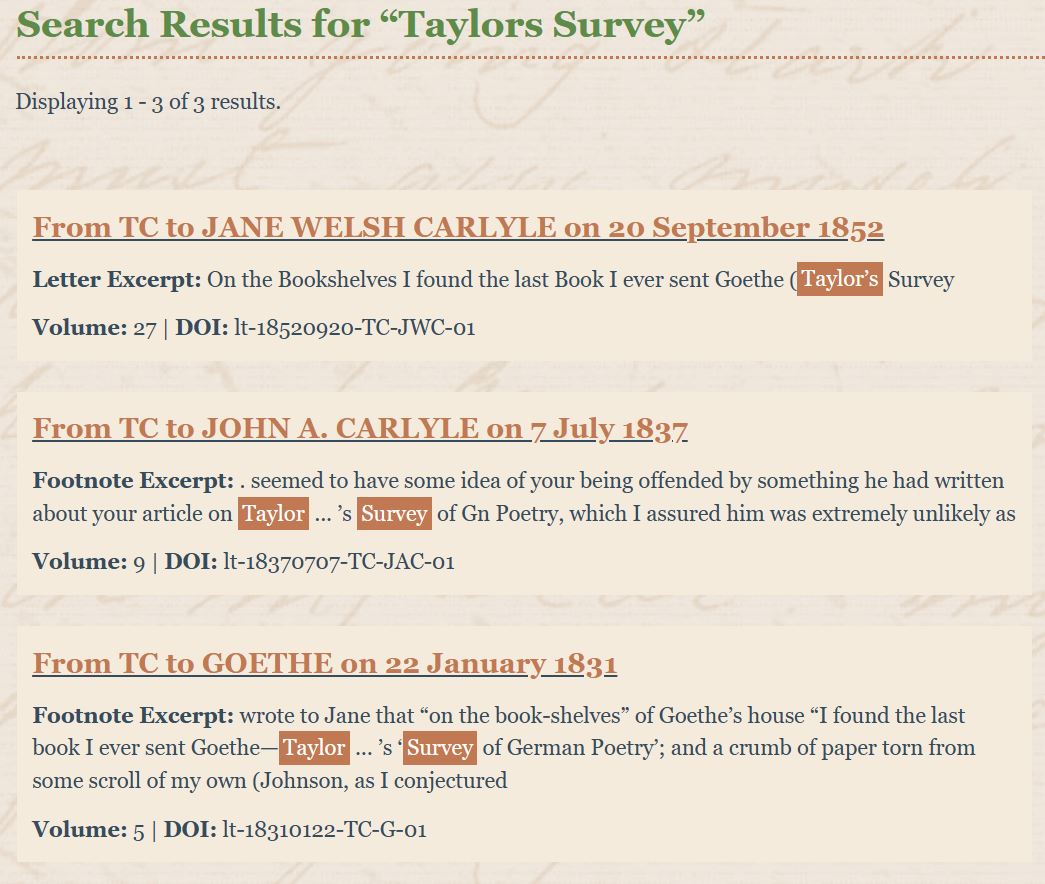
A sample of how using the index works. Very useful and efficient.

Fortunately, the CLO has copious footnotes on many subject, making the obscure more understandable. It also has a good indexing system. A few years back the index showed on each letter—links to the items in the letter that were indexed. Type about anything Carlyle-related in the index and it brings up results with links to the letters you’ll find that item in. The illustration with this paragraph shows an example of references to one of Carlyle’s less well-known essays.

I don’t know how much time I’m going to put into reading these letters for a while. After finishing Vol. 10 I’m taking some time off from reading them. Oh, I still open the database from time to time and read a letter. I’ll get back to it in a bigger way, maybe next year some time.

While the collecting of the Carlyles’ letters took over a century, and is not over yet, it’s a massive project that has a very specialized audience. I don’t necessarily recommend people rush out and buy either the print letters or start perusing the online letters. For me, they are a source of pleasurable reading.


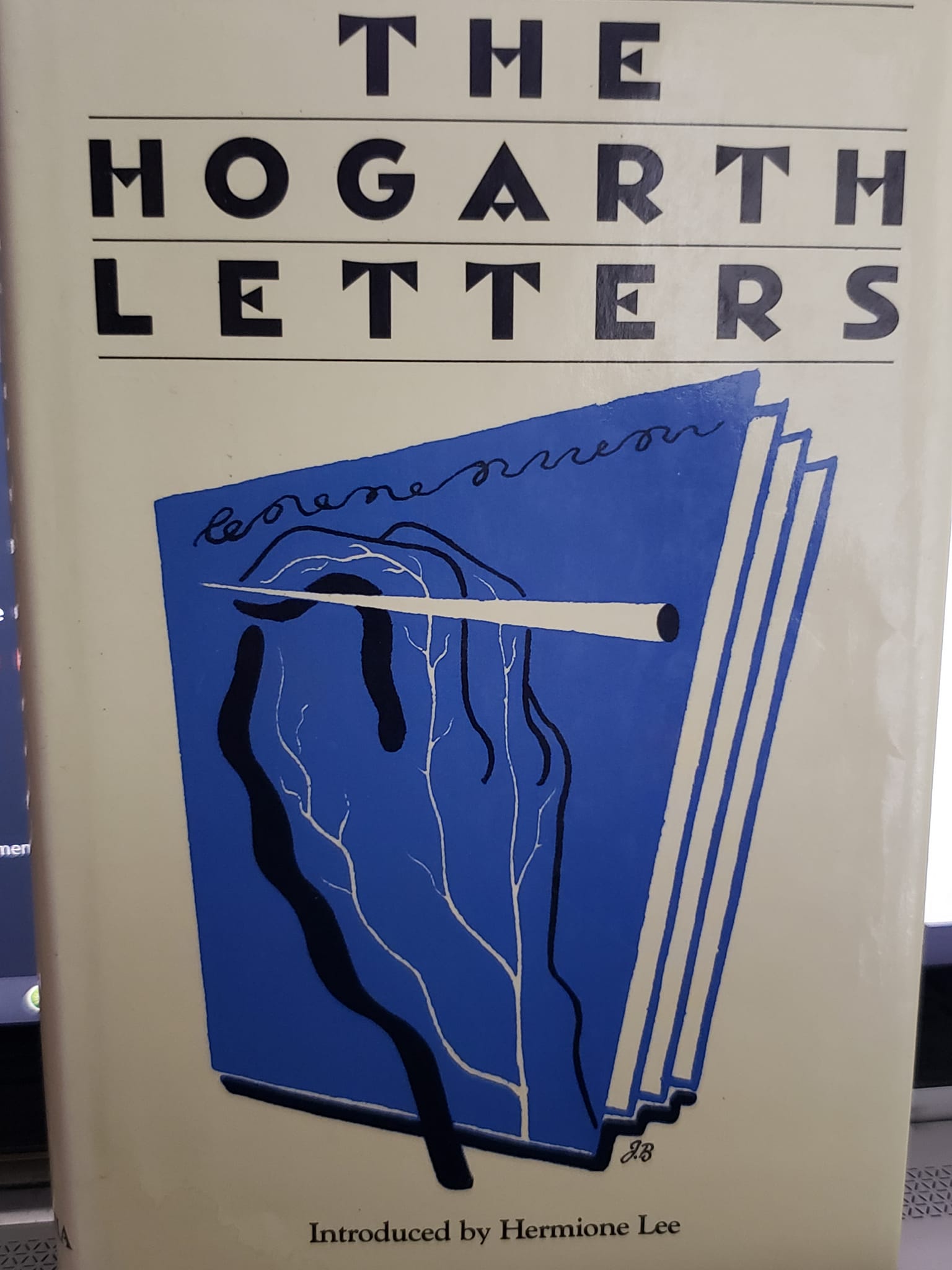
Book Review: The Hogarth Letters

Not a keeper; only 2-stars; not recommended.

It’s difficult to remember where I picked up different books. Before embarking on this road trip, I searched my bookshelves for a book to take to read, something that looked interesting but was probably not a keeper. In the basement, in the area where we set up a bed for when needed when we have lots of company, I found a book titled The Hogarth Letters. I had no idea what it was about, when I got it, how new or old it was, but it sounded perfect. Upstairs and into my book bag it went.

It turned out to be something much different than I expected. I love reading letters (as regular readers of this blog will know), but it turned out this book wasn’t really letters. This was a publisher’s (Hogarth Publishing) stunt from the early 1930s. Twelve different people—writers, politicians, etc.—wrote fictitious letters to people. Not necessarily real people. What the “letters” were were essays disguised as letters. The subjects were of the authors’ own choosing, and the person behind the stunt—er, project, Hermione Lee, did an introduction.

Essays from Great Britain from the early 1930s. The Great Depression was on world-wide, or coming on. It was the time between the two world wars. Communism was on the rise. Some of the essays, such as the one by Viscount Cecil, dealt with disarmament. I read that one through and learned from it, though many of the references and circumstances were obscure in 2023. Still, it wasn’t bad. A couple of other letters/essays were to real people, such as Madan Blanchard, Virginia Wolfe, and W.B. Yeats, the poet. Others were to a fictitious person representing a class, such as an archbishop, a modern novelist, a young poet, a grandfather.

I began this book at the beginning, even though a book such as this could be read at any of the essays that seemed, from the title, most interesting. I read the first couple all the way through, but then I found them increasingly uninteresting. I started reading them, found myself skipping or just reading the first sentence in each paragraph. The last three or four essays I quit after getting halfway into them and finding myself not benefitting from the reading.

I plan on abandoning this book, but not quite yet. As I write this, I’m halfway into the letter to W.B. Yeats. I may finish it. I have six more essays to go, and I will at least start each of them and perhaps finish a couple.

Originally published in 1931 (my copy re-published in 1986), I can’t recommend this book. Perhaps I’ll feel differently if the last six letters/essays are better than the ones I’ve read. If I leave a rating somewhere, it will be 2-stars. Maybe they seemed interesting at that time, but almost 90 years later, not so much.

Nor is it a keeper. When we get home, it will go straight to the donation pile. And it goes into the category of, “Where did I get this book (for $3.00, apparently), and why did I think I needed it?”

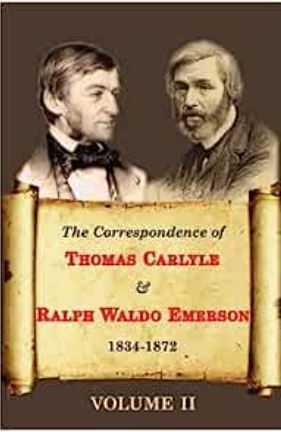
Book Review: Carlyle-Emerson Correspondence

Two volumes of these letters are well worth reading. They are available without charge, being out of copyright, from Google Books and perhaps other places.

I had planned to write a post today about the pastoral change our church is going through, but I think I’m going to wait until Friday for that. So here’s a book review, of the book The Correspondence of Thomas Carlyle and Ralph Waldo Emerson.

I first read this during the early 2000s, having found it on Project Gutenberg, downloaded both volumes, formatted them for a good mix of easy reading and concise printing, and printed them. I read them rather quickly, my second foray into the world of letter collections after the letters of Charles Lamb. Recently I learned that you can upload a Word file to Kindle. I did so with these two volumes and read them again on my phone.

At that time, Carlyle I was just beginning to know, and Emerson was a total mystery to me. Neither man had been part of the curriculum in my school years, and my adult reading up to that point had been in different directions. Why I happened upon these volumes, why I downloaded and formatted them, and why I shoved other reading aside for them are all mysteries to me.

But read them I did, and loved them. These two literary giants, from opposite sides of the Atlantic, both influential in their milieu, both men who enjoyed friendship. Carlyle was probably the more brusque of the two, Emerson the more gentle. They divided over politics, including the question of slavery. Hard to believe in this day, but Carlyle was pro-slavery, and this became a wedge between them.

Yet the friendship endured. Emerson, who had both inherited ad married into money in America, took note of Carlyle’s poverty and became his promoter in the New World, where he thought Carlyle would find an audience. He found publishers and negotiated deals favorable to Carlyle. Soon, dollars were sent eastward to be converted into pounds, and Carlye could soon say he was not poor any more. Implied was he was now free to write what he wanted rather than to write for money.

The friends met during Emerson’s three trips to Europe. The first time, in 1833, Emerson (who was totally unknown to Carlyle) sought out Carlyle, whose magazine articles Emerson had taken special note of. They had a 24-hour visit before Emerson left for the return voyage. But the conversation was stimulating. Eight months later, Emeron wrote to Carlyle, and the forty years of letters commenced.

The letters are rich in the words of friendship. They discussed their writings, their homes, their families, their lives. At one point, Emerson pulled back from immediately returning Carlyle’s letters, at least in part due to the rift over politics. The correspondence never ended, but it tapered off. The first twenty years include at least twice the number of letters than the last twenty.

The Emerson quote I include on my website comes from one of his letters to Carlyle. In this, my second reading of the letters, I found great enjoyment. I suspect someday I will read them again.

Learning a Word: Ontological

Unlike the last word I took note of on this blog, today’s word is not archaic. I came across it in a magazine article I’m reading on-line. Here’s the quote.

Annabel Patterson, [her section], in her [article], explores the “peculiar ontological status of letters as texts, as generic modifiers, or as members of a distinct and in some ways unique genre,” arguing that the correspondences of [three old Englishmen] a natural Ciceronianism.”

The article I’m reading has to do with collections of letters. Having just done my talk on collections of letters to the Northwest Arkansas Letter Writers Society, my urge to read more about the topic has not yet run its course. Hence, I did a search for “letter collections” on JStor, and this is one that popped up.

The definition I find for ontological is:

  1. relating to the branch of metaphysics dealing with the nature of being: “ontological arguments”
  2. showing the relations between the concepts and categories in a subject area or domain:
    “an ontological database” · “an ontological framework for integrating and conceptualizing diverse forms of information”

I gotta tell you, that doesn’t help a lot. The study of “being”? I don’t really know what that is. I looked up ontology and got this for a definition:

In metaphysics, ontology is the philosophical study of being, as well as related concepts such as existence, becoming, and reality.

Which wasn’t any help.

All of which suggests to me that I’m reading the wrong things.

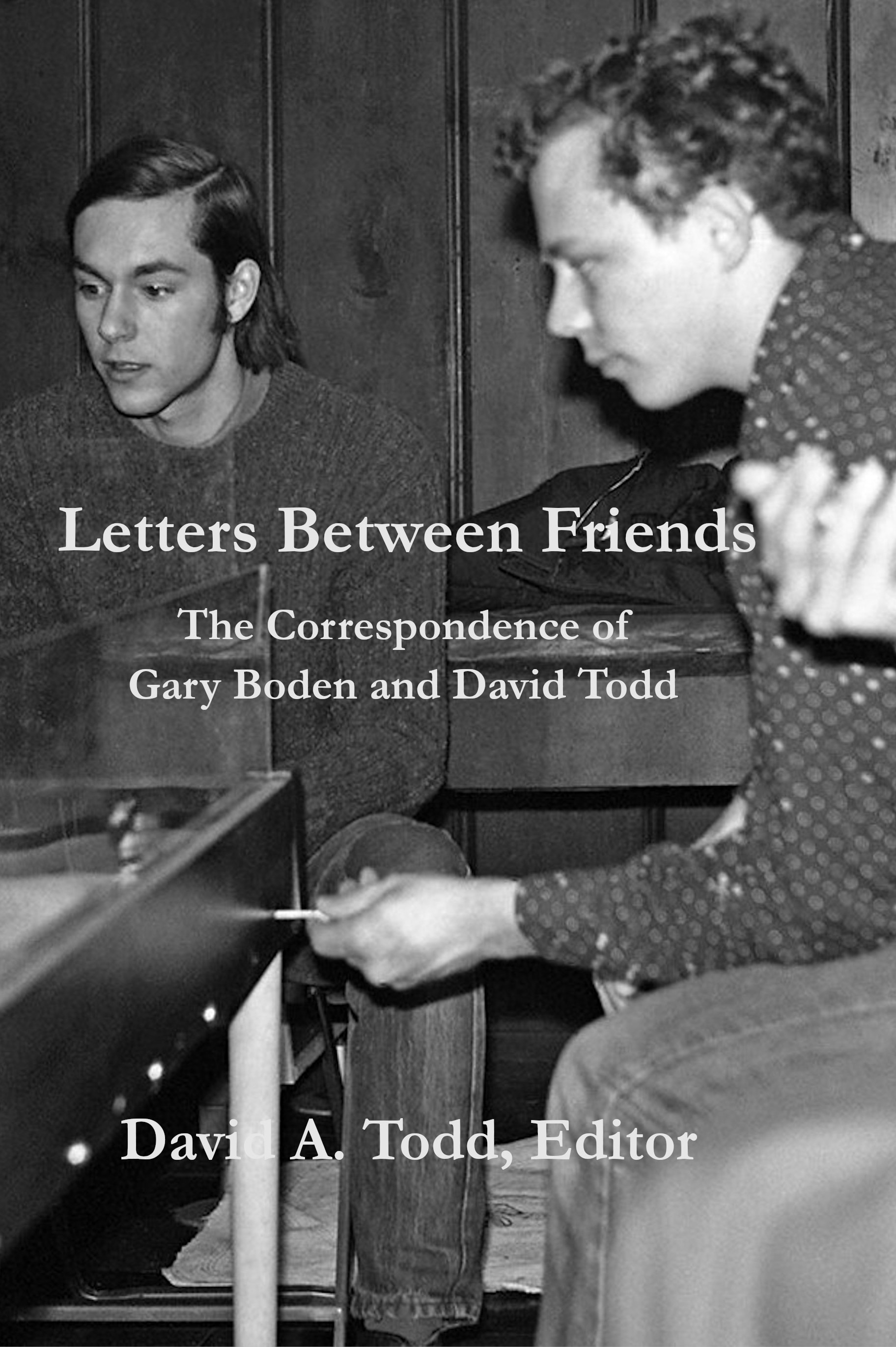
Letters Between Friends

Corrected, redacted, and now available as an e-book. And as a paperback, though that’s quite expensive.

My latest book, Letters Between Friends, is different. It is a collection of letters, mostly sent as e-mails, between Gary Boden and me. We met in high school, most likely when we were both on the track team. Our real friendship began in college, however, and continued on into adulthood. We had many common interests, including track, boy scouts, political views, and summers spent on Point Judith Pond in Rhode Island, our houses visible to each other less than a mile away but a five mile drive to get from one to the other.

The idea for this book came to me shortly after Gary died in July 2020 (not from covid). I took a little time to pull up all e-mails he and I had shared through the years, all of which I had saved. I found it to be a rich exchange of ideas, happenings, and on occasion foolishness.

The idea came to me to pull these together into a book to present to Gary’s widow and daughter. I didn’t know if Gary saved e-mails the way I did. I thought that would be a nice gesture, a lasting memorial to Gary and to the friendship we shared. While I exchanged e-mails and sometimes snail mail with a few other friends, they amounted to a tiny fraction of the amount Gary and I shared.

I asked Gary’s daughter about what e-mails he kept, which turned out to be fewer than what I had. I’m not sure mine are a comprehensive record. In fact, I have only one letter before 2007, one that Gary sent with a Christmas card in 1993. I had an e-mail program I used before 2007, but alas, those letters are lost into the ether.

The letters in the book include some from a few other besides Gary. In those years when I made trips to Rhode Island, four of us would try to get together. The e-mails usually flew between us as we tried to coordinate our schedules. Then, after my visit, we kept up the multi-person exchange for a while. All but one of those correspondents were fellow 1970 graduates of Cranston High School East.

These letters are not works of art. They are what would be called “familiar letters”, not artistic letters. They capture normal thoughts and communications. For me, those are the letters I tend to like to read best. I left in all the typos so as to reflect what we read at the time they were sent. Here’s an example, showing excerpts from letters we exchanged on 17 November 2008, a day Gary and I celebrated as National Boise Idaho Potatoe Day (don’t ask why):

David to Gary: I begin my work day, at least the pre-hours, by wishing you felicitations on this glorious day. I’m afraid the adherants [sic] to what should be a national holiday are slowly dwindling in number. Is it more than 2? Or has it always been just 2?

Thanks for coming by and reading my blog….

Gary to David: May you also have a grand and glorious NBIPD.

It’s always been only two.

I don’t know how you keep up the volume of writing you do and have time for anything else. Maybe it’s that engineering training and a billable hours mindset that makes you efficient. It’s fun to check in on your blog and I’m curious about a lot of things so your topics naturally raise some questions for me.

I had planned to have the book ready to go in time to take it to Rhode Island in August 2022. Unfortunately, I had to cancel my trip there. So I completed the book and shipped it. I published it on Amazon so that a few friends could buy copies. My plans were to pull the book down after everyone had made their purchases. However, one of the correspondents thought it was so great, he posted it on Facebook for the world to see. I quickly asked him to take it down, explaining that I hadn’t sought permission of the copyright owners for publishing their letters to a broad audience. He removed it. Another correspondent in the book said he, too, thought I ought to let the book be known to the world.

So I went through the process of obtaining the permissions needed. Two correspondents asked for a handful of redactions, which I made. I saw two redactions that should happen as well as a half-dozen typos to correct, and I did those. Then I reformatted the book for print, and developed an e-book. I uploaded the new files on Saturday, March 18. Amazon approved them the same day. The book had remained for sale all the time while the permissions process was progressing.

Now, Letters Between Friends is out for purchase by the general public. Letter collections are not very interesting to most people, so I don’t expect this to be a best-seller. In fact, I would be shocked if it sold more than 10 copies. But it’s out there, for whatever good it will do. It is available at Amazon should you want a copy.

A tribute to a friendship cut short.

Thinking About Letters

I made this presentation on Tuesday, but still haven’t put the stuff for it away.

When I came to The Dungeon this morning, mug of coffee in one hand and laptop computer in the other, I was greeted by a mess. Lots of writing related stuff strewn on my near worktable. A few stray income tax forms on the printer table (making me wonder if I forgot to put one in the packet I mailed to the IRS).

And also on my worktable, some things about letters. Three are notebooks that contain just a few letters, the ones I’ve been digitizing then discarding the originals. I need to consolidate them into one notebook and complete the process. Three notebooks to go to a thrift store, a little more free shelf space.

Somewhere, either on the worktable or possibly upstairs still, are the things needed for the presentation I did on Tuesday to the Northwest Arkansas Letter Writers Society. The topic was “Letter Collections: A Window on History in the Making”. The presentation went well, and we had a good number of people there. Now I need to get a number of books back on shelves and my notes somehow stored so that I can find them again should I ever need them.

Gary is gone, but the letters between us live on. A few edits to this are possible this month. Hang on, folks. It will soon be done and available.

Then, there was the book Letters Between Friends. I thought I had written about this before, but a look back on my posts indicates I haven’t. I guess that was because I wasn’t quite ready to announce this project to the world. And, actually, I’m still not. I finally have permissions from all copyright holders to publish the book, but I had a few redactions to do then reformat as needed. I also felt I should add an e-book, which takes some more formatting.

But I found my copy of it, before redactions, on my worktable. I need to find two hours of time for completing this project, then let people know it’s available. It will be of interest only to family members and classmates of the people involved. Perhaps 20 copies will be sold. I would consider that a success.

But when will I get to it? The two Bible studies I’m working on have consumed all my available writing time. And they will do so today. Somehow I have to carve out those two hours to complete that project.

And another two hours to complete what’s needed to get rid of those three notebooks. That may not take that much time. I should get to it. Right after supervising two workmen at the house today, one in the morning, one in the afternoon. Right after the weekly grocery run. Right after finishing a letter to my oldest grandson. Right after…

…oh, where is my to-do list?

Oh, yes, I’m still reading that scholarly magazine article about letter collections. I should finish that today and dump the pixels back into the ether.

Monthly Progress and Goals

The sequel is done, and close to publishing ready. Hang in there, folks.

And, for the second month in a row, I forgot all about publishing my progress against my goals as the first post for the month and setting new goals. I should have done that Friday. What was I thinking? Well, a couple of days late, here they are. The progress first.

  • Blog twice a week, on Monday and Friday. Yes, I did this. I liked the series I thought of, posting library memories.
  • I won’t be attending writers meetings this month. There was nothing to do about this goal.
  • Edit and complete A Walk Through Holy Week, Part 6. … Part of this goal is to, at the end of February, have a publication-ready book. I completed this! I was able to knuckle down, finish all chapters and sections, add the Introduction, and declare the book publication ready. I even figured out a cover scheme for the series.
  • Begin work writing AWTHW Part 7, simultaneously to when I teach it. I have been doing this. Fairly successfully I think. My co-teacher and I have now taught two lessons in the series. Chapter 1 corresponding to Lesson 1 is complete. Chapter 2 corresponding to Lesson 2 is close to complete. Last night, after doing other things and watching some Miss Marple movies, I spent a very productive hour on it. I think I shall be able to finish Ch 2 today, putting me ahead of where I usually am for this simultaneous teaching and writing.
  • Get TKTTT to beta readers and receive their feedback back. I did this. One of two grandchildren read it and gave me feedback. I also sent it to an elementary school teacher to give to students who will be beta readers. No feedback from them yet, but it will be coming soon.
  • Work with the cover designer of TKTTT. Yes, I got with the cover designer. I gave her my ideas, and she will work with it. Hopefully she is working on it now.
Gary is gone, but the letters between us live on. A few edits to this are possible this month.

So, here are some goals for March.

  • As always, blog twice a week, on Monday and Friday.
  • Attend four writers meetings this month. I already attended the first one, held last Thursday.
  • Keep up with A Walk Through Holy Week writing simultaneously with teaching. You never know what curve balls life will throw at you, but, based on how this is starting, I think it is doable. By the end of March, I should be through Chapter 5 and have started on Chapter 6.
  • Finish either Part 4 or Part 5 of AWTHW. I actually worked on this a little last month. Or maybe that was Thursday-Friday, which would be this month. I spent time reading where I was when I pulled of this last year, split and organized files in the new part designations, and put a few words down. Part 5 is farther along than Part 4, but I feel like I want to get Part 4 done first. We’ll see.
  • Organize some writing ideas files. I began this last Thursday and presented them to the Scribblers & Scribes critique group. They liked one idea a lot, but not the other. A new idea came to me on Saturday and fleshed out a bit with brainstorming yesterday. I plan to document that on Monday—today—the put it out of my head until the time is right.
  • Get any needed edits done to TKTTT according to feedback from beta readers.
  • Make a handful of edits to Letters Between Friends, and republish it. This is based on feedback from copyright holders. This is not really urgent, and I may put this off until AWTHW and TKTTT are further down the road.

That’s enough. If I get all that done this will truly have been a productive month. Also, my business partnership taxes are due this month, which will cut into my writing time.