Category Archives: Writing

Harder to Multi-task

I’m concentrating quite a lot on my health these days. I used to use most of my noon hour to write. Now, as soon as I finish eating, I go outside and walk, either a half-mile or mile depending on weather. Once it cools down some I may punch that up to a mile and a half.

Once I get in from my walk, I may have fifteen minutes left in my lunch hour, a perfect amount of time to get most of a blog post written, or edit part of most of a chapter either of my own work or someone’s in my writers group. Alas, I find I have no concentration for either.

In the evenings, after supper, Lynda and I go for a walk, usually between one and two miles. It’s in the upper 80s at this time, so when we get home I go down to The Dungeon, where it’s cooler and I can cool down faster. And write, perhaps a blog post, or get going on a chapter in a new book or short story. Or prepare two other books for their print versions. Except the last few nights I haven’t been able to concentrate. I end up playing mindless computer games for an hour, cool down fine, but am unproductive.

It’s as if the quest for weight loss and better health have taken over my mind, my being, and I have no ability to concentrate on anything else. I suppose that’s the way it’s been a good amount of the last ten years with my writing. And for the five years before that for genealogy. But it’s worse now. Now the health quest is consuming me, and I have no ability to multi-task my brain and do some activities in the other things.

Unfortunately, I estimate it’s going to take me another year or even a year and a half to get to the weight range I should be in. If I keep up the walking and occasional flexibility exercise, maybe add a little strength training, I’ll be in good shape to match my proper weight. Can I go that long with single tasking?

I don’t think so. Somehow I have to come to a point where I can do all the things that interest me, all the things that I need to do, and do them simultaneously.

I think that will be my goal for the rest of this year: balance competing, good activities. I’ll report back later with the results.

July 2013 Sales


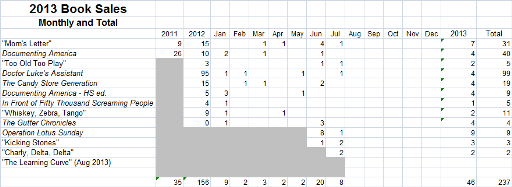
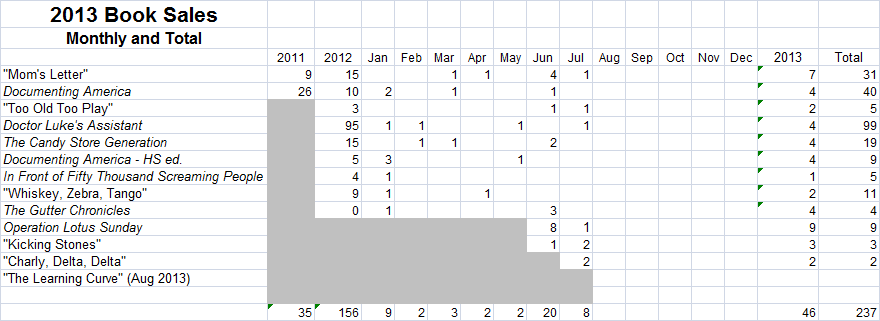
Here’s the book sales story for July 2013. Eight sales total. Seven of those were e-books and one a print book. That’s of six different titles. So that’s down from my 20 sales in June, but otherwise is way ahead of what I sold in February through May, and just behind the nine in January. Still not even thinking about bestseller lists.

I added one book in July: “Charley Delta Delta”, a short story. I’ll past in two sizes of my sales table, one easy to read and a smaller one of the size I have to use at my self-publishing diary at Absolute Write.

What’s Next? A Professional Essay

Just a few minutes ago I uploaded a short story, “Charley Delta Delta” to Amazon and Smashwords. It’s my twelfth item to publish (if you count the two versions of Documenting America as separate items. Time to move on to something else to write.

So it’s time to decide what to write next. Actually, I’ve already decided. I believe I will write the following, in this order.

I have a professional essay I wrote for work titled “The Learning Curve: 11 Suggestions for Accelerating Your Professional Development”. The essay was written specifically for my employer, CEI Engineering Associates, Inc. It needs some modification for the general market. I began going through it a couple of months ago, and got half way through it. I believe I can have it ready to publish in a week. Except I’ve got some graphics in it, and would need a cover. But they’re simple graphics, and I hope I can do them. So, I would hope to publish this in the first half of August.

This week at work I began writing the second volume of The Gutter Chronicles: The Continuing Saga of Norman D. Gutter, Engineer. In two lunch hours I wrote 850 words. The first volume was a 42,000 word novella in fifteen chapters. It deals with workplace situations, humorous things that have happened to me over my 39 year engineering career. I figure the new one will be about the same, and have about half the chapters planned. I have no schedule for this, but now that I’ve started I think I’ll keep on it till it’s finished. Although, I haven’t really thought ahead to the ending.

The next novel I’m going to work on is Headshots, the sequel to my baseball novel In Front of Fifty Thousand Screaming People. I may be crazy to do this, given how the first one didn’t sell, but that’s what I plan to do.

Once I get past them I’ll stop and re-think.

In a State of Rebellion

Over the last week or two I figured out what my problem is. The symptoms are that for the last month I haven’t felt like doing much. I come home in the evenings and just play computer games or read Facebook sites or…similar things.

I didn’t think it was burnout. I completed Operation Lotus Sunday in late May, and did all the publishing things by mid-June and had it up for sale. The before the end of June I had “Kicking Stones” polished and published and “Charley Delta Delta” written and ready for the critique group. I have multiple projects I could move on to next. One of them, a professional essay on learning, is written and half-edited.

Writer’s block wasn’t the problem either, as the ideas are flowing, and any time I did sit down to write the words flowed well. And my lethargy, if that’s the right word, spilled over into other areas. I quit checking the mail for bills, or checking my bill pile for what was due. I quit updating my financial spreadsheet, which was months behind. And at work I quit doing a number of the routine things I’m responsible for, focusing instead on the non-routine things. And I came close to quitting blogging, and updating my Facebook author page.

My problem wasn’t that I couldn’t do what I needed to do, it’s that I didn’t want to do what I needed to do.

Then it finally hit me: I was in a state of rebellion. Not against authority, but against responsibility. I was thinking of the carefree days of youth. I had been diligent for so long in all my work areas (home, office, writing), church, health, etc. that I was tired of being responsible. So I let all my responsibilities go, except I did keep working on getting to a point of better health.

I came on this realization over the last three weeks. To pull out of my rebellion I’ve been slowly ramping up my activities. I wrote a series of blog posts here last week (or maybe it was the week before), and did some posts on my other blog. That felt good to be writing again. Next I tackled my household financial spreadsheet. I managed to get caught up on expense and income entries last weekend, though I still have distribution and balancing to do. And tonight I verified that all checkbook entries are in the register and added the balance. So I think I have a better grasp on finances now.

At work I began to get back to doing those routine things. The last two days have been good as I got caught up on a bunch of training records, getting completion certificates out and managing our on-line training subscription. All that is pretty much up to date, and tomorrow I can tackle some other things.

With those off my mind, I can turn to the responsibility of ordering books to send to my launch team, and for selling by hand. I have a few people who want to buy them. And then I can turn to completing the essay and making an informed decision on what writing project to jump into next.

I’d love to write more, but I’m out of time if I’m going to be responsible about doing all that I must do, so I will end this. While at the doc’s office today I wrote out a schedule of blog posts for both blogs. I have the next two weeks covered, so you should see me here more often.

The Story Behind “Operation Lotus Sunday” – The Project Planned

This is the fifth in my series of posts about how it came about that I decided to write Operation Lotus Sunday. Here are links to the other posts: The Story Behind Operation Lotus Sunday – Where I Was.

It was the last day of the 2004 Write To Publish Conference in Wheaton, IL. As I said in past posts, I was trying to answer the question: Am I a writer, or did I write a novel? Meaning, I had one novel written that I was shopping around. Was that the sum total of my book-length writing, or was I going to try to make a career out of writing? Career might be too strong of a word at this time. Did I intend to write multiple books with the idea of making money from that writing?

I think the answer to that question had always been yes, otherwise I would have just gone ahead an self-published Doctor Luke’s Assistant. But my writing ideas, as far as fiction was concerned, were limited. I had the idea for the baseball novel, but hadn’t done much with it. So I was trying to decide.

One other idea that had been running through my head also came to gel about this time, but for a non-fiction book. I had written, a couple of years before, four newspaper guest op-ed pieces. I called them Documenting America. In these I took an American historical document, quoted it, commented on it, and tied it to a current issue. The local newspaper ran them, and I received some good compliments from people who read them. I had thought about making them into a newspaper column that I would self-syndicate, but at this conference another idea came to me: turn them into a book.

I don’t know that the book idea completely gelled this week, but it came close. I had already written more than the first four, maybe up to about twelve, just to show myself that the idea was viable. If I turned them into a book, however, I could flesh out the chapters. The op-eds were limited to 500-750 words, but the material, as I saw it, would be better with chapters in the 1250-1750 range. If I did a book of this, I could do a better job with it.

So suddenly, I had the completed novel, the fledgling baseball novel I’d been thinking about for a year or so, and the new novel based in China. Plus I now had the non-fiction book to write. This was enough ideas for me to realize this was a writing career, not just a one novel wonder.

The last day of the conference I found myself at the same table as James Scott Bell. I had attended his daily class on fiction writing and learned much from it. As we shared what we were writing, I told about the book that had come to mind during the conference. Titled China Tour, it would follow the trip we had made in China in 1983. I would base the itinerary on our trip and the sites on our trip diary. The conflict would come from the American couple whose marriage is in danger, and who become embroiled in a CIA operation while there due to a case of mistaken identity. Their marriage would be under greater strain due to the extraordinary measures they would have to take as a result of the CIA operation.

Everyone at the table said it sounded good. Jim Bell didn’t say much, but he nodded his head as I told the plot, especially when I said I had the trip diary an 1983 tour books as source material. He definitely approved of that.

So, that’s my story of how I came to write the book. China Tour, which was always a placeholder title, became Operation Lotus Sunday just before publication. Sales are slow, but it’s out there. It’s my fourth self-published novel, and I guess I’m a writer.
The Story Behind “Operation Lotus Sunday” – From Trip to Plot

We returned to the United States in December 1983, our time in Saudi cut short by a growing shortage of work. This was just two months after we returned from our Asia trip. Into a box went our trip diary, our tour books, our photos, along with everything else we shipped home, and we left Saudi on December 2, 1983, planning to spend almost four weeks in Austria. It was so cold, however, we cut our trip to about ten days and headed home to Rhode Island. We left the kids with my dad and flew to North Carolina to house hunt, returning to RI just before Christmas.

Eventually our shipment caught up with us in North Carolina. The box (or boxes) with our tour souvenirs arrived. Those boxes went in storage in the basement. A few years later they went into storage when we went to Kuwait. Then they came out of storage when we returned to the States again in 1990 and moved to Arkansas in 1991. Those boxes moved from storage warehouse to outside shed to garage and eventually to the basement of the house we moved to in 2002, where we still live.

At some point I opened the box, found the day timer and tour books, and put them on shelves somewhere in the house. I think I took a quick look through the diary, but didn’t yet read it in detail.

So now it’s June 2004. I’m in Wheaton, IL at the Write To Publish Conference, having down time in the evenings and trying to decide if I was a writer or if I had just written a novel. Also I was thinking about the grand tour I had taken more than a decade before writing ever crossed my mind, and if my experiences from that could feed into writing. I realized that China was the most exotic place in our travels, and wondered if I could work up a book plot from it.

At some point during the four days of the conference it hit me: the trip diary from our Asia trip was somewhere on a shelf back in Arkansas. So was our 1983 Fodor’s Guide. So were the tour books we picked up on the trip. So was the propaganda that we kept receiving in our hotels in China. Could I build all of this into a novel?

James Scott Bell’s advice on conflict came to mind. He didn’t say it this exact way, but basically a novel must be built on conflict. Introduce your protagonist, plunge him/her into conflict, keep the conflict and stakes rising, and eventually have him/her rise above it all. How could I work conflict into our China trip?

Over two to three days a plot gelled. All conflict doesn’t have to be physical danger. You can have emotional conflict, marital conflict, parents vs. children conflict, financial conflict. Conflict comes in lots of forms. How about, I thought, having an American couple touring China who are in the midst of marital conflict? Then, how about if they become involved in a CIA operation while there? Double conflict.

By the last day of the conflict I had it fairly well worked out. Not all the details, not the name of the main characters, not the number of minor characters, but the basic plot with its lines of conflict were there—and I’ll relate them in the next installment.

The Story Behind “Operation Lotus Sunday” – New Ideas Begin

So I’m on the Wheaton Campus, attending the Write To Publish Conference in June 2004, trying to decide if I was a writer or if I had written a novel.

I took the continuing class on fiction writing taught by James Scott Bell. I took good notes. I still remember a lot of what Bell said, especially his thoughts on dialog. Sitting in that class, as well as in some others, ideas began to come to me for other writing projects.

The first was some more ideas for In Front of Fifty Thousand Screaming People. The second editor I met with was not interested in Doctor Luke’s Assistant. Bible-era novels don’t sell very well, he said, with there being a limited audience for the genre. His publishing house already had its “stable” of writers for the genre, with no openings for new ones. He asked, “What else do you have?” I told him about a political novel that had crossed through my mind, but which wasn’t well developed. He said no, he wasn’t interested, but added, “What else are you working on?” I told him about FTSP; he said he was interested and that I should send him the first three chapters whenever I had them done.

So I began to more seriously think about this baseball novel, and how to work Mafia influence into it. Bell spoke a lot about conflict in his class, so I was thinking about how to develop more conflict.

At the same time, I had been thinking about my overseas travels and how to work them into books. Through the years I’ve read about people—politicians, writers, royalty—who had made the “grand tour” around the world to gain perspective for their life work. I was disappointed that I couldn’t make such a grand tour to enhance my writing. Then I realized: I did make the grand tour. I lived overseas for five years and visited more than 30 countries. I just did it before I ever thought of being a writer, and so needed to pull from memory those things I needed to enhance my writing.

In my dorm room in the evenings, after putting down some ideas or some actual words for FTSP, I began work on a mental sketch of a novel. Or, I should say of a plot. Or, I should say, of going through our expatriate life and travels, and trying to decide if there was anything in those times that could form the nucleus of a novel.

There were years of living in Saudi Arabia and Kuwait. Would American readers care about that? Based on the total lack of interest by Americans we interacted with in the years after returning to the States, I thought not. We had some good travels in Europe in 1982, our first real travel adventure after moving to Saudi Arabia. But except for one train mix-up nothing really came to mind.

Our second long trip out of Saudi Arabia was our round-the-world trip to Asia in 1983. Hong Kong, China, the Philippines, and Thailand, for a total of 30 days. Surely something from that trip would be good at the nucleus of a plot. And it came to me. I began to focus on China, as I’ll explain in the next post.

The Story Behind “Operation Lotus Sunday” – Where I Was

I can trace the genesis of Operation Lotus Sunday to June 2004. However, before I get to that, I want to set the stage of where I was in my writing career at that time.

The place was the Write To Publish Conference in Wheaton, IL. This was my first national conference to attend, having been to one regional conference in early 2003. I came there to pitch my first novel, Doctor Luke’s Assistant, to editors and agents. It was completed and polished with several rounds of edits. I had another idea in my back pocket, the start of my second novel, In Front of Fifty Thousand Screaming People, which I was ready to share if the opportunity arose. Other than this, I was planning on attending classes, meeting other writers, and generally enjoying myself.

The first day I was able to pitch DLA to an editor, who passed on it. I had an appointment with a second editor the next day, and hoped for the best. The classes were turning out quite good (though I took a couple that probably weren’t the best for me). As we talked about each others’ books and writing “careers” I got to thinking about what my next steps would be.

For me, I was in the process of deciding if I was a writer, or if I was someone who had written a novel. DLA was done; FTSP was outlined but not started, and whether it would ever be written was an unknown. Did I have more books in me? I was working on my poetry book at the time, but I knew that was almost certainly not for commercial publishing. So where was I going?

Construction on the campus of Wheaton College, the venue for the conference, meant difficulty of moving around. There was no evening coffee shop on campus, and I didn’t want to walk off campus to find one. So after the evening sessions I went to the computer room in the dorm and updated on e-mail and a few web sites (no laptop in the family back then). And thought about what I could write. An hour later I was alone in my dorm room, and thought some more. Slowly over those four days, ideas for more writing projects came to mind.

I’ll tell about the two main ideas in the next segment.

June 2013 Sales

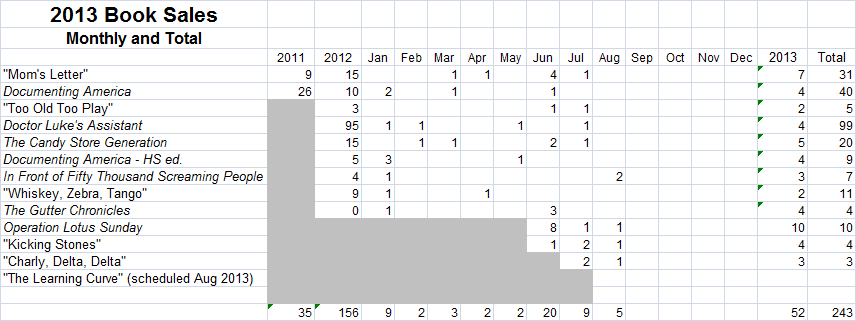
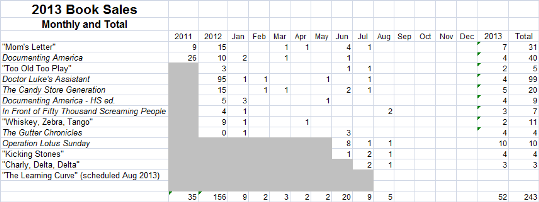
As slow as February through May were for sales, and with two new titles appearing in June, I was really hoping for sales to pick up. And they did. I sold a total of 20 books in June. While that’s not exactly bestseller status, it’s enough to give me an upbeat outlook. Here’s my sales table.

So that’s seven different titles selling. I was surprised when Barnes & Noble reported through June 27 to see three sales of Operation Lotus Sunday s0ld on June 25, which was the first day it appeared in their catalog. I was also surprise and please to see a few sales of The Gutter Chronicles, which has sat without sales for some time. Even had a review of it posted.

For linking at a writers’ site I’m on, I’m pasting in a smaller copy of the sales table.

A Conan Doyle about to break-through

This past Sunday, the weather being pleasant and our getting home from church with fair promptness, I fixed a cottage cheese and lunchmeat lunch and took it to the sun porch to read. Or maybe this is more of a Florida room, except it’s elevated—an appendage to the house fitted with some expensive heating units (that we never use) and without air conditioning. I decided I would get back to reading in the letters of A. Conan Doyle (http://www.goodreads.com/book/show/359482.Arthur_Conan_Doyle).

It probably helped that the last time I went to Barnes & Noble I bought, from the discount table, a two-volume set of the Sherlock Holmes stories, arranged chronologically. The first, A Study in Scarlett, was published in 1887. When last I read in this book I was somewhere around 1885 or 1886, so I knew I was getting close to that momentous occasion.

Unfortunately, the editor wrote that not many of Doyle’s letters between 1885 and 1890 survived. For some reason his correspondents didn’t keep them, I guess. So in the book I moved into this period with mainly editorial comments and brief, and sometimes unattributed, references to the various autobiographical works of Doyle.

At this time he had three novels circulating among publishers, with one of them A Study in Scarlett. He stated he had high hopes for the novel, but he also thought another was better. But all of his novels received rejections, and went off to another place. Doyle bemoaned that sometimes they weren’t even read. If only the editors would read them they would like them.

Finally a publisher offered him £25 for the copyright, with no royalties. Doyle held out; he wanted royalties. The publisher didn’t budge. Nothing else was selling. His medical practice was paying most of the bills, but literature was where he really wanted to be. Finally he took the offer, and Scarlett was published in December 1887, not as a stand-alone book first but in an annual.

Reviews initially weren’t great. The normal number of copies of that annual were printed. That’s as far as I got with my reading on Sunday. Sherlock Holmes had seen the light of day, but was still mostly unknown. This coming Sunday, hopefully, I’ll move into the period of 1888 and beyond when Holmes became the most famous fictional detective, and Doyle practically a household name.

Is this encouraging me to at all while I’m in a very dry period of my publishing career, dry in terms of sales, not of ideas and production. Not really. If publishers and initial readers can’t see genius in the work of A Conan Doyle, what hope is there for me? Twenty years later a copy of that annual sold at auction for more than £150,000. That offers some encouragement.

Though in twenty years I’ll be 81. Alas.