Category Archives: Writing

Change of Writing Plans for the next Two Weeks

I had a meeting to go to this morning at the City of Bentonville Planning Office. As expected it lasted about 45 minutes. The City library is pretty close, and since my colleagues and I took separate vehicles (because they both had other meetings to go to afterwards), I went to the library.

A library is almost as good as a used book store. In some ways it’s better, because it will be better organized. Rarely do I visit a library and wind up disappointed. Today was no exception.

I had two purposes I wanted to accomplish there: 1) see if my inter-library loan books had arrived; and 2) see if they had the index to National Geographic magazine that included the 1970s and 1980s. I went straight to the reference desk, where the lady was alternating her gaze between books and her computer. On her desk were several books that looked like inter-library loan books, and, though most of the covers were obscured by the paperwork wrapper on each book, one looked like the cover of a book I was expecting.

They were indeed both of my books. She had just processed them and only needed to scan the bar code before she could give them to me. It took less than a minute. The books are harmonies of the gospels published in 1988 and 1996. I haven’t done much research into modern harmonies, relying instead on harmonies from the 1700s, 1800s, and early 1900s that I could access on-line. These two will help to flesh out my research.

At the reference desk I also learned they had the exact NG Index I was looking for. One more minute and I was at a table, with the index open, looking at the entries for China. Perhaps I should explain more.

We have a ton of NG mags in our basement storage room. When we moved to this house in 2002 I tied them up for transport, and haven’t looked at them since. From time to time I’ve bought a few newer ones, or had them given to me, and put them loose on the shelf. I have a recollection of one or two articles in NG in the late 1970s or early 1980s about the terracotta soldiers buried in Xian, China. We visited those in 1983, and I have a fairly vivid memory of them. One of the characters in China Tour, the tourist husband Roger Brownwell, mentions this NG article and has it with him. I figured, as some last minute research, I should re-read the article. It’s been thirty or so years since I first read it.

Last night I went to the shelves with the mags. Kn0wing only that it would be somewhere between 1974 and 1983, I began looking. What I found was that: many of the strings I tied them with eleven years ago had come loose, making handling difficult; they were stacked two-deep on two shelves, making for 10 feet worth of shelves to go through; the lighting was so bad I couldn’t read the words on the binder (except for the date); and the bundles of mags, such as they were, were not necessarily all of one year—except I found duplicates, so maybe other bundles were all of one year, and I just couldn’t find them in the poor light on the ten feet of shelves. I gave up.

Thirty minutes of on-line searching revealed that the National Geographic Society does not have an on-line index, and it seems no one else had created one. Hence, knowing I would be near the library today, I decided I would see if they had the index I needed. I knew if I could just find the month and year of the magazine I needed I could find it in the storeroom.

Sure enough, I found it in the index: April 1978, with an earlier, briefer article in December 1974 that I should also look at. As well, I found articles in 1982 and 1983 for two of the cities we visited and which are scenes in the book. Tonight, God willing, I should be able to find them and set them aside for reading.

I may not learn anything new in these articles, but it’s absolutely essential that I not include in the book anything that wasn’t true in 1983, which is when the events in China Tour took place. Plus, in these articles I may find a few ideas I can use to enhance the authenticity of the book.

So, since I have a way to find specific NG issues needed, and since I have these two books for only two weeks from inter-library loan, I figure my reading and writing priorities have changed. Tonight I will:

  1. first find the NG issues on the storeroom shelves and bring them upstairs.
  2. second begin reading in one of the two harmonies.
  3. edit at least 40 pages of China Tour. I’m currently through 78 pages of the 250 page book.
  4. if time allows, begin reading the key NG article.

This may be too much for one night, even with leftovers needing only a generous dose of micro-waves before eating, and even dessert prepared. But we’ll see. For sure most other writing projects, either in the works or on the mental to-do list, will be shoved aside for the two weeks that I have these two books.

How great is a library?
March 2013 Sales

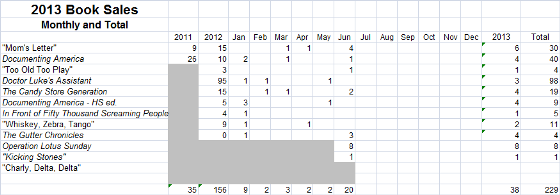
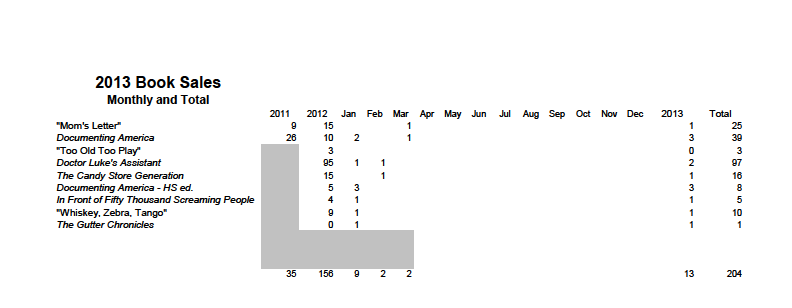
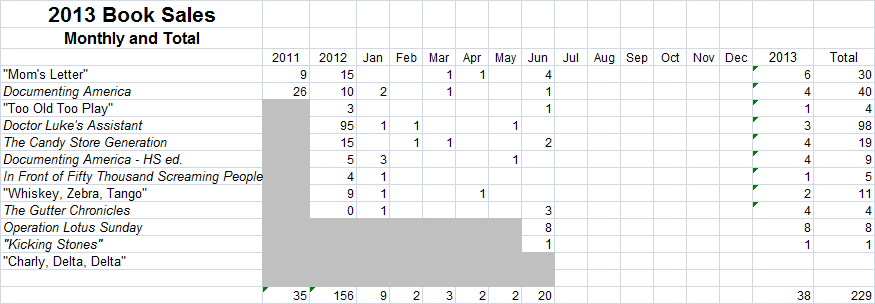
March was just as dismal as February in terms of sales. I don’t know that I officially posted February’s sales. I sold two whole books in February. In March I again sold two books. That actually made March more dismal than February, since it had three more days in it. That gives me 13 sales for the year, which is three less than I had at this time last year with only three publications out instead of nine.

Here’s my sales table. I’m not going to post a graph. Interestingly those two sales were of my first two self-published works.

So, I guess I need to re-think going with the Dean Wesley Smith strategy of ignoring promotion and putting all my effort into adding new titles. It seems I can’t get my new titles out fast enough to keep the interest of readers. That, plus my Genre Identity Disorder, seem to be working against sales.

But I don’t really like promotion, so for now I’ll keep writing and trying to bring new works to the market. China Tour is probably two months away at the rate I’m editing (which is very slow). I have nothing else in the works, though I’m thinking of taking some items I’ve written for work and turning them into generic professional engineering publications and putting them out there. It won’t help much with those who have bought my other works, but maybe it will bring in a few sales.

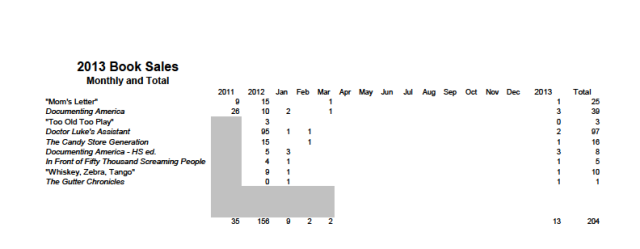
And, adding a smaller version of the table to upload to Absolute Write.

Not Enough Time for the Books

Lately I’ve fallen into a little better routine, at least as far as my reading is concerned. I have a small book in the pick-up that I read a little in at traffic lights, or just before I get out to go somewhere. Or it’s there when I head into the doctor’s office, like yesterday.

In the evening at home, around 10 p.m., after whatever writing I’ve accomplished or chores I finished, after I tend to family finances and the paperwork that produces, I take up my current book and read. It could be any one of a number of books, though for the last five or six nights I’ve read in my primary book, Letters from an American Farmer, about the status of colonial life right around the American Revolution. I suppose you could call this research for a future volume of Documenting America.

As I sit in my reading chair, I look around the living room. To my right is the built-in bookcase, holding a couple of hundred books, mostly still to be read. Many of them are antique books, handed down through my family. Others are contemporary, mostly Christian topics. To my left, behind the couch, is an antique table with about twenty books on it. These are mainly smaller ones, all modern. Some are devotional, some are small group studies, others similar.

In the bedroom, on the dresser, is another batch of perhaps thirty books of a similar mix to the last described batch. In the secretary in our bedroom are another four shelves of books. Almost all of these are to be read.

Should I describe the lower floor? With it’s twelve book cases, it’s six-foot table with forty books waiting to be shelved? Or the store-room with boxes of books on the utility shelves, and boxes more on the floor, waiting to be donated. For the books downstairs, some have been read, but then kept for our library. Lynda’s read more of her novels than I have of my classics, novels, and non-fiction.

This morning the moon was large in the west, just above the horizon as I pulled away from the house for the 15.6 mile drive to the office. Admiring the moon made me think of the universe, which got me to thinking about science fiction. So far I haven’t written any science fiction—not because I don’t want to, but because the demands of it are so different from what I write now. Plus I don’t need to expand my Genre Identity Disorder any more than it already is.

Years ago, I suppose before I began writing creatively, I thought about the first steps our species would have to take if we were going to leave earth. I actually thought through a couple of series of sci-fi books. I never wrote anything about them, because I didn’t consider myself a writer at the time, and had no ambition to be one. I suppose that was the earliest appearance of those desires.

But the beautiful moon made me once again think of writing sci-fi. That, if it ever happens, would be after the sequel to In Front of Fifty Thousands Screaming People, after the sequel to Doctor Luke’s Assistant. It would be after my series of cozy mysteries, The Alfred Cottage Mysteries. And after the series of books I have brainstormed and somewhat captured on stock trading. And after I turned DLA and its sequel into a series of early church history books. For sure it will be after I edit and publish China Tour.

It would probably be after the six Christian non-fiction books I’ve programmed to write in future years, after the few more books I’ve thought of for the Documenting America series. And certainly after I somehow get my poetry book, Father Daughter Day, illustrated and published. And I’m not even sure about the short story series I’ve started. Or the professional essays I’d like to publish.

So where am I the worse basket-case? In my accumulated books reading or my dreamed-of books for writing? Between the two I’m for sure quite busy.

No Sale

It’s been a long dry spell without a sale. My last one was February 13. So right now it’s 41 days without a sale. This has been a difficult time. A large part of the prevailing wisdom about promoting your published works is to not promote them. Rather, write more things and get them up for sale.

That’s pretty much what I’ve been doing—not promoting, that is. About once a month, on the self-promotion days of a couple of Facebook writer groups I’m in, I promote something. On even rarer occasions I post a reminder on my Facebook that I have books for sale. I did that last night.

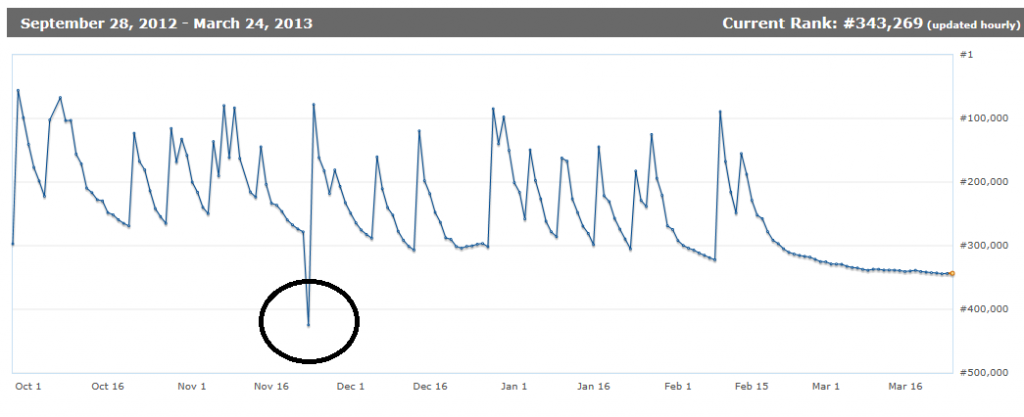
On of the things Amazon has, something that’s still in beta mode, is an author ranking. As of last night I was #343,269. That means 343,268 authors within the Amazon system are more popular than I am. Here’s a graph of my ranking.

Sobering, isn’t it? You can see from this graph how, at these lower levels, a single book sale can propel you upward by a couple of hundred thousand places. That tells me that somewhere between 100,000 to 150,000 authors will have a sale at Amazon on any given day. By the way, the big, one-day drop I circled on the chart was Thanksgiving Day. Amazon seemed to have a glitch in their system, and that does not look like a valid ranking. That one day excepted, I’m at my lowest ranking since Amazon instituted the system.

I suppose the sales will come. At other places at Amazon’s Author Central site they say they are having to reconstruct some things, and that sales haven’t posted since maybe February 1. However, my stats show at least two sales after that, so I don’t think I can hope that a bunch of sales are happening and they just aren’t posting.

We’ll see what happens. I’m at least a month away from publishing China Tour, with nothing in between them. I have a couple of professional essays I could put up fairly quickly, and they wouldn’t need fancy covers, so I could do them myself. But would even that small amount of work divert me from my creative writing and delay my overall progress? It’s a decision I need to make over the next few days.

I’d Like Another Gig

This time last year I was writing two columns per month at the e-zine Buildipedia.com. It was good work, $100 for a 500 word column, topics that flowed naturally from my work, minimal research. I received good feedback from the editors, and they rarely changed anything I turned in, not even a word.

But in May they cut it back to one column per month, and after June they stopped it all together. Not enough ad revenue to support it, or maybe not enough visitors to the pages; not sure which. $200 went to nothing real fast. That may not seem like a lot of money, but it really helped with the budget.

I sure would like to find something similar. On Wednesday I began the process of looking. I found an on-line blog-like magazine that was perfect for replacing Buildipedia. I started filling out the on-line application. Then I realized the last post was sometime last summer. It appears it’s no longer an active site.

I estimate there are about 50 other sites I need to check out. I’m not optimistic about finding something. But maybe, maybe.

Next “Writing” Steps

China Tour is done. As I posted on my Facebook author page, I finished the first draft of the novel on Sunday March 17. The word count is 71,571.

Now I’m letting it sit for a while. Not too long, however. I think about a week. I’m anxious to edit it and publish it. It’s also possible a plot hole or two may need to be filled. Early in the book I may allude to something later in the book, only to find as I wrote that I never added the thing I intended. Those all have to be fixed. My past experience is that the first round of edits will result in more words, as I think of things I need to clarify, or more references to put in, especially in a book in a foreign culture as this is. I suspect I’ll add close to 1,000 words in this edit.

The second round of edits will be for the purpose of trying to reduce the word count. A first draft will almost always be wordy. Too many modifiers, too much passive voice, too many times of not thinking whether a certain word is needed. I don’t know where this will end up. It’s possible I’ll find whole sentences to come out or paragraphs to drastically trim. Those 1,000 words from the first edit may be offset and more in the second edit.

Edits after that will consist more of proof-reading, and incorporating things that beta readers might find. Not that my past experience with beta readers pointing out minor glitches is all that good. Normally I receive, if I’m lucky, general feedback about publishability, though on well over half of the books I’ve given out to beta readers I heard nothing from them at all, not even if they read the book.

So for a week, or two at the most, I’m not writing new material or even editing. I’m going to use this time to do the following.

  • Prepare Doctor Luke’s Assistant and In Front of Fifty Thousand Screaming People for issue as print books. I finished most of DLA last night, and should finish it tonight.
  • Complete, or at least get well along, on my 2012 income taxes. I’ve made a start, though there’s much more to go.
  • Decide on whether to enter two or three poems in a poetry contest. At $5 per entry it’s probably throwing money away, but….
  • Write a query letter for a magazine article idea I have and sent it to a major Christian magazine.
  • Write and mail a genealogy letter to a cousin. I’ve been putting this off due to busyness.
  • Keep up with blogging.
  • File a bunch of stuff.
  • Work with the cover designer for China Tour.

So the time will be full, just not on new writing.

Conflict, Conflict, Conflict

It’s been more than a week since I’ve written here. So busy, so lazy, so uninspired.

I’m down to the last three chapters in China Tour. This is the point where the action should get fast and furious, the conflict be greatest, the hero become the hero, and then have a quick cool-down to the end of the book.

Randy Ingermansson, a novelist best known for creating a system of novel writing called the Snowflake Method, discusses how to begin a book. In the opening, he says, introduce your main character and plunge him/her into conflict. Then, as the book goes on, raise the stakes in the conflict. Make it harder to achieve aims while at the same time make the consequences of failing to achieve aims more disastrous.

This is what the American reader wants. Whether it’s the same in other countries I don’t know. But books that follow this “formula” seem to be the ones that sell better. In real estate it’s location, location, location. In novel writing it’s conflict, conflict, conflict.

The conflict could be physical danger, emotional turmoil, or just about anything. Frank Peretti’s early and best known novels were about spiritual conflict.

I’ve read some novels, however, that were so full of conflict I was tired of it half way through. One book that struck me this way was J.R.R. Tolkien’s The Hobbit. I need to first confess that I haven’t read the full book yet. I read some kind of abridgement to it, and listened to an audio abridgement, and read some of the book. Tolkien’s writing style isn’t my favorite, and I’ve had trouble getting back to it, and back to The Lord of the Ring trilogy, which I also started and didn’t finish.

In the abridgement, Bilbo never seemed to get a breath to just be a hobbit. I was tired for his sake by the time he got to the forest elves (I think I’m remembering that correctly). I would have liked a little more balance between conflict and resting. Oh, well, that may be just me. The popularity of the book indicates millions of readers don’t agree with me.

In China Tour, one of the couples has reached Beijing and the other will in the next chapter. The remaining two aims, not necessarily in agreement with each other, is to see the Bibles delivered to the persecuted Chinese Christian, and to make contact with the Chinese dissident and put him in CIA custody for extraction from the country. That was supposed to have happened in a rural province in the south, over the border to Vietnam, but the tourist couple got in the way of the spy couple, and the plans got blasted to smithereens.

I have the means of extraction figured out, the location, and how the principles will achieve it. I don’t know if the conflict is high enough or not. I’ll know that tomorrow or Sunday when I actually write it. I know for sure that I haven’t raise the stakes of failure sufficiently. Just this morning, however, I thought of a way to do that. It will happen in a chapter already written, and I’ll catch it on the first round of edits.

So, for the next three writing days I will be trying to create conflict. A strange position for a lover of peace to be in. Wish me luck.

Three-part Writing Problem

Or four parts if you include my two blogs as another part, or if you count them as two then actually five parts.

I continue to read in Carlyle’s works, even going so far as to prepare my own bibliography of his works, and to purchase a printed bibliography. I found the ones on-line to be very inadequate. Even the one I downloaded from Google books, published in 1881, had a lot of gaps, as did the 1919 one I also downloaded. The 1989 one I ordered came, and it seems to be quite complete. From it I’m completing my bibliography, trying at the same time to figure out how to structure it. Each evening I try to read a few pages in Correspondence Between Goethe and Carlyle. This is going well, despite many formatting problems with the e-book. I should finish this by this coming weekend.

I need to resume my work on China Tour, and bring that to completion. As I think I said previously I have only 3.7 chapters to go, and I know pretty much what I want to write. Scenes from these chapters dance in my head. I believe I have the method worked out whereby the goals of both the CIA couple and the Bible smuggling couple are achieved. Even the denouement is clear to me. About ten days ago I realized I had a major omission in an early chapter, dealing with when the two couples meet and how they resolve a particular problem. The additions to a specific scene have at last come to me, and now I need to write it.

Then today, in my before work hours, I resumed work on my Harmony of the Gospels. It’s been a while since I wrote about that on the blog, and I haven’t touched it since last June. This is more a labor of love and a self-study aid. I’m down to having one appendix to write, that of the crucifixion. Today I wrote a few words in it, and pulled up a reference I downloaded many months ago and began reading it. I refreshed my memory of what needs to go into this appendix. I basically have about 30 minutes a day to work on this. I suspect it will take me two weeks, at that rate, to write this appendix.

I’d really like to add a couple of essays to the Harmony, not necessarily tied to specific chapters or times in Jesus’ life, but to some general topic, such as why try to harmonize the gospels at all. I started one of those over a year ago, and must see where it stands.

Then my blogs demand to be worked in. I’m trying to post at a six-per-week frequency: three to each blog, with one day off. I haven’t arrived there yet, generally achieving four per week, sometimes even three. I want to keep working on that schedule.

But for right now, here is how I plan on dividing my writing time.

  • Spend 30 minutes a day before work on the appendices and essays of the Harmony.
  • Spend 30 minutes a day (max) during the lunch hour on my Carlyle research, though toward what end I’m still not sure. This will never end until I make an end of it.
  • Spend the rest of my writing time, which is whatever minutes I can carve out of the evening and weekend monoliths, on China Tour until it is finished.
  • In whatever moments I can further find, perhaps in the pieces chipped away from the monoliths, to write six blog posts a week.

This is a worthy goal, one which I will work hard to make into a reality.

Solitude

A curious convergence today caused me to read two items on the same subject from greatly different locations. Literary agent Rachelle Gardner today posted to her blog an article titled The Lonely Life of the Writer. Her point is that, since the largest part of the world doesn’t understand what it’s like to be a writer or to seek publication, the writer is pretty much alone in those pursuits.

Then, looking for something to print and read during the lunch hour, I went to the Carlyle Letters On-line, pulled up a month in a target period for which I want to know more about Carlyle’s thoughts and pursuits, and I found this in a letter he addressed to a friend from his home town.

Zimmermann has written a book which he calls ‘the pleasures of solitude’: I would not have you to believe him: solitude in truth has few pleasures, uninterrupted solitude is full of pain.

So the solitude of the writer’s life is a converging subject in those two reads. Solitude can mean different things, however. As Rachelle Gardner used it, it was not being alone physically but being not understood by those we are around. Carlyle seems to mean it as the physical, though he quite possibly could mean either one or both.

Continuing in Carlyle’s letter, I find this interesting continuation of his thoughts.

But solitude, or company more distressing, is not the worst ingredient of this condition. The thought that one’s best days are hurrying darkly and uselessly away is yet more grievous. It is vain to deny it, my friend, I am altogether an unprofitable creature.

This reminds me of John Wesley’s statement in a letter to a woman friend, early in his life, about he feared passing through this life and not leaving his mark. Carlyle echoes this.

Perhaps this is a feeling more widespread among those who pursue the creative arts than I figured upon first discovering that Wesley quote. The time it takes from the decision to produce a written work that one hopes will impact the world until the time it actually does impact the world, a time of solitude of mind if not of body, is huge. No matter how short it may be it will seem long. Our words designed to entertain or inform reach no one for the longest time.

I have no real conclusion for this, no take-away value for the reader. Count this as a journal entry of an observer of his own writing life.

Back after a break

On February 7, Lynda and I began a long road trip to San Diego. The main purpose was to attend the Environmental Connection 13 conference, the annual conference of the International Erosion Control Association. I moderated a panel discussion on low impact development, and presented a half-day course in specification writing for erosion and sediment control works. We included three vacation days, plus the weekends, and so were gone for 12 days.

During this time I did very little with writing. I brought the printed manuscript of China Tour with me, intending to edit it, or thinking that possibly Lynda would read some more in it. All I did was read and handwrite some edits on the first chapter. I also kept up with a couple of writing blogs, though not rigorously every day. I worked on re-formatting a Thomas Carlyle book that I downloaded from Project Gutenberg. That’s actually quite enjoyable and relaxing.

But we’re back now. It’s time to get back in the saddle and get to writing. China Tour lacks only three chapters and maybe 8,000 words from being finished. Then of course will be comprehensive editing. My cover designer is lined up, and we’ve had conversations about the cover. A marketing plan is rolling around in my brain. Right now I’m hoping for a book launch in May, though whether that’s early or late will depend on a number of circumstances, most importantly the birth of grandchild #3, granddaughter #1, currently “scheduled” for mid-May but anticipated earlier just like her next older brother.