Category Archives: Writing

Solitude

A curious convergence today caused me to read two items on the same subject from greatly different locations. Literary agent Rachelle Gardner today posted to her blog an article titled The Lonely Life of the Writer. Her point is that, since the largest part of the world doesn’t understand what it’s like to be a writer or to seek publication, the writer is pretty much alone in those pursuits.

Then, looking for something to print and read during the lunch hour, I went to the Carlyle Letters On-line, pulled up a month in a target period for which I want to know more about Carlyle’s thoughts and pursuits, and I found this in a letter he addressed to a friend from his home town.

Zimmermann has written a book which he calls ‘the pleasures of solitude’: I would not have you to believe him: solitude in truth has few pleasures, uninterrupted solitude is full of pain.

So the solitude of the writer’s life is a converging subject in those two reads. Solitude can mean different things, however. As Rachelle Gardner used it, it was not being alone physically but being not understood by those we are around. Carlyle seems to mean it as the physical, though he quite possibly could mean either one or both.

Continuing in Carlyle’s letter, I find this interesting continuation of his thoughts.

But solitude, or company more distressing, is not the worst ingredient of this condition. The thought that one’s best days are hurrying darkly and uselessly away is yet more grievous. It is vain to deny it, my friend, I am altogether an unprofitable creature.

This reminds me of John Wesley’s statement in a letter to a woman friend, early in his life, about he feared passing through this life and not leaving his mark. Carlyle echoes this.

Perhaps this is a feeling more widespread among those who pursue the creative arts than I figured upon first discovering that Wesley quote. The time it takes from the decision to produce a written work that one hopes will impact the world until the time it actually does impact the world, a time of solitude of mind if not of body, is huge. No matter how short it may be it will seem long. Our words designed to entertain or inform reach no one for the longest time.

I have no real conclusion for this, no take-away value for the reader. Count this as a journal entry of an observer of his own writing life.
Back after a break

On February 7, Lynda and I began a long road trip to San Diego. The main purpose was to attend the Environmental Connection 13 conference, the annual conference of the International Erosion Control Association. I moderated a panel discussion on low impact development, and presented a half-day course in specification writing for erosion and sediment control works. We included three vacation days, plus the weekends, and so were gone for 12 days.

During this time I did very little with writing. I brought the printed manuscript of China Tour with me, intending to edit it, or thinking that possibly Lynda would read some more in it. All I did was read and handwrite some edits on the first chapter. I also kept up with a couple of writing blogs, though not rigorously every day. I worked on re-formatting a Thomas Carlyle book that I downloaded from Project Gutenberg. That’s actually quite enjoyable and relaxing.

But we’re back now. It’s time to get back in the saddle and get to writing. China Tour lacks only three chapters and maybe 8,000 words from being finished. Then of course will be comprehensive editing. My cover designer is lined up, and we’ve had conversations about the cover. A marketing plan is rolling around in my brain. Right now I’m hoping for a book launch in May, though whether that’s early or late will depend on a number of circumstances, most importantly the birth of grandchild #3, granddaughter #1, currently “scheduled” for mid-May but anticipated earlier just like her next older brother.

Four Points of View

Last night I finished a chapter in China Tour (or, as I might rename it, Smugglers and Spies). It’s the chapter for September 23, 1983, when both couples are in Xian, China, but don’t run into each other.

I don’t want to give away the plot—not that anyone thinking about picking up the book in the future is likely to come here and read a spoiler—so I won’t say too much. The tourist couple and the CIA agent couple find themselves in places of extreme tension, sexual temptation. They are supposed to be working on a plan to get the dissident out through Beijing three days hence, rescuing a botched operation. But instead of sticking fully to business, they are thrust into the sexual temptation.

I’m writing the book in multiple third-person point of view. That is, the narrator is inside one person’s head at a time, one of the four main characters. In one chapter I have one other POV, a Chinese agent’s. Writing in this manner you have to keep track of whose POV you’re in, and limit observations to what they sense and think.

The alternative to this is to write it in third-person omniscient. This is when the narrator has a God-level view. He can be in anyone’s head, see what anyone sees, tell the reader what anyone is thinking. Herman Wouk used this POV in his classics The Winds of War and War and Remembrance, as did James Michener in Centennial.

I like the omniscient POV, but publishing industry insiders say it is less favored by the average reader nowadays. So, I decided for simple third person for China Tour.

The scenes I wrote last night and over this past weekend required careful attention to make sure I didn’t “head hop”—that is, begin a scene in one person’s head and end it in another’s without a good reason to do so and a logical transition. The scenes from last night weren’t that hard. The four main characters were all in different places. But the ones from the weekend were difficult. The two couples were together, and the scenes were short. I was in the agent-husband’s head, then the tourist husband’s, then maybe the agent wife’s, then the tourist wife’s. Back and forth from scene to scene.

I don’t really know if I got it all right. I’ll be re-reading them over the next two weeks and seeing if I kept the POVs pure. It will be an interesting exercise, and the most complicated use of POV I’ve used up to this point in my writing career.

The book is now 61,000 words. I have four days of it yet to write (Sept 24, 25, 26, and 27, 1983). The last day will be the denouement and should be short. The 26th will be the longest. Right now I don’t have a clue what I will write for the 24th and 25th. I think they might be short as well, maybe 1000 words each. So right now it looks as if the book will be close to 70,000 words. I think that’s a good length for a spy novel.

I don’t expect to be writing much new material over the next two to two and a half weeks, and business and pleasure will have a hold on me. But I will have a lot of time to think through these last four days of the book, and plan what to do next.

The book launch? Right now I’m guessing around April 1, 2013, but there’s the finishing and the editing and finding and replying to beta readers and final corrections and formatting and working with a cover designer and uploading. So we’ll see if I can keep to that schedule.

January 2013 Sales

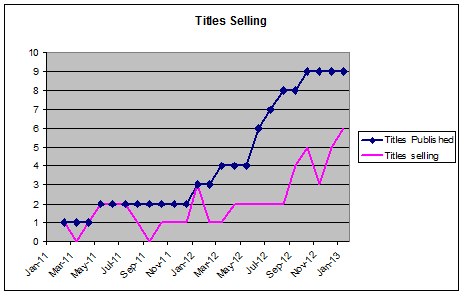
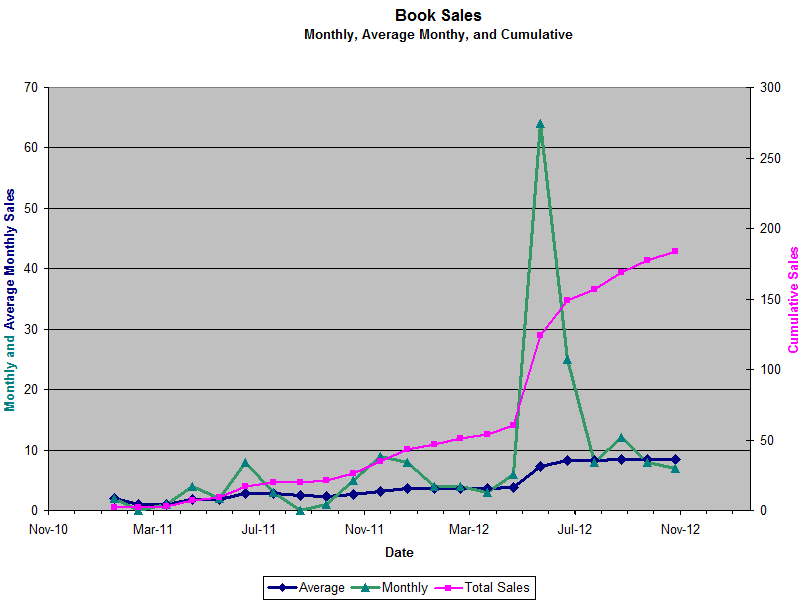
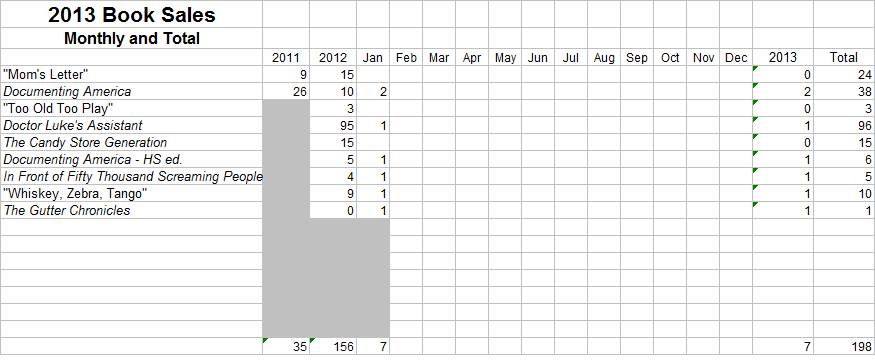
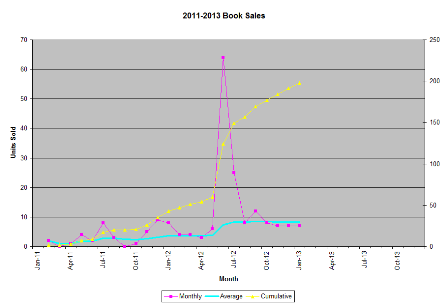
January has closed. It’s time to post my book sales. Here’s the table and graph.

As you can see, it’s not a particularly encouraging situation. Since October I’ve had 8 – 7 – 7 – 7 sales per month. True, I’ve not done a lot to promote my books (a FB post here and there; speaking to a few people about them), but it’s still pretty dismal.

With baseball season coming on I need to figure out how to promote In Front of Fifty Thousand Screaming People. I also need to have the cover re-done, but not sure I want to spend the money at this time.

Passing through a dry spell

It began a week ago today, or maybe even a week ago yesterday. The dry spell, I mean.

It’s not writer’s block. I know exactly what I want to write next on my work-in-progress. And what after that and after that. I think I finally have all the scenes in my mind right up to the end of the book.

So why not write? It’s an overwhelming sense that it doesn’t matter if I write or not.

I could say more, but I think I’ll leave it at that.

Review of 2012 Publishing Goals

Back in January 2012 I established some publishing goals for the year. Since I just did the same for 2013, I thought I should go back and see how did on those goals. I wrote them in three posts last January. I’ll summarize them here and tell how I did.

Fiction

Publish my second short story, titled “Too Old To Play”. I did this in January, exactly on schedule. It’s only sold three copies, but it’s there and available.

Publish my novel Doctor Luke’s Assistant. I did this in March, exactly on schedule. It’s been my best selling work so far.

Publish my novel In Front of Fifty Thousand Screaming People. I did this in August, a little later than I’d hoped, but I delayed it for consideration by a publisher, and by then I was too engaged with other projects to jump right back in this. It isn’t selling, but baseball season is just around the corner.

Publish another short story in the Danny Tompkins series. I did not do this. Instead I wrote a different short story and published it, and it’s sold 10 copies.

Begin work on my third novel. Okay, I suppose this was a writing goal, not a publishing goal. I did this, beginning China Tour in October.

Non-Fiction: Articles

The no-money one of these is Suite101.com. I did not write any articles for Suite101 this year. As I wrote in January, “The site is soon to go through a major re-vamp. I’m waiting to see what they do, and if anything I want to write on will still be suitable.” The revamp occurred. I’m making a little more residual income there than I thought I would, but I still don’t expect to write any articles for them any time soon, almost certainly not in 2013.

The one for decent money is Buildipedia.com. As planned I wrote for Buildipedia for several months. Then they axed my column. I haven’t had any ideas for feature articles for them, so that prospect is dormant for a while and probably will remain so.

The third gig is a site named Decoded Science. I wrote and published one article with them in 2012. I still like the concept of Decoded Science. I like the owner/editor. I just haven’t had any ideas for articles. I wanted to do a series of articles on low impact development. The owner/editor was favorable, but I haven’t found time or energy to do them. It’s a possibility in 2013, thought not all that likely.

Non-Fiction: Books

The Candy Store Generation. I wrote this and published it in July 2012, more or less on schedule. I liked how it came out. It’s sold about 15 copies, which is a big disappointment.

John Cheney of Newbury, Massachusetts. This was to be a family genealogy book. I found no time to add to the research I’ve already done, so did not write anything on this. Maybe some day.

Articles written about floodplain engineering that would form the basis of a decent book. Yes, they would, but I’ve done nothing on this other than brainstorm a little.

A second book in the Documenting America series: the Civil War years. I wrote the first chapter of this, or most of the first chapter, then abandoned it for the time being. The research was going to be much more than I thought. I read some as research, maybe 10 to 15 hours of reading. I wish I could have written it, and hope to do it in 2013.

So, I didn’t do too badly, did I? I hope I do as well, relative to my goals, in 2013.

Locking In Ideas, even out of season

I wrote a blog post some time ago about capturing ideas for writing. Actually, I may have written several posts about that between here and my other blog, An Arrow Through The Air.

Two situations have come up in the last few days where I was able to do this. Actually, I guess it was three.

On my novel in progress, China Tour, I’m in the middle part of the novel now, between the two main plot points. This is the part where a novel often sags, as the protagonist overcomes a series of conflicts, preferably rising in danger/difficulty, before moving into the end game. And it’s the part of this novel I had mostly not thought out. So I’m writing each scene as it comes to mind.

But while driving home from work yesterday an idea for a conflict came to me. It seemed to be a good one, but I didn’t use memory techniques to lock it in. By the time I got in the house not only had I lost the idea but I forget I’d even had an idea. After supper and going through snail mail, I went to The Dungeon and started writing earlier than usual on a week night. I typed a few words, continuing a scene from where I left off Wednesday evening, when the idea came back. I grabbed a piece of paper to write it on, then decided to just put it at the end of the Word document, set off from the rest of the text.

While writing for the next couple of hours, two or three other ideas came to me. They went at the end of the ms. as well. So by the time I knocked off for the evening, around 10:00 p.m., having added over 2,000 words to the novel, I also had good ideas documented for middle-of-the-novel scenes. It was a good evening of writing.

So upstairs I went, intending to do some pleasure reading, but before I left the computer I saw one of the volumes of The Annals of America, the one for the Civil War years. I took it upstairs with me, and instead of reading for pleasure I went through the Table of Contents to find items to include in a future volume of Documenting America. While that book was a stand-alone volume, I have always hoped to make a series of volumes based on the style of the original book. I listed about twelve documents to include, and spot-read in two of them to make sure they are suitable. They are. The book will need about thirty documents all together, or perhaps a few less if I use some documents for two chapters. It’s not much, but it’s a start—and it’s on paper.

The other idea capture event happened on Tuesday. I was at a professional lunch, a PowerPoint presentation made by an Arkansas state official. It was all words, and sitting in the back of the room I couldn’t really see them. Plus, it’s stuff I already know, for the most part. So rather than concentrating on that I took a napkin (I hadn’t brought a note pad with me), and began thinking through books that might eventually go in my future series, The Alfred Cottage Mysteries.

Now, this is really long-range planning, as I don’t expect to be writing any book in this series. But I’ve thought of the series much over the years, had a couple of books in mind, but not the full series. So as the regulator droned on about short-term activity authorizations, I wrote on the napkin. Here’s what I came up with.

  • Alfred Cottage and The Coroner’s Inquest
  • Alfred Cottage and The Lost Love
  • Alfred Cottage and The Lost inheritance
  • Alfred Cottage and The Lost Years
  • Alfred Cottage and The Wife Murderer
  • Alfred Cottage and The Fornicators
  • Alfred Cottage and Stolen Identity
  • Alfred Cottage and The Cherokee Princess
  • Alfred Cottage and The Abolitionist
  • Alfred Cottage and The Cobbler’s Will
  • Alfred Cottage and The Soldier’s Son
  • Alfred Cottage and The Rum Runners

Each of these, except the next-to-last, comes from something in my or my wife’s ancestry. Some will have large pieces of the real family history as a basis, some just a small part. All of them will be fiction, however, with many embellishments and conflict added along the way.

As I’ve told people, when I dream I tend to dream big. Here’s a big dream: 12 books that are years away from being started, yet are already finding their way out of the gray cells and on to paper.

Stay tuned.

Self-Publishing Surprises

I’m currently in my 22nd month as a self-publisher. When you figure I was working on it a month before actually publishing something, that makes 23 months. I must say that a number of things have surprised me.

  • How uncomfortable I feel about marketing. I just don’t like it. It pains me to make posts to Facebook saying, “I have a new book for you all to buy.” Or the equivalent post for some FB writers groups I joined. I just don’t want to be a shill for my own books. This may spell doom for me as far as becoming a well-sold and well-read writer.
  • How difficult the technology is, or at least how steep the learning curve is each time something is needed. I’m not stupid about these things, and can probably figure a lot of them out for myself, but the time sink to do so is enormous.
  • How my books just don’t sell without marketing. Dean Wesley Smith and others say you should just keep writing and publishing. I thought he used to say get 10-12 books/titles available before you do any marketing. Now I notice he’s saying 20-25 books. I’m sitting there with 9, so either way I have more work to do. That’s if DWS is right. What if he’s wrong, and I should be spending more time marketing rather than writing. Oh, refer to a previous bullet point.
  • The total lack of response to In Front of Fifty Thousand Screaming People. I have three sales total. Three, in the four months it’s been out. I made quite a few posts about it, on this blog, my other blog, FB, and in FB writers groups. And nothing. I don’t really see how I can write a much better book than this one. Surely there are people out there who like baseball books. I guess I just don’t know any of them.

I could probably list a few more surprises, but will end it here. Oh, just one more: how there was no elation resulting from holding a printed book with my name on it in my hands. None. It was more of a so-what feeling.

Yeah, I’ll stop there. Maybe all of this will turn around at some point. Maybe I’ll learn to be a shameless self-promoter. Maybe I’ll find an audience. Maybe I’ll learn to write books that people want. Maybe I’ll return to content farm writing. The future is wide open.