A Writer’s Nugget from C.S. Lewis

I’m not talking about something he wrote, say some fiction or non-fiction, that was especially good intrinsically for writing’s sake. No, in a lecture he made a statement that is of considerable worth for writers. Here it is.

What are the key-words of modern criticism? Creative, with its opposite derivative; spontaneity, with its opposite convention; freedom, contrasted with rules. Great authors are innovators, pioneers, explorers; bad authors bunch in schools and follow models. Or again, great authors are always ‘breaking fetters’ and ‘bursting bonds’. They have personality, they ‘are themselves’.

This comes from the lecture titled “Christianity and Literature”, which was read to a religious society in Oxford. It was originally published in Rehabilitations and Other Essays (Oxford 1939). I have it in a book titled The Timeless Writings of C.S. Lewis, which is a recent reprinting of some collected lectures and articles by Lewis published in separate volumes.

I find Lewis’ words to be particularly insightful, instructing, and inspiring for an aspiring author, one who is planning to write secular works with a Christian worldview underpinning them. It is not convention that marks the great author, but spontaneity; not works patterned after someone else’s but creativity, perhaps also or better stated as originality. Great authors should break fetters and burst bonds.

This is something I must look at in my own writings. Am I bursting bonds, breaking fetters? Seeking not to bunch in a school but rather be an innovator, a pioneer, an explorer? I sort of think so, because I haven’t really sought to pattern my work after anyone, and, perhaps, my lack of learning in the great literature that preceded me means I don’t know a whole lot about those who I might pattern after.

True, as much as I love Robert Frost a lot of my poetry sounds Frostian. On-line critics have said as much, always in a good way. As to the mechanics of my prose, so far no one has said “You sound like ———.” The ideas I have for novels don’t seem to easily fall into genres. The Alfred Cottage Mysteries are almost cozy mysteries–except they won’t always involve a murder, and Alfred, while an amateur detective, will be solving crimes of years past, not of the present.
Documenting America is neither history nor politics, but rather a mix, and I think unlike anything I’ve seen before. Will it sell? We’ll soon see.

At writers conferences and on writer/agent blogs I keep seeing advice such as: follow the genre rules. Lewis would say “Innovate. Break the fetters of genre. Be spontaneous.”

I’m going to be thinking long and hard about this advice from Lewis. Well, he wasn’t purposefully giving advice for writers. He was defining what he thought were the characteristics of great writers. I think I’ll have more to say about this over the coming days.

It’s Not So Sweet in Suite-land

On February 23rd or 24th, Google changed their main ranking algorithms. Over years and months Google had figured out that a lot of web content wasn’t really original content. Unscrupulous writers had “scraped” material from other sites, typically reputable sites, and passed it off on their own sites as if it were original material. So search for any subject, and you would find that a lot of it was the same. News site JKM had the exact same words as the New York Times. PQR Blog was identical to Wikipedia. And they all could rank high in a Google search engine results page (SERP).

Google knew it was long overdue to fix this. And fix it they did—or, from some perspectives, break it—in a new ranking algorithm last week. The objective was to weed out the scrapers and weed out the content farms from ranking high in the SERPs. By content farm, I mean those sites that hire a bunch of writers to rush out loads of low quality articles—400 hasty words about something popular. Get it posted, get the ads automatically running, get readers finding the pages then clicking on ads. Money into the coffers.

Suite101.com, where I have 127 articles posted, is a site that many consider a content farm. The writers of it would beg to differ, however. Yes, we have a lot of poor writing on there. Some is from native English speakers but a lot is from ESL people who have trouble with smooth composition. The writers who hang out in the Suite writers forum don’t think of ourselves as a content farm.

Google disagrees. We’ve been hurt bad by the algorithm change. You can see the graph accompanying this post, which shows my page views cut in half since the Google change. My articles didn’t change and I haven’t added any for about three weeks. Whether they were good, bad, or indifferent quality, they didn’t change. But Suite now has less “Google juice”, and my page views are suffering. It’s a little to early to know if my revenues have taken a similar hit. They’re down, but they fluctuate enough that they might just be on the low side of normal. It’s going to take another week or two till I know about revenues.

What to do? I never made a lot there anyhow. I enjoyed writing the type of articles I wrote there, however. Whether it’s done anything toward establishing my writer’s platform I don’t know, but I suppose not if it has now been relegated to the bush league. Plus, if I’m going to self-publish my stuff, the platform carries less importance.

I’m so into writing Documenting America right now, and so close to finishing, and have so many other writing projects begun, under research, or cued up, that a hiatus from Suite might be a good thing. Let’s see how it all shakes out in a week.

Still Working Hard on Documenting America

Last night I spent nearly three hours in The Dungeon, writing on Documenting America. Having just written and type two new chapters over previous days, I decided to spend last night expanding some chapters that were either newspaper column length or that I started years ago but never really completed.

The three I picked were chapters I drew out of a letter Thomas Jefferson wrote to his Virginia colleague Samuel Kercheval on July 12, 1816. [Note: A couple of transcriptions of this on the Internet erroneously have the date June 12, 1816.] Kercheval had written Jefferson, asking for his opinions on changing the Virginia constitution. Kercheval thought certain parts of it were not as good as they should be, and seems to have been one pushing for a constitutional convention. But, the Virginia constitution was Jefferson’s baby, having been based on his own work. Heck, he may have even written most of it. What would Jefferson think about his baby being revised?

Jefferson wrote back in detail, saying he agreed with most of what Kercheval did (which must have been based on something Kercheval wrote in his letter; haven’t seen it yet) and so he didn’t mind weighing in privately, but didn’t want his views showing up in the newspaper. In his letter, Jefferson threw his “baby” under the bus, saying it was indeed time to change it.

This is such a good letter that I was able to draw three chapters from it, on the following themes:
1. Constitutions might be good, but they are not perfect, and should be subject to change at regular intervals. Flaws in constitutions are overcome by active participation in government by an informed citizenry.

2. The best republican government is that which includes the broadest possible electorate, the most equitable representation, and fairly frequent elections.

3. Public debt is a bad thing, because it results in higher taxes, which results in citizens having to work so much to pay their taxes that they have no time to participate in government.

This letter is, in my opinion, one of the most important documents from United States history. Everyone should read it, internalize it, and remember what Jefferson was saying. A good transcription can be found here. A scan of the original letter starts here and continues for several pages. The same Library of Congress collection says it has the Kercheval letter, but I checked it and it was signed by a Thompkins. Perhaps Kercheval published under an alias the pamphlet he sent to Jefferson, but Jefferson knew who he was.

Close reading of the Jefferson letter last night and today convinced me that I have some more work to do on these three chapters, not so much my analysis but the quoted portions of the letter. I’ve got a lot of overlap between the three chapters, and I need to separate them a little more. I guess that’s part of tonight’s work.

Meanwhile, a little bit of easy browsing turned up more sources, outside the Annals of America. One of those is a collection of letters sent to Secretary of the Treasury Salmon P Chase at the outbreak of the civil war. I skimmed a couple of them, and found good fodder for other chapters. The other is a series of letters written by Ebenezer Huntington from 1774-1781, when he was first a law student and then an officer in the Revolutionary War. I skimmed some of these too. They seem kind of drab, simple reports of what’s going on where this soldier happened to be. But drab during a war for independence is historical, so maybe I’ll be able to use these as well.

So, the research continues apace. There’s so much out there it’s almost frightening.

Research for Documenting America

When I was on the working vacation recently, Moses Austin went with me. Moses wrote a journal on his trip through the Ohio Valley and on to Saint Louis. That trip took place during the bitterly cold and snowy winter of 1796-97. He started out from the mountains of Virginia, then into Kentucky, then territory that would eventually become Ohio, Indiana, Illinois, and Missouri (still under the control of Spain at that time). His return trip was by way of Kentucky and Tennessee.

An excerpt of this journal is the first item in Volume 4 of the Annals of America, an Encyclopedia Britannica publication. My analysis of that document, or rather of that excerpt, is a chapter in Documenting America. I took that volume with me for research reading material. Lynda drove some on the first day of the trip, so I pulled that out of my reading bag and started at the beginning. Later, at our hotel in Orlando, I was able to finish the excerpt and write two chapters in manuscript.

Now, a journal of a trip, even a trip through wilderness areas, may not be inspiring writing. When I began reading it I wasn’t sure it would be good material for a chapter, let alone two. But I did find it to contain information that I thought readers of Documenting America might want to know about. So I read the whole thing and wrote. After returning home I typed the two chapters, no. 27 and 28.

My research didn’t stop there. First I made a trip to Wikipedia for a brief bio. Now I know a lot of people moan about Wikipedia and inaccuracies. I’m sure they have some, maybe many. But for initial research and sources of information, I’ve found it to be a good place to go. Austin’s bio was brief, but certainly longer than the paragraph in my source. It gave me some good background, subject to confirmation if I used any of it.

As I said my source gave only an excerpt of the journal. Those ellipses that the Encyclopedia Britannica people use don’t tell me much. Was there good material in those left out sections or not? They took it from Vol 5 of The American Historical Review, which sounded like a publication. A search through Google Books turned up the volume. Talk about instant library loan, without the $2.00 search fee! Downloaded in five seconds, and the applicable pages printed in another hundred or so.

Before the journal was a biographical sketch of Moses Austin, written by his son, the famed Stephen F. Austin, and edited by one of Moses’ grandsons. Only a few pages long, it was an excellent short bio. It blew away the information given in the Annals and in Wikipedia. It’s tempting to join Wiki as a contributor, just to be able to flesh out Moses Austin’s biography. Maybe later.

The full journal, in all its glorious, archaic language full of long paragraphs, inconsistent spellings, and poor punctuation was there, having appeared in the April 1900 issue of the magazine. I scanned the full journal before typing the chapters. Some of the removed material was good, and I included it in the quote portion of the chapter. The except had been six or seven pages. The full journal was twenty. Should I read the whole thing? After all, the chapters were written, complete except for any editing I will do upon later contemplation. And having written two chapters from this document, I’m not likely to write another.

I was fascinated by this journal, however, and decided to read it all. I’m glad I did. Much of the removed material was of great interest to me. Austin described his route, including the towns he stayed in or the isolated farms he either found hospitality at or was rejected. I was able to trace his route on my road atlas. Some of the places still have the same names, such as Crab Orchard Kentucky.

Austin described the towns, and gave thoughts on their economic prospects. It’s interesting to see what he wrote about the prospects for places such as Louisville, and how he was correct about what it could become. I also found his constant bemoaning of the American government’s neglect of the areas he traveled through to be quite interesting (sorry, Joe F and Mrs. Rosen). The US government was busy trying to establish its place in the roll call of nations, develop governmental institutions, and figure out if a self-governing republic would really work. It was kind of to do all that and establish regional or civil governments in Cahoika or Kaskasia, or even Vincennes. I found in Austin’s words a third chapter, on the idea that even back in the late 1700s there were people who wanted the government to guarantee an outcome. But that chapter will have to wait for another volume.

The purpose of Austin’s trip was to see the lead mines in eastern Missouri. This was under Spanish dominion, so he needed certain letters and permissions to do this. I never knew that sixty miles south of Saint Louis, thirty or forty miles up from the Mississippi River, were rich lead deposits that were easily mined. But there was. The place names today reflect that: Leadwood, Irondale, Iron Mountain, Old Mines, Leadington. Missouri has an historic site there, called Missouri Mines State Historic Site. So I learned something in this extra research.

One other item of research to mention, something I haven’t done, and probably won’t. In The American Historical Review are many footnotes concerning journal entries. Mention is made of various original documents, such as American State Department papers, that would probably be good reading. Various secondary documents that further illustrate the points Austin makes are also cited. How wonderful it would be to find some of these documents and study further!

But, that would not make Documenting America a better book, I don’t think. I’m not writing a scholarly work, but a popular “history”, bringing lessons out of historical documents to see what lessons they hold for today’s America. Research for my own enjoyment won’t further that goal.

Ezra David Schneberger

At 6:32 AM, in Oklahoma City, our daughter Sara gave birth at home to our second grandchild, Ezra David Schneberger. He was born at home, in a birthing pool, after just 1 hour and fifty minutes of labor. Mother and child are fine.
His brother Ephraim slept through the big event, and looks kind of sleepy holding his baby brother.
Off to write a cinqain commemorating the event.
ETA: 7lb 6 oz, 20 inches

Posts in Real Time

I have been away on a working vacation from February 17 until today. I attended the annual conference of the International Erosion Control Association, where I delivered three papers, met a lot of the leadership, and attended my first meeting as a member of the Professional Development Committee. Monday, Tuesday, Wednesday were all business. The other days were driving and vacation.

Before leaving, I took time to write a few posts for the blog, and scheduled them to post about every two days. I also wrote one from there and posted it for later appearance. I like that feature of Blogspot, something I never used before, and which turned out to be incredibly easy. It lets me keep the blog fresh while being unable to write and post.

During the trip I had a fair amount of reading material with me, but found less time for reading than expected. I had volume 4 of the Annals of America, which is my first source for documents for Documenting America. I read the first item in the book, a report from 1797 by Moses Austin, father of Stephen F. Austin, of a trip he made from Virginia to the Ohio River valley and even to St. Louis and a little beyond. The document was fascinating, and I have written two chapters from it, one during the trip and one today, typing both of them this evening. The book is now up to 29, 275 words, so is still coming along.

I also had a notebook with various writings of John Wesley in it. I read some in that, both on the trip and today, but found it more difficult reading. Still, I have pretty well identified some material that will form the basis of a chapter in my Wesley small group study, so the reading, if limited, was profitable.

The week ahead looks very busy from a writing perspective. I have to prepare and send an invoice for some writing I did, the first of those I’ve had to do. That’s a tomorrow noon thing. The editor for Buildipedia asked me to try to move forward an article I thought I could take till next week to do. That’s a tomorrow evening thing. Despite some new troubles at Suite101 concerning changes Google recently made in their search engine algorithms, I’d like to write at least two articles this week for Suite. They will be Tuesday and Friday things.

And, while away on the trip I learned from Facebook posts that a woman in our church is a writer, excited about recently having sold some of her writing. I contacted her, and she is interested in seeing a writers group formed at church. I know of five others who in one way or another have either written things or have expressed an interest in doing so. This will be a Wednesday thing, I think, to see what can be done about organizing this group, with an eye to begin meeting maybe in April.

So the week looks full, and I hope on Saturday I can make a report of incredible productivity. Of course, I’ll be writing here before then.

My First Sale of "Mom’s Letter"

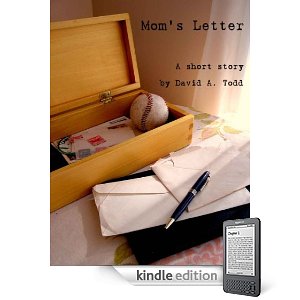
My e-short story, “Mom’s Letter“, has sold one copy since I listed it not quite two weeks ago. Yea! That sale was to someone I know, a former colleague in the poetry wars on Poem Kingdom, years ago when we were moderators together there. Poppy also wrote a nice review for it, an honest review, not a fake one. I’m grateful for that.

Due to having been away from home for an engineering conference, combined with a little vacation, I haven’t been able to do anything to create a buzz for the story, except for one post here, one on the Suite writer forums, and one post at Facebook. I need to get to a few other places and do some posts. A few more sales would be nice.

On this trip I’ve managed to write one chapter for Documenting America. The document I reviewed has also given me fodder for at least one more chapter, maybe two if I want to. Once I type that chapter in I should be at 28,000 words. So that’s edging ever closer, and publishing it before the end of March is possible, though possibly rushing it.

The sun is shining. I’m on vacation, and by the view through the windows it appears a gentle breeze is blowing. I should be outside, walking the campus or sitting by the pool, reading. Perhaps I will. I’ll set this to publish tomorrow, actually, and fool all my readers (all ten or so of you) as to my whereabouts.

Little Time to Write

Work has pretty much consumed my waking time this week. I’m at a convention/conference–well, it ended today. I presented three papers on erosion control: two one-hour presentations, and today a half-day class. This was too much, and until noon today I had little time to do much outside of present my classes, wind down, and prepare for the next class. I attended no other classes, other than a full-day course on Monday. Tuesday afternoon would have been free, but I had to put together the PowerPoint for today’s class.

I’m glad it’s over. Three papers in two days is too much. I put a lot of energy into the presentation, just as I do for my brown bags at work. The time to wind down and relax a little doesn’t give much time to do other brain-intensive things, such as write or research. Sunday I managed to complete one chapter (in manuscript) in Documenting America. I’m going to generate one more chapter from the document, but I think not tonight. Tonight I want to do a little bit of Wesley research. Haven’t done any all week. I may only read an hour, maybe less, but I need to do it. I think I have enough brain power left for that.

My cold pretty much ended on Sunday or Monday, minor residual hoarseness persists, but that will be over soon. I’ll be anxious to get back to researching and writing, perhaps by Sunday afternoon or evening. Looking forward to it.

How to Structure the Wesley Small Group Study?

I’m committed to writing this small group study, maybe titling it “Essential John Wesley”. But how to structure it? For previous studies I’ve written, for each lesson I made up a simple sheet, two-sided, a mixture of text and graphics, but not a lot of reading. This seemed to work well. The class had no homework, not much to read. These several were all Bible studies, so relied heavily on the scripture.

Not so with the Wesley study. Obviously the Bible will be a big part, but so will Wesley’s writings. My goal is to help the class know Wesley and appreciate how he impacted England for 60 years and the world since then, and how he is important to our religious heritage. So in addition to the Bible, I need to work in some of his writings. But how?

At present, I’m thinking of doing this pretty much like I’m writing Documenting America, but with a twist. For each chapter, maybe 15 to 20 in all, I think I’ll have the following.

  1. A short intro (a paragraph) of what the issue at hand is, and what Wesley’s contribution was to it.
  2. An excerpt of some one of Wesley’s writing. I’ll shoot for a mixture of letters, journal, sermons, books, tracts, magazine articles (as I can find them). Typically this will be 400-500 words (longer than for Documenting America), but I would not be opposed to a 1000 word excerpt if that’s what it takes to get the point across.
  3. A discussion of the passage, and how that relates to the issue raised in the chapter intro. I may also try to tie this to the Christian life in the 21st century.
  4. Not in Documenting America, I think I will have a series of discussion questions here. For any print version, I’ll include space to write answers. For any e-versions, spaces won’t be possible, I don’t believe, without knowing html and maybe not even then.

That’s the plan. I’d like to have the total word count somewhere around 25,000 to 35,000, which doesn’t seem too far off some of the small group study books I’ve seen. That would be 1250 to 2500 words per chapter. I’m not sure all will be equal.

Anyhow, that’s what my thinking is right now. I’m in the midst of my research of Wesley’s writings, and may change my mind as I go along.

Publications of John Wesley

As research for my Essential John Wesley small group study (and, by the way, that’s not a firm title; not sure what I’ll call it), I went searching for a bibliography of his works. Through the wonder of Google books and its advanced book search function, I found several. One I looked at today and printed is The Works of John and Charles Wesley: A Bibliography, by Rev. Richard Green, 1896. It includes 291 printed pages, including index, excluding front matter. It is a listing only of works by these two men, not about them.

This is the only Wesley bibliography I’ve looked at so far. I’ve looked at a lot of titles, and most of them indicate they are bibliographies of works by and about John and/or Charles. I’ll want to look at one or more of those, but for now the Green Bibliography will suffice. It lists 417 printed works. As I haven’t been all the way through it, I’m not sure if this includes compilations or issues of the Arminian Magazine by individual numbers. I saw that it had at least one year of those listed as a bound compilation. How much of that was written by Wesley and how much was by others I still have to research.

This is a great reference. For each work it gives: the full title page (the words thereon, not a facsimile), the name of the publisher, the date of issue, and all known editions in the 18th century. For many various annotations are included. Sometimes it’s what a biographer said of the publication. Sometimes it’s something Wesley said in his journal or an outgoing letter. Sometimes it’s the editor’s commentary, such as when he had a hard time identifying date, edition, printer, or whether the work is truly accredited to Wesley.

Some of that is for the work of the scholar, of course, which I’m not holding myself out to be. I love reading Wesley’s works and reading about him, but I seriously doubt I would ever have the time needed to become a Wesley/Wesleyan scholar. I will be satisfied if I can really pull of this small group study. My pastor thinks it’s a good idea. Between him, our youth pastor, my son-in-law, and on-line references, I have plenty of material, maybe too much. The trick will be to quickly digest all of this into a reasonable series of lessons, and then to write whatever I’m going to, and figure out how to disseminate it.

For sure the adult life group I co-teach Sunday mornings will become the trial group for this. I don’t know how well they will take to it, or even if they will agree to doing it. Still, that’s my plan. Stay tuned for more information.

Author | Engineer