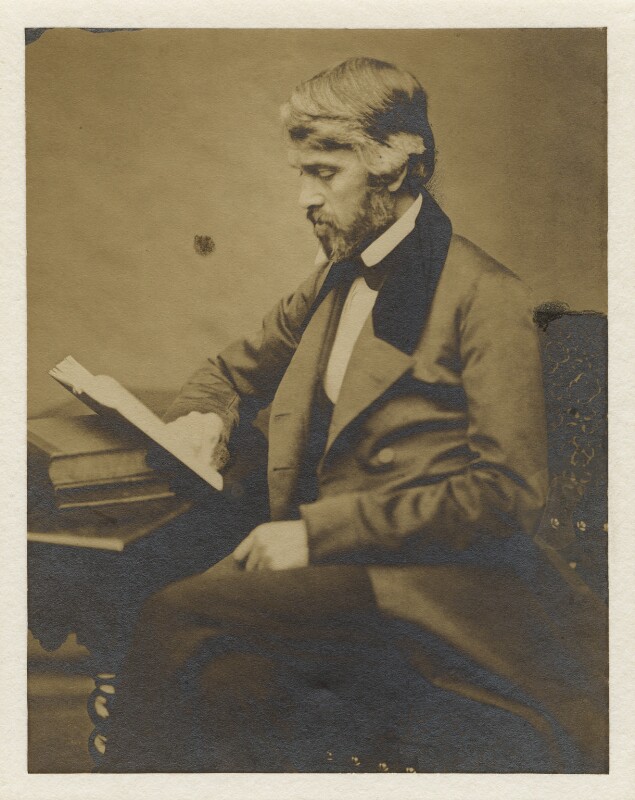
One of my reading places is The Carlyle Letters Online, which has 11,000 letters written by Thomas and Jane Carlyle. They were active letter writers during the Victorian era in England, and earlier mostly from Scotland. Thomas wrote for a living. He struggled in the early years, picking up encyclopedia hackwork and magazine contributions as he could get them. By around 1840, with the help of Ralph Waldo Emerson championing Carlyle’s books in the US, he had reached a measure of financial comfort. I’ve written other blog posts about Carlyle.
Maybe two months ago, I came across an interesting tidbit in one of his letters and wanted to blog about it. But I faced a dilemma of my own making: how to properly reference the letter and location? Traditional referencing, handed down through various academic organizations, expects you to give the publisher, publisher’s location, name of publication, author name, page no., etc.
I’ve come to believe that’s an archaic way of doing references in the Information Age. Here’s my example. The specific letter I’m interested in was written 8 April 1846 by Thomas to his wife Jane, who was on holiday at a seaside villa. It’s been published in a 4-volume biography of Carlyle by Anthony Froude written in the years after Carlyle’s death in 1881. That biography has been republished, and the letter has been in other collections of Carlyle’s letters. Now it’s available at the Carlyle Letters Online.
Since there are so many potential sources for someone to go to check my work and the quote I’m fixing to give, it seems like the traditional methods of citing sources forces the reader to get a copy of the exact publication the person doing the quote used and find the page. How about we do something like this.
Here’s the letter I want to make the quote from. I find an interesting observation of Carlyle in the third paragraph of the letter. Assuming the paragraph breaks are Carlyle’s own and not the publisher’s [online publisher in this case], why not just cite the source as a particular letter written by Carlyle to a particular person [his wife] and found in a particular paragraph? In this case, it would be:
Carlyle, Thomas; a letter to his wife Jane Welsh Carlyle, 8 April 1846, paragraph 3. Accessed 7 September 2026 at Carlyle Letters Online.
If the quote is from a long paragraph, you can add a letter to designate approximately where in the paragraph the quote is from, e.g. paragraph 3a, or 3b, or 3c…. In this case the quote comes from a relatively short paraph and starts the paragraph, so a letter shouldn’t be needed to clarify the location. The person wishing to verify the quote can look through the entire paragraph if necessary, which is no more work than having to scan an entire page based on the traditional citation method.
Of course, my method will result in the person making the citation having to do a little more work to count up the paragraph and decide on the letter designation, but I think it’s time well spent. Of course, I doubt if anyone at the Chicago Manual of Style or other organizations care about my better way of doing it.
Well, that’s a lengthy introduction. Time to give the quote.
I really wish you could find an eligible House somewhere out under the quiet sky,—removed fairly from these tumults and loud-braying discords of every kind; which it is growing really horrible and miserable to me to spend the remnant of my days among!
Carlyle, Thomas; a letter to his wife Jane Welsh Carlyle, 8 April 1846, paragraph 3; accessed 7 September 2026 at Carlyle Letters Online.
Thomas was at their London home, Jane at some friend’s seaside villa near Liverpool. He was working on the second edition of his book about Oliver Cromwell, she just lazing around and enjoying her holiday. Thomas had asked her to look around for a house in a quiet place they could rent for a season to get away from London’s summer climate.
I must say I sympathize with him. How often do I think it would be nice to get away for a long stretch, not have to worry about home repairs, organization of stuff, other routines. It would be nice, if I could swing it, to have a cook and a house maid. I think we could do without a butler and a footman and a chauffer. We sort of tried that with a four week road trip last summer that included a week on Cape Cod (unpleasant) and two weeks in the Berkshires (very nice). Perhaps we’ll get to do that again some day.
Well, that’s my post for today. Not exactly earth shattering—that is, of course, unless the CMOS sees this and decides to adopt the Todd Method as an alternative way of making citations.
ETA: I see that I also posted about this comment in this letter earlier this year. I forgot about that. Ah, well, it was obviously still on my mind.