All posts by David Todd

A Few More Tasks During this Time

As I mentioned in the last two posts, I’m in an interim time presently. Documenting America is done; the next project is to be decided. During this time I’ll be proofreading Documenting America, working on my income taxes (okay, not writing related except for my writing income and expenses), and deciding on my next writing project.

However, as I’ve thought about it, that’s not the only things this writer will have to accomplish over the next month. Here’s a few more I’ve thought of.

  • File my many source documents for Documenting America. I printed off a lot of pages of as many as twenty documents. These are in piles here, piles there, in my carry to work portfolio, and some who knows where. I have a small hanging file box ready for these, so this should be a relatively quick project. File the obvious ones immediately, and move the others there as I find them.
  • Set up my writer’s web site. My son has been bugging me to get this done, says he’ll even help me. Said if I made him an administrator he would be able to do updates. And he promised not to post any communist/socialist propaganda on there. This is something I know I need to do. With freelance work in four different publications, engineering articles in three others, plus a few newspaper features, I need to get this done, now especially that I have “Mom’s Letter” up for sale. I haven’t felt like going to the monthly hosting expense until I was really, really sure I needed it. I think it’s time, probably past time.
  • Format “Mom’s Letter” for the Nook reader, and any other e-reader (Sony, Apple) that could generate a sale or two, and get it listed.
  • Related to that last one, some better research into the whole self-publishing arena. I’ve crossed the first hurdle in Kindle eSP, but I’ve far from mastered it. The other e-readers may all support Pubit, which would be nice. Then there’s the paper self-publishing as print on demand books. There’s a couple of different platforms available: Smashwords and CreateSpace are the two I know by name, but much more research is needed. After Documenting America goes up as an e-book, I plan to make it a POD book. Plus others in the future.

As I said, I’ve no shortage of things to do. None of this is going to be done quickly, and income taxes take precedence over all things writing, with my proofreading tasks holding second place. It’s good for me to list these, however, lest I think I have some free time available and goof off.

Other Writing Projects

Well, I received a couple of comments to my post about the next writing project. Still looking for more, is anyone else wants to make a suggestion.

Writing is fairly far from my mind right now. The siege is on at work. I’m working late, late into the evening on flood studies and water line construction and drainage fixes. I have a hump of work to get over. Once that’s done, maybe I can get back to writing. For now about all I have time for in the evening is to proof-read a chapter or two in Documenting America and do the early work on income taxes. I don’t have the energy or desire to read for research, or outline a project, or write even 500 words on a project.

But this too shall pass, and before long I’ll be writing again (something other than quick blog posts, that is). In anticipation of that, I’m still brainstorming writing. In addition to the projects I mentioned in my post on 14 March, I have a couple of other directions open to me. These are:

  • Format Doctor Luke’s Assistant for self-publishing, first as an e-book but then as a print-on-demand book. I could read it again, but I think it’s ready for this next step.
  • Expand Life on a Yo Yo small group study into a short book, and POD-self-publish it. Because of illustrations, it won’t work as an e-book unless I know html, which I don’t.
  • Expand The Dynamic Duo small group study into a short book, and POD-self-publish it. Same deal about illustrations.
  • Expand Sacred Moments small group into a short book, and POD-self-publish it. Same deal about illustrations. Are you sensing a pattern here?
  • Take my Isaiah small group study notes and build it into a book of some as of yet undermined length, and e-self-publish it. I can’t remember how extensive my notes are. I know I prepared a few sheets for the class, but will have to look and see what I have.
  • Begin work on another small group study I’ve been pondering, From Slavery To Nationhood, a study of Israel’s wandering in the desert, plus before and after. I’ve been thinking about this one for a long time.
  • Begin work on Volume 2 of Documenting America. Strike while the iron is hot, that sort of thing. I’ve developed a rhythm of sorts, and might be able to churn out another in the brand with less work than any of these other projects. This one is also tempting. In writing volume 1 I have come across many things I’ve bookmarked to go in volume 2. This one is also tempting.

So, I have no shortage of projects to chose between. And I’d appreciate any reader’s thoughts on these projects.

Look out writing world. As soon as this work hump is over, I’ll be back.

Time to Move to a Different Project

Documenting America, Volume 1, is finished, all but the Introduction, which I started last night and should finish tonight. My attention will now turn in three directions.

One is to proofread Documenting America and get it ready for self-publishing. I intend to go through it slowly, both my text and the text I’m quoting, looking both for typos and better ways to say things. I’ll also hope my beta readers give me some comments.

Second is income taxes. I need one evening to file trading papers for the year (those not yet done; I have some filed), one to assemble all my documentation, and a third to actually begin. I think all my spreadsheets are built, so I’m ready to go.

Third will be to turn to another writing project. Unfortunately I don’t have time to rest on my success of completing Documenting America. Gotta keep writing, keep researching, keep pressing on. I will call the Buildipedia.com editor this week about my next batch of assignments, and I may write one or two articles for Suite101.com. Those are on-going freelance work and I don’t count them as projects. I also have a prospect to write for a legal website, concerning construction law. Don’t know if that will come through or not.

I have to decide on my next writing project I could divide my available hours between two project for a while, but one must eventually have supremacy. The projects I have going, in various degrees of completion, are the following.

  • In Front of Fifty Thousand Screaming People, my baseball novel. I’ve written around 15,000 words on the way to about 85,000 words. Haven’t looked at this for at least two months.
  • Screwtape’s Good Advice, a small group study. I have the introduction and four chapters done, on the way to 32 chapters. Given that the Narnia movies are being rolled out, which gives a little increase in the interest of all things C.S. Lewis, maybe I should finish this and self-publish.
  • A Harmony of the Gospels, a non-commercial project. Last week I gave a copy of this to our new pastor, which has renewed my interest. The harmony is done. I have about 40 pages (estimated) to write to complete the appendixes and passage notes. It’s tempting to plow ahead with this, even though it’s not for profit.
  • Essential John Wesley, a small group study. I’ve done some of the research, and would love to get this done and teach it next time my turn to teach our Life Group comes around. We have about twenty-two weeks of lessons lined up, so that’s the time frame for completing this. This would be partly a labor of love and partly a ministry/commercial project.
  • To Exile and Back, a small group study. I’ve done “all” the research on this, and outlined the project. Time to start writing. I put “all” in quotes because I’m sure as I write it I’ll find holes in the research.

So, what say you, faithful readers of this blog, and drop by readers? Does any of these look like a good direction for me to go next? Anything that sticks out, positively or negatively?

An Evening at Barnes and Noble

So I put in a lot of hours at work this week, about 50 through Friday, and I’ll work at least seven today and maybe five tomorrow. The work load demands it, the wife is out of town, and I’m able to do my writing for a couple of hours in the evenings, so why not try to get ahead of the workload curve? I’m not getting much recreation, and little exercise (though I walked at noon yesterday, ten minutes in 20-30 mph winds). Still, I’ve been eating well, my weight is falling, and I have little or no desire for snacking. Maybe giving up chips and soda for Lent is a good thing.

I decided to treat myself last night and after leaving the office at 6:00 PM I drove 2.2 miles out of my way, a true expense with gasoline at $3.459, to go to Barnes and Noble. I usually do this at least once each time Lynda is out of town, though didn’t the last two times she deserted me for the grandkid(s). I browse through the remainders tables, and sometimes find a bargain. I look through many of the aisles, looking at lots of books, and every third trip in have to buy one. I daydream that mine will be there someday, though I know the odds against that are astronomical. Eventually I grab a magazine or three from the rack, buy a vente house blend, and sit in the coffee shop and read. Normally I can’t do that for very long, for Sidelines Syndrome takes over and I feel I should be writing. So I leave halfway through the vente and head home and thence to The Dungeon to write.

But last night I was in the store almost two and a half hours and suffered not at all from Sidelines Syndrome. I didn’t buy any books tonight, though I found three that were tempting. The first was The Kennedy Detail, written by Gerald Blaine, one of the Secret Service agents assigned to JFK. Focusing much on Dallas, he speaks of how the agents felt in losing the man they were sworn to protect. I read in this for over an hour. Someday I’ll buy it, but not for $28.00. The second one was Founding America. This caught my eye because it is mainly a compilation of original documents from 1774 to 1791, with a few editor’s notes. The idea is sort of what my Documenting America is. We have no reason to be ignoring source documents in favor of historians’ sifting through them and in the process giving opinions. Read the documents; they aren’t difficult to understand. I didn’t buy Founding America, though I was sorely tempted, and the price was better at $12.95 (I think it was).

It seems to me much has changed in Barnes and Noble. I find fewer shelves of books and more display tables. These tables hold fewer books than the shelves they replaced did, and some have games, puzzles, or other non-book items. At the front, where latest releases were once displayed, is a Nook display. In some places in the store a major amount of shelves have been removed in favor of even larger display tables.

The teen book section seemed to be larger than before, the poetry section smaller that the even minuscule size it have been previously, if that’s possible. Reference books seemed to occupy fewer shelf-feet. Cookbooks even seemed to be reduced, as maybe were travel books.

These latter things people now get on line. Google for a reference. Google a recipe, Google a destination. Or Bing them. As a result B&N doesn’t need to stock as many books because they don’t sell. What will happen when Nook and Kindle take over the world? The brick and mortar stores are shrinking, and will soon be shrivelled. Such are the observations of an occasional B&N patron. And, as always, I set off the alarm as I left, even though I bought nothing and carried nothing out of the store I didn’t bring in except the vente. I warned the cashier that I always set it off, so was not arrested for shoplifting.

Oh, the third book that caught my eye? It was in the remainders section, on a lower shelf, a neat stack of perhaps twelve copies. When I saw it, I almost whipped out my cell phone and called good friend Gary in Rhode Island. The book was The Screaming Skull, & other Classic Horror Stories. The Screaming Skull? Who knew a college freshman prank, quite minor at that, in which no animals were hurt, no feelings were hurt, no one was bullied, no hate speech was uttered (except maybe by the subject of the prank) would find its way onto a remainders bookshelf in B&N in Rogers Arkansas in 2011? Maybe I should have invested the $7.95 plus tax just to say I had it. Gary, check it out at a B&N where you’re at.

A Fulfilling if Tiring Day

It’s only 5:15 PM as I start this post. My daily work log includes lots of items. I began the day with my Bella Vista water transmission main project, trying to do the work needed to tie down some remaining easements needed. I shifted to my Bentonville flood study, the bane of my existence. I’m on Revision 5, which will be the 5th submittal to FEMA. I then shifted to a citizen complaint in Centerton concerning drainage problems that have been hanging on for four years, and a floodplain issue from the last three months.

Through all this, I shifted back and forth to filing papers for the Bella Vista project. I thought another man was going to manage the project under my direction, so I was letting him file as he saw fit. That didn’t happen, however; he was assigned to other projects, and the papers mounted. Earlier this week I re-did the project filing system to my liking, and began to dribble a few papers into the notebooks. Today, any time I finished a pressing project task, I shifted to the filing. I must have stuffed a 150 pages in those notebooks. I’ve got double that yet to go, but I feel much, much better about it.

The usual parade of people needing senior engineer advice came by or called. A backflow prev enter problem, a paving overlay problem, and some floodplain issues in Rogers took up some time. Then there’s the project from almost nine years ago that wasn’t constructed per the approved drainage report: one storm sewer run was reduced in size. For lack of another body carrying a brain of adequate intelligence, I wound up doing the calculations and mini-report over three days this week. That came back with another request today.

And over all this was the Bentonville floodplain engineering. I’m going back and forth between the model and the map, seeing where they don’t agree, tweaking the model when that makes sense and marking up the map for changes when that makes sense. It’s getting close. Thirteen more cross-sections to go for the 500-year floodplain, then a recheck of the 100-year floodplain and the floodway to make sure they didn’t get out of whack due to the last changes. Then there will be a short engineering report, maybe four work hours to complete. That’s a Monday task.

I’m so sick of floodplains. If I never saw another one I wouldn’t mind. Yet I’ve got three more to do in the next year. In fact, I’m coming in to the office tomorrow and Sunday to try to get something done on the Rogers flood study that has been backed up due to the Bentonville flood study that was backed up due to the Centerton flood study. Then there’s another Rogers one to do and then another Bentonville one to do. I’m so sick of them, I feel like going out in the rain, standing in the worst portion of Tributary 2 to Little Osage Creek, and just ride the flood wave downstream.

But instead, I think I’ll review two more cross-sections then call it a day. With Lynda still in Oklahoma City, tending to grandbabies, I’ll head to Barnes & Noble, browse the remainders table, look at shelves where someday I might have a book, grab a couple of mags, drink a vente house blend, and just relax for two hours. Then home to write the last (or maybe next to last) chapter in Documenting America. Oh, yeah, before the work day began I found a document I needed, a full version of one of John C. Calhoun’s speeches. Of course, that led me to another speech of his, which I may use instead of the one I intended. Ah the tentacles of research.

Signing off. I’ll have this post in two hours, when I will be firmly b-i-c in the B&N cafe.

The Federalist Papers as Source Documents

I don’t remember much coverage of The Federalist Papers in my history classes. In fact, I guess I don’t remember my history classes much at all. But I’m reading these as possible source documents for my book Documenting America.

For those who don’t know or remember what this is, The Federalist Papers were a series of newspaper editorials written by Alexander Hamilton, John Jay, and James Madison, in 1787-1788 for the purpose of convincing the citizens of New York to approve the new constitution that had been proposed by the Constitutional Convention. They felt that New York was the key to getting the constitution approved as the law of the land, but they were concerned that New York would not approve it.

So these three founding fathers agreed to publish editorials/essays in the New York newspapers to convince the electorate to convince their legislature to approve the document. The essays were published under the name of Publius. History tells us, however, that who was writing the editorials was known at the time. Starting with reasons for having a stronger central government than they had under the Articles of Confederation, they moved on to each branch of government, and all the major provisions passed out of the Convention.

In a way these gentlemen failed in the task. New York the constitution in a timely manner. Yet, it still became the Constitution because enough other states ratified it. Eventually New York came through with a late ratification (not as late as little Rhode Island, which didn’t ratify it until two years after the other states, and then only through bullying). It turned out that New York was not as critical as everyone thought.

I haven’t read all of these yet. I read the first three, then jumped ahead to the chapters on the Judicial Branch, for another project. But what I’ve read has been outstanding. The case for a stronger central government was clearly made in the first three, IMHO. Government was essential, Publius said, to the securing of rights. Weak government, weak rights. Stronger government with adequate checks, balances, and separation of power, protected rights.

Should I be considering these as source documents for USA history? After all, they have no official standing as government documents. The three men were acting in official capacities in one way or another, but the editorials seem to be more private than public. I have decided that they are source documents. They are perhaps the clearest indication of what was in the Founding Father’s minds for our Constitution and the republic that it created. No doubt many of them also wrote letters that would reveal their minds, but these are scattered—and they are no less private than these. I could go through the minutes of the Constitutional Convention, presuming they are somewhere on-line, and I may do that. I have a book that gives the minutes of the ratifying convention for Massachusetts, and hope someday to glean something from that.

For now, The Federalist Papers form the basis of four chapters in volume 1 of Documenting America. I anticipate using a similar number in all subsequent volumes.

Lent

Today is Ash Wednesday, the beginning of Lent. As an evangelical Protestant, I don’t belong to a church that “officially” practices Lent. But I grew up Episcopalian, in New England, which meant I grew up thinking of myself not as a Protestant but as an English Catholic. Lent was a big part my life. As a family we practiced the revised dietary rules, and each of us always gave up something for Lent. I typically gave up my favorite Saturday morning cartoon. Later, in the teen years, it seems we must not have followed it as rigorously, for I don’t have clear memories of Lenten practices from those years.

A few years ago I decided to re-introduce Lenten observance in my life, spurred on by my son-in-law who, although an evangelical pastor, had made Lent a practice of his. The first year I gave up computer games, which had begun to consume way too much of my time. That year I stuck to it quite well. I did this each of the next couple of years (two or three, can’t remember), although never really got through the forty days without playing some games.

This year, for some reason, it seems more important to me to prepare for the celebration of Jesus’ resurrection by in a small way experiencing his passion. So I’ve decided to expand a little. I will give up computer games again, and to it add soda pop and chips. Both of these are enjoyable to me, and will be a sacrifice to do without. On the chips, I’m going to except tortilla chips in taco salad, which is a staple of ours. Kind of hard to have taco salad without chips.

In addition to this, our denomination is doing a common study beginning today, called Ashes to Fire. It will cover the Lenten and Easter seasons, concluding at Pentecost. Our congregation is having all life groups at all age levels study this material. The pastor’s sermons will reinforce the life group lessons, and a devotional book will have a week worth of readings on it. Tonight we will have an Ash Wednesday service. I’m looking forward to it.

And I’m looking forward to Lent. I want to have something to give up, not because I have to, but because I want to experience Christ, his suffering, and his resuurection as I never have before. I begin the liturgical season with optimism and determination. How this plays out I will find out, but I feel that I will be able to carry through with my decision. I’m not seeing this as a burden, but as a joy to partake in.

Ben Franklin in Paris

I first wrote Chapter 16 of the first volume of Documenting America five or six years ago. Well, it’s chapter 16 now that I added some before it. I think it was eleven or twelve originally. The documents of the chapter were two letters written by Benjamin Franklin from Paris on May 1, 1777. He was ambassador for the thirteen colonies, then fighting for their independence from Great Britain.

Franklin had been there less than three months, but he already had measured the political landscape and formed conclusions. England was having trouble recruiting troops. Mercenaries from Germany were available, but hard to come by. France, and her ally Spain, were preparing for war against England, but for the moment would not move. Since reports from America told him of improved prospects for Washington’s army, Franklin was optimistic that the American forces could hold off the British.

Franklin also concluded that continental Europe was on the side of the colonies. Even those nations and people who did not live in liberty were pulling for us. We were “the cause of all mankind.” If we won our liberty, formed a government, and stayed free among the roll call of nations, perhaps liberty for them was possible.

As I reviewed this chapter last night in preparation for expanding to full length this week, I knew I needed to see the Franklin letters again. So, through the miracle of Google Books, I found an 1818 volume that had them. They really weren’t much longer than the excerpts I had planned to use as a newspaper column, so I decided to use the full letters (minus salutations and closings). However, I saw in the old book that Franklin wrote a short letter to a third man that day. It was just as good as the other two, so into the chapter it went.

The longer amounts of letters, and some expansion of my commentary, brought the chapter up to 1478 words, and the book up to 35,447. I have one more chapter to expand, and I think two more to add, bringing the total chapters to thirty, and the word count to around 39,000. That doesn’t include an obligatory introduction, or table of contents, title page, copyright page, etc. Nor does it include some advance notice of volume two. I’ve learned recently that novelists who e-self-publish a series will add something of the plot of the next volume to the one at hand, creating some anticipation. Sounds like a good idea to me.

So, my first e-self-published book comes closer to completion. I project I’ll have it done by Saturday or Sunday. I’ll then print it and begin a couple of weeks of proofreading while waiting for my beta readers to review it and give me feedback. At least, I hope they do that. So far, no word.

It’s late, and I really need to get to bed. I want to read a little, however, and prepare for tomorrow’s writing work.

A Writer’s Nugget from C.S. Lewis

I’m not talking about something he wrote, say some fiction or non-fiction, that was especially good intrinsically for writing’s sake. No, in a lecture he made a statement that is of considerable worth for writers. Here it is.

What are the key-words of modern criticism? Creative, with its opposite derivative; spontaneity, with its opposite convention; freedom, contrasted with rules. Great authors are innovators, pioneers, explorers; bad authors bunch in schools and follow models. Or again, great authors are always ‘breaking fetters’ and ‘bursting bonds’. They have personality, they ‘are themselves’.

This comes from the lecture titled “Christianity and Literature”, which was read to a religious society in Oxford. It was originally published in Rehabilitations and Other Essays (Oxford 1939). I have it in a book titled The Timeless Writings of C.S. Lewis, which is a recent reprinting of some collected lectures and articles by Lewis published in separate volumes.

I find Lewis’ words to be particularly insightful, instructing, and inspiring for an aspiring author, one who is planning to write secular works with a Christian worldview underpinning them. It is not convention that marks the great author, but spontaneity; not works patterned after someone else’s but creativity, perhaps also or better stated as originality. Great authors should break fetters and burst bonds.

This is something I must look at in my own writings. Am I bursting bonds, breaking fetters? Seeking not to bunch in a school but rather be an innovator, a pioneer, an explorer? I sort of think so, because I haven’t really sought to pattern my work after anyone, and, perhaps, my lack of learning in the great literature that preceded me means I don’t know a whole lot about those who I might pattern after.

True, as much as I love Robert Frost a lot of my poetry sounds Frostian. On-line critics have said as much, always in a good way. As to the mechanics of my prose, so far no one has said “You sound like ———.” The ideas I have for novels don’t seem to easily fall into genres. The Alfred Cottage Mysteries are almost cozy mysteries–except they won’t always involve a murder, and Alfred, while an amateur detective, will be solving crimes of years past, not of the present.
Documenting America is neither history nor politics, but rather a mix, and I think unlike anything I’ve seen before. Will it sell? We’ll soon see.

At writers conferences and on writer/agent blogs I keep seeing advice such as: follow the genre rules. Lewis would say “Innovate. Break the fetters of genre. Be spontaneous.”

I’m going to be thinking long and hard about this advice from Lewis. Well, he wasn’t purposefully giving advice for writers. He was defining what he thought were the characteristics of great writers. I think I’ll have more to say about this over the coming days.

It’s Not So Sweet in Suite-land

On February 23rd or 24th, Google changed their main ranking algorithms. Over years and months Google had figured out that a lot of web content wasn’t really original content. Unscrupulous writers had “scraped” material from other sites, typically reputable sites, and passed it off on their own sites as if it were original material. So search for any subject, and you would find that a lot of it was the same. News site JKM had the exact same words as the New York Times. PQR Blog was identical to Wikipedia. And they all could rank high in a Google search engine results page (SERP).

Google knew it was long overdue to fix this. And fix it they did—or, from some perspectives, break it—in a new ranking algorithm last week. The objective was to weed out the scrapers and weed out the content farms from ranking high in the SERPs. By content farm, I mean those sites that hire a bunch of writers to rush out loads of low quality articles—400 hasty words about something popular. Get it posted, get the ads automatically running, get readers finding the pages then clicking on ads. Money into the coffers.

Suite101.com, where I have 127 articles posted, is a site that many consider a content farm. The writers of it would beg to differ, however. Yes, we have a lot of poor writing on there. Some is from native English speakers but a lot is from ESL people who have trouble with smooth composition. The writers who hang out in the Suite writers forum don’t think of ourselves as a content farm.

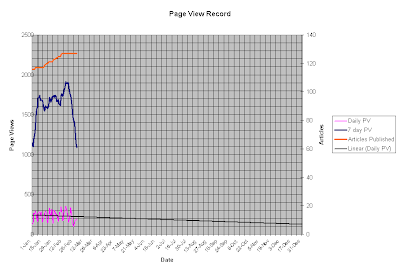
Google disagrees. We’ve been hurt bad by the algorithm change. You can see the graph accompanying this post, which shows my page views cut in half since the Google change. My articles didn’t change and I haven’t added any for about three weeks. Whether they were good, bad, or indifferent quality, they didn’t change. But Suite now has less “Google juice”, and my page views are suffering. It’s a little to early to know if my revenues have taken a similar hit. They’re down, but they fluctuate enough that they might just be on the low side of normal. It’s going to take another week or two till I know about revenues.

What to do? I never made a lot there anyhow. I enjoyed writing the type of articles I wrote there, however. Whether it’s done anything toward establishing my writer’s platform I don’t know, but I suppose not if it has now been relegated to the bush league. Plus, if I’m going to self-publish my stuff, the platform carries less importance.

I’m so into writing Documenting America right now, and so close to finishing, and have so many other writing projects begun, under research, or cued up, that a hiatus from Suite might be a good thing. Let’s see how it all shakes out in a week.