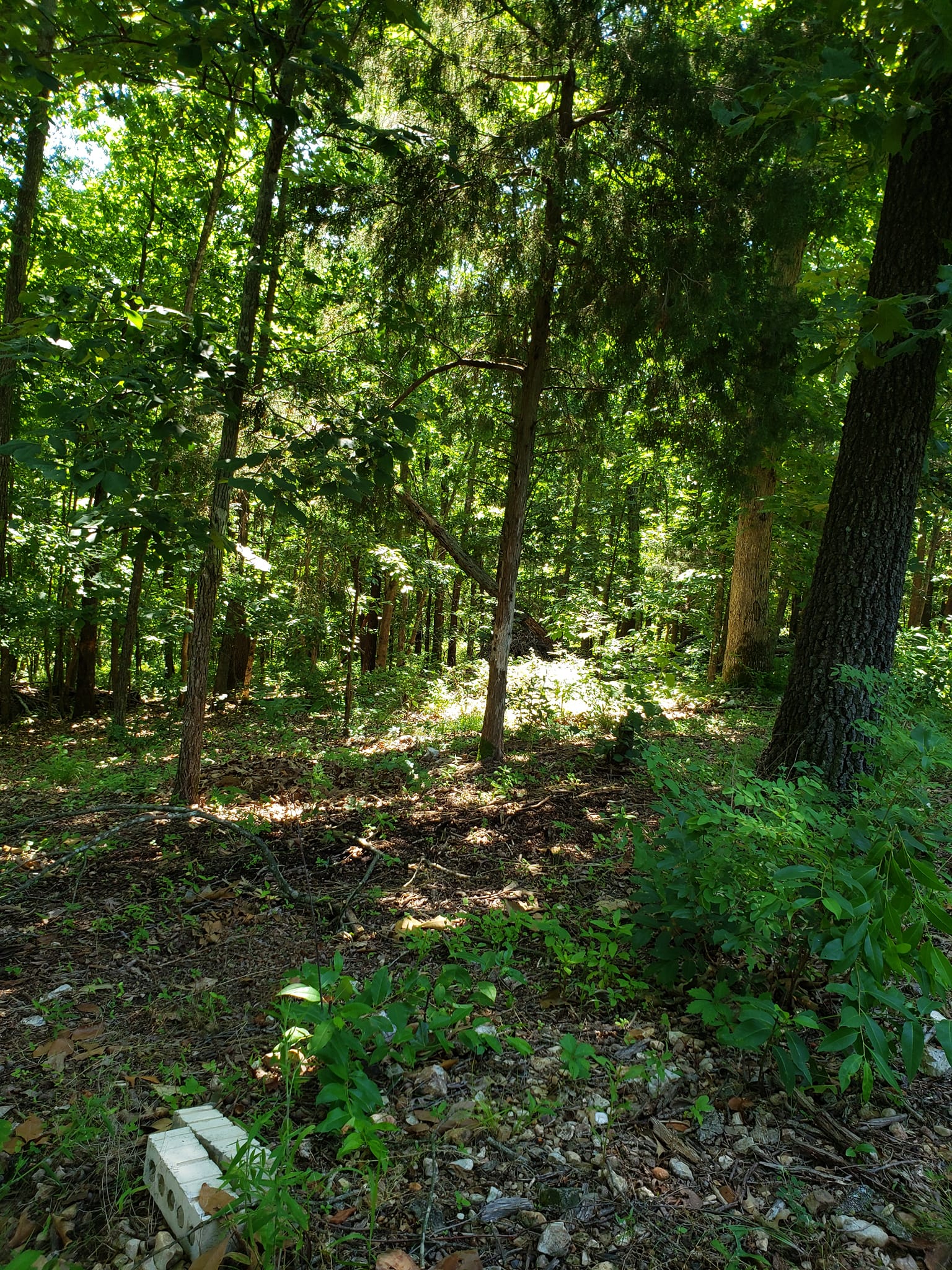
I love being out in nature. Too bad my knees and heart prevent me from going on long, woodland hikes.
I think, a few posts ago, I mentioned I had a new writing idea. Not sure if it will be a book or something else. Right now, it’s just an idea not yet fully developed.
I got this idea from the book I’m currently reading, Darwin’s Century. This is a book that talks about Darwin’s predecessors among naturalists, who came up with a piece of the evolutionary theory. Darwin put them all together. The part I’m at now is about Darwin’s voyage on the Beagle, and how this impacted his intellectual journey on his scientific road. Soon it will get into the theory itself, and talk about the people who helped to “sell” Darwin’s theory to the scientific community and the world. Right now, without having looked ahead or checked the Table of Contents, I’m not quite sure where the book is going—other than it’s pro-Darwin and pro-evolution.
This is the seventh book I’ve picked up about evolution. I find the story fascinating. I have only one more I plan to read (if I can find it at a reasonable price) and re-read one other. That should complete what I feel like I need to know to be well informed about the subject.
Oh, make that eight books. I forgot about the novel I read recently that dealt with some of these issues.
These have got me to thinking about the opposition that the theory of evolution has set between science and religion. Many people who believe in God think evolution is bunk. And many people who believe in evolution think God never existed but was a manmade concoction.
The crux of the matter falls into two categories, or maybe it’s three: God’s sovereignty, creation of humans, and old earth vs. young earth. I’ve been trying to put this into succinct, short paragraphs describing what I see as errors on both sides, but I haven’t yet been able to find the phrasing I want. I’m making progress, however.
I’m tempted to put the drafts of two paragraphs in this post, but will hold off. I need to learn to finish things before posting. Suffice to say I like how the two statements are shaping up.
So what about this book, or whatever this writing idea turns into? What’s the premise? It’s that God is seen in nature, that all that we see is His creation—however He set it in motion and however it continues. Also that science is an ever-changing thing, and we need to be careful about ever saying “The science is fixed,” and basing any type of beliefs about what science says at present.
Well, this post is unfocused today. Sorry about that. That tells you where I am with this writing idea: unfocused. Perhaps I’ll get some focus before long, as I put little thoughts on paper.
I don’t know how this will work, but I did it. The first episode went live this morning. The next will appear on Thursday. Then the episodes will come two a week, Monday and Thursday, until all are published.
Today is the day that I have become a Kindle Vella author.
But it was one day last week that I officially took the plunge. I won’t give the full story right now. Here’s the short version.
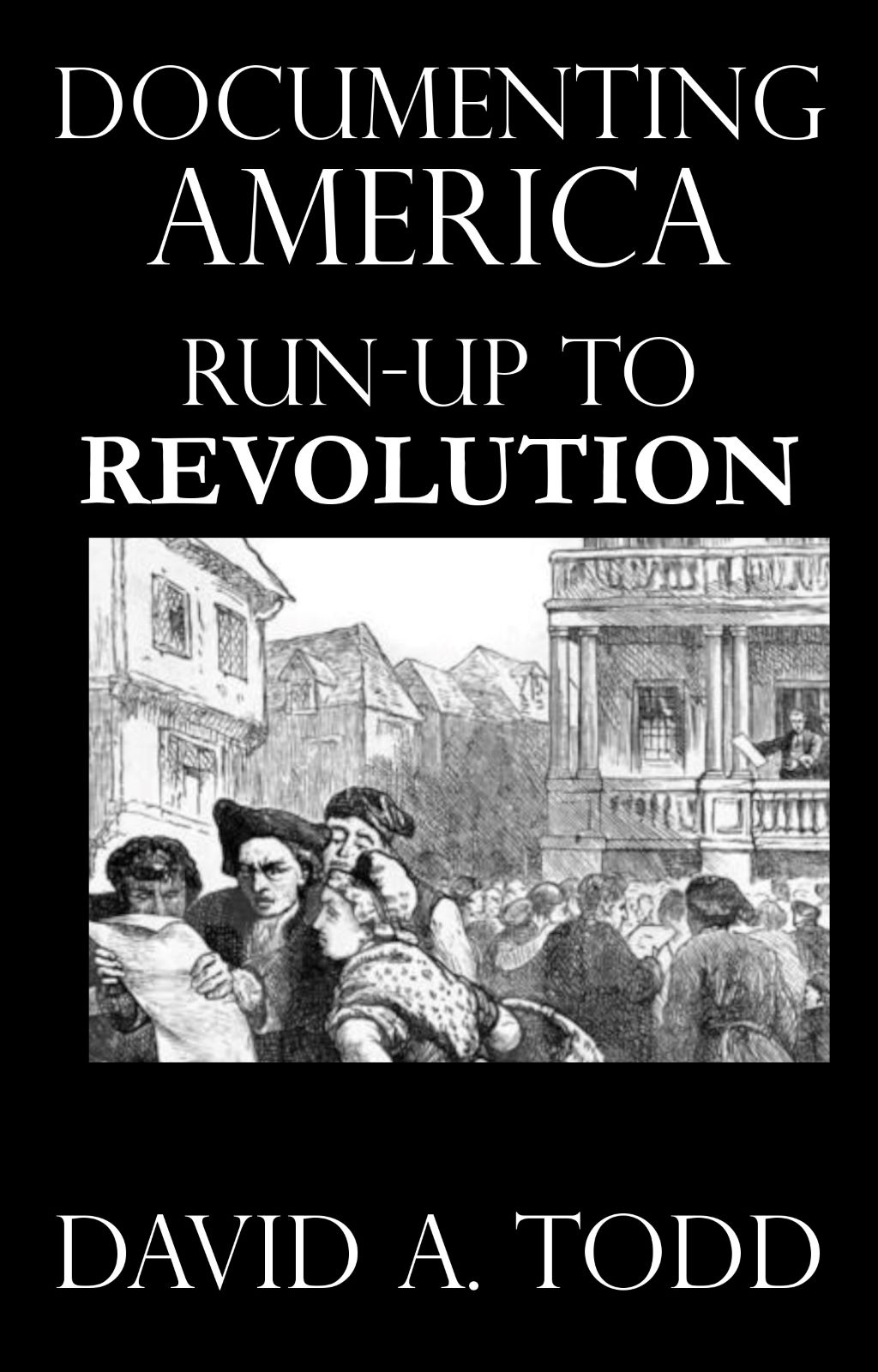
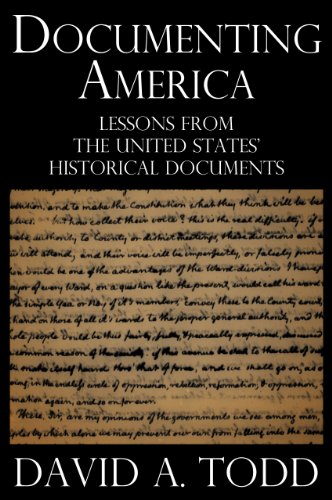
I’ve been working on Documenting America: Run-Up To Revolution, since June. I did the research for this back in 2021, but other writing got in the way. But I made good progress on it in June, July, and August. I felt I was working toward a schedule that might have the book published in October if everything went right, or in November if not.
Completing the fourth book in the series would feel good. I published the last one in 2019. I can’t believe it’s been four years since then. I had enjoyed writing the series and always planned for more volumes, but other books got in the way. Finally, I made the decision that this one would be next. The fact that I have more sales in this series than any other was a strong inducement to get back to this.
But my plans were interrupted by Kindle Vella. For those who don’t know, Vella is a place where authors publish their stories/books as a series. Chapters are called “Episodes,” books are called “Season.” They can be published on any subject, at any frequency the author wants.
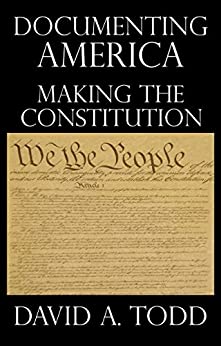
Volume 3 of Documenting America, on the events that bought us the Constitution, was published in 2019. I waited too long for the next volume.
Vella has a combination of fiction and nonfiction titles, but fiction dominates. I’ve browsed the nonfiction lists and haven’t been impressed with what’s there.
I’ve been watching Vella a couple of months. No one really knows if it is going to be successful. I finally decided there was no downside. I publish episodes while I’m still finishing up the final chapters. Vella allows you to publish the season as a book thirty days after the final episode appears. So I put it on Vella first. That causes me to be disciplined, to keep writing, editing, uploading, formatting, and promoting. When done, I’ll pull the episode back into a book and publish it that way.
Maybe I’ll make a little money with this volume on Vella, maybe not. But the book will be published, perhaps three or four months later than intended, but it will be published. Maybe it will join the ranks of its older brothers in the series and increase my sales later on.
Here’s the link to the series on Vella.Or maybe that’s just to the first episode. The first three episodes are free for anyone to read. Some number of free tokens are available to new readers. After that, you buy tokens and use them to read episodes. I’m not quite sure of the cost to read a book like this. But check it out.
Susan is a long time writing friend and colleague.
I met author Susan Barnett Braun at the 2011 Write-To-Publish Conference in Wheaton, Illinois. I attended that conference with the help of a generous Cecil Murphey scholarship. Susan did the same. I was one of six people who were members of an on-line writing group, The Writers View 2. Six of us in that group received scholarships. We got an e-mail loop going before the conference and agreed to meet, share meals together, and hang out.
Susan received her scholarship by other means, perhaps direct from Cec’s website. But when she got to the conference and quickly came to know of our little huddle of scholarship winners, she “crashed our party,” so to speak, and joined us for meals and other conversations.
Susan and I kept in touch afterward. She was beta reader for several of my books, providing great feedback. One of her daughters, who is talented with graphic arts software, has made several of my book covers.
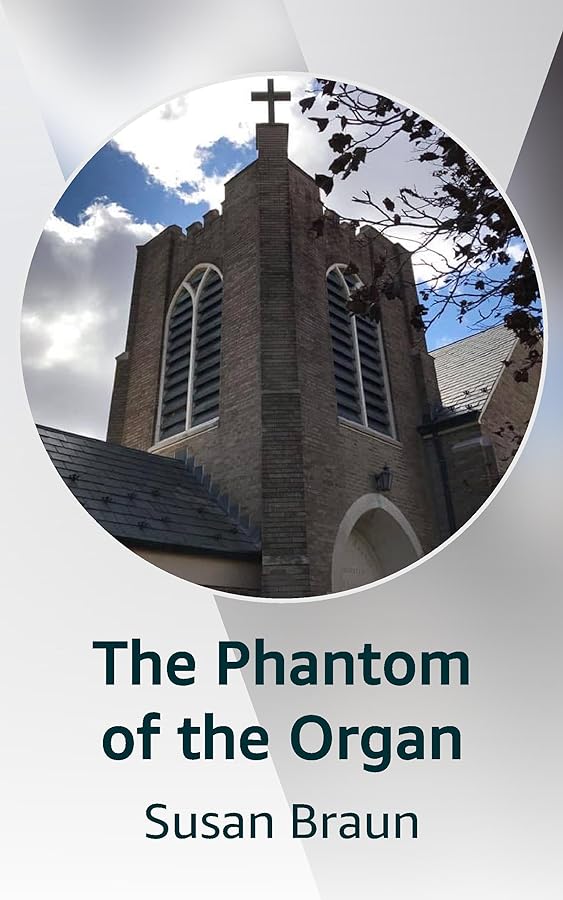
What evil lurks in the organ loft? You’ll only find out on Kindle Vella.
Susan recently dipped her toe into the Kindle Vella pool. She wrote about it on Facebook, and I exchanged e-mails with her about the process and prospects, then offered to interview her here about it.
Q: Before we get into Kindle Vella, tell us a little about your writing career up to this point.
Susan: I loved to write even as a child, and wrote several books while in elementary school. I would write them out in longhand, and my mom would type them for me on the typewriter. I’d even take a few snapshots and add those in. I wrote my first book as an adult in 2011, when I wanted to write a memoir of my childhood for my 3 girls to read someday. After doing that, I attended a writing conference which further lit the writing fire. I wrote two other books in the next year or two; one a biography of “mad” King Ludwig II of Germany, and the other a children’s biography of Kate Middleton.
Q: In an e-mail to me, you implied that “Kindle Vella got me writing again”. That implies you’ve been through a dry spell, or at least a non-writing period. Is that true?
Susan: It is, as far as books go. After my whirlwind of writing the three books about a decade ago, I didn’t write more books. I just didn’t have the ideas or the motivation that I often felt when I had written my books. I have, however, blogged since 2008. That’s been great in keeping me still writing in some form. I have to say it feels good to be working on a longer work, a story/book, again.
Q: What made you decide to write a serialized story for Kindle Vella?
Susan: In June, our family took a vacation to Glacier National Park and the surrounding area. One night, we had dinner with my husband’s cousin. She is a prolific writer, and she immediately asked if I’d heard of Kindle Vella. Although the term was vaguely familiar, I didn’t know anything about it. She told me about how she’d become a big fan of Vella. It’s a different way of releasing a book, one chapter (or “episode,” as Vella terms it) at a time. She works full-time writing grants, but on Saturdays she writes on her Vella stories and then releases a couple of episodes each week. She liked the way it’s so easy to do this, plus after a story is fully released on Vella, Amazon makes it easy to convert into an e-book or paperback 30 days later. She was so excited about Vella, and spoke so highly of it, that I caught her enthusiasm and thought I might enjoy trying it too. I like the idea of serialized stories — it reminds me of the “old times,” when authors often released stories this way, but in magazines, not online.
Q: Tell us something about the story line in Phantom of the Organ.
Susan: Fiction isn’t my usual genre. In thinking about what I might write as a fiction piece, I thought of what I knew. That led me to the world of church, and specifically, a church organist. I thought I might like to try writing a mystery, and I liked the idea of combining a church with a mystery. My girls have always loved Phantom of the Opera story. All those threads came together for me, and I came up with a church organist who is practicing at night in the church, when she hears strange noises … The Phantom of the Organ was born.
What’s that noise in the organ loft? Life as church organist in Pleasant Grove is calm– until Melody hears a series of odd noises and finds herself locked in the church one evening. Is there a phantom lurking at St Matthews? And can the congregation locate a mysterious monetary gift in time to save the church? New episodes Tuesdays and Saturdays.
www.amazon.com
Q: Rumor has it there will be a season 2 of PotO. Is this true?
Susan: Yes! My original story line took me 10 episodes to tell. I thought that was that. But then, I realized I was liking the characters and setting I’d come up with. I wanted to spend more time with them! So, I thought up another mystery for season two; this one involving items going missing from St Matthews church. My plan at this point is that I’d like to come up with four seasons. With each season running just over 10,000 words, that would be a book nearing 50,000 words. At that point, I would plan to release the story as an e-book and paperback. Can you tell I’m having fun with this?
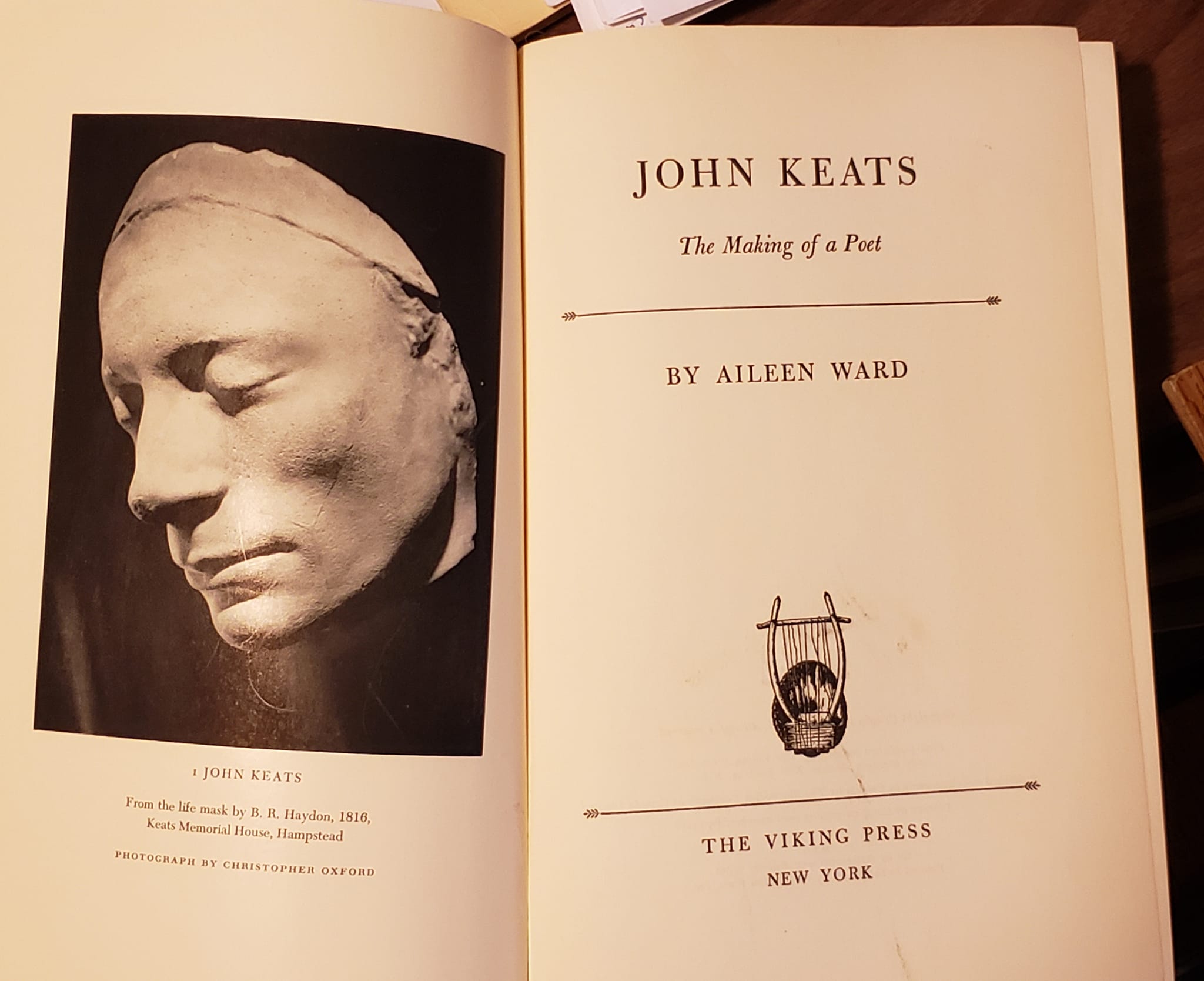
The book title page and the frontispiece: a “Life mask” from 1816
In July, while looking around for a book to read—a book I would find interesting yet wouldn’t want to keep after reading, I saw on my bookshelves in the storeroom John Keats: The Making of a Poet. By Aileen Ward, published in 1963, this was perfect. It looked like serious biography, the subject of poetry still holds my interest, and I didn’t think it would be a book I’d like to read twice.
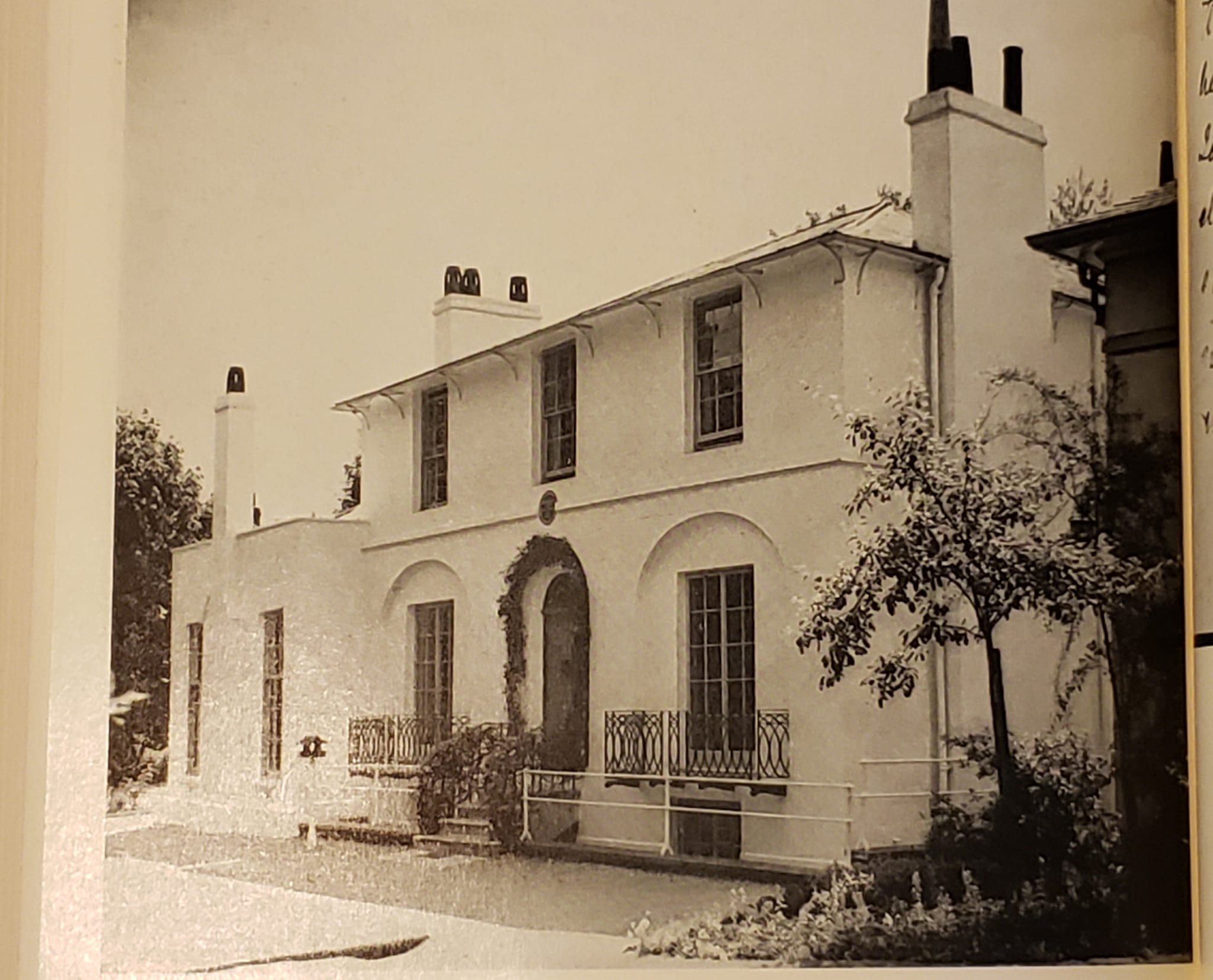
Wentworth Place, where much of Keats writing took place.
Born in 1795 in London, son of a groom/stableman, Keats was one of the “Romantic era” poets. The last major one to be born and the first to die. Before reading this, I knew his poetry and read some of it. I have, somewhere upon my over-stuffed bookshelves, a small volume that someone pulled together of best-known works, and a volume of his complete poems.
But I knew little about the man except about his tragic death from consumption at age 25. This book told me much about him. His father was a hard worker who opened a business for stabling the horses of travelers; he died when Keats was 9 and away at boarding school. His mother was a gadfly who quickly remarried upon her husband’s death, left the family for a few years, then returned in time to have Keats nurse her through the final stages of consumption when he was a teenager.
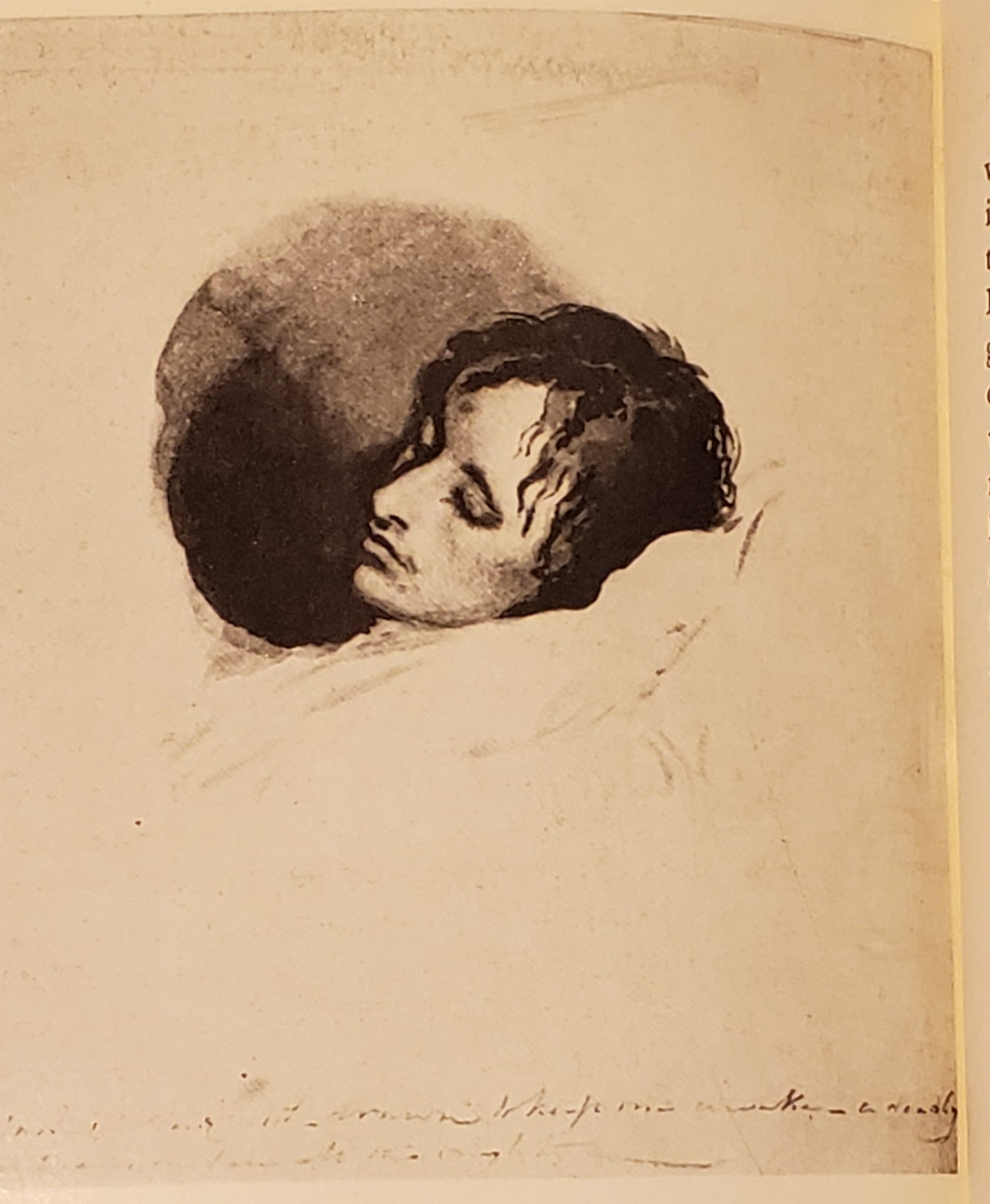
A sketch of Keats on his deathbed, 1821.
Keats took up the study of medicine and seemed to do well with it. He was at the point of launching into one of the lower-level medical sub-professions when poetry became his main interest. He began to write it and found he could do it. Alas, he fell under the influence of Leigh Hunt, who was roundly disliked by the better known literary critics. Hence Keat’s first poetry book, published in 1817 while he was still planning on a career in medicine, was also denounced by those same critics.
Despite this, Keats laid aside the medical field and took up poetry as his vocation. His long poem, “Endymion,” published and panned by the critics, is not considered a classic. According to Ward, many of his shorter poems were autobiographical, written about this or that person, or place, or event. The most famous of these is “On First Reading Chapman’s Homer”.
But Keats struggled financially, as well as in his health. He never received his full inheritances from his parents and grandparents, never earned much from his published poems, and lived without extravagance.
This biography does a good job of telling all of this, sometimes in almost too much detail. But it does keep moving and did keep my reading. I read about 10 pages a day in my noon reading time, in the sunroom our outside in the woods when the weather cooperated, and finished it in a little over a month.
I found the sources used by Ward and her way of spinning them into the story particularly impressive. Despite how old this is relative to our modern times (Keats died in 1821), it seems she was able to document close to every day of his life: when he wrote which poem and why; where he traveled; who he dined with; what his health was like at the moment. It helped that Keats left an extensive correspondence behind at his death.
I am so glad I saw this book on the shelf and read it. I rate it the full 5-stars. I’ll not read it again and it’s not a keeper. But learning about this little piece of poetic history has acted like a tonic in my reading life.
Time to work on a cover for the newest volume in this series?
It’s that time of the month—time for accountability of writing goals. How did I do last month vs. what I planned? First, the progress.
Blog twice a week, on Monday and Friday. As usual, I achieved this. Only one time did I find myself late and have to throw something together.
Attend three writers meetings. One writers group is folding, so I’ll only have three most months henceforth. Attended all three, as well as an online social gathering of writers.
Begin serious writing work on Documenting America: Run-Up to Revolution. I don’t know how fast this will go—or how slow—so I won’t set a word goal. I actually began this on Saturday, and was able to complete the commentary part of Chapter 1—first draft, of course. This bodes well for future writing progress on this book. Yes! I made some major progress on this. As of 8/31, I had 12 of 31 chapters complete. The rest have the source documents fully edited and are ready for my words to be added.
Read more in reference documents for my new Bible study idea. If everything gels, get started on the study overview and outline. I didn’t read any more source documents, but I did spend a little time improving the outline.
Continue to work on digitizing/discarding of genealogy papers. Yes, I did this, though made less progress in the last week than previously.
Now for some goals. I’m a little hesitant to set any, because my mind has been too active on some potential new projects. But, if I don’t set some goals I’m just drifting to the future instead of steering a purposeful course. So here they are.
Blog twice a week, Mondays and Fridays. I suspect my readers are tired of seeing that goal each month.
Attend three writers meetings, plus the online social gathering.
Complete the first draft of Documenting America: Run-Up To Revolution. This is very doable, but I will have to be disciplined, especially in consideration of…
.. Decide on whether to post my new Documenting America book to Kindle Vella and, if I do, get the first chapter/episode published on Wednesday, September 6.
Tie down the new writing idea that came to me on August 28-30. Write all I can about the idea in manuscript. No, I’m not sharing what it is now. Heck, I don’t know when I would have time to write it if it seems viable.
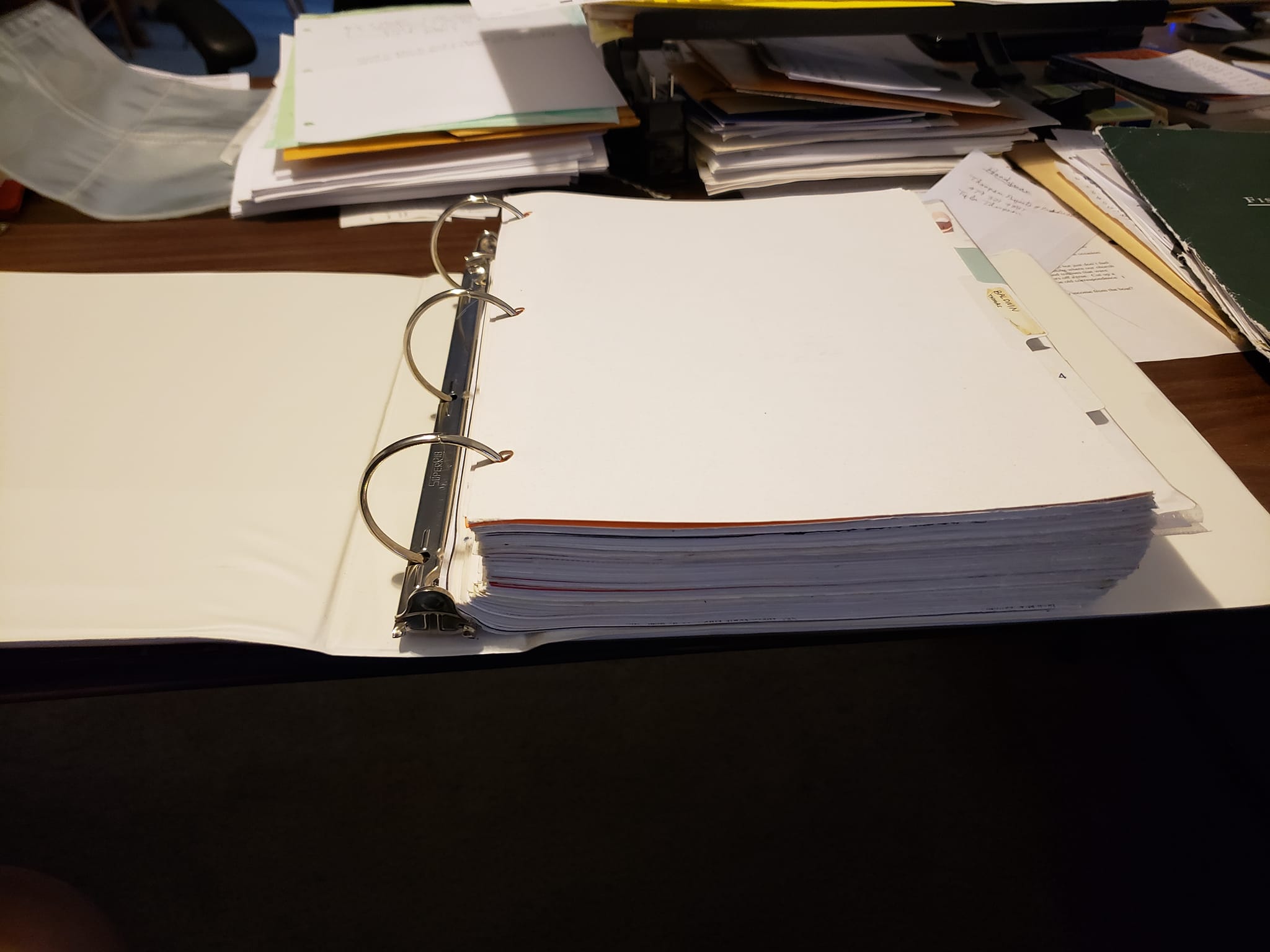
Enough! I’ll also be working on the genealogy papers digitization project. I have a very large notebook open on my desk that I’d like to get all the way through in September.
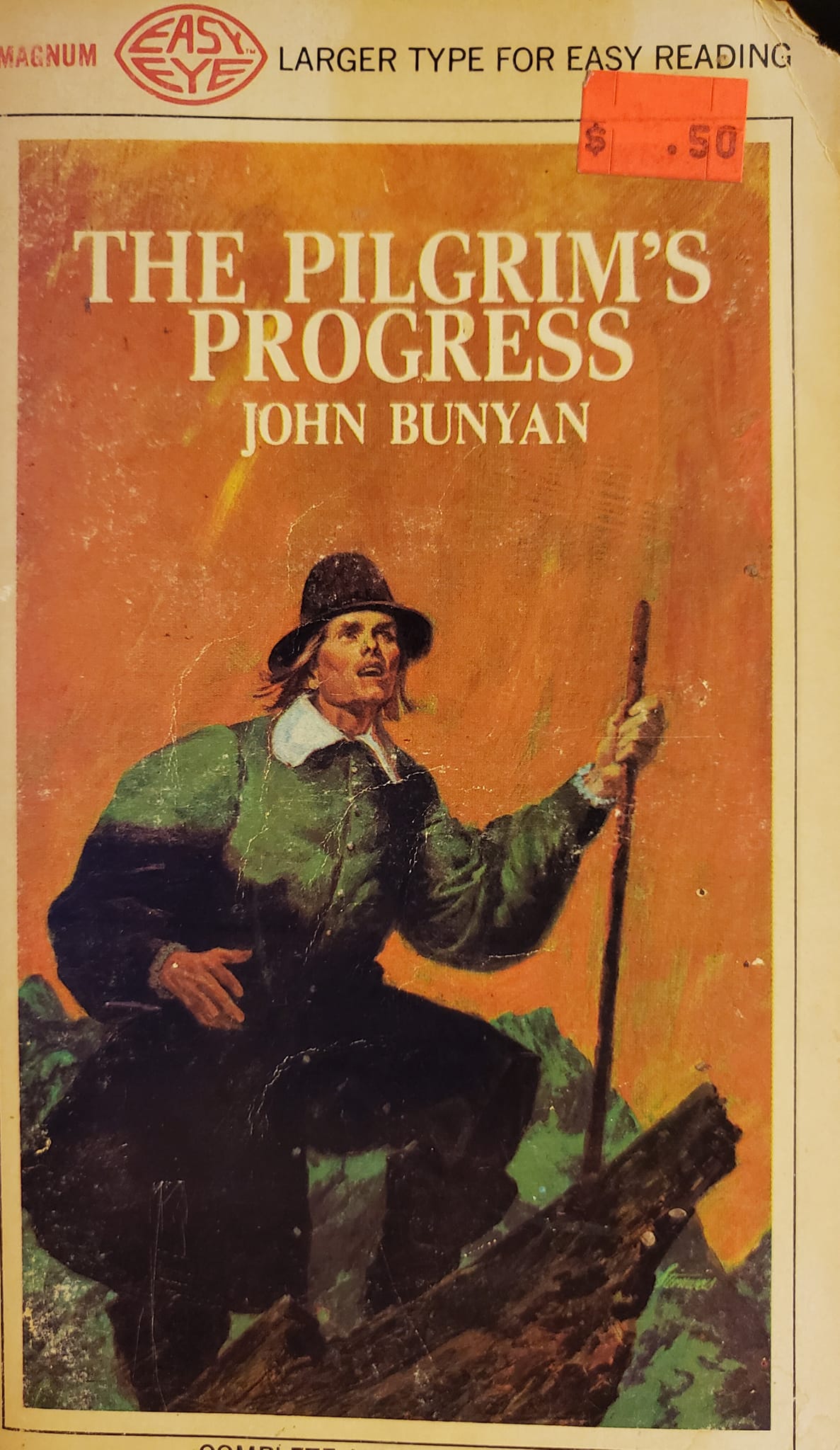
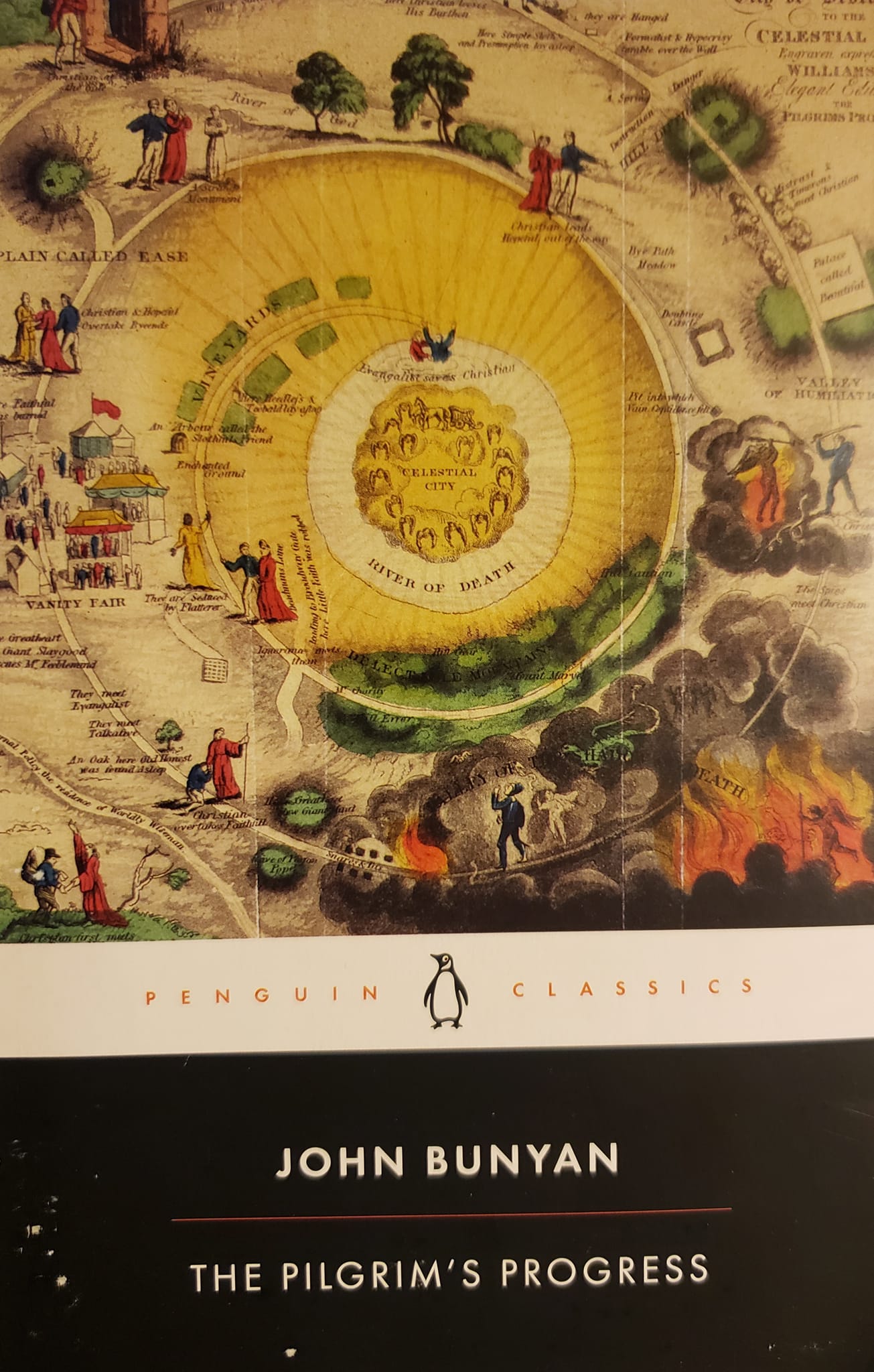
The Pilgrim’s Progress by John Bunyan is a Christian classic novel/allegory that has been around since 1678 in part and 1684 in complete version. For some reason, while I knew about this for years, I never read it.
But a couple of months ago, while browsing my bookshelves for something to read, I found this. I suggested it to Lynda early this month and she agreed we should read this.
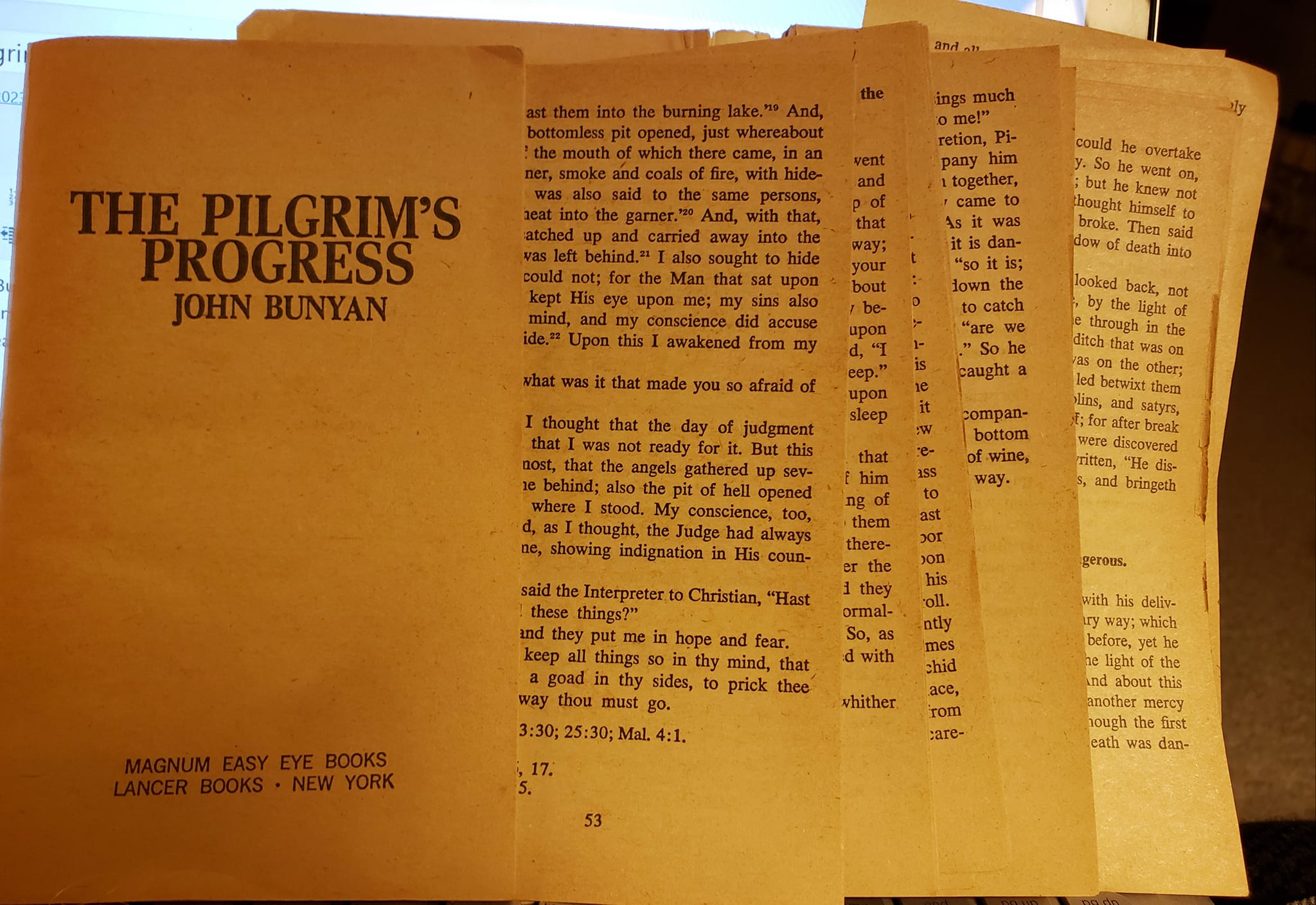
Let me tell you, this is a hard read! The subject matter is great; the language is archaic and quite difficult to read, especially aloud. It didn’t help that the book we had was a mass-market paperback from 1968 that fell apart less than halfway through. While we were out and about for a doctor’s appointment, Lynda suggested we buy a new copy rather than power through with the loose pages. So we bought a new one.
…it fell apart, given that it was 55 years old and cheaply made. So we switched to…
The problem was that the book divisions weren’t the same in the 1968 and the newer (2008 or later) book. Bunyan’s book has lots of marginal notes and scripture references. In the 1968 book, the marginal notes are printed as headings between paragraphs. In the new book they are in the margins. Once I was able to orient to the new system, the reading was definitely easier in the new.
…this newer book. Much easier to read (better font, cleaner pages).
For those who don’t know the story, the first part follows a man named Christian, who lives in the City of Destruction. He decides to go on “pilgrimage”—the allegorical word for he became a Christian. He “leaves” his wife and four sons for his journey. Along the way he encounters many problems. He walks with a huge burden on his back. He walks alone, though frequently encounters both those who would deter him from his goal and those who would help him to reach his goal, the Celestial City.
In the second part, Christian’s wife, Christiana, decides she has made a mistake by not going with her husband on pilgrimage. She leaves the City of Destruction with her sons and Mercy, a young woman from the town. Their journey is much different than Christian’s was. They are given a “conductor”—a man named Great-Heart who will help them on their way. Their party of seven (Christiana, Mercy, the four boys, and Great-Heart) heads on the journey. Their guide advises them where to go and protects them from many of the dangers. Their party swell with additional pilgrims.
Eventually they reach the river across-which is the Celestial City. One by one they receive a message via “post”, and are given the time when they must enter the river and cross to meet their king, the allegorical description of death.
As I said, the reading is difficult. Neither of our books had modernized text or punctuation. I did some modernization as I read, but it was difficult.
I’m not going to rate this classic. And, while I suspect I will never read it again, I won’t discard the new book. I’ll find a place for it on the shelf. But the older book is going into the recycling bin.
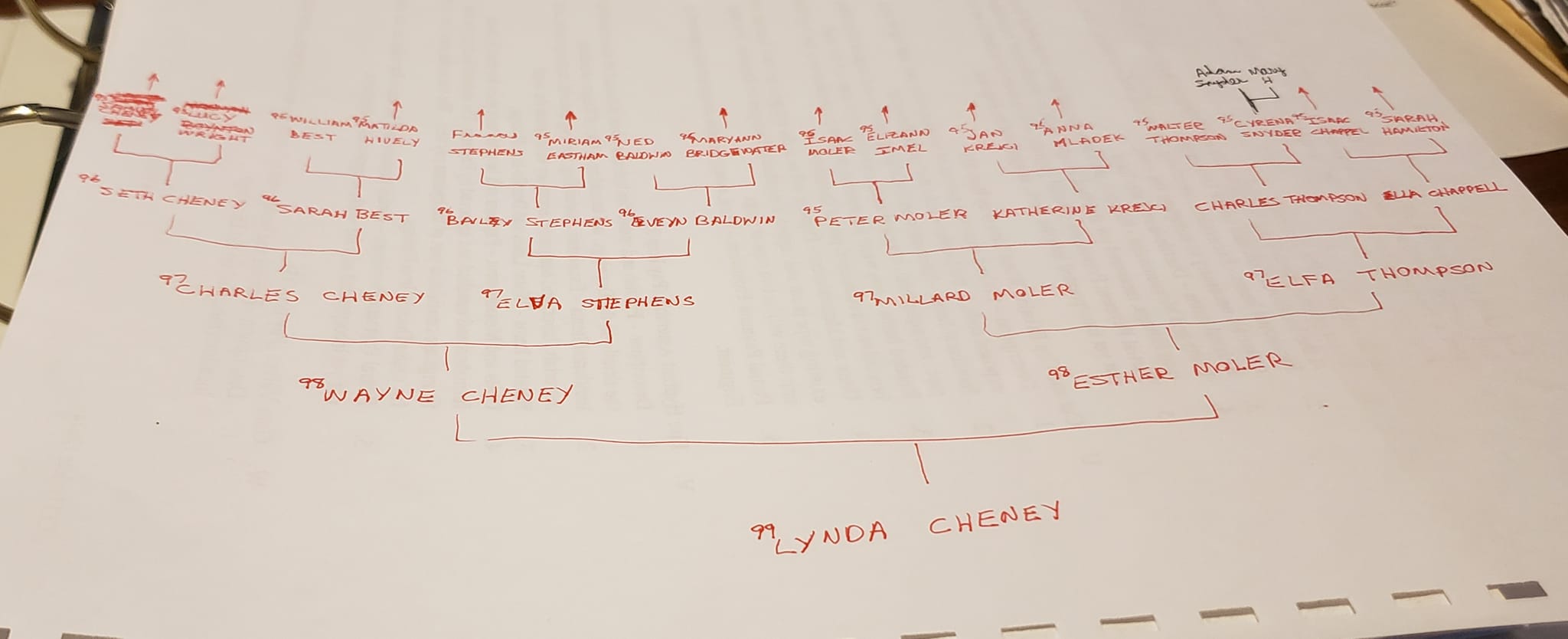
Genealogy charts like this for my wife’s ancestry: will I ever see them again?
There have been times in my life when I got a foreboding that I was doing something for the last time.
The first time it happened was when I flew out of Boston in 1990. We were back in the USA after Iraq invaded Kuwait, living back in Asheboro NC, waiting for the situation to clear. I took temporary employment with Metcalf & Eddy in a Boston suburb, and flew up once a month for a three-week stay in their guest house. I flew back to NC in November and, as we looped around the city after takeoff from Logan airport, I remember thinking, will I ever see Boston again?
The was probably foolish thinking. I was only 38 years old. My dad and brother still lived in Rhode Island. I should have realized I would have many more times to be in Boston. But that was the feeling I had.
The next time was leaving Kuwait in July 1991, out of the severely damaged airport. That was an accurate foreboding, as I’ve never gone back there.
I start working on this notebook today.
It happened in 2010 when I was in Rhode Island for my 40-year high school reunion. My brother was hospitalized. He looked awful. A new health problem had recently developed, compounding three other major problems. I remember thinking as I left the hospital that I thought he had less than 5 years to live. In fact, he didn’t make two years, and my premonition was correct.
Now that I’m a lot older, I get those forebodings more frequently. Every time we make a trip to a home town or old haunt, I can’t help but think, “Will I ever see this place, or these people, again?”
But I generally can put those thoughts out of my mind. Is this the last car I’ll ever own? Is this my last big vacation? Is this my last long-distance drive? Yes, I set those thoughts aside and concentrate on what I have.
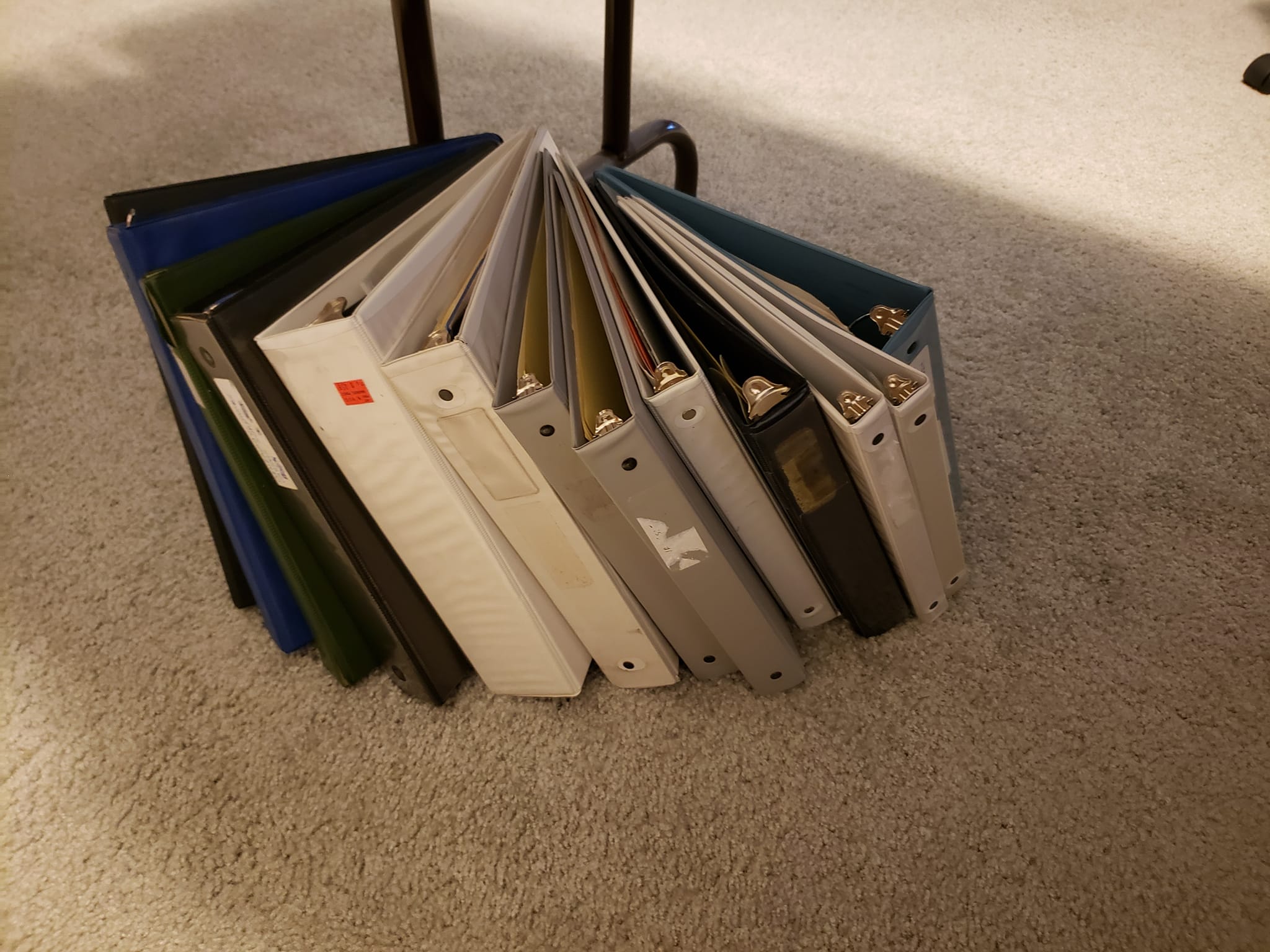
13 notebooks emptied, ready to be brought up to the staging area for donations.
I had just such a foreboding yesterday. Not about people or places but about a thing. Or actually a bunch of things: my genealogy research papers. I think I’ve mentioned this on the blog before, at least in the Progress and Goals posts. I had a lot a lot of genealogy papers. I made it a practice to write everything down as I researched. I came up with filing systems and reorganized. Then, as the 3-ring binders seemed to reproduce themselves like fruit flies (but taking up much more space), I carved out a shelf in my closet for them. Six feet of glorious space to put notebook after notebook.
Except the shelf filled and I had to lay some horizontally on top of the others. Then, my interests began to change and I spent much more time on writing than on genealogy. So many of my notes were incomplete. Even as research became easier as more and more records were placed on the internet, many for no-cost searching, I did less and less.
Every now and then I’d hear from a relative, the old obsession would rear up and I’d research in a frenzy for a week or two then…back to writing, with another twenty or thirty papers stuffed into an already over-stuffed notebook.
Now, as we are in the process of disaccumulating in advance of a future downsizing, as I looked around for what I could get rid of next, I spied the shelf in the closet and realized that row of notebooks were something I couldn’t keep.
But what to get rid of, what to keep? What to save, what to trash? How to get rid of the bulk of those papers without destroying my research, just in case someone in the future cared to know what I had learned about the family?
I’ll try to make this short. I first went through the notebooks and pulled out any sheet with a name on it that had no further information. To recycling. Next I took a hard look at some family lines that I had a little research on but which I never did a whole lot of research on. Out they went. This, if I remember correctly, got rid of three notebooks after consolidation.
That left around 25 notebooks—still way too much. I knew I had to digitize these papers and save them to the computer. But how to do it, and how to save them so that they would be findable in the unlikelihood they would ever be needed again, either by me or by a descendant?
I had only recently discovered that my printer was also a scanner, and that it had options such as scan to PDF, jpg, or to text. I had already been using it to scan printout of letters and e-mails. I could just shift a little and use it for genealogy papers.
That’s what I’ve been doing for a lot of 2023. I made it a goal to scan and trash 10 sheets a day from the notebooks. That would be over seven reems of paper in a year. It took me a while to get going. I figured out a way to save everything digitally so that I could find everything again. About five more notebooks into the process, I realized my filing system was a bit cumbersome and was slowing down the work. It took me a week or two of experimentation before I figured out a better way.
With that better way, and with old Betsey (the name I just gave to my scanner) cranking away, I discovered I could easily scan and trash 20 sheets a day, taking relatively little time. Now I was up to close to 15 reems a years. That would make a real dent on that closet shelf.
Yesterday was a catching up day. I scanned 57 sheets and filed the electronic files. That emptied one more binder. I set it on the floor under my worktable with the others, all waiting to be carried out of The Dungeon and to the garage staging area for things to be donated. Right now it’s 13 notebooks. I’ve already donated a few earlier in the year, and I think it’s 18 that have been cleaned out and declared surplus.
Ah, but I was talking about forebodings. Yesterday, as I scanned and filed all those papers—many showing incomplete research, I got the sense that I might never see them again. Will the time arise that will allow me to expand the research? And will it come to a point where I no longer care?
So that’s where I’m at today. Did I save my “darlings”, or kill them, as Hemingway famously advised writers to do? Time will tell.
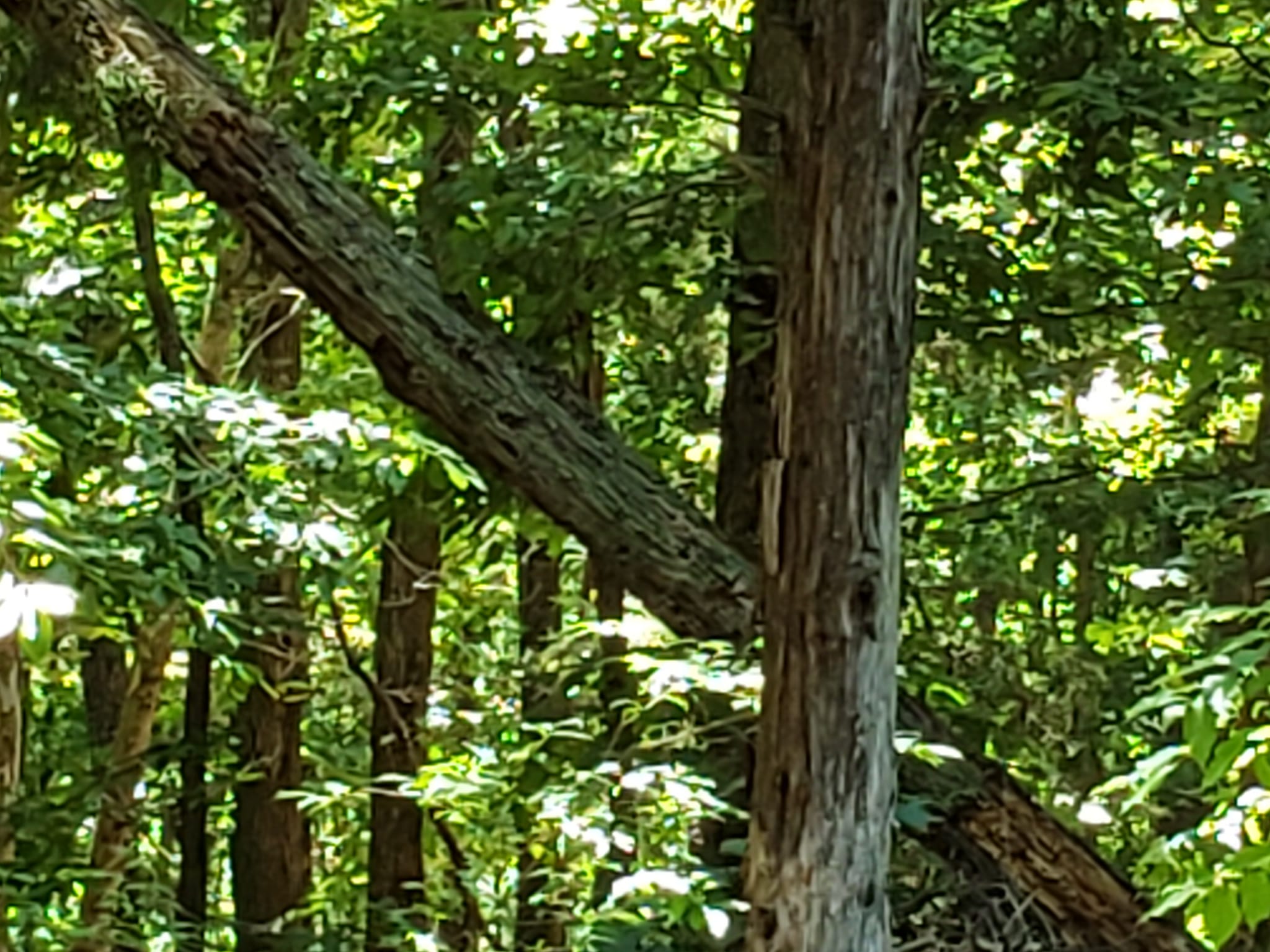
No, climate change did not bring down this tree. It grew too big for its root system on the rocky hillside.
What is it they say? When engaging in conversation, avoid politics and stick to the weather and your health? But who wants to hear about my new aches and pains, or how my good knee has started to hurt a lot? So that leaves the weather.
But it seems even the weather is a source of contention these days. This seems to have been a hot summer. Across social media, people are posting memes “Only [so many] days until fall” says a man sweating under a hot sun, holding one of those portable, battery-operated fans as he can barely put one foot in front of the other on the sidewalk. It’s as if people forgot, from last year to this, that it’s hot in July and August.
The problem is that discussing the weather leads on to global warming—or climate change to use the latest term. Look how many hot days we had this July compared to last. It must be global warming. Mankind’s activities must be heating up the planet. Thus, a simple mention of weather in casual conversation become a source of contention, as one believes in climate change and the other doesn’t.
Right now, people can’t wait for cooler weather. What will they be saying in January?
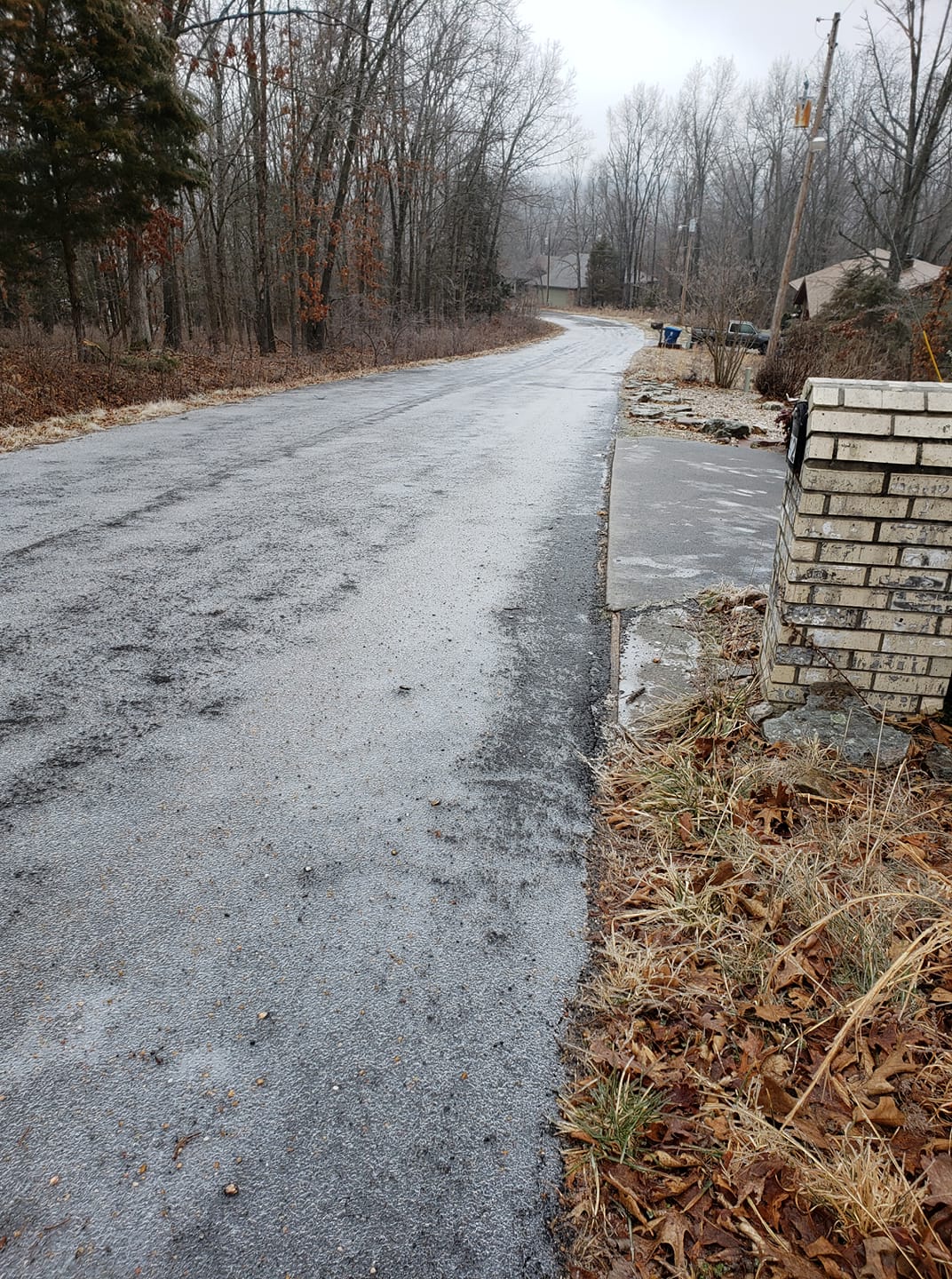
I had occasion to begin studying my utility bills recently, trying to see if a gadget my wife bought is having the advertised effects on our power usage. Our meter reading for July 2023 was indeed significantly below July 2022. Might this gadget be working? For the first time I noticed that our utility bill shows average temperatures for the month. July’s average high was 89°. I checked last year, and the average high was 93°. So this year was cooler, or should I say less-hot. We also have a new air conditioner, put in at the end of August last year.
I’ve heard lots of complaints about the temperature this summer. They tend to come from the same people who complained about the weather last winter. Hot, cold. Doesn’t matter. People need something to complain about.
Right now, remnants of Hurricane Hillary are hitting the western US, the first tropical storm to make landfall in the USA from the Pacific Ocean in over a quarter century. I can’t wait for the pundits to come on TV to say this is obviously an effect of manmade climate change and we must change our ways if we are going to save the planet for future generations. A couple of days ago, a tornado touched-down in my native Rhode Island—a very rare occurrence. It hit the cemetery where my parents and grandparents are buried and did a lot of damage to mature trees. Are people already saying, “See, see! Climate change!”
People, it’s hot in summer and cold in winter, depending on where you live. Some years are hotter than normal, some cooler. Some hotter than normal in the East, some cooler than normal somewhere else. Turning weather into a discussion on climate change, which necessarily morphs into politics, is a waste of time.
One storm, or two storms, or one summer season, are not enough to make a claim that human activities are causing climate change. It may be that they are. In fact, I feel fairly certain that modern society, as we live in the USA, is adding heat to the atmosphere. Whether that’s changing earth’s climate in an irrevocable manner is another question, one I’m not ready to discuss in social settings.
It’s now 6:20 a.m. on Monday morning. Got up earlier than I wanted to when I couldn’t get back to sleep. I’ll now get dressed and go outside for some yardwork, trying to beat the heat on what is predicted to be a 100° day. It’s summer, and heat is expected. I have a small place that is overgrown with weeds and I’d like to get it cleared today. Tomorrow, maybe I’ll tackle deadfall on the woodlot.
By next week it is forecast to be in the 80s for the highs. Happens every August.
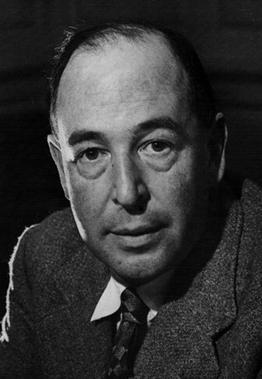
Lewis, probably 15 years after he wrote “The Screwtape Letters”.
In a recent post, I talked about how the Law of Undulation was featured in a chapter of C.S. Lewis’s The Screwtape Letters. That all came from Letter #8. Then, in Letter #9, Screwtape tells Wormwood that, while God uses the valleys (troughs) people go through for their growth and maturing as Christians, it is also a good time to tempt “the patient.” He provides three specific pieces of advice.
In the first place…Trough periods of human undulation provide excellent opportunity for all sensual temptations, particularly of those sex.
While God will use the trough periods for our strengthening, they are also a time of danger, for temptations seem stronger when we are at our weakest. “The attack has a much better chance of success when the man’s whole inner world is drab and cold and empty,” wrote Screwtape. Yet, if the Christian can just get through it, he/she will be the stronger for it.
That moves us on to the second suggestion from uncle to nephew.
But there is an even better way of exploiting the Trough; I mean the patient’s own thoughts about it.
Screwtape has previously advised his nephew that clarity of reasoning is not in the devil’s interest. Best to keep him in confusion, use lots of jargon. Convince him that his Christianity is just a phase, like other phases he has been through in his life.
Another possibility is that of direct attack on his faith.
The patient, still a new, adult convert to Christianity, probably thought his high following conversion would last forever. Now he’s in a trough. Wormwood should try to say to him, “Aha! It’s just a phase, this Christian thing. See, you’re right back where you were before that prayer you made a few weeks ago.” That’s not true, of course. The patient’s standing before God depends on the fact of his conversion, not the rise and fall of his feelings.
Lewis was an intellectual who came to faith by way of reason, not emotion. In this book, you actually see a lot of Lewis in the patient. The temptations that Screwtape suggests Wormwood use are likely such as Lewis himself faced. Since I last read this book about 15 years ago, I’ve learned much more about Lewis’s life and read many more of his writings, including the three volumes of his collected letters.
The Screwtape Letters has been called a work of Christian apologetics. But I don’t see it as that. To me, it’s a discipleship book. It is chock full of advice of how to live a more consistent Christian life, to be stronger in the face of the world’s temptations, and end your Christian walk stronger than you began it. I first read this in 1975 (or was it late 1974?) when I was a baby Christian. This book so helped me in my beginning Christian walk, it has been a book I’ve gone back to several times through the years, and I’m sure I will go back to it again.
As we go through this study, I may make other posts about it. I won’t let it hog the blog (ooh, I like that), but I’m sure I’ll have several more posts about this, one of the greatest books of the 20th century.
This week, I’ve been unable to write anything. My work-in-progress, Documenting America: Run-Up To Revolution, sits more or less where it was on Monday morning. I think I got a few words written on Monday (completing a chapter I left undone on Friday), but no more.
On Tuesday, I sat in The Dungeon as usual, pulled up the next chapter to write, and…nothing came to me. I couldn’t make sense of the source document, already edited to length. So I put that aside and came back to it on Wednesday. And on Thursday. Nothing. I still couldn’t see how to write the chapter.
Part of the problem is my hurting left shoulder. Did I write about that before? It was severely strained when I was walking Nuisance, our daughter’s family’s dog, in early June, and the dog had an encounter with a snake. They saw each other before I saw the snake. They lunged at each other, and in restraining the dog, boom. My shoulder was damaged. It’s not broken or dislocated, but it hurts like the dickens (as Dad used to say). Having my arm in the typing position seems to be where it hurts the most.
So I’ve been doing other things this week. I wrote a couple of long-hand letters. Organized some e-mails. Worked on my correspondence files from 2018 and 2019, deleting duplicates. Digitized some genealogy papers. That still hurts my shoulder, but I have enough breaks from holding my arms in place on the keyboard.
Oh, one other thing that’s been taking up some time and brain power is arranging for repairs to be done on the house. Dealing with contractors, getting estimates, scheduling work. I always find that draining. One item is now under contract and will be done next week. I should get the final estimate on the second one today. The third I’ll deal with next week.
So that’s where I’m at. Writer’s block for the first time in my writing “career.” I’ll try again today and see if the words will come. Maybe Monday I’ll be able to write that second C.S. Lewis/Screwtape post.