Back on January 16, I laid out my publishing plains for the year, with special emphasis on the first quarter. At the end of that post I said I’d come back after the first quarter to give you an idea on my progress. Well, we’re now half-way through the second quarter, and I just now remembered I’m supposed to do that. Sorry that I didn’t follow through.
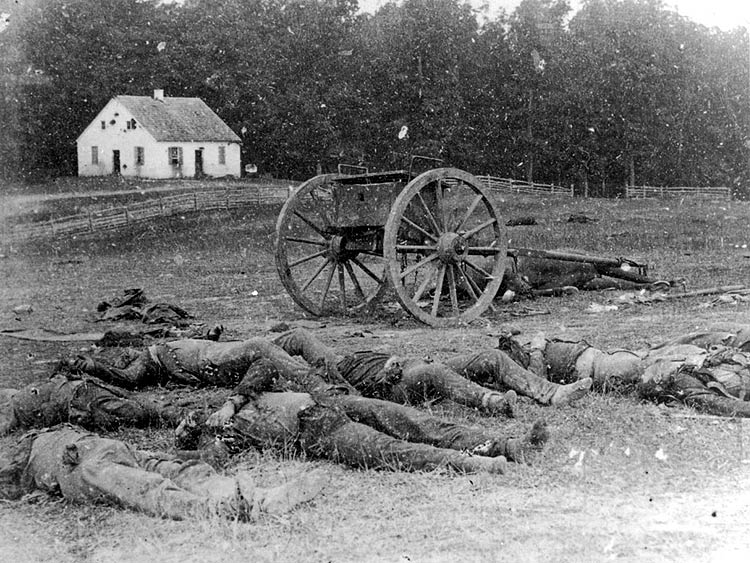
The Civil War Edition of my “Documenting America” series is nearing completion.
I can give a report now, for sure. I listed nine bulleted items that I wanted to accomplish in the first quarter. I’ll repeat them here, and give the progress report on each one.
Jan 1: Begin reading for research for Documenting America: Civil War Edition. I wrote then: I achieved this. I’m reading a little almost every day for this.
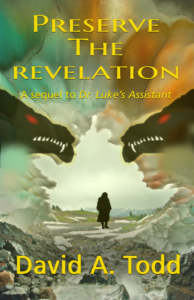
Jan: Complete the first draft of Preserve The Revelation. I wrote then: I actually did this Saturday, Jan 14, at 8:10 p.m.
Jan 31: Edit Doctor Luke’s Assistant and republish it. I re-read this in 2016 with an eye toward making edits in it. I’m ready to go with typing. This schedule should be doable. I achieved this. I don’t remember the exact day, but while letting Preserve The Revelation sit a while, I typed the DLA edits and republished it, both in e-book and print form.
Feb 15: Edit Preserve The Revelation once. I achieved this, I think by Feb 15.
Feb 28: Edit Preserve The Revelation again, which I hope will be the final edit. I achieved this, though it turned out to NOT be the final edit. I had to do one additional round.
It’s published as an e-book at Amazon; print book and other e-book formats, though some editing for Apple remains.
Mar 15: Publish Preserve The Revelation. Much must be done for this to happen, some of which I’ve already set in motion. I achieved this, though not quite by my target date. The e-book was published March 23, and the print book on April 5.
Apr 1: Publish Headshots as a print book. I’m unclear of where I stand with this. In 2016 I edited and re-published the e-book version of this. I don’t remember how I did my edits, whether to a master file or to the e-book file. I’ll know more when I get back to this, probably early to mid-March. No, didn’t achieve this. Instead, I switched my attention to the next item.
Apr 2: Resume writing on Documenting America: Civil War Edition. Actually, I hope to write some on this much sooner than that. But I’ll be satisfied with not doing so until early April. My guess is I’ll have two months of writing to do on it. I achieved this. In fact, I’ve been able to give it much more attention than I anticipated. I wrote about this a week ago. As of last night, I have only four chapters to go to finish the first draft.
Blog on a regular Monday and Friday schedule. I’ve already missed a couple of those. I’ll be satisfied if I have 40 to 50 blog posts for the year. I achieved this. Since my Jan 16 post, I don’t think I’ve missed a scheduled day of blogging. Or, if I did, I blogged a day late, but got it done.
As for my overall publishing plans for the year, here’s what I wrote before, along with the progress report.
Finish my novel-in-progress, Preserve The Revelation, and publish both as an e-book and in print. Done!
Finish my non-fiction book-in-progress, Documenting America: Civil War Edition, and publish both as an e-book and in print. I said I was 40% done in January, based on work of a couple of years ago. I’m now sitting at 95% done on the first draft.
Four chapters done in the next volume; hopefully it will be a 2017 publication.
Finish my workplace humor novella-in-progress, The Gutter Chronicles: Volume 2, and publish both as an e-book and in print. Nothing done on this yet. I haven’t given up on it.
Write a new story in the Danny Tompkins short story series. Done! I published this on March 16.
Write a new story in the Sharon Williams Fonseca series. Nothing done on this yet. The plot for the next story still hasn’t come to me; though, to be honest, I’ve had a few glimmers into the plot, but have pushed them aside to work on other things.
Finish Carlyle’s Chartism Through The Ages, a non-fiction work. Not even thinking about this at present.
Continue working on Thomas Carlyle Chronological Composition Bibliography. Not even thinking about this at present.
Two other items have come to mind, which I’m adding to the list. Call me foolish, but I’m doing it.
Publish the six Danny Tompkins stories as a box set, both in e-book and in print. This should be fairly simple, the hardest part being the cover. Together, they will be just long enough for a print book.
Publish my research into the Stephen Cross family of Newbury, Massachusetts. This was genealogy work into my wife’s family, Stephen’s wife being the sister of Lynda’s great-great-great-great-great-great-great-grandfather. I’m planning a much longer book on the whole family of ten siblings, but that’s going to have to wait a while. Meanwhile, I have this part done, needing only a little narrative and formatting. It will be 80 to 100 pages, I believe, which would be a nice little genealogy book.
So there you have it, new publishing plans for the year, but no specific publishing goals for the rest of the second quarter. I’ll be back with future writing/publishing goals and reports.
In his sermon yesterday, Pastor Mark Snodgrass started off with a baseball illustration. He said he once had an ambition to become a professional baseball player—until a coach convinced him he didn’t have the talent for that. Mark admitted he had trouble with the curve—and the slider, the knuckleball, the change-up. It was a good opening for his sermon.
I identified with that. I for sure didn’t have any skills for baseball, even at the junior high level. But more than that, I have trouble with the curve. Not the curveball the pitcher throws, but at the curves life throws up.
Last Thursday, I had a curveball thrown at me by life. Took my pick-up into the dealership for routine servicing, as well as to look at a developing problem. I had it there at 7:00 a.m. I was first in. Yet, they didn’t call me until the end of the day, saying they didn’t have it done and wouldn’t that day. Curveball.
Just yesterday, life threw another curve at me, though it was of my own making. I took a walk after lunch, going 2.77 miles at a pretty good clip. Just a minute before getting home I kicked at a stick in the road, to nudge it off the pavement. My foot hit the pavement too hard, refused to go forward, and, since I was kicking while walking, my body kept going when my foot stopped. I tumbled onto the asphalt pavement. I’m okay. A few scrapes, my right knee hurting a little, and minor trauma in my left ankle. Maybe a painful hip and lower back. So the kicking was my fault, but the inability to judge that, and to maintain better balance, was the curve life threw.
I don’t like curves thrown at me. They take me out of my comfort zone. I like routine best. Up at 6 every morning. Shower, shave, dress, grab my lunch and hit the road. Eat a simple breakfast at work. Have my quiet hour at my desk, begin work at 8. Five glorious days of routine every week. Yes, after 43 years it’s getting tiring, but I can do it a little longer.
Curves can be almost anything. A dinner fixed that doesn’t turn out as nice as you’d like. A book sale that turns into a return. A well-planned day that goes askew when a client asks for something you weren’t expecting. A shelf that starts to fall apart because it wasn’t well made in the first place. A plot line in a book that doesn’t seem to work out, and you have no idea how to finish it.
I need to learn to not let the curves get to me. Somehow. I’m not sure how, but somehow.
Battles, weapons, and bodies dominate when you write about war. It’s been an eye-opener for me.
I was planning on writing a fairly lengthy post tonight, but late this afternoon my equilibrium was upset by a company that is supposed to be providing me service, for which I’m paying top dollar, but which doesn’t give me service. I’m upset, and don’t really feel like writing a post. But it won’t be any easier in the morning, so I’d better do it now.
My current writing project is Documenting America: The Civil War Edition. I know I’ve written about it before. I had set it aside for a while, even after I finished Preserve The Revelation, while I was working on income taxes and home projects. I finally got back to it last weekend—that is, around April 22. It will be the second book written in my Documenting America series.
For each chapter in the book, I have the following items to do.
Identify the subject matter I want to cover;
identify the source document(s) for that chapter;
Load the source document(s) into my book file;
Excerpt the source document(s) down to a manageable length;
Write a historical summary about the document(s)/subject;
Write how the document(s) ties into an issue we deal with today, typically political or social; and
Format the chapter properly.
These are discrete tasks for each chapter, except some tasks have to wait on another. Obviously I have to identify the document I want to use before I can find it/load it/excerpt it. Writing the historical and political/social sections must follow from the documents. But, I have the choice of finishing all parts of a chapter, or work on like tasks regardless of the chapter, or a mixture of these. I’ve been proceeding along the latter path. Sometimes I work on finding a document. Sometimes I do the excerpts. Sometimes, instead, I write the perspectives for chapters I’ve already done the excerpts for.
As of Wednesday night, I had:
Identified all but one chapter subject;
Identified the documents for all but that chapter;
Loaded the documents into my Word file for all but that chapter;
Done the excerpting work for all but two chapters;
Written the perspectives for 20 of 30 chapters; and
Properly formatted about 15 chapters.
This tells me I’m somewhere beyond 50 percent done with the book, but it’s hard to tell, working on it as I am.
This will be the second book in my “Documenting America” series.
About a week ago, as I was proceeding along my hybrid path, I came to realize that what I had was just like ingredients, dumped in a bowl, according to some recipe. I’ve never done baking, and most of the things I cook are simple. Cut, chop, saute, mix in a few spices, fry or cook in the over till done. All nice and safe, nice and easy both to cook and look at.
A few years back, however, I watched my wife fix something—tortilla soup, I think, same as we had the last three nights. She followed the recipe, which she had memorized, and dumped everything in Dutch oven. Chicken breasts, frozen chopped spinach, frozen mixed vegetables, cans of diced tomatoes, cans of two different types of beans, can of green chilies, and a teaspoon each of chili powder and cumin. There they sat, in the pan, a non-homogenous jumble. How does this come out as soup, I wondered?
But I then saw an amazing thing. A little bit of mixing with a strong spoon, and the ingredients were soon a homogenous mixture, suitable for cooking as soup.
I also watched her do this with a cake, or something like that. The ingredients just sat there, in their un-mixed state, an ugly, impossible to understand mess. Then the mixing occurred; it went in the oven, and it came out a beautiful, calorie-laced confection, perfect for whatever the celebration was.
I hope my book turns out the same. Right now it feels like ingredients dumped in a bowl. Most of the research is done, with about 1/3 of the writing yet to go. The ingredients are all just sitting there, waiting to be “mixed”, i.e. completed. It’s hard to see exactly where I stand in the writing, how the book will come together.
But come together it shall. Wednesday night I made the decision to delete the unstarted chapter. The other chapters seem to be running longer than I expected, so I’ll be okay as to length. I’ve typed all the excerpting edits, but still have the one chapter to go with excerpting, and it looks to be a hard one. I should finish that this weekend, and hopefully write the perspectives on three or four other chapters.
I’m at the point where I really, really want to get those ingredients mixed, get the thing finished, let it sit for a week or two, and then edit and publish it.
We didn’t see each other from 1959 to 2002. It’s been good to stay connected these last 20 years.
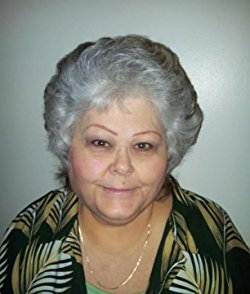
My cousin Susan Todd is a writer, with several books to her credit. I’ve written about her before. We used to see each other years ago, when I was so young I haven’t carried those memories to adulthood. Her father moved the family in the mid-1950s. There’s a photo of us together in 1959 in the family album. Otherwise, I had no contact with her until the late 1990s. I started working on genealogy. I had no idea where she was, so I contacted her dad, my uncle, and got an address, and wrote her.
I was just starting to write then. She’d been at it for a while. That common bond, along with the family tie, caused us to maintain contact. She even came to Arkansas and stayed with us for a couple of months.
Somehow I missed that she had a new book out last year. Shame on me. So here, belatedly, we talk about it.
Q: I see your latest book, Tangled Lives, was published in 2016. I guess I missed the book launch. Tell us something about that book.
Suz (her preferred diminutive): This book idea sat in my files for quite a long time before the reason I started it resurfaced. When I first began investigating the Internet, I was a wide-eyed overzealous sleuth as green as grass. I claimed my ticket and hopped aboard to venture to places in hopes of meeting people that I would never come to know in my limited surroundings.
This is Suz’s 9th book, all of which are available at Amazon.
Assuming that the people I encountered would be as honest and forthright as me; I dove in. Stone Blue was like no other person I’d ever met or will meet. Taking her on as a character was easy—all I had to do was draw from everything she said and did in our relationship. This woman had—issues—none of which I blew out of proportion.
She had to be written about. I couldn’t have made this woman up if I tried. Therefore, I went to a place I knew she’d fit in—under the porch with Moses Down. Thus, Tangled Lives came alive on paper.
Q: You say “there’s a thin line between fact and fiction,” and challenge your readers to tell which of the characters are real, and which are fictional. So, are you saying that some of your characters ARE based on real people, with, I presume, the names changed to protect the innocent (or guilty, as the case may be)?
Suz: I love to people watch. It’s not a new idea it’s been done on street corners, shopping malls, in families, on jobs and simply anywhere you find life. I have to confess that over the years I have nitpicked personalities. Whether from my upbringing or self-taught I seem to have trouble with some people’s behavior. Because I can’t correct or eliminate these individuals’ conduct—I write about them. On paper, I can expose their shortcomings, educate them, or simply let them be what they are allowing the reader to pass their own judgment.
The world affords a vast panorama of fictional possibilities—all you have to do is open your door or in some cases go to a family reunion.
Q: What genre do you consider Tangled Lives to be, or is it one of those books that defy genre classification? I’m assuming, even though some characters are “plucked from real life” that we are talking about a novel, not a non-fiction book.
Suz: Maybe it’s a ‘fictional how to and not to’.
Q: Your Amazon page shows nine books (I think) to your credit. They appear to be a mix of fiction, non-fiction, and memoir. What kind of author do you see yourself as, primarily?
Suz: I’m definitely a fictional author. Someone, I’m not sure who, once said that we should write so that the characters leap off the page. I tend to take my people-net and after capturing a few crazies, annoying or rare real life finds—embed them in a book. I often wonder which of my characters will some reader say, “That’s me!”
Q: I assume you’re working on a new book. Tell us about it, and when it might be out.
Suz: ‘A’ book? I’m laughing, Dave, because you know all too well that—A—book is never a reality. It’s more like, which one am I going to finish first. I hop about my files like a frog under a bug light. But I have to say that Covert Plumage and God in a Sweater are running neck and neck.
Now that I’ve finished moving and the last of the boxes have stopped calling my name to unpack them while enjoying coffee in the morning, I’m beginning to hear my characters clamoring to come out and play on my keyboard. No rest for the author in me. Who knows, maybe this year two books will make it to the finish line.
Mine is self-published, and the quality of my graphics, compared with Gibney’s, demonstrates that.
In my 2012 book The Candy Store Generation, my last chapter is titled “Had Enough”. My premise there is that the Boomers won’t fix the mess they made, and it will fall to a future generation to come to the point where they’ve had enough of the Boomers, and somehow right the ship. I’m hoping it’s the Gen-Xers, maybe in combination with the younger Boomers. I said I was more than ready for the Had Enoughs, whoever they will be, and suggested they may have to take drastic measures.
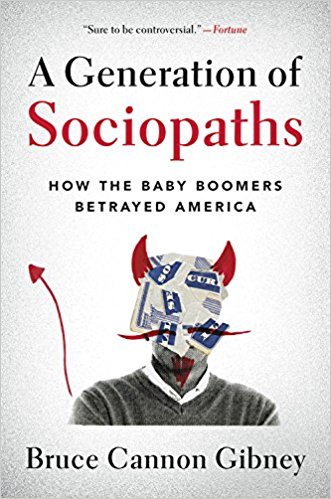
I just read a book that I’ll call the first salvo from the Had Enoughs: A Generation of Sociopaths: How the Baby Boomers Betrayed America, by Bruce Cannon Gibney. It came out this year, and Gibney’s been doing lots of media to promote it, though I always seem to miss him. When I learned about the book, and researched it as best I could, I reached out to Gibney’s publicist, requesting to interview him on my blog. She said he had no time for that, but that she would send me a review copy of the book. I jumped on that.
Gibney is a Gen-Exer, I think of the Disco Wave of that generation, giving him a fair amount in common with the Disco Wave of the Boomers. I say “I think” because I can’t find out his age. He may be 51, making him younger than the Disco Wave. In calling the Boomers “sociopaths”, Gibney goes much farther than I did. He says we Boomers, as a lot (though there will be exceptions) are antisocial, in the sense that we care nothing about society, caring only for what benefits us, what furthers out position. He quotes extensively from the Diagnostic and Statistical Manual of Mental Disorders to show how Boomer traits are anti-social.
I think Gibney’s cover is horrible. But his book’s selling better than mine, so what do I know?
Maybe so. I’m not willing to go there. I just think the Boomers are running everything into the ground through inability to manage anything. Business, government, households, pensions, all are being mired in unpayable, unserviceable debt. That’s the premise of my book. Gibney agrees. He spends a lot of time on that, though attributing Boomer failure to their sociopathic tendencies. History can judge between us.
Gibney talked about how the Boomers were raised, how they reacted to the Vietnam War, and has much to say about “neo-liberalism”. I really can’t figure out what that is, but he says it’s a bad thing, and the conservatives are guilty of it. I’d have to read the book again to better understand that part of his argument. Gibney’s book is much better researched than mine. I got a lot of data from Congressional Budget Office, and used Wikipedia to determine ages of Congress and know when the Boomers took over. My graphics are only fair; Gibney’s are much better, though I would have thought that, with the budget of a major publisher behind him, they would be stellar. They are not—only much better than my inferior ones. I also used my experience of having been a Boomer (of the Beatles Wave) and having lived through it all, something Gibney can’t do.
I disagree with much of what Gibney says, not the least of which is his definition of the Baby Boomers. He says they are those born between 1940 and 1964, they are white, and native born. I know of no other book that have the Boomers other than born in the years 1946 to 1964. I don’t know how you can exclude Black or Hispanic Americans from the Boom. Methinks Gibney is feeling a lot of white guilt. That’s okay. He made his millions investing in startups such has PayPal (started by his roommate at Stanford), Facebook, Palantir, Spotify, and more. I guess when you’re younger than 50 and worth millions, you can indulge in guilt, no longer having to worry about where your bread is coming from.
I also think Gibney focuses on some wrong items. For example, he blames the Boomers for things that happened in the 1960s and 1970s, even the 1980s, before they were in power. He kind of forgets who was in power then. But he says that those in power were catering to the Boomers, who were a large voting and purchasing block. So, it’s the Boomers’ fault that their predecessors screwed up certain things. No, I disagree. It’s the Boomers’ fault that they didn’t right the ship when they had the chance, instead letting it drift into stagnant waters and, their future being secure, didn’t try to make things better for those who would come after them.
Gibney writes with an Eastern Megalopolis view, slanted by California elitism. He is a product of the city. So am I, though my time in the Midwest, overseas, and the south for three decades has hopefully given me a more rounded perspective. Yet, having looked at the same data, come to more or less the same conclusion, we there depart the most in saying what needs to be done. Gibney says we should stop sending funds to rural areas; the cities need them. We should stop throwing so much money after the health care of the elderly (the Boomers beginning to be there), stop doing extreme procedures to extend life, instead letting the sociopathic Boomers just die and stop burdening the young. He wants to borrow $8.6 trillion to immediately fix what the Boomers ruined, and pay for it by growth, which he believes will happen once the Boomers move out of leadership positions.
My conclusion was the Boomers screwed things up by wanting benefits but not wanting to pay for them by taxing themselves, instead borrowing their children’s retirement funds and their grandchildren’s college funds. My solution: quit borrowing, reduce benefits for those who didn’t pay for them. His solution is to move the Boomers out of leadership ASAP, raise taxes, fix what they broke, and put it all on a sound footing. It’s hard to believe that, from the same data, we come to such different conclusions.
It hurt to read Gibney’s solutions. I got angry at them. Then, I remembered what I wrote in my last chapter: “They [the Had Enoughs] will embrace what Thomas Jefferson had to say about inter-generational debt, and will see entitlements as one generation unjustly imposing their will upon a later generation. What will be the first to go? A reduction in Social Security benefits will probably be first…. The Boomers will counter…. The Had Enoughs will laugh at them, and ask, if those retirement and health benefits were so important to you, why didn’t you put them on a more stable footing? Why did you squander trillions of dollars on corporate welfare to save companies you mismanaged?”
Yes, I said I longed for the Had Enoughs to make their appearance. Perhaps in Gibney they have. If so, the next two decades are not going to be pretty.
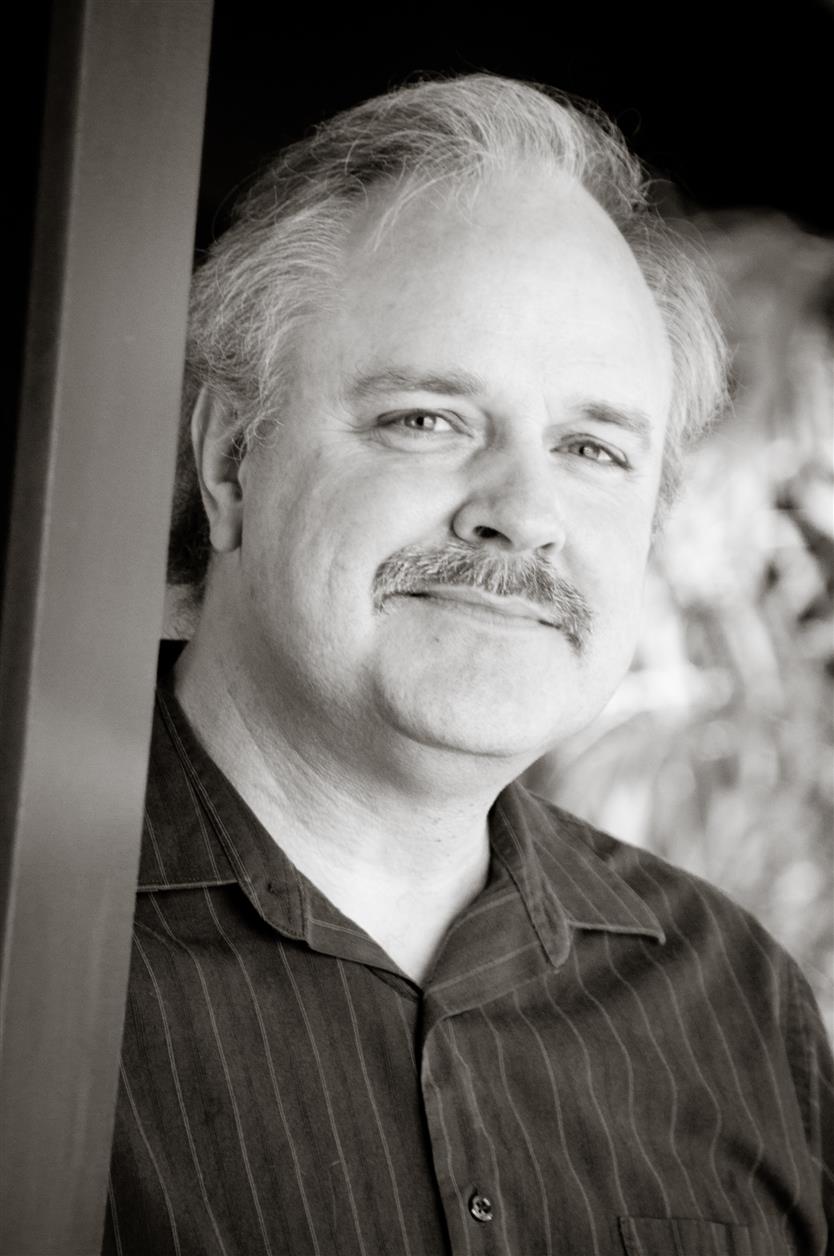
In my continuing series of interviews of other authors, this post features Damon Gray. Damon and I “know” each other from our posts at the Between the Lines blog of the Books & Such literary agency. Truth is, I don’t know all that much about Damon. I’m finding out in his answers. So let’s get to them.
Q: You say you share your “own life-experiences, bringing them alongside biblical narratives in a manner that infuses the stories of our spiritual ancestors with life.” How about giving us a brief overview of those life experiences?
That’s a heavy opener, David, but there is no way you could know that. We all speak, write, and interact with others out of our own experiences. It is unavoidable. These experiences figure largely into our world-view, our character, our personality, our tolerances.
Like many to whom I speak and write, I have dealt with numerous delightful and many painful events and issues over the years. I have endured sexual abuse, infidelity in a spouse, betrayal, six years of watching my mother die of Alzheimer’s disease. I was once incorrectly diagnosed with an ocular condition and told I was losing my eyesight. That was a shocker. I have endured severe church abuse as a pastor, been fired, and ultimately changed careers. At one point I traveled over the U.S. – Canadian border for a year to see a Christian counselor. During one of our sessions, about two months in, he leaned forward, looked me in the eye, and said, “With everything you have been through in just the last two years, I am amazed that you’re still sane,” and he wasn’t being sarcastic. He was quite serious. In 2012, I was hospitalized and faced death twice with the same medical condition just seven months apart, and was told that typically this is a condition that is diagnosed during the autopsy.
I don’t say any of that with bitterness, to sensationalize, or to elicit sympathy from your audience. But experiences like these give us tremendous insight not only into ourselves, but into the total human condition. So if we apply that to the way we approach Biblical texts and narratives, we are sometimes able to crawl inside the heads of those about whom we are reading, right?
Let’s just take the example of Hagar. She is a servant, or a slave. I get the impression that Hagar did not have much say over what happened to her. Sari, Abram’s wife, seemingly cannot bear him children, so she has Abram conceive a child with her slave, Hagar. Hagar does indeed conceive, Sari is overcome with jealously and ends up convincing Abram to send Hagar away. It’s brutal!
So, here we have the first single mother in the Bible. What is going through her head? She did exactly what she was told to do. Now she’s bounced out on her ear with no means of caring for herself and her young son.
I have not experienced that specific circumstance, but we all have to be able to draw on our own life-experiences to identify with what is happening inside these people. These are not just stories. These are real men, women, and children who are toiling their way through life just as you are and as I am.
Q: Your website says you are a dynamic speaker, a word-crafter, and I see a picture of a trombone player there. Would you say you are a man of the arts, despite your technology background?
I started playing the trombone in the fifth grade and played all the way through my university years. Then it sat in the closet for a couple of decades until I pulled it out again to play in the horn line with the worship band at church. I majored in music for the first three years in college, but decided I couldn’t easily make a living that way so I changed majors to Mass Communication with an emphasis in Radio Broadcasting and Newsprint.
But you’re right, I’ve always had something of an affinity for the arts. I still do. I did a lot of drama in high school and college as well. In fact the Dean of the drama department, along with his wife, tried to persuade me to change majors from music to drama. I declined, because the same problem exists there as does with music. There are too many starving actors and musicians!
The technology thing is just a means of paying the bills. It is something I know how to do, but not something for which I have a great deal of passion. When I reached the end of my rope with the challenges of full-time ministry, I needed a new career path, and that one seemed reasonable, so I dove into it and have been doing software development and database programming now for 22 years.
Q: Summarize your speaking ministry for us.
For me, there are a couple of key components to being able to speak to a crowd. First off, I have to know what I’m talking about. If I don’t know my subject, then it is best to just sit down. Secondly, I have to believe in the subject. I cannot speak persuasively about something in which I do not believe. That is why I could never build a career in sales. I cannot sell you something I am not persuaded you really need to have. But it works great for public speaking, because you know that whatever I am addressing is something in which I truly believe.
If those two components are in place, I can speak and teach, and I very much enjoy doing so. I have spoken to groups numbering in the single digits to those numbering in the thousands. It is critical, however, to keep it in perspective. What I mean is that you have to keep it always before you that this is not about you! I keep a quote from Randy Alcorn above my desk that reads, “The greatest danger of notoriety is you start thinking about you. People then exist to serve you, exactly the opposite of what Christ modeled.”
I have formulated a concept within the last couple of years around which I am building my ministry. I call it “Long-View Living in a Short-View World.” As believers, we must keep that eternal perspective in focus as we reach out to a world that can barely see beyond the end of its own nose. This has to be about Jesus and his eternal kingdom, and moving that kingdom forward.
“It’s not about you. It’s about your audience.” I understand what that speaker was saying, but ultimately, I don’t agree. It is not about me, or the audience. It is about Jesus, and how we all work as a single unit – his body – to move his kingdom forward. Now, to do that, I have to be healthy and functioning, just as you have to be healthy and functioning, as does everyone in your listening or reading audience. So, in that sense, what the conference speaker was saying is accurate.
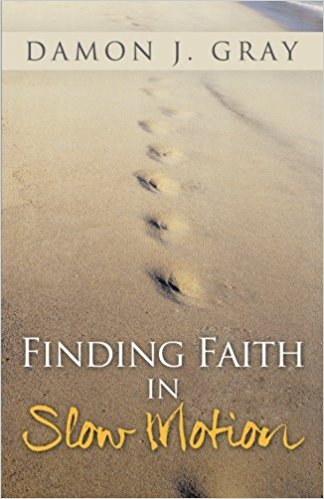
Available at Amazon
Q: Your first book is Finding Faith in Slow Motion. Tell us about it.
That was never really intended to be a book, but rather it was my own personal research project. My dearest friend had been diagnosed with leukemia, and has since passed on to be with Jesus. It was gut-wrenching watching this disease relentlessly attack his body. At the time we were wracking our brains trying to figure out why he wasn’t being healed of this disease. I mean James tells us, “Is any one of you sick? He should call the elders of the church to pray over him and anoint him with oil in the name of the Lord. And the prayer offered in faith will make the sick person well; the Lord will raise him up.”
Well, we did that – more the once. We prayed over my friend, anointing him with oil, pleading with God to eradicate this disease – and he didn’t – at least not in the sense that I wanted and expected. That’s where the research project began. I wanted to figure out why my friend wasn’t being healed of this cruel disease. And the more deeply I dug into it the more I realized I needed to wrap my mind around the most basic concept of faith.
Those notes sat on my shelf for several years, and it is my wife who eventually persuaded me to publish it, saying, “Damon, you can’t keep this to yourself. You have to share this.” So, I self-published that 2013.
Q: Your upcoming book is The Christ Saturated Life. Tell us about it, and when it will be available.
The Christ Saturated Life is an idea I started toying with as I pondered Jesus’ parable in Matthew 12. He talks about an unclean spirit that left a man and traveled through waterless areas looking for a place to rest, but found no such resting place. So the spirit returned to the man it just left, referring to the man as a house. The house had been swept clean and it was in order, but it was left empty. So the spirit, called seven of its spirit comrades, spirits more evil than itself, and the eight of them took up residence within the man. That’s a nasty state to be in!
The driving premise for me is that the man left a void within himself, and a void demands to be filled. We have to fill ourselves with something, but what? So I began contemplating the idea of being completely filled with the mind of the living Christ. I were completely saturated with Christ, filled to the point of overflowing, so much so that he radiated through my pores, what would that look like? How would that change the man I am today? I assure you, David, the Christ Saturated Life does not look like me, and that’s okay. With the ideal in front of me, at the very least, I know which way to walk. I know that toward which I am striving. I can see the target.
The manuscript is draft-complete, and I am in active discussions with a handful of agents who are considering representing it. I don’t know when it will be released. I am learning that the wheels of traditional publishing turn very slowly.
Q: I assume you have another book in the wings, or perhaps several. What do you have cooking up in the future?
I do have some ideas in the wings (there’s a drama reference for you), but in reality, you have more books actually published than I have ideas for manuscripts!
I’m chewing on one that I’m tentatively calling Swan Song of the Messiah. There is this myth that a swan will sing a song just prior to its death, so this will be a look at the statements Jesus made from the cross.
Another one I’m contemplating is based on Acts 2:42 where the new disciples devoted themselves to four specific things – The apostles’ teaching, the fellowship, the breaking of bread, and prayer. My thought is that there must be something significant about those four devotions if that is what they applied themselves to.
I have been asked to consider writing a book on the believer’s response to sex trafficking in the U.S. One of the most heavily traveled corridors for young girls who have been enslaved in the sex trafficking business runs just a few miles from my home – between Portland, Seattle, and Vancouver, British Columbia. It’s a horrifying reality that is far too easy to turn a blind eye toward. A friend of mine runs a refuge that rescues these young girls and helps them escape that nightmare.
I think Gibney’s cover is horrible. But his book’s selling better than mine, so what do I know?
I mentioned before that I’m currently reading A Generation of Sociopaths: How the Baby Boomers Betrayed America, by Bruce Gibney. I’m now more than halfway through it, maybe as much as 2/3rds. I probably won’t finish by this weekend; maybe next. When I do, I’ll post a full review here, as well as at Amazon and Goodreads.
As I said in another post, I took interest in this book because of the book I published back in 2012, The Candy Store Generation: How the Baby Boomers Are Screwing-Up America. Similar title, obviously a similar subject. I had to read it. Fortunately, his publicist gave me an advance reader copy, no charge. That’s great.
Mine is self-published, and the quality of my graphics, compared with Gibney’s, demonstrates that.
I’m just about to the point where Gibney is going to give some solutions, I think some overall solutions. So far he’s been outlaying the problem as he sees it. As I did, he covers how the Boomers took over the leadership in the U.S.A. in the 1990s, though he talks more about their influence as a voting block before that, and how that influence caused their predecessors to make some bad decisions. He also has a different definition of Boomers than I did. He says it’s those born from 1940 to 1964, and only the white people. Most sociologists place the start of the Boomers as 1946. However, in my book, I did say that those born from 1940 to 1945, the “Elvis Wave” of the Silent Generation, had much in common with the Boomers, especially the Elvis Wave of the Boomers (born 1946-1950).
The main premise we each have is about the same: The Boomers are guilty of intergenerational theft by piling up the massive debt this country has. It was $16 trillion when I published my book. It’s $20 trillion now. While we have the same premise, we have different conclusions as to why the Boomers have performed so poorly in leadership. I say it’s because the Boomers relied too much on government to solve problems better solved by the individual. He says it’s because the Boomers relied too little on government. Same problem exhibited by the same symptoms, but a drastically different conclusion.
The one thing you can say we agree on, as another way of stating the premise: The Boomers did not provide a firm basis of government finance to support the services they had the government provide. I say it’s because they demanded too many services; he says it’s because they wouldn’t tax themselves enough to pay for the services. Perhaps it’s two sides of the same coin. Either way, the coin was stolen from the Boomers’ children’s retirement fund, and from their grandchildren’s college fund.
As I get further into the book, I may find that Gibney’s conclusions aren’t quite what they appear to be on my incomplete reading. We’ll see. One thing he did less than me was try to explain why the Boomers are the way they are. I took a whole chapter on that, based on what I lived through and how, looking back over years and decades, I can see how that caused us to have certain characteristics. He touches on that a little, but focuses almost exclusively on the results the Boomers have produced, rather than on what caused their “pathology”, as he would call it.
Hopefully, when I finish reading Gibney’s book, I’ll be able to say something more positive about it. At the moment, I think my book is better. I may be a little biased, however. Back to reading, writing, researching, and making a mess in The Dungeon.
I don’t have a lot of time to write my post today. My workday was busy before I got to the office, and it’s become hectic since then.
I was going to give an interim report on the book I’m reading, but thought of a different, shorter topic. Yesterday was a leisurely day for me, as the Lord’s Day should be, especially one so important. I even was able to watch a little television. In that watching I heard some incredible misstatements.
First, on a morning news program, when the commentator at St. Peter’s Square in Vatican City talked about what the pope was doing, he said, “The pope is giving mass right now.” No, the celebrant doesn’t “give” mass, he/she “celebrates” mass. Okay, that’s somewhat minor. I’m not in a denomination that celebrates mass (thought I grew up in one), so this didn’t offend me. I found it amusing, though possibly some people around the world would be offended by this reporter’s ignorance.
The second one was on a show on the History Channel in the evening, about the search for Jesus’ DNA and determining if any relatives to Him could be found. It was a 2-hour program, kind of interesting (different than the usual Easter program of the Bible story). At the start of the program, they made it clear that the Bible said Jesus had no descendants, and that they were looking for relatives. That is, they said that in the program. In the various trailers leading up to it, they acted like they were looking for Jesus’ DNA descendants.
Right at the end of the program, they actually said that. I didn’t write it down, so can’t give you the exact quote, but it was essentially, “With this DNA research, we hope to be able to find Jesus’ descendants.” The entire program they made it clear they were looking for relatives of Jesus—i.e. people descended from a common ancestor with Jesus. Then, at the end, they resorted to yellow journalism.
Very disappointing. I may write the History Channel and tell them so.
Yes, I’m very, very close to having my taxes done. Normally I do them much earlier than this, around the end of February and first of March. But, this year at that time I was working on Preserve The Revelation and “Growing Up Too Fast”, either editing, writing, or publishing. They were done toward the end of March. I needed a break, so didn’t begin them for a few days, maybe around April 3.
I won’t take a long time explaining this. Our taxes are complicated. Our stock trading partnership, my writing sole proprietorship, my work, Lynda’s social security. It makes for lots of forms, and worksheets from the instructions. I have Excel spreadsheets built to do the calculations. All I have to do is come with the W-2, the 1099s, and deductions statements. This year my paperwork was well organized. I also have to check my spreadsheets against the forms and instructions for the tax year, in case something has changed.
I had the Federal done, and began working on the State. My spreadsheet links the State to the Federal, and rounds the Federal amounts to 00 cents, as Arkansas requires. Everything flows quickly from the Federal to the State. But, at the last minute, the State wanted me to attach Federal form 8889. I scrambled, and found that form 8889 is REQUIRED if you have an active Health Savings Account, as I do. I’d never heard of this before, but apparently I should have filed it every year since I had the HSA, about six or seven years. Since my HSA is funded with pre-tax dollars, I have no tax consequences. However, I still have to file it. I had two stressful days learning about and then completing Form 8889. But it’s done.
The status is: My Federal and State forms are done, printed, signed, copies, and mailed. My partnership calcs are done, the forms printed, and signed. All except for one form that I forgot about printing. I couldn’t do it at work today, so I’ll do it at home this evening and mail it all Monday. I also do taxes for my mother-in-law. I did the calcs on them last night, concluded she didn’t owe any taxes, and so decided to set them aside for a couple of days and take a break.
During these last two weeks, engrossed in taxes as I’ve been, I’ve done almost nothing for writing. That should change this weekend.
I published “The Candy Store Generation” in July 2012. Thus, I’m more than four years ahead of Gibney.
A woman I worked with alerted me to a program coming up on National Public Radio, about a book named A Generation of Sociopaths: How the Baby Boomers Betrayed America. I immediately took notice, because of my book which, by its title, would seem to cover the same ground: The Candy Store Generation: How the Baby Boomers Are Screwing-Up America. My co-worked had read mine, liked it, and thought I should know what else was out there.
I looked into the book. It’s by a man named Bruce Cannon Gibney, who, it turns out, is not a Baby Boomer, but of the next generation, usually called Gen X, but sometimes called the Baby Busters. It’s current rating on Amazon is 3.1 stars (it was a little higher when I first looked at it).
I decided this was a book I should read. But, always looking for other authors to interview on this blog, I reached out to Gibney’s publicist and requested an e-mail interview. She responded back that he didn’t have time for that, but they would be glad to give me a book to review. Obviously, I accepted.
It arrived Thursday, and I started reading it that night. It has a long Forward and a long Introduction. Consequently, I’ve only read through chapter 4. I hope to do a chapter a night, or perhaps two when busyness allows. I’ll be back to report what I think. I will say this, however: Gibney’s graphics are far, far better than mine. That goes to show how a publisher can add value to a book.