All posts by David Todd

When Do The Ideas Stop Coming?

Yesterday an idea for a new book passed through my head. Or maybe it was last Saturday; can’t remember. No, I remember now, it was Sunday morning, while I was getting the grandchildren ready for church. We are watching them for 11 days or so while their parents are on Sabbatical. Actually, the wife tells me it might be 13 days. Which is okay by me. Yes, it’s hard on the constitution and mindset of a 63 year old, but it’s good for me, will help keep me young. That’s the theory, at least.

So what was I saying? Oh, yeah, the writing idea. Actually, I don’t need any more writing ideas. For the last couple of months I’ve been making writing to-do lists when I’m in meetings/presentations where I don’t have to pay much attention. I work chronologically, starting with the things I’m working on now, setting goals on when to complete them, then move on to the things I know I want to do next, then on to things more distant in the future.

I’ve done this in four different meetings. Earlier this month I took that lists and compared them, trying to gauge what I could realistically accomplish, and what was really pie-in-the-sky type dreaming rather than planning.  I found that the lists weren’t too far off. Sometimes I had things switched on the lists, sometimes I had things off by a month or two between lists, but all in all they were pretty consistent. I have them entered on my weekly writing diary sheet (something I don’t keep up with as well as I should). This gives me a reminder of what I want to accomplish in the near future.

For the things that are far out there, say in 2016 or 2017, perhaps they are more dreaming. But just having them on the list is a reminder to me that other writing tasks are waiting to be completed. This helps keep me writing, rather than slacking off. If I let slip the thing scheduled to be completed by Sept 1, 2015, that could cause a dozen other things to slip. So it’s motivation of a sort.

So where was I? Oh, yes, the writing idea. I don’t need any more writing ideas. When I look at that to-do list, which really does include things out as far as 2017, I realize I have enough writing ideas already in the hopper to keep me writing out to the time when I assume room  temperature. I don’t need one more thing to add to the list.

So I’m letting the recent idea go. I’m not writing it down, to preserve it until a more opportune time. I’m not sure it was a very unique idea anyway. It would be a retelling of an age-old story with a little bit of a twist. If it’s actually a good idea, perhaps it will stay with me, and will someday be added to the to-do list, or at least get an idea page in my writing projects notebook. But for now, I’m letting it go. See you later, idea, or perhaps never again.
The Sunday Report – June 14, 2015

Well, I did a little better job keeping up with posts to the blog over the last two weeks; not perfect, but better. I thought for today I’d write a fairly simple report on what’s going on in my life, as it relates to my writing life.

We are, at present, playing host to our three grandchildren, ages 7, 4, and 2.  Consequently I’ll be working short days for the time while they are here, to keep my wife from going batty and to lessen the work she’ll have to do, which is always hard on her back. This will also mean I’ll have less time available to go to The Dungeon and get my work done. The kids came on Thursday, and will be here at least through next Sunday, June 21.

Fortunately, I just wrapped up my writing project. My family history book, Seth Boynton Cheney: Mystery Man of the West, was completed on Thursday. All but for one photo, that is, which I added on Friday. Yesterday I uploaded it to CreateSpace. All but the cover, which I tried to create beginning Friday evening and was unable to do. A friend at work is going to help me with it, and I suspect it will be ready by Tuesday. That will allow me to order a proof book.

The proof book is critical in this case, because I had planned to do the book in color, but that would drive the cost up to a minimum of $36. In black & white it can go for $12, or maybe a little less. $36 is too much, so I’ll have it printed in b&w. That will mean I’ll have to look at the proof and decide if I need to do anything with some of the color photos/illustrations. I may have to do without some, or swap some out.

Fortunately I have time for that. While I wanted to have the book completed and out by June 15, the Cheney family reunion isn’t till July 31-August 2. I’m sure the book will be done long before then.

Between now and then, the only other writing work I intend to do is make sure all my books are properly listed on Goodreads. I think five of them aren’t listed at all, and one has the wrong cover showing. Adding books is easy, so I can have those all added in one evening. However, changing a cover requires an action by a Goodreads staffer. I made a request six months or a year ago to have the cover changed, but never heard back from anyone. I’ll try it again. If I don’t hear back, I can just delete it then add it back with the new cover. At least I think I can.

Some greater use of Shelfari, an Amazon thing, might be in the cards, to see if it improves visibility of my books. Researching advertising services might be another thing I’ll spend a little time on.

So writing continues, though every day I’m seeing less and less reason to go on with it.

Foolishness from Authors Continues

An author whom I’ve never read, Ursula Le Guin, had a blog post at the Book View Café Blog. Titled “Up the Amazon with the BS Machine”, the title is an obvious play on words, BS in this case not meaning what everyone would first think, but rather “bestseller.” The post is interesting to read, and not terribly long. The gist of it: She doesn’t like the way bestseller lists are developed, thinks the books that make it on the bestseller list are garbage, and blames Amazon for the situation while at the same time exonerating the publishers.

She seems to forget that Amazon is primarily a bookstore, not a publisher. Sure, they do some publishing functions, such as Kindle Direct Publishing and CreateSpace for self-publishing, and they have a couple of publishing imprints that currently are small. Le Guin doesn’t like any of it. Read the article and you’ll leave thinking she says “bring back the good old days.”

There must be a logical fallacy in this. A behaves. Environmental conditions change and A behaves differently. B doesn’t like A’s new behavior, and blames C for it—C being not the environmental conditions but another entity who is also behaving based on changing environmental conditions but who has no effect on A’s behavior.

I suspect Le Guin is having trouble selling books. I’ve never read anything she’s written, and don’t know what she writes. I’ve heard her name, but her books haven’t popped up on my radar. I take it she’s fairly popular. She’s probably been on bestseller lists multiple times.

So what’s her beef? It’s that the books that make the bestseller lists aren’t of very good quality. Yet these books make the list, not because people want to read them, but because Amazon is pushing them, and because of this push they get even more sales and climb even higher on the bestseller list. Meanwhile, books of better quality (which I presume includes her books, though she doesn’t say that) languish farther down the lists or don’t appear at all.

This push that she bemoans is what the Big 5 publishers do all the time. They call it “velocity,” and woe to the book that doesn’t have it.  They buy “co-op” from bookstores to get a couple of titles on featured displays at the front of bookstores. They buy ads to push the books they think will sell best. They sponsor links on search engines, links that masquerade as search results and fool people. Thus, the publishers, in cahoots with bookstores, are manufacturing bestseller lists by pushing books to create velocity. Personally, I don’t know there’s anything wrong with that. It’s a business practice, not a conspiracy.

So the evil she bemoans really isn’t Amazon. It’s the very publishers she champions. Just another example of top-tier authors not liking the changes in bookselling, and blaming Amazon instead of the party that is really at fault. The madness continues, madness that has been called Amazon Derangement Syndrome.

Free Exercise of Liberty – Not Always Smart

Some time ago I started a series of posts on a political subject, the furor then raging over freedom of religion laws either just passed or being considered by legislatures in several states, most notably Indiana and Arkansas. Here are the other posts in the series, should you wish to read them before continuing with this one.

A Class of Rights – Part 1

A Clash of Rights – Part 2

Freedom of Conscious – Political and Religious

My main point has been people have a right to freedom of conscious, and ought to be free to exercise that right. Other people have a competing right, the right to not be discriminated against based on their race, their gender, or other issues (such as their sexual preference, i.e. homosexuality). What you have is a clash of rights. In that case, whose right wins? It’s not an easy question. The media debate tends to be favoring the right to not be discriminated against should triumph over the right to free exercise of conscious. I suspect, however, that if the issue were really pressed, they [the media] would want to be able to freely exercise their conscious, and that they are really trying to suppress the rights of those whose consciouses are contrary to theirs.

As the debate on those laws raged (it’s since died down a lot, hasn’t it?), the most disturbing part of it, to me, was the situation with the Memories Pizza shop in Walkerton, Indiana. A reporter, I suppose knowing the owners of the shop were devout Christians, asked if they would cater a same-sex wedding. Stop for a moment and think of the absurdity of this. Pizza for a wedding reception? This question was a set-up, for the purpose of either embarrassing or causing harm to the shop. The results were predictable: the shop owner said they would refuse to cater the same-sex wedding, citing their religious stand against homosexuality and their rights under the new law.

The reaction was also predictable. The pro same-sex marriage side made all kinds of hateful statements and, allegedly, threats of harm against the shop and its owners. Those in favor of the statements of the pizza shop owner started a crowd funding campaign for the shop and raised over $300,000 in less than 24 hours, 10,000 people donating an average of $30.00. To this the other side responded it was a bogus campaign and the organizer was going to pocket the money. On and on it went.

The fact that the furor has died down is, it seems, and indication that the passage of the laws didn’t cause society to collapse.

So, it’s time for me to answer the question: If I were the owner of the pizza shop, or the cake decorator, or wedding planner, or whatever business that serves the public, would I serve the same-sex wedding? I’m opposed to the practice of homosexuality, on religious grounds, believing it to be a sin against God and man. Hence, I oppose the legalization of same-sex marriage, seeing no reason to change what has been a tradition in virtually every society in the world for thousands of years. I want the law to recognize I have, or should have, freedom of conscious and freedom to act on that conscious.

However, with all that being said, I would serve the same-sex wedding if I ran such a business. My reason? It gives me an opportunity to give a Christian touch to someone who I think needs it. I don’t see it as a statement of agreement with what they are doing. I see it as fulfilling Paul’s cautions about not always exercising your freedom of conscious, and his other statement about by all means saving some. If my serving the wedding would bring one someone attending one step closer to Christ, that’s what I’d want.

Book Review – The New Testament Documents: Are They Reliable?

It was at a thrift store, I think, that I picked up The New Testament Documents: Are They Reliable? by F.F. Bruce. Originally published in 1943, the small paperback I bought was from July 1971, and a printing of the 1959 revision of the book.

I had seen this book referenced in various other writings about the New Testament. Other writers always made it sound like a book I’d like to read sometime. When I finally found it on those mixed shelves, I was surprised at how small it was. 120 pages is all. Sure, the font is small, but still it’s a fairly short book. I haven’t done any reading into Bruce’s background, and why he would write this book and what his qualifications are to do so. That research remains in the future for me. For now the book stands on its own without me knowing anything about the author.

As, perhaps, it should be. While we want to know for most non-fiction that the author knows what he’s talking about, whatever they write should make sense regardless of who wrote it. Bruce’s little volume does.

I was surprised to see that such a small book was so highly prized and referenced. Yet, as I read it, I could see why. Bruce makes an excellent case that the New Testament is reliable both as “a witness to God’s self-revelation in Christ” as well “as a record of historical fact.”

I’m already a Bible believer, so Bruce was speaking to someone who was anxious to have his current beliefs reinforced. He didn’t disappoint me.  Starting with why it matters whether they are reliable, he moves on to the probable date the books were written and how they came to be accepted into the canon of the scripture. From there it was on to the gospels, a special chapter on the gospel miracles, thence to Paul’s writings, then Luke. He digs into the archaeological evidence for what the New Testament says, and concludes with looking at contemporary and near-contemporary writings to show how they testify to these scriptures. All this packed into 120 pages.

Bruce certainly doesn’t waste words. Nor is this work boring, though it is scholarly. I think Bruce was writing to the average Christian of the 1940s, to give them confidence, in a world that was beginning to question, that the documents upon which their faith rested were indeed reliable. He achieved that aim, in my not-so humble opinion.

This book is a keeper. Perhaps someday I’ll re-read it; or maybe go back into it as a reference for something else I’ll write in the future. If you have a chance to read it, by all means do so.

Book Review – The Oxford Inklings

I’ve known about the existence of the Inklings, the writers group to which C.S. Lewis and J.R.R. Tolkien belonged, for some time, and have wanted to read a good book about them. I had bought one for my Nook, but it turned out to be mostly a picture book—some words to support it, but not an in-depth analysis like I was wanting. For years I’ve been aware of Humphry Carpenter’s book The Inklings (1978), and have intended to read it, but have never been able to find it.

I finally found that analysis by searching, and came up with The Oxford Inklings: Lewis, Tolkien and Their Circle, by Colin Duriez. Ordered it at Barnes & Noble; it came in in March, and I read it in April.

I give this book 5 stars, and highly recommend it to others who want to know more about this group.  The book is scholarly, yet at the same time very accessible, easy to understand. Duriez has obviously done research, and knows what he writes. I learned much from this book, such as:

  • How large the Inklings were, much larger than I realized. While Lewis and Tolkien were the core, almost two dozen other writers took part in the group at various times.
  • How long they lasted, from the mid-1930s till Lewis’ death in 1963. The main years were from 1940 till 1960.
  • Exactly what kind of group it was, for improving as writers and for the fellowship only fellow writers can enjoy.
  • How important C.S. Lewis was to the group. Duriez presents him as the glue that held the group together, or perhaps better described as the rock around which the group revolved. Tolkien was as well known, and as active in the group, but Lewis more central to the group’s history.
  • The other things C.S. Lewis had going on in his life, such as the Socratic Club, his tutoring, and his lecturing. It’s been a while since I read a Lewis biography. Perhaps I read some of this before, but if so I’d long forgotten many of the details.

Suffice to say that I enjoyed this read. As a writer myself, who has been a member of several writers groups, mostly short-lived, it was of great interest to see how this group did it. I’m going to keep this on the shelf, in my growing Lewis collection. My only caution to other readers is that, if you have a good background on the biographies of Lewis and Tolkien, you might find this a little too elementary in places.

Freedom of Conscious: Political and Religious

Third in a series. See the first two here and here.

News story, from the New York Daily News, February 22, 2015, http://www.nydailynews.com/news/national/gay-hair-stylist-drops-new-mexico-governor-client-opposes-same-sex-marriage-article-1.1027072: A hairdresser in New Mexico refused to continue to provide service to New Mexico Governor Susan Martinez after she came out in opposition to same-sex marriage. From the article:

“The governor’s aides called not too long ago, wanting another appointment to come in,” he told KOB-TV. “Because of her stances and her views on this, I told her aides no. They called the next day, asking if I’d changed my mind about taking the governor in and I said no.”

News story, seen April 27, 2015 at Yahoo, http://finance.yahoo.com/news/gay-businessman-deeply-sorry-hosting-132836168.html: A New York City hotel that caters to the homosexual community hosted a “fireside chat” type event for Ted Cruz, Republican Senator from Texas who is running for president. From the article:

“I am shaken to my bones by the emails, texts, postings, and phone calls of the past few days,” one of the hoteliers, Ian Reisner, wrote on Facebook. “I made a terrible mistake. I was ignorant, naive, and much too quick in accepting a request to cohost a dinner with Cruz at my home.” …some called for boycotting the Reisner and Weiderpass’ Out NYC Hotel, which caters to LGBT customers, because of Cruz’s social conservative positions.

These are two examples of where businessmen who serve the general public either refused service to someone for political reasons, or are sorry they didn’t refuse service to someone for political reasons, and implied if they had it to do all over again, they would refuse to serve in that instance.

On Facebook, when debating someone about a Christian’s refusal to provide services for a same-sex wedding, I used two examples. First, a black caterer being asked to cater a KKK rally. Second, a Democratic owner of an event center refusing to all his center to be used for the campaign kickoff by a Tea Party Republican mayor. In that debate the person said it was ridiculous to bring up hypotheticals, and that religious believes should never be a justification for refusing service. I disagree with him about the hypotheticals. Indeed, when discussing policy changes, whether they be proposed by politicians or pondered by the courts, I believe you absolutely need to consider how the change would affect people. What better way to do that than through hypotheticals? Wild hypotheticals aren’t helpful, but reasonable hypotheticals are. And I don’t think mine were wild.

So I ask the question: Should a person in business be allowed to discriminate against another person based on a difference in political beliefs? Should the homosexual hairdresser be allowed, by law, to refuse to serve a straight person who opposes same-sex marriage? Should a black person be allowed, by law, to refuse to serve a white person who believes the Black race is inferior to the White and proposes policies that would enforce that belief? I believe they should be so allowed, by law.

How is political belief so different than religious belief? The same amendment to the Constitution that protects freedom of speech (which the original framers meant to refer to political speech) also protects the free exercise of religion. If someone is legally allowed to discriminate on the basis of politics, why not on the basis of religion as well? Yet the same people who cheer the New Mexico hairdresser for discriminating based on politics excoriate the Indiana pizzeria owner for discriminating based on religion. I really don’t get it, except that deep down, behind those who would accept the one and deny the other, is the desire to wipe religion from the earth. Many may not even realize this is the goal; it may be latent as opposed to active, but I think it’s there.

Obviously, I would not propose a person be allowed to discriminate based on race when that discrimination is based on religion. I’m not so sure that the same applies to homosexuality. Yes, some homosexuals (including lesbians) are most likely born with a same-sex attraction, and thus for them to be in a same-sex relationship is following the course of their nature. Others, however, undoubtedly choose to be in a same-sex relationship, for whatever reason. For them this is not a natural thing. What I’m saying is the issue isn’t as clear.

Let’s take one more hypothetical. A homosexual flower shop owner refuses to serve the wedding of a heterosexual couple. Legal, or illegal? Apparently illegal, if it was for the straight bakery to refuse a same-sex wedding. That decision would most likely be based on political beliefs, not religious. The distinction, however, is very small.

So, these religious freedom restoration acts passed by Indiana and Arkansas this legislative season: are they important, or not? Are they needed, or not? I would hate for the black caterer to lose the legal right to refuse service to the white hate group. I would hate for the homosexual hairdresser to lose the right to refuse to serve the straight person due to that person’s politics. Yet, I see that as a tiny step after losing the religious reason.

Book Review – Pollution and the Death of Man

I’ve read a couple of books by Francis A. Schaeffer, and heard/read much about him, so when I saw his book Pollution and the Death of Man at a thrift store, I bought it and put it at the top of my reading pile. I finished it about a month ago. Today I’ve finally gotten around to writing a review. My verdict: 3 stars only; not recommended to others.

The book dates from 1970, at the height of the early environmental movement. Shaeffer was living in Switzerland at that time, and looked from afar on that movement in the USA. He attempted to write a Christian response to these issues. As always Schaeffer’s writing is clear and easy to read. My problems with the book, which keeps me from rating it higher and recommending it to others, are:

1) poorly stated premises and intent.

2) no clear conclusions drawn, i.e. what then should Christians do.

3) over-reliance on two magazine articles, to refute them.

The book I have is a paperback, published in 1992 by Crossway Books. It includes an added chapter to what Schaeffer originally published, written by “Udo Middleman”, as well as reprints of the two articles. The book itself, that is the material provided by Schaeffer, is less than 100 pages.

As I read that material, I had a hard time telling the difference between what Schaeffer declares is the way things are, as opposed to how he suggests it ought to be. This led to some confusion. The book appears to have been written to refute claims in the two articles from the late 1960s which said that, at least in part, Christianity was to blame for the environmental crisis, what with their “have dominion over the earth” mentality. Not so, says Schaeffer. A Christian is a steward of the earth, a protector, and should act accordingly. That is the gist of what I took away from the book.

Some excepts and comments:

So pantheism is not going to solve our international ecological problem. Lynn White’s position [one of the articles] is not going to solve it because it is obvious in practice that man really does have a special role in nature that nothing else has. And, third, a Platonic view of Christianity is not going to solve it.

He came close to losing me with his discussions of pantheism and Platonic views. I had to plow through this part, the only part of the book that was difficult to understand.

The value of a thing is not in itself autonomously, but because God made it. It deserves this respect as something which was created by God, as man himself has been created by God.

I agree with this completely. The creation of all things by God is what gives them value. Nature has value because it was created by God and forms a vital part of what man is.

He made me as I am, with the hungers of my spirit and my body. And he has made all things, just as he has made me. He has made the stone, the star, the farthest reaches of the cosmos. He has done all this!

Again, I agree. Well stated, Mr. Schaeffer.

It is the same when we have dominion over nature: it is not ours. It belongs to God, and we are to exercise our dominion over these things not as though entitled to exploit them, but as things borrowed or held in trust. We are to use them realizing that they are not ours intrinsically. Man’s dominion is under God’s dominion.

Again, well stated. This is the closest Schaeffer comes to stating a solution to environmental problems.

…a truly Biblical Christianity has a real answer to the ecological crisis. It offers a balanced and healthy attitude to nature, arising from the truth of its creation by God. It offers the hope here and now of substantial healing in the nature of some of the results of the Fall, arising from the truth of redemption in Christ.

This is a good summary, although it really offers no specifics for how a Christian should deal with the environmental crisis, if indeed in 2015 it is still as dire—or if it is worse—than it was in 1970. Schaeffer may have been trying to make his book timeless, but in so doing he lessened the value of it by presenting no practical solutions.

For here is our calling. We must exhibit that on the basis of the work of Christ the church can achieve partially, but substantially, what the secular world wants and cannot get.

A valid statement, I think, though I’m not sure he has really made his point in the book.

When we have learned this—the Christian view of nature—then there can be a real ecology; beauty will flow, psychological freedom will come, and the world will cease to be turned into a desert.

This is perhaps a stretch. So i agree with his somewhat soft conclusion, that the Christian should be a steward of all that God has given us. This includes nature and the natural environment. Schaeffer spends too much time on visual pollution and the spoiling of the picturesque beauty of nature’s appearance, rather than on the structural aspects of environmental degradation.

The bottom line is: The book isn’t bad, but I suggest you not waste your time on it. Find a better book dealing with environmental protection. I don’t plan on reading this a second time, and so it will go in my giveaway pile.

Daddy-Daughter Day

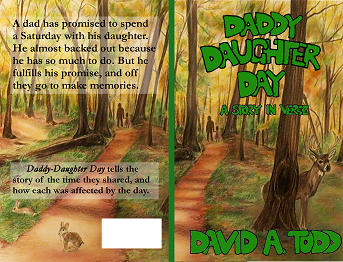
CS Cover with green font abt 362x262Well, I did it. After years of having the book done, but wanting to do something a little different with the production, I finally decided this was the time, and published my poetry book Daddy-Daughter Day.

I’ve written about this before, perhaps several times on this blog and my other blog. It was originally titled “Father Daughter Day”, but I was talked into changing the name by a number of people. As I’ve written before, it is a story told in a series of poems. A dad has promised to spend a Saturday with his. He forgot about it. When she reminded him at the crack of dawn, he told her to get lost, then thought better of it, and decided to fulfill his promise to her. The book describes the day they had, the activities they did (to some extent a broad outline of the activities), and how each reacted to those activities and to being together.

A goal I had for the book, or rather for the poems in the book, was that each poem should stand on it’s own as a complete work, and yet should fit seamlessly into the book as part of the whole story. I haven’t yet had any feedback from readers concerning this goal, though the poems I’ve work-shopped on-line seem to have worked in this regard.

Sales are slow, as should be expected, but I’m hoping it will catch on.


A Clash of Rights – Part 2

Continuing from my last post, I want to discuss the idea of a clash of rights again. Let’s think about it from a political sense for a moment. Does a person have a right to associate only with those of the same political beliefs? And if so, can this right extend to those who have a business that serves the public?

An example I used on Facebook was that of a small city, where there was one event center, owned by a staunch Democrat. The mayor of the town is a Republican, and the event center owner hates him and everything he and his party stand for. Let’s say they are both white men. The mayor wants to rent out the event center for the start of his re-election campaign. The Democratic owner of the event center refuses, stating he will not rent it out for a Republican event. Is he within his rights to refuse service?

I would hope he has the right to refuse to serve the Republican, based on his political views. But maybe not. The Republican has the right not to be discriminated against for his political views, and the Democrat has the right of conscious. Which right trumps the other?

That’s not so far-fetched. And of course political rights clearly don’t trump some civil rights. If it had been a black person wanting to rent the event center for his daughter’s wedding, the white Democratic owner couldn’t refuse to rent to him on the basis of political views. Or say it was a black owner. He couldn’t say, “You know, you white Republicans have oppressed my people enough. No, I’m not going to rent it to you for your daughter’s wedding, based on my political views.  I don’t think that would be within the law.

You see, a person doesn’t choose his race, but he does chose his political opinions and actions. So should a person be allowed to refuse to serve another person based on the politics of the two? I think that’s a very important question that needs to be settled. Race is inherent; political affiliation is not. Must a person who runs a business that serves the general public be forced to serve someone of a different political stripe? If the event is a political one, I would think not. If the event is a private one (such as the wedding reception), I would still think not. I would still like to see the person retain his right to conscious based on his political beliefs. In those cases, I can’t really see how anyone’s civil rights were violated.

What say you? Do you agree with me or not? Do we have the right to act on political conscious?

I think I’ll end this post here.  In the next one I’ll start honing in more on how this relates to the homosexual situation. And in one after that, I may finally get into where I stand on the narrower issue.