Category Archives: Christianity

Christmas Memories: Church

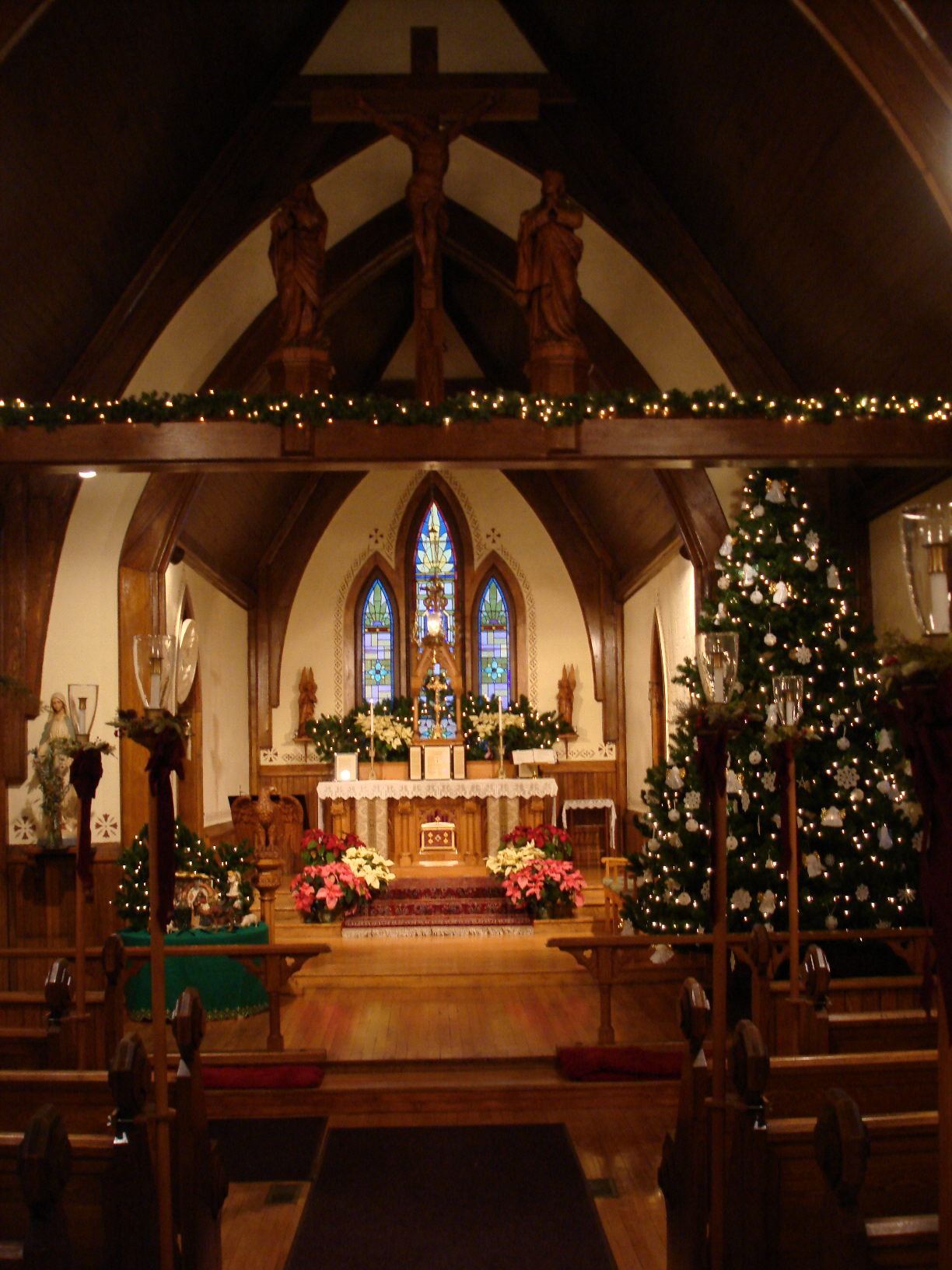
The Epiphany was less elaborately decorated than this church, but the decorations seemed sufficient and appropriate.

In a number of past posts in Decembers previous, I shared Christmas memories. I had thought of doing another one of those posts this year, but am not sure what to write about. I’ve covered such things as the way we did our wrapping paper, how we bought and decorated the Christmas tree, the idea of progressive decorating, and the candy house. What else is there to write about?

I’m writing this on Sunday evening. Today we had an excellent service, the guest speaker being Dr. Mark Lindstrom, our former pastor and now district superintendent. Then our adult Sunday school class had its annual Christmas party, something we hadn’t had for a couple of years due to the pandemic.

Church growing up in Cranston, Rhode Island, meant services at the Church of the Epiphany, an Episcopal church. Our church was more English Catholic than Protestant. We attended Christmas morning when we were young, but I remember the year we were first old enough to attend Midnight Mass. That would have been when my brother was around 7 or 8 I would guess. I remember it was a normal work night for Dad, so Mom’s parents came from Providence to get us and take us to church.

I remember the church was nicely decorated with garlands, wreathes, and votive candles on the ledge of each stained-glass window down each side of the sanctuary. The decorations were not as lavish as churches put up now, but they seemed appropriate to us. I guess I ought to say to me, as I can no longer ask other family members about it.

The processional was “O Come All Ye Faithful”. That was different than the processional for morning service, which was “Sing, Oh Sing This Blessed Morn”. But that song wouldn’t have been appropriate for a nighttime service.

About 3/4 of the way through the service, we sang a slow version of “Silent Night”. On the second verse, the house lights slowly started to lower. By the third verse they were out completely, and only light was from the candles on the altar and the votive candles. I remember how beautiful it seemed. A few years later, when I was an acolyte at Midnight Mass, I was the one to control the lights, and was quite nervous about doing it right.

When mass was over, many families exchanged presents. I don’t remember us doing that. What I do remember is that Dad was at the back of the church. The Providence Journal let him off early from his shift, and he came straight to the church.

Once we began attending Midnight Mass, Sunday morning became a little different, but that’s a memory for another day.
Thoughts on Divine Service

I am learning much from this Livingstone biography, not all just about him, but also about the times he lived and places he traveled to. Also, as shown by this blog post, some inspirational material.

Part of my normal schedule is to read the last hour or so of the day. I normally post reviews of those books—not every one, but a lot of them. Right now, my reading is a tome: David Livingstone: His Life and Letters. I’m on page 334 of 631, so just past halfway. That’s after 30 sittings to read.  Another month to go on it, I guess.

It is a good book, going into much more depth than the simple biography of him I read not all that long ago. I’m learning lots about him, things I didn’t know at all. But this isn’t a book review. Look for that in a little over a month. This post concerns a statement in this book. It quotes Livingstone as writing, “It is a pity that some people cannot see that true and honest discharge of the common duties of everyday life is Divine Service.”

The book doesn’t always do a good job of identifying the source of the Livingstone quotes, so I don’t know if this came from one of his letters or an official report he might have made concerning one of his missionary duties or exploration journeys. But this got me to thinking.  Was Livingstone right? Is faithfulness to everyday responsibilities really a type of divine service?

We are coming up on winter. It won’t belong before we’ll have a snowstorm that sticks on the driveway. I’m very careful as I shovel or scrape, making sure I don’t slip and fall, don’t take more weight in the shovel than I ought to. Is clearing the driveway, something I actually enjoy doing, really an act of divine service?

What about the simple act of taking the garbage out to the compost pile, or taking out the trash on trash day? What about dusting or vacuuming? Fixing meals, washing dishes, cleaning off the counter? Or we could ask about any other type of household or employment drudgery.

We usually think of acts of divine service as something in ministry. Participating in a church work day. Giving to and helping to staff the church pantry. Giving to a compassionate ministry. Teaching a Sunday school class. And many other things.

But to be a responsible adult, to do those works of drudgery or displeasure simply because they need to be done and someone else is counting on you to do them. I can see them as being acts of divine service.

There’s probably a biblical basis for this, though I can’t think of any right now. Paul said something about this in one of his letters to the church in Thessalonica, about living a quiet, law-abiding life. I’m happy to do that, and happy to think that, in doing so, I’m actually serving God and his creation.

Book Review – Christian Reflections

‘Twas in this book that I found the essay “Christianity and Culture”. I will need to read it another time or two to fully understand it. Meanwhile, I have completed the second of three books in this volume.

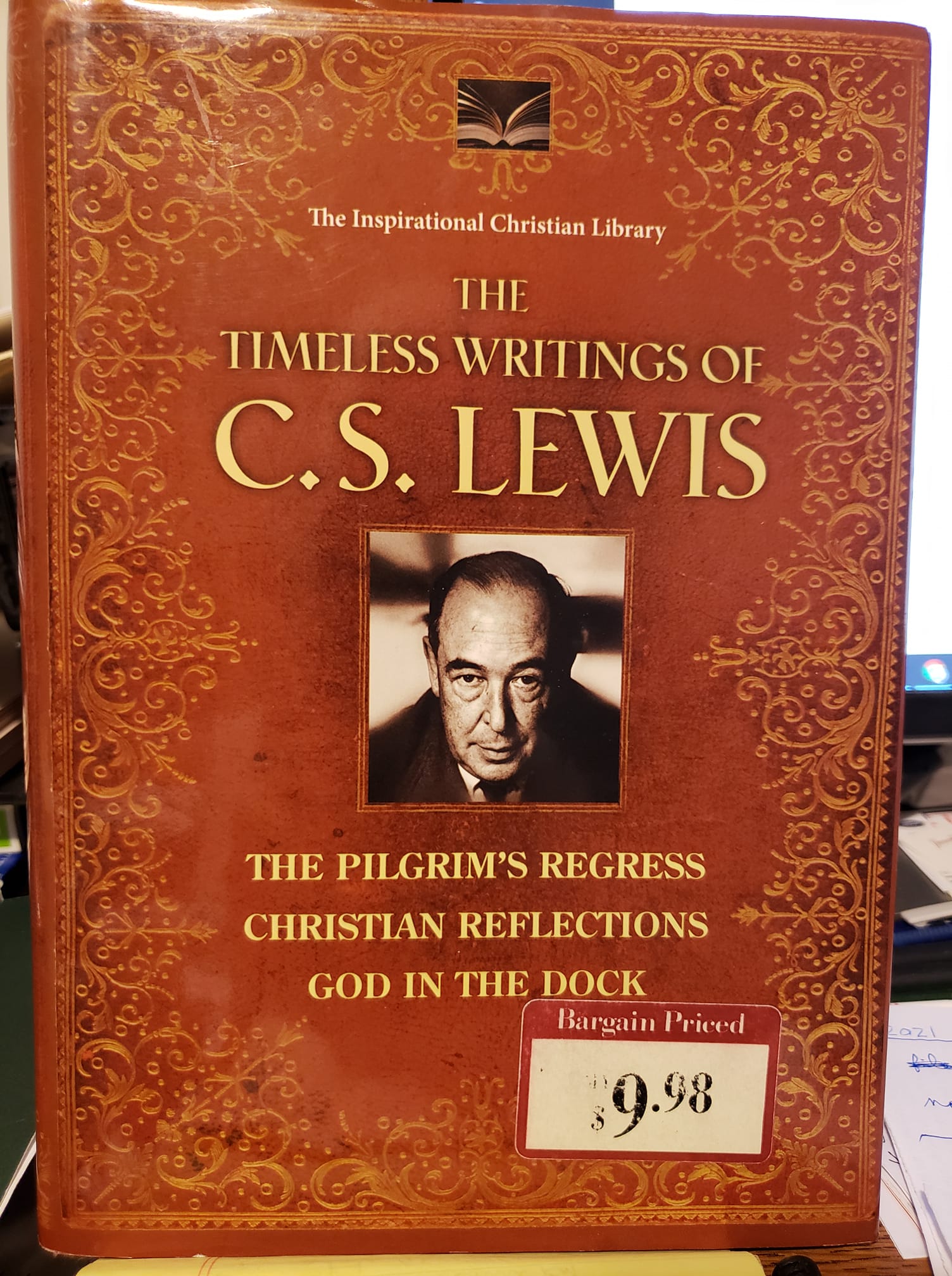
The book Timeless Writings of C.S. Lewis is actually three books in one volume. The first is The Pilgrim’s Regress, the first book he wrote after his conversion to Christianity, which I read earlier this year and reviewed.

The second is Christian Reflections. This is a compilation of Lewis’s papers, talks, and essays published in 1967, four years after his death. They were collected, edited, and published by Walter Hooper, who was Lewis’s secretary near the end of his life and became his literary executor after his death. He took on the job of organizing the mass of Lewis’s writings into collections.

This book has items composed from 1939 to 1962. The fourteen items are arranged more or less chronologically. The first is “Christianity and Literature”, a paper Lewis read to an Oxford society in the 1930s, and which was included in his first collection of essays, Rehabilitations, published in 1939. I read this in one sitting back in 2019, and found it to be a great help. I found several things to inspire my writing.

The next was “Christianity and Culture”. Published in a magazine in 1940, this essay generated a debate with several critics—a debate that played out in the pages of the magazine. This book includes Lewis’s three contributions to the discussion, the original essay and two responses to his critics. I’ve been looking for the other site of the discussion. I found one item. When I find the other, I’ll come back to this for a fuller reading. I reviewed this essay previously on the blog. I read this in both August 2019 and September 2021, though I’m not sure I finished it the first time.

After this, the essays are a mixed bag. I’m not going to give all the titles here. I read them slowly, in many sittings, in 2021 and 2022. Many of them I found hard to digest. Several I don’t remember at all. I read them, at least according to the notation in the book I did, but I couldn’t tell you what they are about. Were they too difficult for me, or did I read distractedly, without the wherewithal to comprehend what Lewis was saying? The only way to know is to read them again.

And that I shall do, though I know not when. The third book in this volume is God in the Dock, another of Hooper’s posthumous collections of Lewis essays. I’ve read a couple in this, but have yet to tackle this formidable looking document. I’m going to read something lighter before I do.

What about Christian Reflections? Is it worth reading? Is it a keeper? Yes, it is worth reading, but probably only for the dedicated Lewis reader. It is available as a separate volume, if you want to pick up a copy. As to it being a keeper, yes, for sure. Not only because I have more to read in this 3-in-one book, not only because I don’t want to break up my C.S. Lewis collection just yet (if ever), but also because I need to re-read some of these, sometime years hence. Perhaps I’ll still be posting at this blog, and will have something more to say about it.


A Difficult Transition

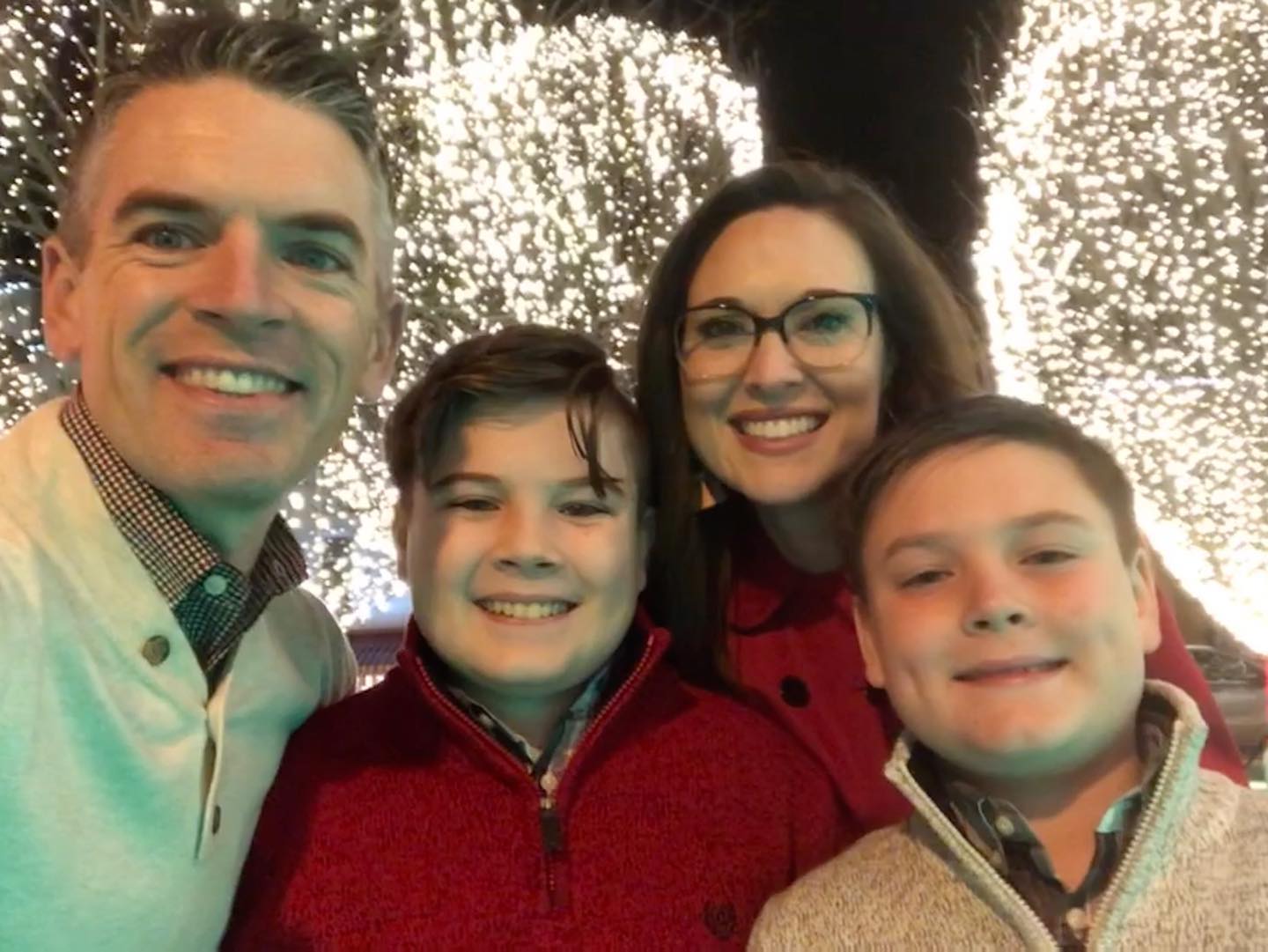
Not the most recent photo of the Snodgrass family, but a good one.

Yesterday was a sad day, as it was our pastor’s last Sunday at our church. Rev. (Dr.) Mark Snodgrass has been our pastor for close to 12 years. His children, Paul and Luke, were 4 and 1 when he and Lauren came to Bentonville in January 2011. Now they are teenagers, and this is the only home they know.

Pastoral changes are never easy. I was trying to figure out how many I’ve been through since I’ve been in the Church of the Nazarene. I think it’s around eight, though one of those happened while we were overseas. Mark is the pastor I’ve had longest, which perhaps makes it most difficult.

I haven’t been in any positions of church leadership during Mark’s tenure, as I pulled out of church leadership long ago, believing it wasn’t the ministry I was meant to be in. But as a Life Group leader, I interacted with our lead pastor quite a bit. He came to us right at the time I was starting to self-publish. I gave Mark several of my books. When I published books on Christian topics, I asked for guidance from him about whether my writing was doctrinally sound.

From time to time, I would have lunch with Mark. Once I retired in January 2019, my trips from home to Bentonville greatly reduced but, not having a job to do, I suggested we get together for coffee when I made the 13 mile drive for some purpose and when he had time and I had time. This resulted in us meeting at the Bentonville Library around four times a year. Those were good times. We discussed church topics, politics, social types—just about anything.

In these conversations, it became quite apparent that our politics differed. So did our belief in what I call social styles. Mark is big on community. I’m big on individualism. He’s an extrovert (a social style also called “Expressive”). I’m an introvert (a social style also called analytical). I tend to crave being alone and thrive working by myself.  I embraced self-checkout at Wal-Mart, not because I want to do that work but because that means one less person I need to talk with each time I went shopping. Mark loves to be among people and probably thrives when working in committee. But despite these differences, we became good friends. I will miss these occasional meetings.

We didn’t sell out of the book, but we sold a lot. I increased the print run from what Mark wanted. Turns out he was correct.

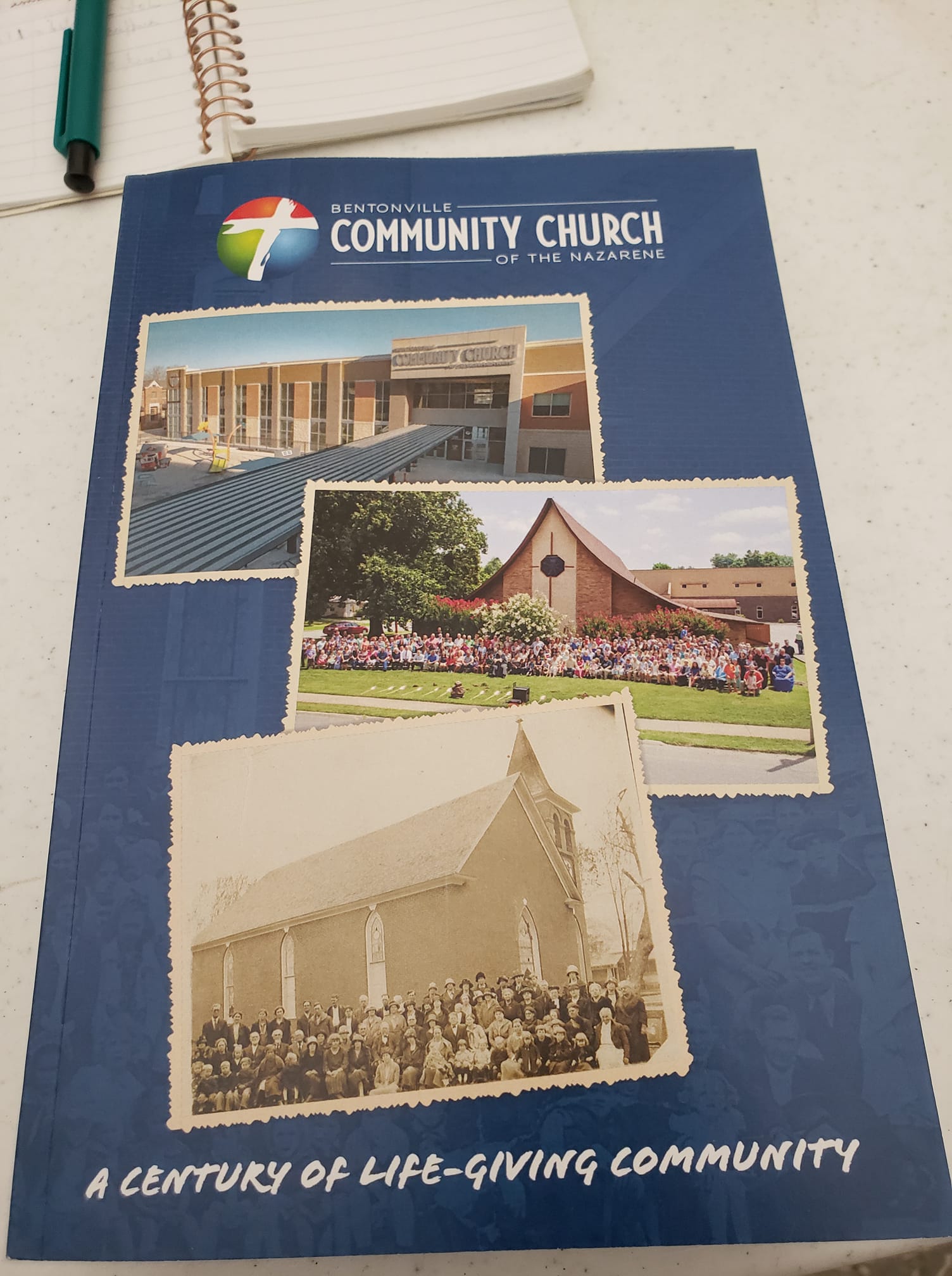
In November, 2020, Mark asked if I would write a history of our church’s Centennial. I agreed, and began work in January 2021. I made some amazing discoveries, which I shared with Mark along the way. He seemed pleased with the work I showed him, though some I didn’t tell, but let him see them as posts on the church’s website. The impact of those surprises were good. I don’t think Mark ever felt he made a mistake in his appointment of the “church historian”. That’s the closest I got to church leadership during his pastorate.

Mark has been called to a strong church in the Kansas City area. That’s only four hours away, and Kansas City was once Lynda’s and my home. Is getting together possible sometime in the future? Part of the process of a pastoral change is the letting go. The pastor has to let his/her current church go in order to fully minister to the new church, though of course a pastor never totally forgets those he/she ministers to. But the church also has to let the pastor go, not keep bugging him/her as they seek to acclimate to their new congregation.

The separation is hard, especially after twelve years. But I’ve prayed that God will confirm his call to his new church as he ministers there.

Godspeed Mark, Lauren, Paul, and Luke.

Book Review: Witness

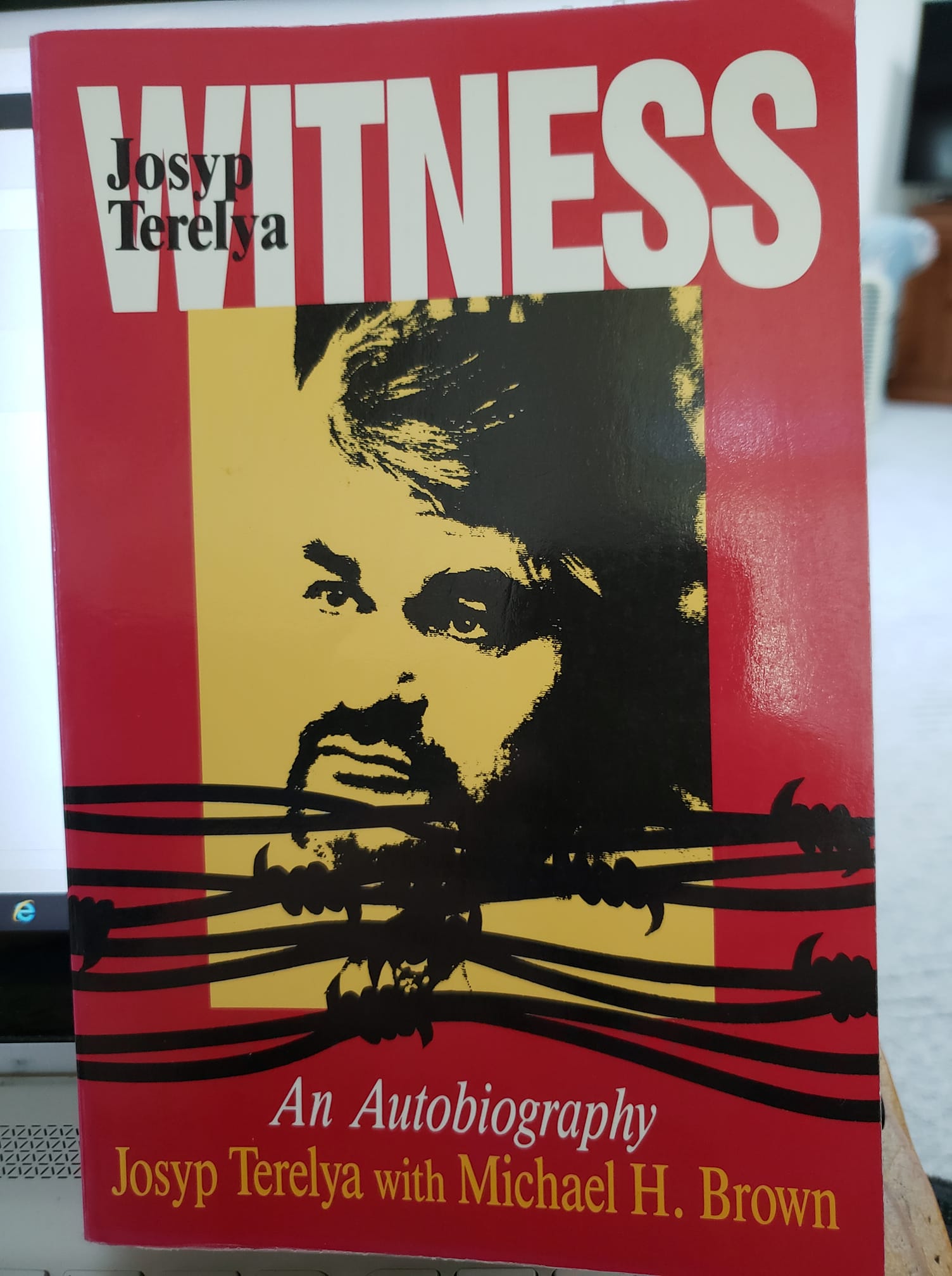
An excellent book about a man who suffered horrendously at the hands of the Soviet communists.

When you are a buyer of used books, you sometimes wonder where you got this or that book, how long you’ve had it, and why you bought it. So it is with the book Witness: An Autobiography by Josyp Terelya with Michael H. Brown. Terelya was a prisoner in the USSR in the 1960s-80s because of his Christian faith.

The reason I wonder why we bought the book is because Terelya is Ukrainian Catholic, which is attached to the Roman Catholic Church. As a Protestant, I’m not anti-Catholic, but I don’t usually read Catholic books. I suspect we bought this at a thrift store, based on the price marking.

However, it is an excellent book. Terelya was born to Communist parents in Ukraine during World War 2. In fact, they were leading communists and very much in favor of Ukraine being part of the Soviet Union. Terelya was influence by his grandparents and others, and became a devout Catholic, much to his parents’ dismay. The USSR suppressed religion, especially any religions that competed with the Russian Orthodox Church.

When Terelya became an adult, he did not hide his religious observances, and was soon put in prison for it. He escaped. He was captured and his sentence increased. Put in a more secure prison, he escaped again. He was beaten, spent much time in solitary confinement, Food rations were inadequate. He developed health problems. The guards also tried to break him psychologically, with frequent interrogations and beatings. As a consequence of his long imprisonment, he developed chronic health problems.

Through this, Terelya survived. He found ways to share his faith and prepare printed materials. Once when he was released for a couple of years, he married and fathered his first child. In later years, two more children were added to the family.

A portion of the book deals with “appearances” of Mary, the mother of Jesus, over a several week period in a small Ukranian village in 1987. Terelya was out of prison by then and took part in observing the visions. He went into considerable detail about these.

My wife and I read the book aloud in the evenings, taking about a month to complete it (with a few interruptions). I’m glad we did. It was unexpectedly timely due to the current war in Ukraine, and it told us a piece of history we had no idea of. Learning new things while being entertained is a good thing.

The book, published in 1991, is likely out of print. But it is worth the read if you can find it. I give it 4-stars, it losing one star due to what I consider an overabundance of placenames without providing a map to give at least a basic idea where places were. Alas, the book is not a keeper. We are going to give it away to a Catholic relative, and hope they, in turn, pass it on to someone who will enjoy it.

August Progress, September Goals

New month, time for a progress report and new goals. First, the progress report. Here are the goals I posted at the beginning of August.

  • Attend three writing group meetings in person. This includes making the presentation at one on Aug 9. Done. My presentation went very well, I think.
  • Blog twice a week, Monday and Friday. I think I missed one day, my first complete miss in a long time. With all that was going on, that wasn’t too bad.
  • Write at least two more chapters in The Key To Time TravelI did not complete this. I worked on one chapter, and got it mostly done in first draft.
  • Write at least two more episodes of Tales Of A Vagabond. I still don’t know what I will do with this. I need to get a little more into it before I can assess if this is a viable item for Kindle Vella. I worked on TOAV, perhaps a little more than I should have. I have completed five episodes. Now to see how I can program this, how many episodes out. At the moment, I’m thinking of setting it aside and get on other projects.
  • Continue to program the next Bible study. The tentative title is Death Kindly Stopped For MeI have now prepared lesson notes for three of the seven lessons in this series. I feel good enough about it that I can definitely schedule it to start in October. Now I need to make a trailer for it. Oops, that goals, not progress.
  • Do some marketing of There’s No Such Thing As Time Travel. Also need to close a couple of sales of this. I did a little marketing on this, but not much. Closed two sales.

So it was a so-so month. I’m not unhappy with it. I gave a lot of time to my paper files digitalization project, and likely will be doing that for a few months. That cuts into my writing time.

On to September.

  • Attend 3 writers group meetings, all in person, including making a presentation at the NW Arkansas Letter Writers Society on 9/13.
  • Blog twice a week on Monday and Friday, as always.
  • Concentrate my limited writing time on The Key To Time Travel. I won’t put a word or chapter goal. I’m in the middle of Chapter 2 currently.
  • Figure out how to make a trailer for my Bible study, Death Kindly Stopped For Me. It will be a simple trailer, but lots to study to make it happen.
  • Hopefully, get back to work on the two Bible studies I set aside a couple of months ago. One needs only an introduction and maybe 1,000 more words in the narrative to be finished. The other I estimate at 70 percent finished. Sure would be nice to find an hour here and there to work on them.

I think that’s it. Possibly more than I can accomplish, but it’s something to shoot for.

July Progress, August Goals

First of the month. Time to review progress last month and set some goals for August. That means return to my environmental series will be delayed one more post.

First, the goals I set at the beginning of the month. They were not ambitious goals.

  • Get back on the two Bible studies I’ve set aside to complete other things. I’d love to set a goal of finishing them by the end of the month, but I think that’s too ambitious. Let me instead say to work on them in at least 10 writing sessions. I believe I worked on the Bible studies only one day. Life circumstances and changed writing interests resulted in my not being able to focus on this.
  • Attend three writers meetings, all in-person. Did this. They were three good meetings.
  • Blog twice a week on Monday and Friday. Might be a challenge with the grandkids here. Did this. Maybe a couple of posts weren’t the best.
  • Work on the programming of the next Bible study. I’ll post about it at some point. I did manage to have a couple of good sessions on this. I’m not as far along as I wanted to be, but at least I made progress.
  • Not originally a goal, but something I worked on was the next book in The Forest Throne series, tentatively titled The Key To Time Travel. I did this because the grandkids were here, and they were interested in getting started on it.

What about this month? I’m still dealing with some health issue for me and my wife. We were going to take a long road trip this month, but that’s up in the air right now due to health. I will decide on that sometime this week. I’m going to establish goals as if we won’t be making the trip.

  • Attend three writing group meetings in person. This includes making the presentation at one on Aug 9.
  • Blog twice a week, Monday and Friday.
  • Write at least two more chapters in The Key To Time Travel. I hope to work on that some today.
  • Write at least two more episodes of Tales Of A Vagabond. I still don’t know what I will do with this. I need to get a little more into it before I can assess if this is a viable item for Kindle Vella.
  • Continue to program the next Bible study. The tentative title is Death Kindly Stopped For Me.
  • Do some marketing of There’s No Such Thing As Time Travel. Also need to close a couple of sales of this.

I’ll leave it at that. This is really a tough month to plan anything, given uncertain health issues.

100 Years of Life-Giving Community

A century of life-giving community completed, ready and looking ahead to the next.

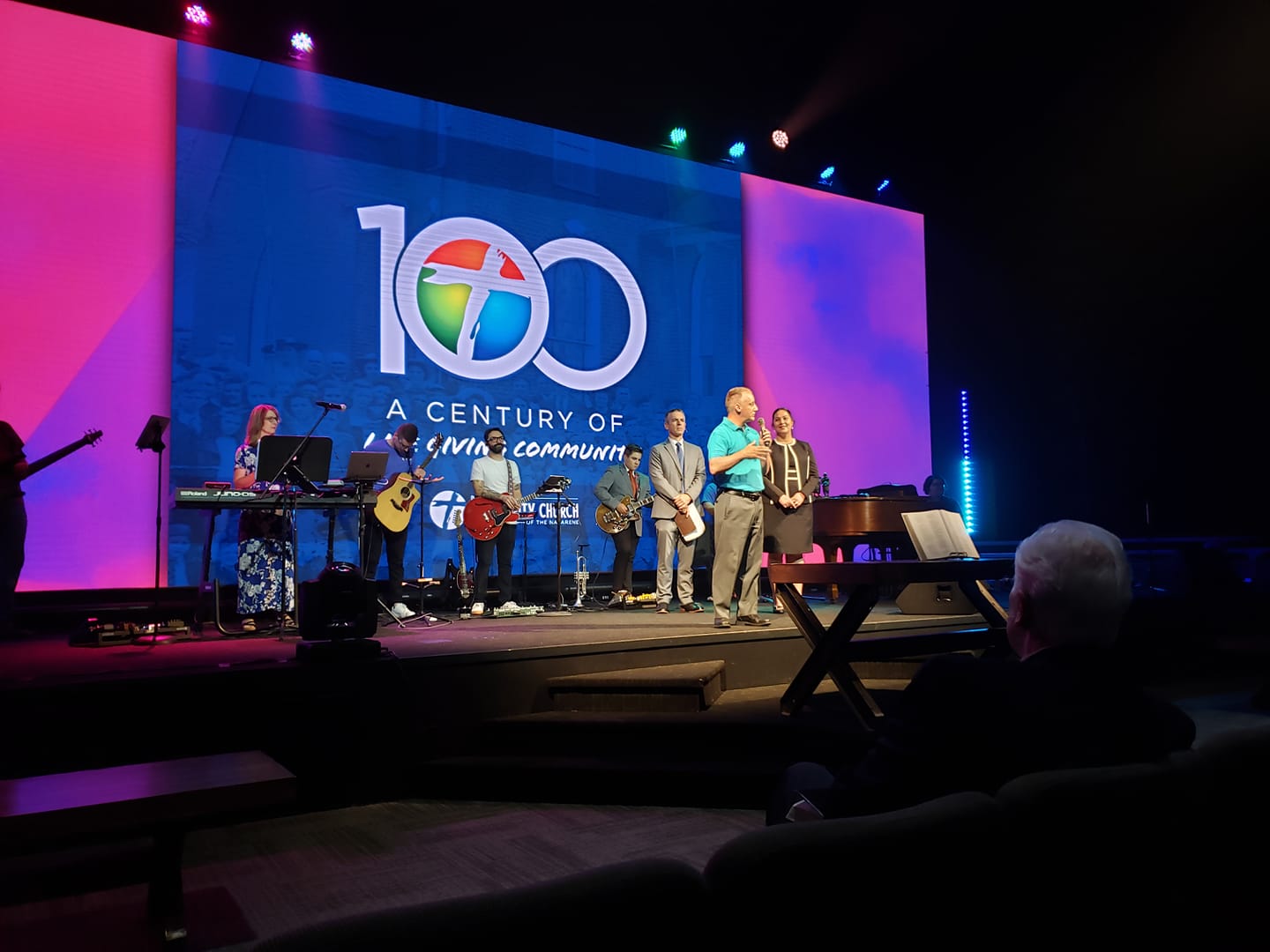
Last weekend, over a year and a half of work came to fruition as our church celebrated its Centennial. Actually, it was our 101st anniversary on July 8. We delayed the celebration a year due to a combination of the pandemic and adjacent construction.

We didn’t sell out of the book, but we sold a lot.

I joined the centennial committee in November 2020 at the request of our pastor, mainly to write the church history. But I got involved in other activities. Brainstorming. Planning. Seeking people whose ancestors had roots in the church. The history was written, printed, and issued for sale on May 22nd.

We did the setup for the Sunday banquet on Thursday. I found out then that the special choir for the Sunday service had some people drop out, and the director asked if I had choir experience. I decided I had just enough experience to help them out. One more thing added.

It’s always good to catch your daughter in a candid shot.

The activities started midday Friday with a ribbon cutting ceremony for our re-established food insecurity ministry, reopened in recently constructed quarters and now called the Community Table. The Chamber of Commerce ran this event. I enjoyed finally seeing the building and how the ministry is stocked and managed.

Friday afternoon our daughter, son-in-law, and four grandkids came for the weekend. By that time I was more or less exhausted, so we had a nice meal out for supper. Meetings and events remained.

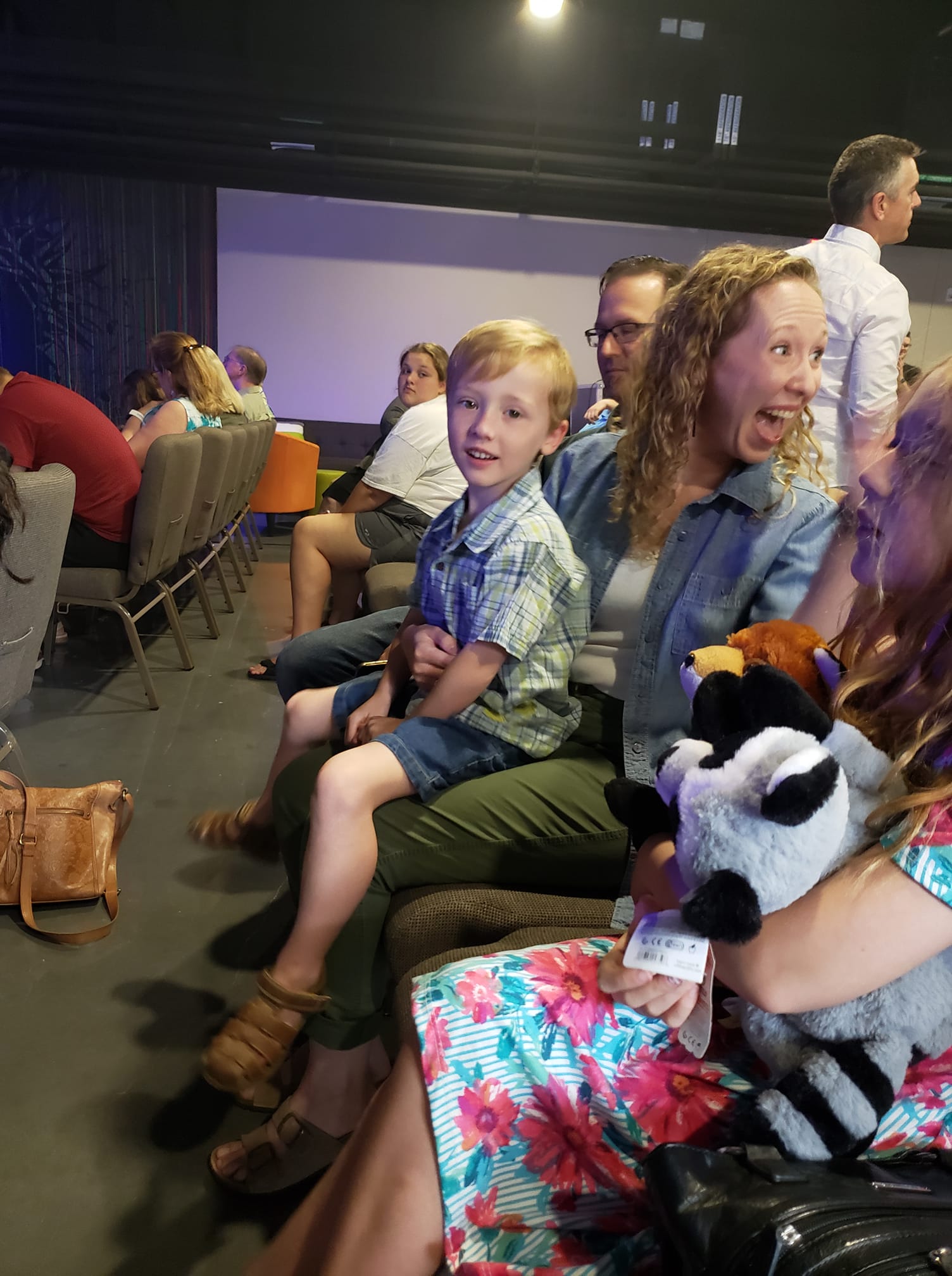
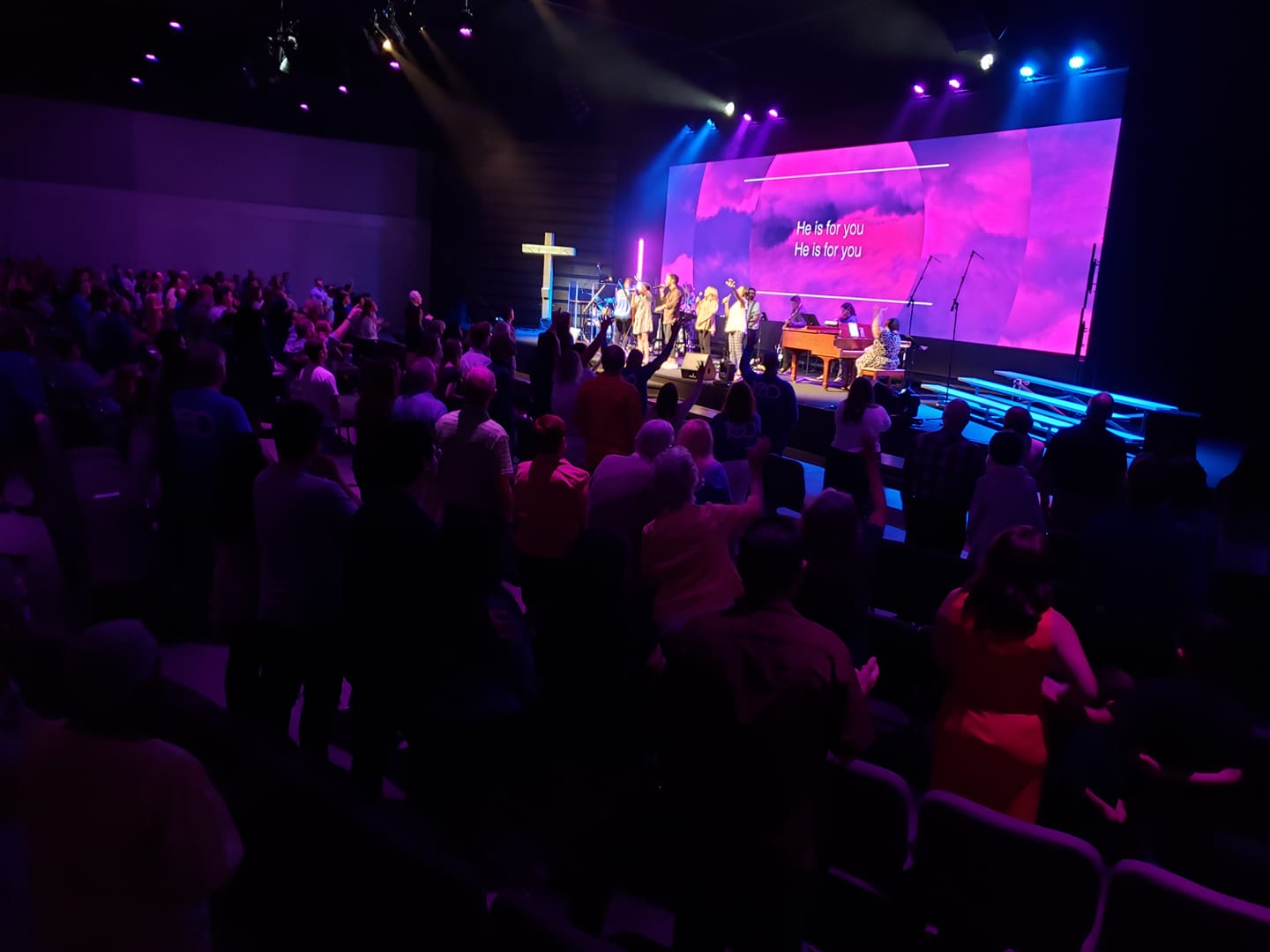
Good worship with music mostly unfamiliar to me. Lots of energy.

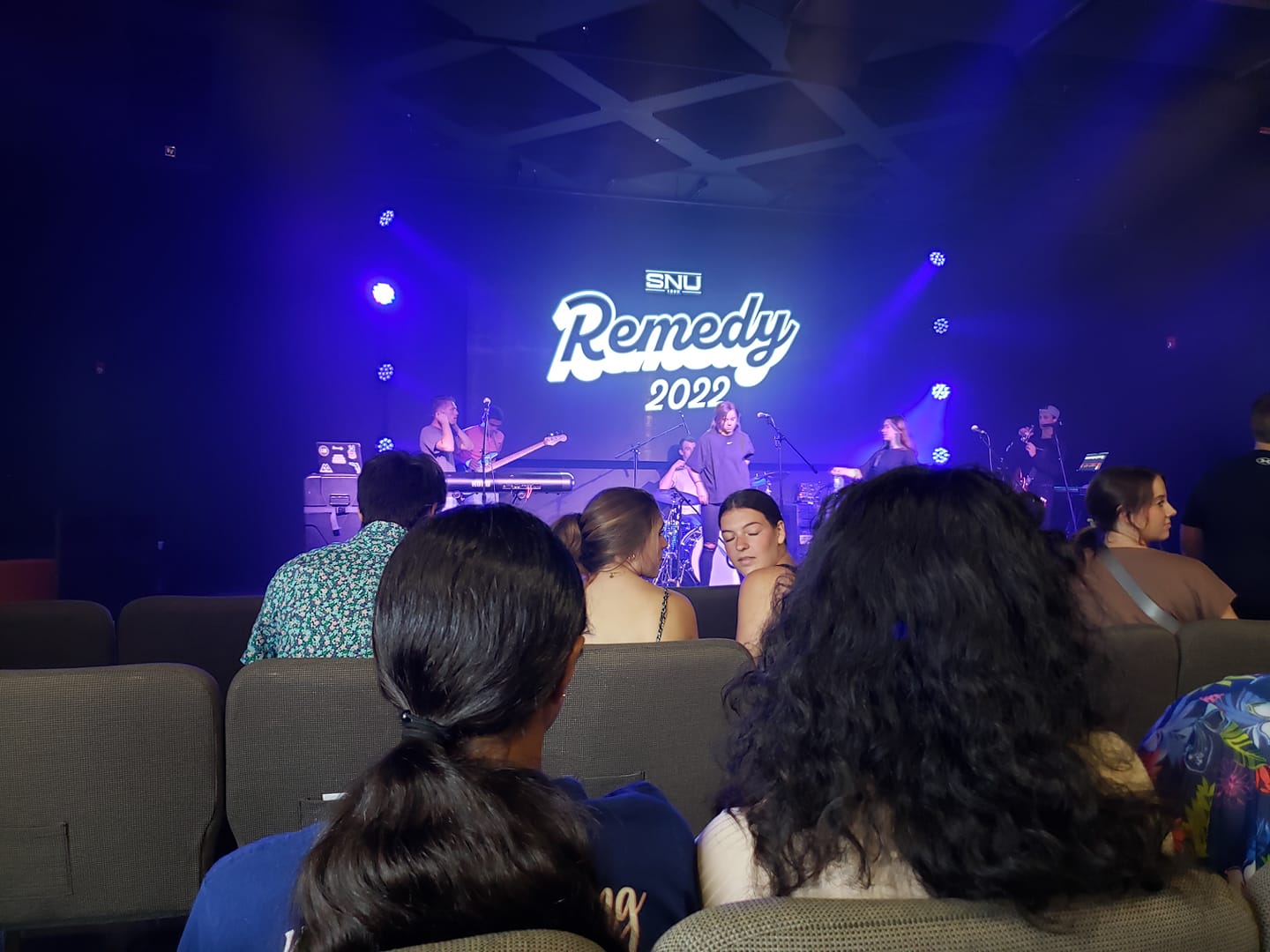
Saturday morning was choir rehearsal. It was kind of nice to sing after a 25-year hiatus from choir. Saturday afternoon was a concert by Remedy, a band from Southern Nazarene University that included two college students from our congregation. It wasn’t my type of music, but the Holy Spirit was present, and worship happened. This took place in our newly constructed space for youth and Hispanic ministries.

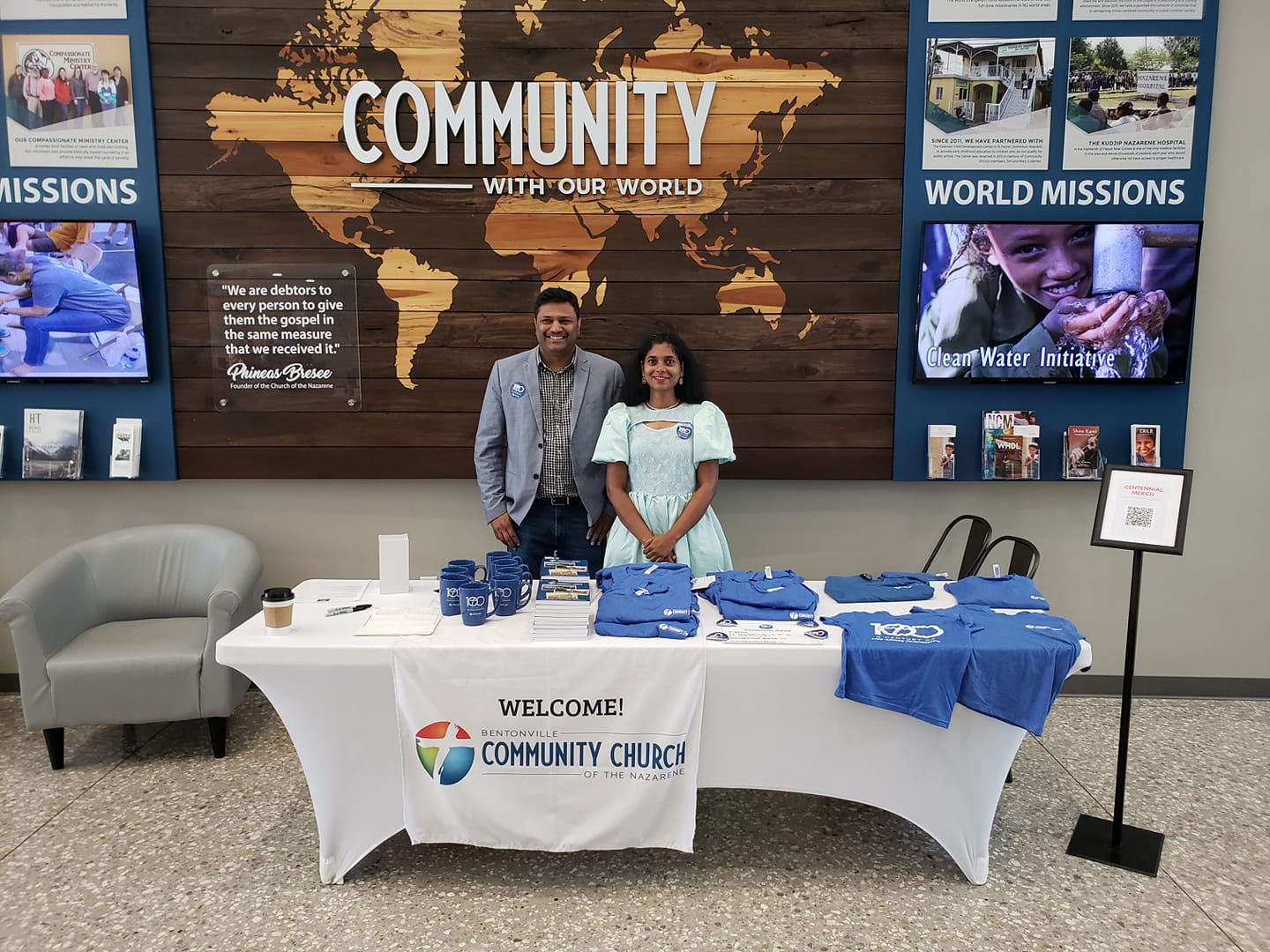
David and Pranathi, among the many who helped out.

Sunday was the big day. Choir rehearsal at 9 a.m. To help with transportation (transporting 8 people in two vehicles, our daughter volunteered to sing with the choir and came with me. We were done by 9:45. That gave me time to greet visitors, signed books and helped direct people, especially to Centennial Hall.

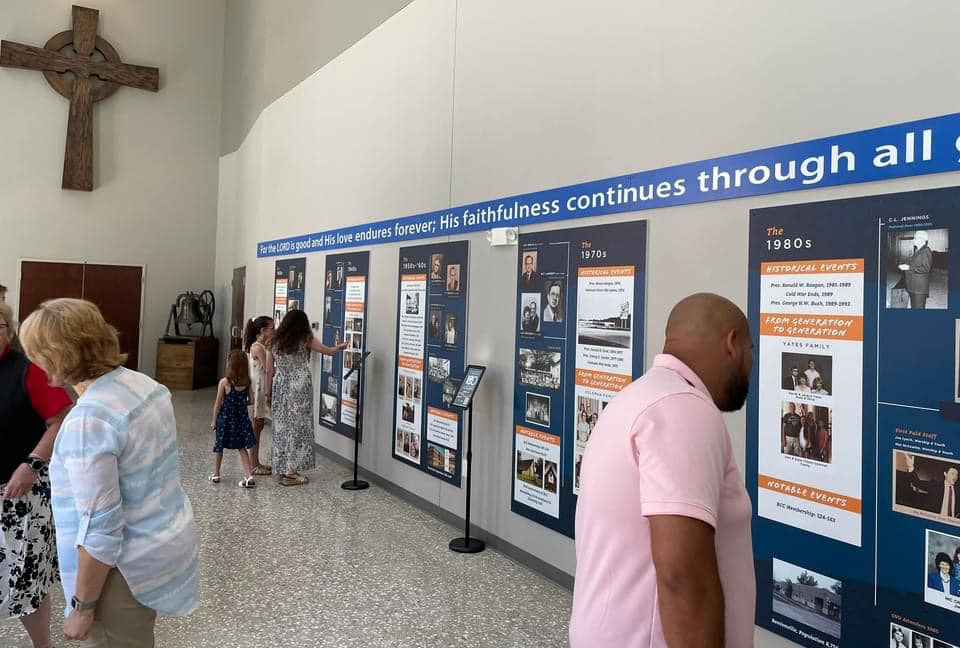
Many visited the diorama in “Centennial Hall”.

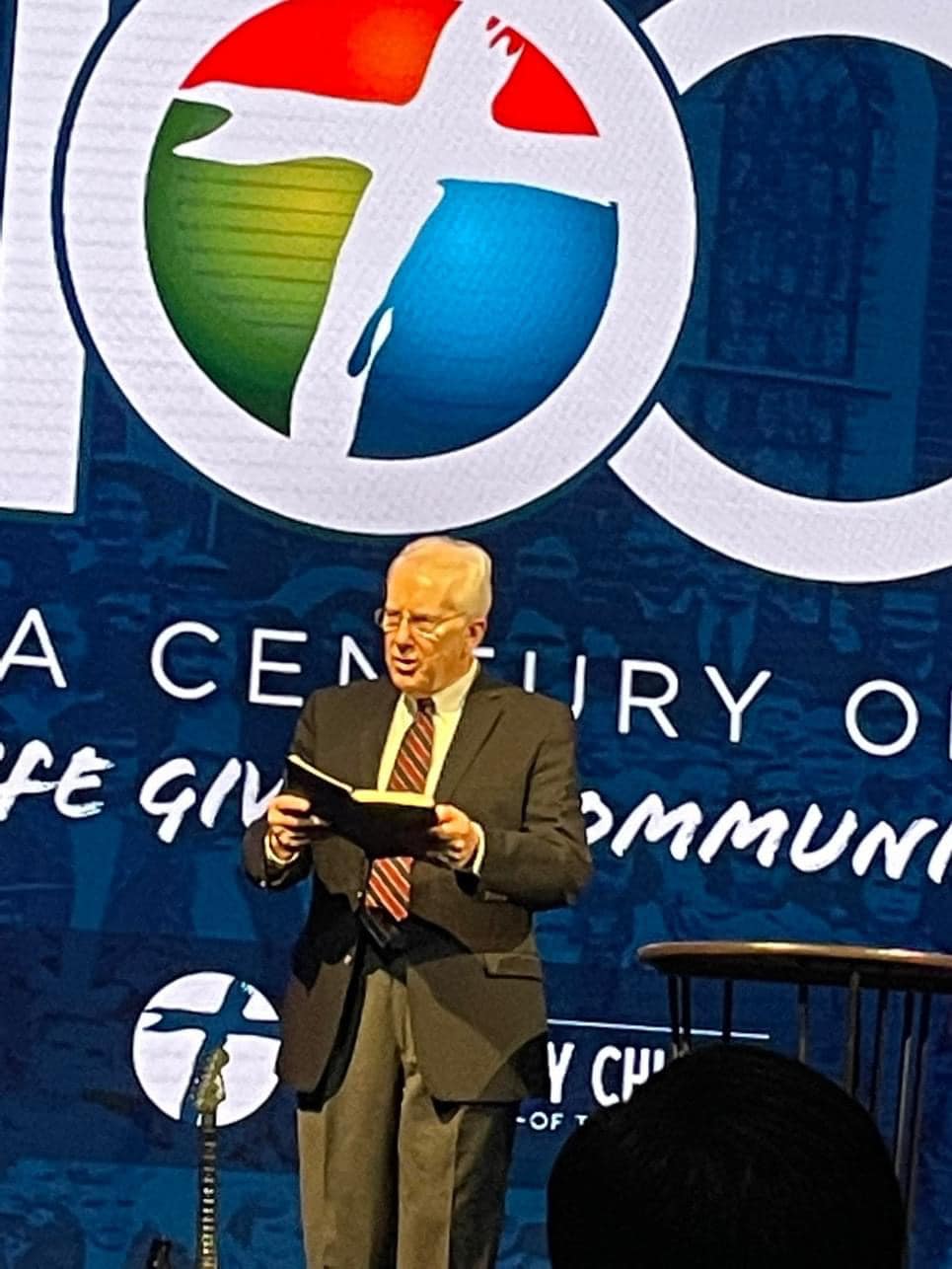
The service was magnificent. It included special music from the Mitchell family, the choir number with two soloists and great live backing music. We *nailed* the choir special. I was thankful for the strong tenor from the Mitchell family being next to me. There was a time for introducing some out-of-town visitors who attended because of their family connection to the church. And we had a wonderful, apt message from Dr. Jesse Middendorf, former General Superintendent of the denomination.

Dr. Mark Lindstrom, our former pastor/now district superintendent, brings greetings.

Immediately after the service, we had a congregational photo taken in our new sanctuary. Then it was to the gymnasium for a BBQ lunch, with the Mitchell family. We had nearly 300 people for that.

Dr. Middendorf brought the Centennial message.

The final event of the weekend was the dedication of the youth/Hispanic worship space. It turned out to be a 45 minute service, with music in Spanish, responsive readings, scripture readings, the actual dedication, and brief messages from our pastor, district superintendent, and Dr. Middendorf.

They opened the Community Table for anyone who wanted to go through it, and our daughter and granddaughter did (the rest of the family having gone home). We got away at 2:45 pm, a full day.

The final congregational song.

All in all it was a great weekend. Bentonville Community Church of the Nazarene is 101 years old. We actually spent more time looking forward rather than backwards. That was an emphasis I tried to put in the history book as well, making it a Centennial book rather than a strictly history book.

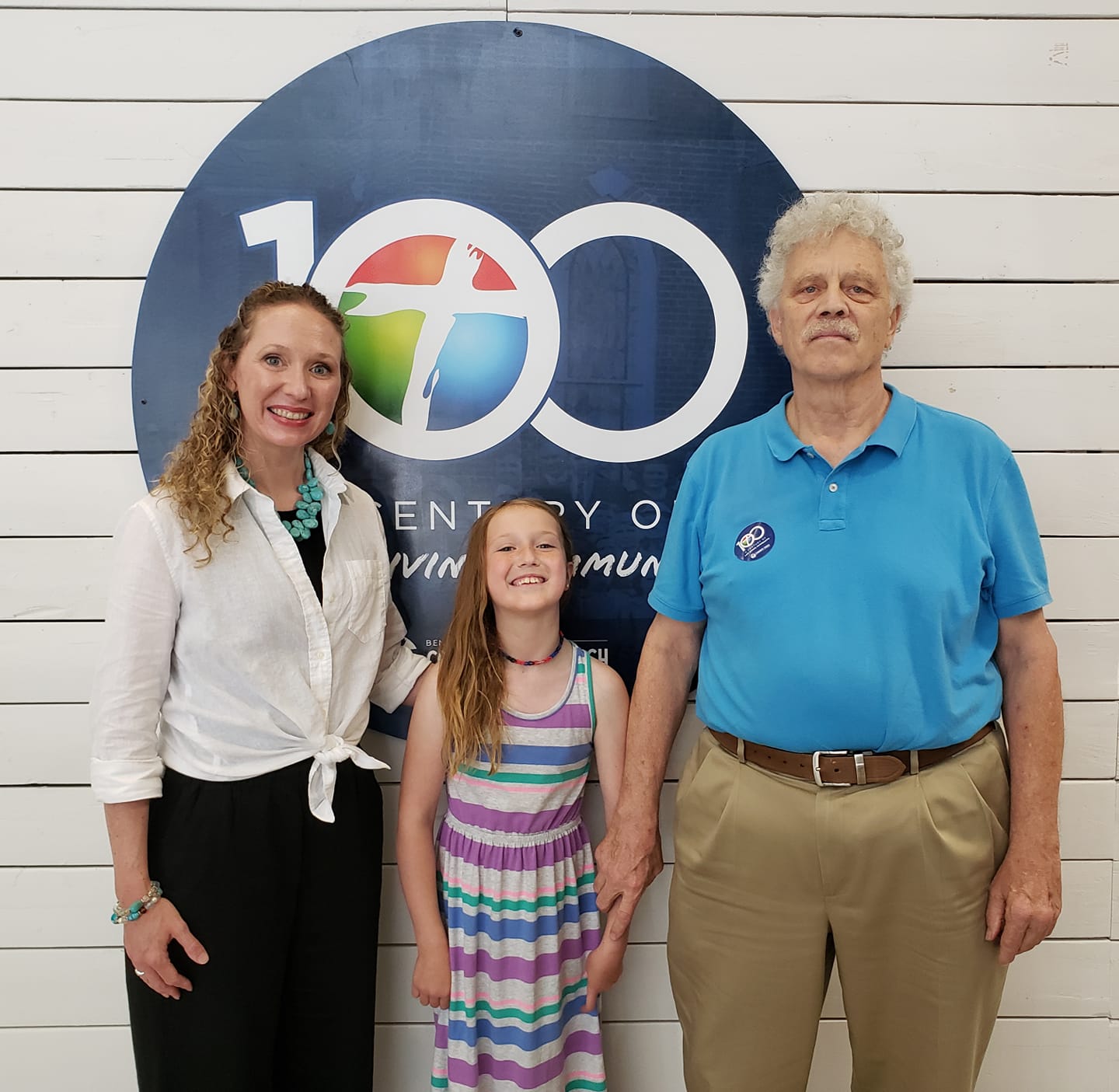
Some of the family had gone home before we thought of the photo booth. And don’t give me grief about not smiling—that IS me smiling.

It’s now time to unwind a little. This week I don’t have to attend any special events. No weekly history post to write. No committee meeting to attend. Instead, we have the three youngest grandchildren with us this week and the oldest grandkid and his friend next week. Time to get back to writing. Ezra and I began work on The Key To Time Travel today.

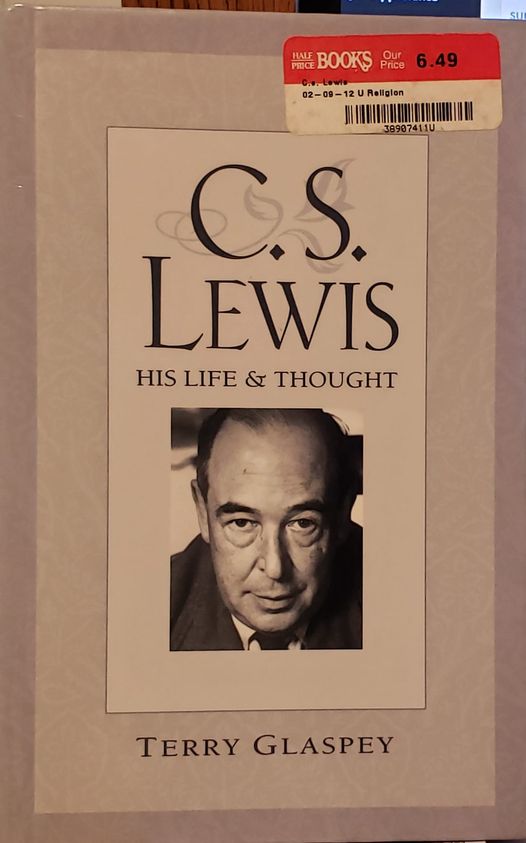
Book Review: “C.S. Lewis: His Life & Thought”

If you don’t know much about C.S. Lewis but would like to, this book is a good place to start.

When we traveled to Meade Kansas for an event at my wife’s home church, we discovered the library there had a sidewalk sale of surplus books going on. Naturally we had to go to it and look for bargains. I bought two books. One of them was C.S. Lewis: His Life & Thought by Terry Glaspey. I read this in about eight sittings in June.

It’s hard to get a bad book by or about C.S. Lewis. The eminent scholar and Christian apologist has had a major influence in the world and in my life. I try to always be reading a book of his or about him. This is the third or fourth I’ve read this year, and I’m reading in the second volume of his collected letters currently.

This book is in two sections. The first is a summary of his life, in short chapters covering brief periods or episodes. This is less than a biography, more of a series of vignettes.

The second half covers Lewis’s beliefs, again in short chapters, about various Christian doctrines and practices. These include quotes from Lewis’s writings as well as commentary by Glaspey. This section is well done, well worth reading.

The book includes a third section: C.S. Lewis: His Legacy. This is only ten pages long. Like the first two sections, it is also well done.

The entire book reads as a summary of Lewis’s life and beliefs, and a good part of his works. If you are looking for an introduction to C.S. Lewis, this would be a good book to start with.

Science and Religion

A few posts ago, I wrote about science and faith, and how they are not incompatible. I stand by that statement. Yesterday, a writer friend I know only through on-line contacts posted this meme, which came from The Other 98%.

Why would anyone think that science doesn’t belong in religion?

Let’s set aside for the moment the wall of separation between church and state. Let’s also set aside the implication that those of the church should have no part in things of the state. Those are subjects for different posts.

The part of this picture that I don’t agree with is “Science belongs here” with the arrow pointing at “State”.  This implies that science doesn’t belong in religion. Or, perhaps, that science is incompatible with religion because religion relies on faith, not scientific evidence and method.

To which I respond with a big, fat, “So?”

As stated in my last post, faith is belief in something for which there is no evidence. I can’t prove there is a God, who created the universe, of which mankind is a small part. But neither can the atheist prove there is not a God. Both rely on faith concerning God’s existence or non-existence.

But why would anyone say science doesn’t belong in the church, in religion? Do such people really think that Christians (or, as some people say in a non-sectarian way, religionists) should not study science, should not believe in science, should not rely on science. Or are they saying that if you are in the church (since the meme frames the argument in a church context, though it does in fact show a synagogue and a mosque though only mentioning “church”), you cannot possibly believe in science? What dreck. What utter garbage.

Of course, perhaps this meme is saying that the state is built upon science, or that science maintains the state.  That also seems like a strange conclusion.

It’s true that at various times in the past the church (i.e. the Roman Catholic church, perhaps others) strongly resisted advances in science and misunderstood how science and faith interacted and could exist very well together. Nowadays, I don’t think that is still true in the main. Those mistakes have, for the most part, been eradicated from the church. At least, it has from the part of the Church Universal that I belong to. I don’t try to keep up with all the branches of the Church Universal.

To paraphrase what I said in that last post, science is experimenting, observing, concluding, and reporting, bit by bit, and so expanding man’s knowledge about the universe. It is involved in what you can prove. Okay, some things that science tells us are theories, based on reasonable assumptions but still lacking some final piece of proof.

Faith takes over for things that don’t need to be proved. What a truncated existence it is for those who have no faith in anything or claims to need evidence for anything and everything.

I hope all Christians study science and so show the foolishness of this meme. Much of my career as a civil engineer was based on science and mathematics. The Other 98% seem to be saying that I can’t be a Christian. Sorry, folks, you’re wrong.

I find my faith to be enhanced by science. My practice as a Christian is so much more meaningful to me because I believe in science.

The wedge between Christians and science is not being driven by Christians, but by memes like this.