Category Archives: miscellaneous

Writer’s Block

This week, I’ve been unable to write anything. My work-in-progress, Documenting America: Run-Up To Revolution, sits more or less where it was on Monday morning. I think I got a few words written on Monday (completing a chapter I left undone on Friday), but no more.

On Tuesday, I sat in The Dungeon as usual, pulled up the next chapter to write, and…nothing came to me. I couldn’t make sense of the source document, already edited to length. So I put that aside and came back to it on Wednesday. And on Thursday. Nothing. I still couldn’t see how to write the chapter.

Part of the problem is my hurting left shoulder. Did I write about that before? It was severely strained when I was walking Nuisance, our daughter’s family’s dog, in early June, and the dog had an encounter with a snake. They saw each other before I saw the snake. They lunged at each other, and in restraining the dog, boom. My shoulder was damaged. It’s not broken or dislocated, but it hurts like the dickens (as Dad used to say). Having my arm in the typing position seems to be where it hurts the most.

So I’ve been doing other things this week. I wrote a couple of long-hand letters. Organized some e-mails. Worked on my correspondence files from 2018 and 2019, deleting duplicates. Digitized some genealogy papers. That still hurts my shoulder, but I have enough breaks from holding my arms in place on the keyboard.

Oh, one other thing that’s been taking up some time and brain power is arranging for repairs to be done on the house. Dealing with contractors, getting estimates, scheduling work. I always find that draining. One item is now under contract and will be done next week. I should get the final estimate on the second one today. The third I’ll deal with next week.

So that’s where I’m at. Writer’s block for the first time in my writing “career.” I’ll try again today and see if the words will come. Maybe Monday I’ll be able to write that second C.S. Lewis/Screwtape post.

When You Wish Someone “Godspeed”

Gotta love on-line dictionaries. Ah, the Information Age!

Our neighborhood is changing. Our street has four houses on it and 14 undeveloped lots. No, scratch that. Five houses and 13 undeveloped lots. Last fall they started to build a house on the lot down the hill. It’s still not yet finished and occupied. In our larger neighborhood that takes in the next street, we have 15 houses (including our four) and maybe another 20 undeveloped lots, or maybe 30.

Things don’t change much here, except for the building of that house. But things do change because people come and go. All but two of those houses have changed hands since we moved here (ours and the neighbors uphill from us), some of them twice. People have retired, moved here, got too old to keep up their house and lot, downsized and moved away.

One recent move is a woman who is technically not among those 15 houses. She is (was) right across from the end of the next street over. Her name is Mary. I hadn’t seen her husband Pat around recently, so when I was out walking one day and she was working in her yard, I asked her about him. She said he had passed away from pancreatic cancer back in November. Next, we saw a for sale sign in her yard, and almost immediately a “sold” sign.

We rarely see her, but one day in late June she was out one day when I was on my walk, so I stopped and talked with her. She said her house sold in four days and she was moving to Minneapolis to be near kids. She would move on July 20. It would have been sooner but she had surgery scheduled for July 5 (I forget which joint was to be worked on). Since I wasn’t sure I would see her again before she went, I said, “Godspeed to you,” and went on my way.

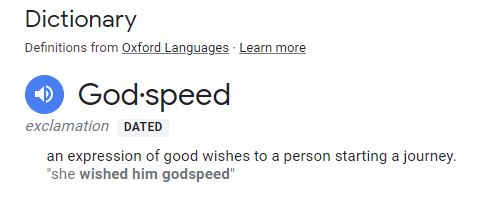
Later, I thought about what I had said and what it meant. “Godspeed” would seem simple enough, but I don’t like to use words if I don’t fully understand them. So what exactly does “Godspeed” mean? Here’s a dictionary definition:

an expression of good wishes to a person starting a journey

Simple enough, and it appears I used it correctly. But where did the word come from? Apparently, it’s from Middle English, originally the second half of the word is from “spede” or “spied”, meaning to succeed; to reach your goal.

So I was saying to her: may God help you to succeed, particularly in the journey on which you are about to embark. That’s exactly what I meant to say, so I’m glad I used ‘Godspeed’, a word I seldom use, correctly.

This may seem like a minor thing to blog about, but it was important to me. I said it at the time to hopefully let her know I was a believer in God without getting into a religious discussion. I’d like to see God be more mainstream in our society, and so used this minor utterance toward that end.

The Living or the Dead

My wife and I had an interesting conversation Saturday night. We were talking about someone we knew in the past, from our church in Kansas City. I wasn’t sure who she meant at first, and I mentioned another couple from the same era and same church. Except I couldn’t remember the wife’s name of the second couple. We talked about it and together were able to remember both couples’ names.

The couple I first brought up was somewhat older than us. When he retired from the railroad, they moved from Kansas City to somewhere in southern Missouri. around Springfield. We had their contact info at one time but have lost it. I wondered, though, since they were at least 10 years older than us, if they were still alive. Was there a way to find out?

I searched for obituaries for them, then searched finagrave.com, a site where I’ve had great success finding dead people there, in my research for genealogy and for the church Centennial book. I looked in those places and…nothing. The couple didn’t show up in any searches. That may mean they are still alive and well and living in southern Missouri. Or it could mean they simply didn’t show up in searches. I then tried searching for them among the living and couldn’t find them there either.

Being unconclusive, Lynda said something about why I searched for them at findagrave, a site she hadn’t heard of before. I replied, “I’ve had more success finding the dead than the living.”

That was a catchy way of saying, perhaps, what my preferences are when searching for people. The dead don’t argue with you. They don’t talk back or insult you. They don’t take political sides or belittle someone you like. They also don’t ignore you when you find them.

Obviously, expectations are different when searching for the living. If you do find someone you’re looking for, it’s likely you try to contact them and, if successful, you hope for an answer. Alas, that answer often is not forthcoming. But, when you search for the dead, if you find them you learn something about them. If they left many footprints, they speak to you through those footprints. It’s not much of a conversation, however.

Maybe that’s why I enjoy looking for the dead so much. You learn a lot without engaging in conversation. The fewer conversations in any given day usually makes it a better day for me. Maybe that’s why I’ve enjoyed genealogy so much over the years. It’s coaxing dead people to talk to you, but without actual conversation—if that makes sense.

This isn’t much of a post, but it’s what’s in my head right now. Perhaps I’ll do better on Friday.

Progress on My Genealogy Project

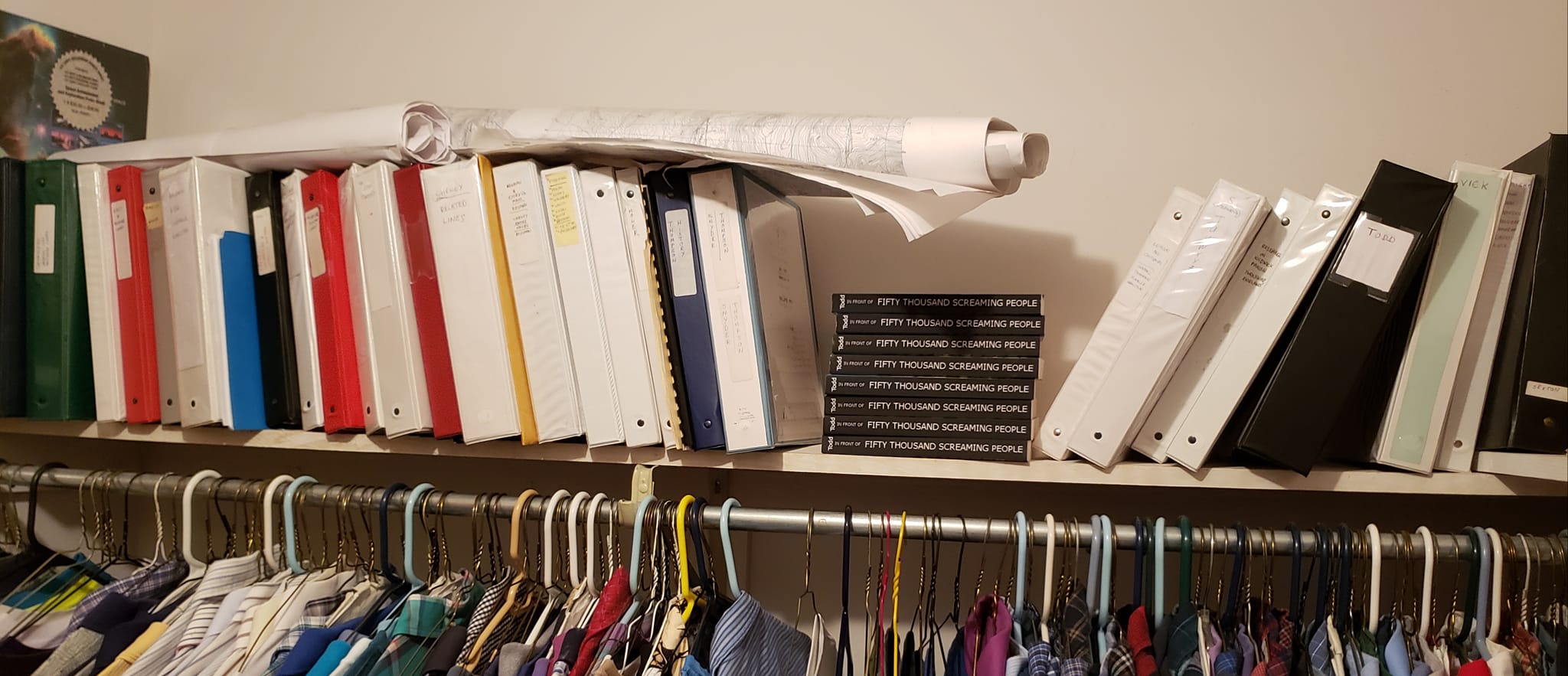
The closet shelf now has enough free space for some of my inventory for my books for sale.

I’ve written before about various special projects I’ve undertaken in the last two years of so. The sale of my 1900 encyclopedia set. The donation of the Stars and Stripes. The transfer of my grandfather’s trunk to a cousin. A collection of letters between a friend and me. The church Centennial book. A special project of some sort always seems to be in the mix of normal work.

Some of those special projects relate to disaccumulation in anticipation of a future downsizing. No date is set, but we know it’s coming. A couple of years ago I looked at the shelf of genealogy notebooks on a shelf in my closet and knew I had to do something about them.

I seriously doubt that my family members will be interested in it. Never say never, of course. I wasn’t interested in my genealogy until I was 46. So children or grandchildren might still show some interest. But as of now, none. When I’m gone, what’s going to happen to them? The trash can, I imagine. I really don’t want to leave them to my heirs to have to clean up, and I doubt I would have room for them in a smaller place.

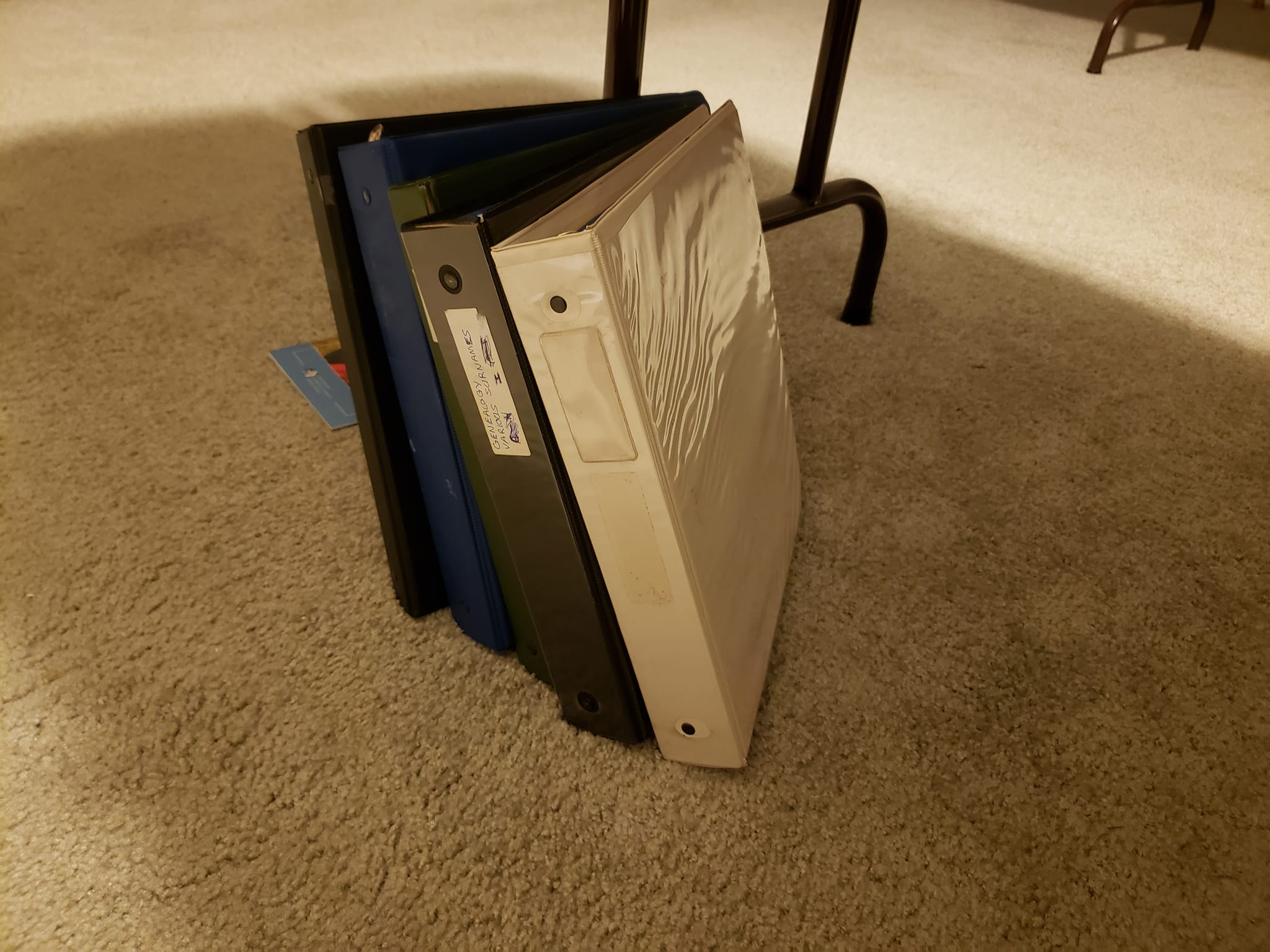
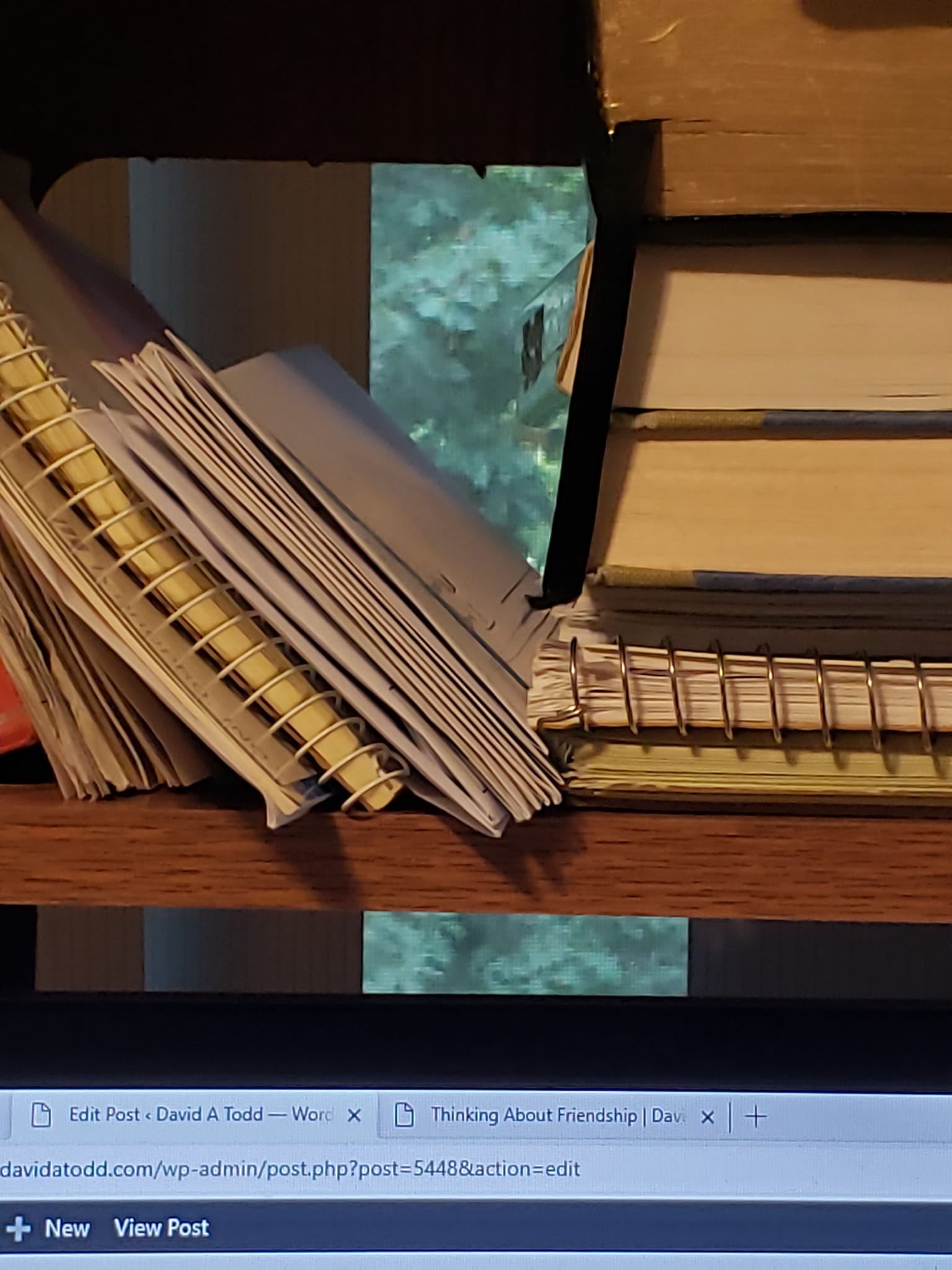
These are about half the notebooks that I’ve been able to declare surplus.

I thought of donating them to some research library. But there are two problems with that. First, since I have been researching all family lines, both mine and my wife’s, and since we grew up in very different places and circumstances, the files would have to be split in two or more places.

But the really big reason why I can’t simply donate them is that they are atrociously unfinished. I started many sheets on many ancestors and never finished them. My documentation of facts I’ve accumulated ranges from excessive to non-existent. I would have to put a lot of work into bringing my files to a much higher level of completion than they are now before I could even think about donating them.

So I went through the notebooks, one by one, to see what I could cull from each. Page by page, I made a keep-discard decision. Some were easy but many were not. I got rid of enough pages to eliminate maybe a notebook or two, maybe even three.

Finally, early this year, I decided what I needed to do was digitize my files and throw most of the papers away. That, at first, proved to be a difficult process. How should I file them, and where? Do I file by family name first and generation second, or generation first and family second? I had already put in place a system for filing genealogy papers, which included a way of numbering ancestors.

But I found the system I started using wasn’t working. The system I needed had to be “retrievable”—that is, if I ever get back to active genealogy research I need to be able to find on the computer the files I digitized. That took some thinking and trials, but I finally got it. I would number each person first by their Ahnentafel number. I won’t explain that. It’s easily findable if you’re interested. Then I would include their generation number. My method for numbering generations is to designate my children to be Generation 100, and count backwards and forwards from there. I’m generation 99, my parents are generation 98, etc.

I decided to save everything to Microsoft OneDrive. If that ever goes away, or if they have a data failure, I could lose everything. That’s a risk I’m willing to take so as to reduce the amount of paper I have.

I began this project in earnest sometime earlier this year. Working notebook by notebook, page by page, I look at each page to see, with a more critical eye than I did before, if it’s a sheet that I want to keep, or if it’s so unfinished or preliminary or far in antiquity that it’s better just to discard it. My goal is to discard 10 sheets a day, either by scanning and discard or by immediate discard.

Ten sheets a day doesn’t sound like much, but over a year that would be 3,650 sheets if I did this every day. That’s over seven reams of paper in a year. That will put a serious dent in that shelf of notebooks in the closet. And while 10 sheets is the goal, my unofficial goal is 20 sheets. that would be approaching 15 reams of paper.

It’s actually kind of burdensome. Making the keep-discard decision, doing the scanning, figuring out the right place to save the scanned file and the right name to give it. After ten pages, I’m somewhat brain weary. Maybe that doesn’t make sense, since “getting things done” normally energizes me. I do feel energized when I work on the project, but it also wearies me.

I’d say I’m averaging 15 pages a day, discarded directly or after scanning and e-filing. That may not be fast enough to do what I want to do, but it’s the best I can do unless I stop all other things that make life interesting.

I’ll check back in and report more about this project in another month. Maybe I’ll have reduced my paper files by another couple of notebooks.

The Tree Came Down

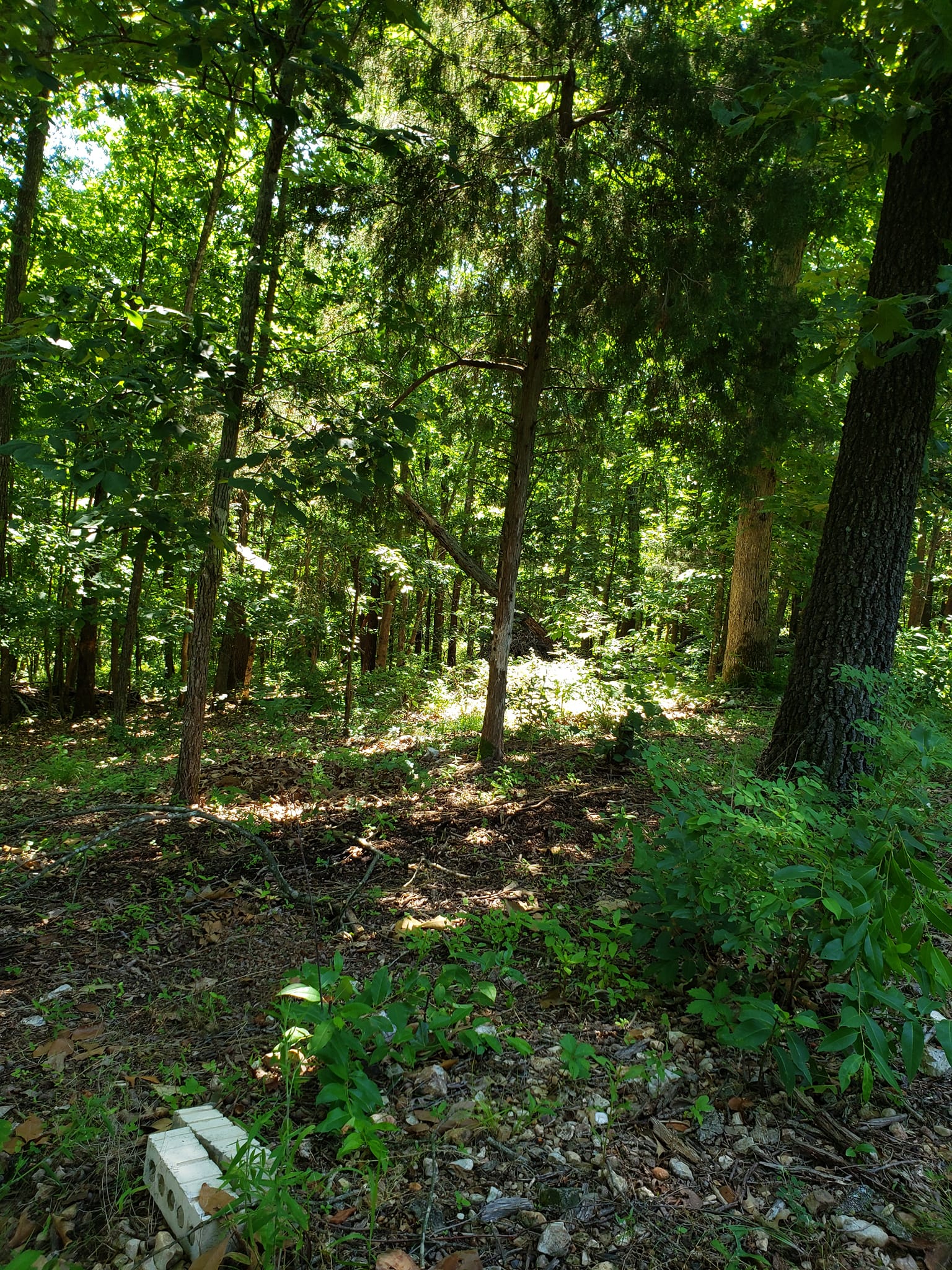
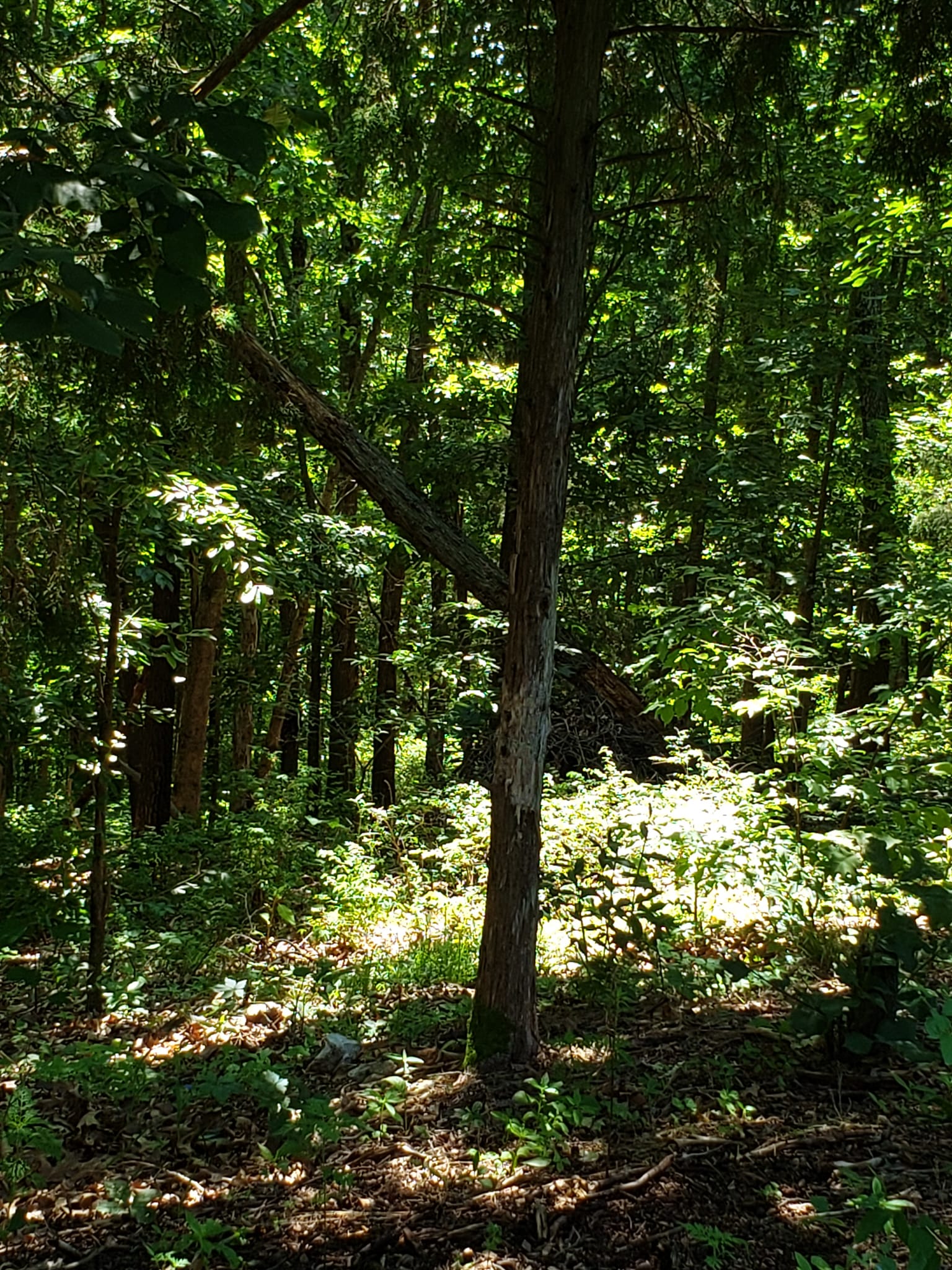
Here’s the view of the newly fallen tree, as it looks from my reading chair in the woods, off in the distance.

Summer is upon us in northwest Arkansas, both by the calendar and the weather. But our temperatures are hovering just below 90°F, or even in the upper 80s, for the daytime highs. Nightly lows are still in the 60s. That won’t last long. A forecast for next week shows us hitting 100 towards the end of the week.

But, I find it is cool enough to go to the sunroom and read around noon. That won’t last long either. My alternative place to read is a spot on our wood lot just south of the house. The lot is sloping, and finding a level spot to set a chair is a challenge. Last year I tried it but had a bad spot. Sitting wasn’t comfortable.

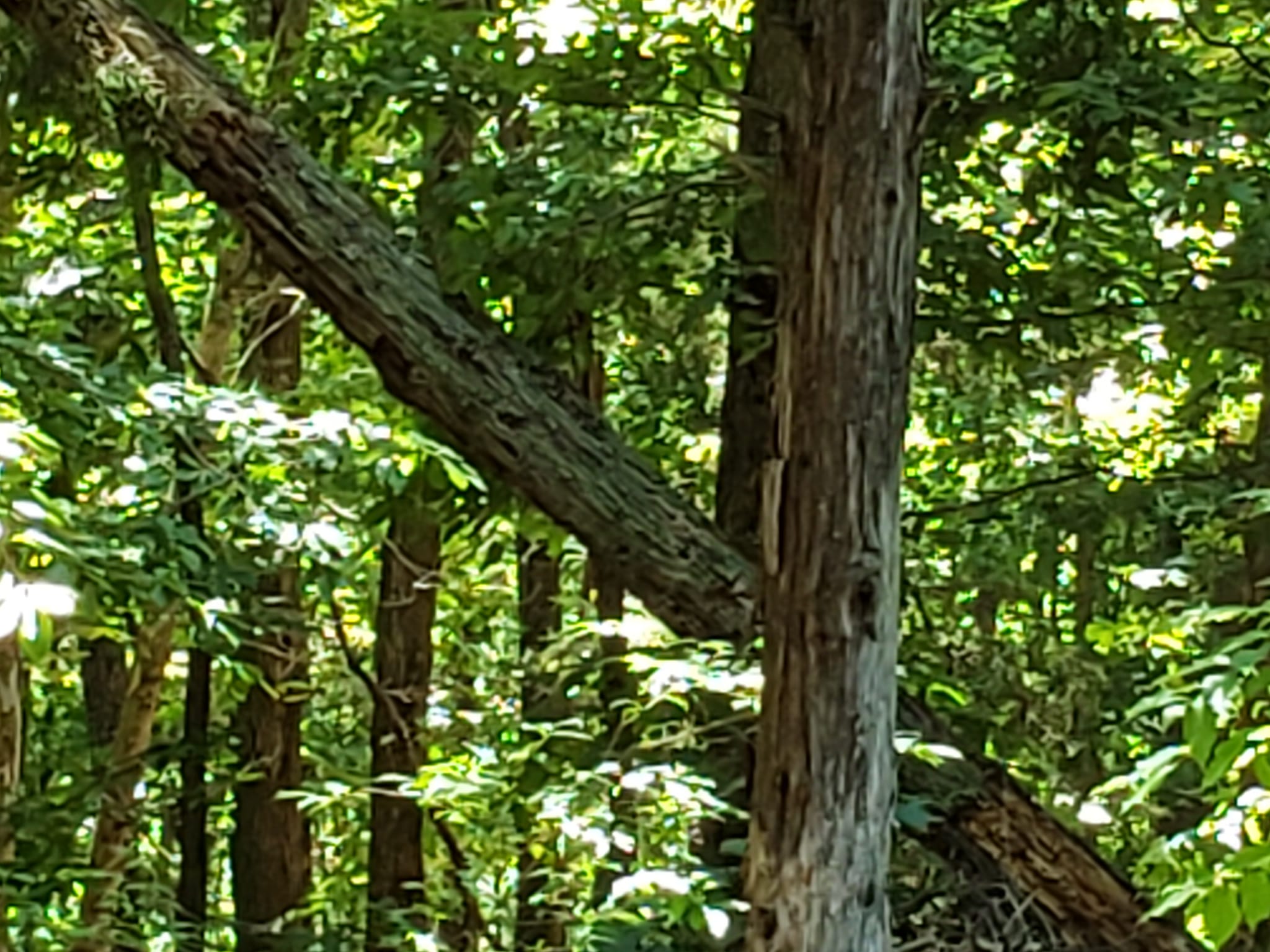
A little bit of enlargement. You can see how it’s at about a 45% angle. I haven’t walked down there yet to see what’s holding it up.

This year I chose another spot, just off the path to my compost pile. It’s not deep in the woods. In fact, when the sun comes around to due south and then a little to the west of south, the canopy of leaves becomes imperfect and it gets kind of hot. But, before 12:30 PM, when the sun is in the right spot and the shade is full, it’s quite pleasant there, even with the ambient temperature above 90.

The problem is, I find sitting in the woods distracting. I come out through the garage, walk the 40 or 50 feet down the path, put my coffee and book on the log I’m using as a table, set out my chair, and have a seat. I open whatever book I’m reading (currently C.S. Lewis’s Reflections on the Psalms), and read.

Except, I find it impossible to concentrate for long. I’m constantly looking up to see what is in the woods. Or to listen to whatever sound is about. Our street is little traveled and so doesn’t give off much noise. If a strong enough breeze is going, I can hear the trees swaying and rustling through the leaves. I don’t hear many critter sounds. Sometimes a squirrel will be dashing here or there perhaps a hundred feet from me. I will watch it for a while. A bird or two may fly through the woods, but birds I hear more than see.

I will take that walk down the hill soon. But I don’t think I’ll do much about it.

Anyhow, one day last week, I interrupted my reading to look into the woods. Off to the right and quite a way down the hill, but still on our lot (or just a few feet south of it), was a tree that was newly leaning, closer to horizontal than vertical. I knew this tree. It was one of three trees in the area where I had established a brush pile and a log pile. The trees were dead, but standing. One of these trees, about 6-inch diameter, had come down over the winter. I’ve slowly been cutting it to movable lengths and taking them down to the log pile.

This new one is at least 12-inches diameter. It sits, as I said, a few feet south of our lot line, but is falling in the direction of our lot. I can’t leave it how it is. In North Carolina they called this type of tree a “widow-maker”. So this will be another one I’ll have to clean up.

A 12-inch tree is too big to try to cut without a chainsaw, so maybe I can get a friend to come with his chainsaw and help me out. I want to keep the lot clean for when the grandkids come, so they can play on it without a lot of stuff to trip over. But that will have to wait until after blackberry season, which is now in full swing.

What’s the point of all this? The difficulty of concentrating, which might be a sign of aging? Enjoyable things seen in the woods? The extra work that an extra lot puts on you? I suppose any of those could be a subject to expand.

I was thinking, though, of how using our senses results in expanded observations. When did that tree come down? We had a windstorm, with a little rain, over Saturday-Sunday night. That might have been it. But, it could have come down sometime before that. I’ve been sitting in the woods off and on for about a month, and I don’t remember seeing it before. Had I not seen it, or was it a new casualty of the forces of nature?

I’m not sure how much we use all our senses. Sight. Hearting. Touch. Taste. Smell. Rarely, I think, do I take a moment to observe around us and evaluate the area with all five senses.

I’m trying to do a better job with this. Right now, Friday evening, I’m sitting in the living room. The TV is on in the background, providing sound. It has to compete with ringing in my ears, however. The sight factor is easy, and I won’t describe to you the combination of furniture, clutter, carpet, etc. that I see. No particular smell stands out from whatever the background smell is. I’m sipping cold water, which has a neutral but somewhat enjoyable taste.

As to touch, I’m in the recliner, laptop on my lap. The chair presses in on me, causing some pain in my slowly-recuperating left shoulder. It reminds me that I don’t much like this chair; something about the height of the arms and the way they press in. The “pillow” behind my head also is a bit too big.

Ah, using the senses. Time to get up and find something to exercise more fully my sense of taste. Peanut butter and jelly, perhaps? Or maybe half a grapefruit.

A View Looking South

[Dateline 31 May 2023, for posting 9June 2023]

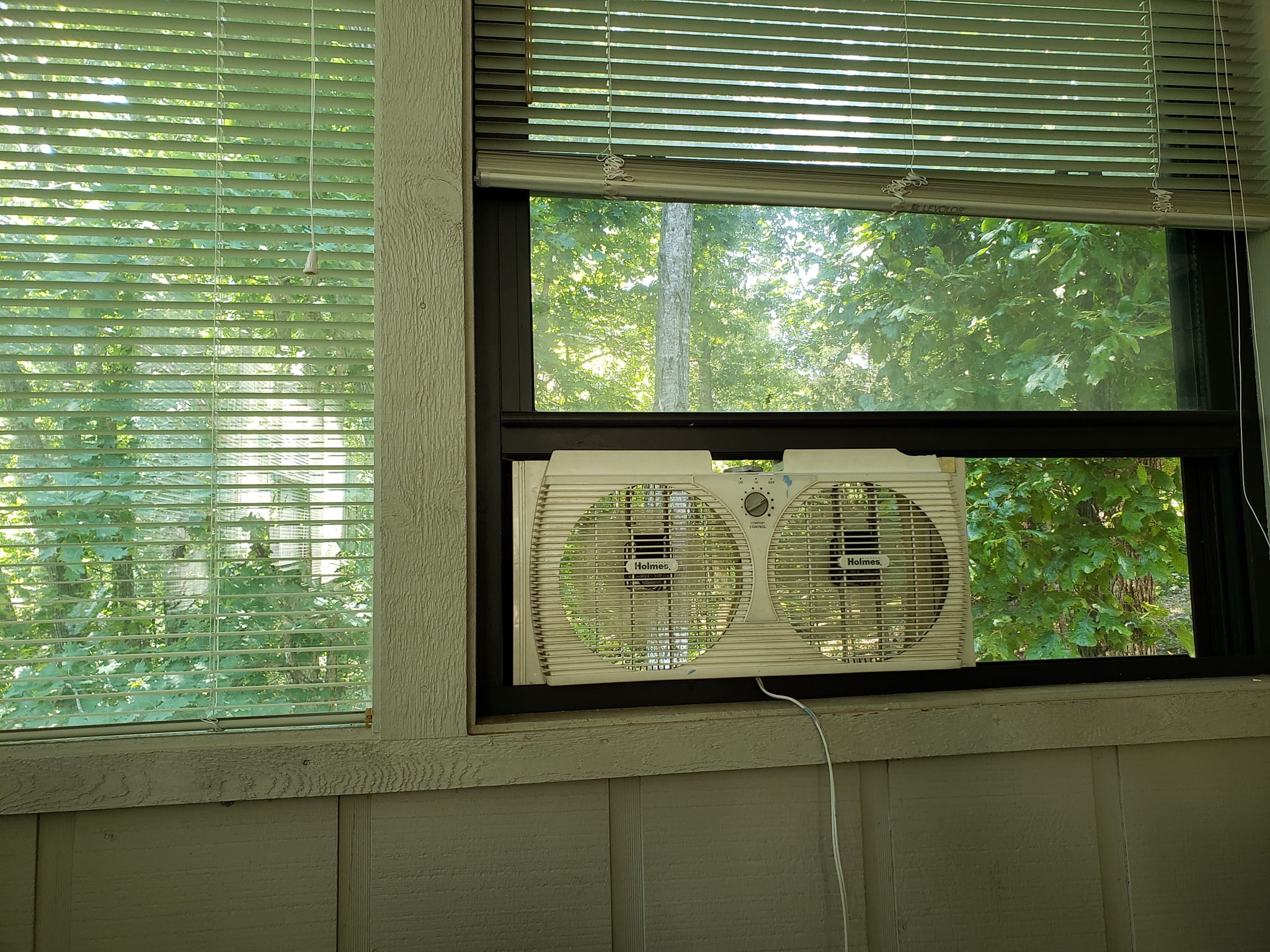
From my reading chair in the sunroom, looking south. It’s hard to tell, but I recently spent a couple of hours cleaning the window fan from years of dirt. Gotta be healthier.

Summer is here—maybe not by definition, but by the reality of temperatures. When I finish my morning work in The Dungeon (writing, stock trading), I go to the sunroom with either coffee or water, and read for an hour.

The sunroom is not air conditioned, and it gets hot in the summer. A time will come, in July and August, that it will be over 90 degrees by noon and more or less unusable. Right now, however, it’s around 80 degrees at that time. Each year I make an adjustment at this time. I swivel my reading chair around to face south, put a fan in the window just a few feet away, and make do with the air flow making the room fairly comfortable.

I made that change yesterday. I would have done it a little earlier, but the fan desperately needed cleaning. That took a long time, as I had to removed the grill (which turned out to be a pain) but couldn’t fully remove it due to some clips on one end. Thus, I had to reach my hand in between the spread grills and clean it as best I could. I finished that on Monday, and used the fan for the first time this season on Tuesday.

Now, when I sit there, I’m looking out the south windows a couple of feet away, rather than the north windows on the other side of the room. What do I see? Well, the chair is low enough, and the window ledge high enough, that for most of the view, all I can see is trees. Oak trees. Most of them with 12-inch or larger diameter trunks. They are dense. The canopy is fairly solid and very little sunlight penetrates it—that’s even after thinning the trees to make our woodlot somewhat park-like. If I raise up a little, I see more of the trees and trunks. The ground is lower, and falling away.

Except for off to the right. There the ground slopes up steeply. I can see the tree line at the edge of the woods, the grassy area between the trees and the street, and the asphalt strip of the street. The grassy area isn’t solid. It is punctuated by blackberry bushes that I’ve allowed to spring up. I can even see a small pile of cuttings from this morning’s yardwork, which I plan to move to a compost pile tomorrow.

Further away, across the street, I can see the woods across the street. A hundred and fifty feet into that lot is the fort I build with my grandsons, but it’s too far back in the dense foliage and I can’t see it from the sunroom. I know it’s there, but I can’t see it.

This new view means that I can no longer see the birdfeeder on the deck; it’s now behind me. However, today I noticed that I can see the birdfeeders reflected in the south windows. It takes concentration to look at the glass and see the small reflection instead of looking straight at the south woods. I was able to see birds come and go, but the reflection wasn’t clear enough to know what type of birds they were.

I have about a month more to enjoy the south view if temperatures are normal. It might even be a little longer than that, if I change my schedule and read in the sunroom before the heat of the day warms it beyond the edges of enjoyment level. Or there will be the occasional rain day, when I can use the room all day.

So what point am I trying to make? To change your schedule according to the needs of the moment? To enjoy whichever view life gives you? To observe the panorama of views that life gives you? I suppose all of the above.

Now in my fifth year of retirement, I’ve come to enjoy my noon reading time. I’m usually up at around 6:30 a.m. and in The Dungeon working by 7:00. With only a short break for breakfast, that’s close to five hours of writing or whatever work I have to do. Reading makes a nice break. The sunroom is nice venue. I have enough books in this house to find interesting reading material for the next 50 years—no exaggeration.

So I keep busy in the sunroom. At times I even look out at the windows and simply enjoy the view.


A Small View Between Obstacles

Hard to see in this photo, but the gaps in the forest are there. I took this photo this morning, and the cloud cover is about the same as Wednesday.

On Wednesday, I came to The Dungeon as per my routine, mug of coffee in hand. I opened my current Bible reading book, which is the harmony of the gospels that I wrote, did my reading, had my prayer time, and got to my work—or maybe my busywork, can’t quite remember exactly two days ago. At some point I went upstairs for breakfast, then returned to The Dungeon and got to my real working time.

The day had dawned cloudy and remained so. At some point I looked up and out the window. Now, the window is covered with vertical slat blinds from the top to the floor. And my computer desk with the upper shelf unit is between me and the window. So two items are blocking my view of the outer world.

But I did have some view, enough to know the clouds were still thick. All I could see was tree leaves and branches. Once the oaks leaf out, which happens in the latter part of April, the holler behind our house is fully obscured. I see leaves close, a little light behind them, and then a mass of leaves that covers all else.

I took note that the leaves were perfectly still—not a bit of movement. But then I focused on the small amount of leaves deeper in the woods that I could see through the small gaps between the near leaves and branches. There, behind the front foliage, were places where gaps in the forest canopy allowed more light to penetrate. And in those gaps, I could see leaves and branches stirring. Eventually, that stirring worked its way toward the nearer leaves and branches, and they began to stir as well.

That got me to thinking of the limited view we have of the world. Our view is obscured by the things around us: the work at home, the work at a job, the need to keep in contact with people. So many things crowd our lives that, to use the old and trite adage, we can’t see the forest because of the trees.

It’s good to be looking for those gaps in what crowds us in to see beyond, to see what the rest of the world is up to. That’s what makes our little piece of the world a better place to live in.

When I took note of that movement in the forest, working from deeper in it to the edge of it made up of our back yard, I knew I had to blog about it, but how do I find meaning in it? Meaning, that is, beyond the gaps that allows us to see a little more of the world? And I thought of what I wrote not so long ago about friendship.

Friendships are the little gaps in the forest, with light penetrating the canopy and shining deep within. Friendships are elusive in this busy world, but well worth cultivating.

I’ve been working hard on my current work-in-progress, A Walk Through Holy Week, Part 5. I’m down to less than 1,500 words to go on the main text, plus some kind of introduction. My hope is to finish it today, though a doctor appointment may be too much interruption for that to happen. No matter if it does; I’ll finish it tomorrow. Then, I’m going to take time to cultivate some friendships I’ve kind of dropped while working so hard between writing and parent/grandparent duties.

Here’s to friendships, and to little gaps in the desk top-unit, the blinds, and the forest, that occasionally align and allow a view of the woder world.

An Odd Delivery

Grandfather Todd’s trunk. Came from Yorkshire to NYC in 1910, to Providence in 1912, to East Providence around 1914, back to Providence around 1945, to Cranston in 1950, to NW Arkansas in 1997, and to Myrtle Beach in 2023.

One of the consequences of being in West Texas on a long-ish (more than two weeks) grandparent duty is that I wasn’t home to handle one very important item, scheduled since January. This relates to decluttering and dis-accumulation in advance of a downsizing some day, specifically to the Stars and Stripes that I’ve written about before.

For decades it held wartime copies of the “Stars and Stripes”, but they are now gone.

Not really about the newspapers, but the trunk they were stored in. This is an old steamer trunk that was one of three trunks that sat in the basement of my parents’ house for decades. As a kid growing up, I never knew the origin of those trunks nor what they were storing.

Someone who knows trunks could probably figure out more about it, such as year of manufacture and value.

On one trip back to Rhode Island, in 1990, Dad and I talked about his war service setting type for the S&S. We went to the basement and Dad showed me all those newspapers he’d sent home from Europe, which his parents kept and put in the trunk.

When Dad died in 1997, I took the trunk back to Arkansas and there it sat, either in my garage or basement, until a few days ago. Last year I removed the contents and shipped them to the University of Rhode Island Library as a donation, keeping a handful of copies as keepsakes.

That left the empty trunk. It was a steamer trunk, nothing fancy. On one end “OT” was painted. I assume, therefore, that this belonged to my grandfather, my dad’s dad, Oscar Todd. He emigrated from Yorkshire, England, to the USA in 1910 at the age of 20. He was in New York City for a couple of years, then made his way to Rhode Island. There he worked, married, and raised a family.

The “OT” painted on the outside is the only real clue I have about the origin, and the reason I believe it belonged to my grandfather, Oscar Todd, and was probably the trunk he brought with him from England to the USA.

I assume that this trunk was the one he brought from England in 1910. I’m sure there’s a way to research it and determine its age and origin. But I’m convinced that’s what it is: my grandfather’s trunk. He kept it, and when those newspapers came in wartime mail, it became a good place to store them.

From 1910 to around 1950, the trunk was wherever Oscar was, in NYC, the Riverside district of East Providence, and Providence. From 1950 to 1997, it was in the basement of Dad’s house in Cranston. From 1997 to 2023, it was with me in two different houses. While not overly large, it just doesn’t fit in with the concept of dis-accumulation. So when I decided to donate the S&S, I decided to get rid of the trunk.

Neither of my children wanted it. I don’t fault them for that. The trunk would take a fair amount of restoration to be a display item. The heirloom value would only be to someone who knew Oscar, and he died before they were born. I thought of others in the family who might want it, and decided on a cousin’s son, Frank Reed. He and his wife have six children, Frank knew Oscar, his great-grandfather, briefly and remembers him, so that seemed the next logical place for it to go.

The problem is, Frank recently removed from New Jersey to Myrtle Beach, South Carolina. How to get the trunk to him? Shipping was a possibility, though expensive. So in January I put out a call on Facebook for anyone making a road trip there who would be willing to take the trunk. Amazingly, a woman responded saying she would be going to the North Carolina Outer Banks and could drive the trunk as far as Raliegh-Durham Airport. Could my cousin meet her there? He said yes, and arrangements were made for the trunk transfer at a certain time on May 9.

But then, grandparent duties took me away from home at the time we would have to get the trunk to the woman who was driving it east. She contacted me; I was in Texas, not planning to be home before May 7, when the trunk needed to go to her.

Our neighbors had a key to our house to water the plants. I contacted them and they were happy to help out. The first transfer, from our house to our neighbors, happened on the 6th. The second transfer, from our neighbor’s to Kimberly’s van, happened on the 7th. The third transfer, from Kimberly to Frank’s son’s car (he went to pick it up), happened in the cell phone lot at Raleigh-Durham Airport on the 9th, and the drive to Myrtle Beach the day.

So much work to get a simple trunk halfway across country. But it happened. Now Frank and his family can decide how best to display and enjoy this family heirloom, either as-is or with restoration.

Dis-accumulation continues. Next, Uncle Dave’s 1900 Encyclopedia Brittanica.


Too Busy To Write

Not going to review this one. I read it, a thin volume, over five or six busy days.

That’s the problem right now, I have too much to do to do any writing. I think it was Tuesday that I put the finishing touches on the first draft of A Walk Through Holy Week, Part 7. Since then, I’ve done no writing. Well, I spent a little time in The Key To Time Travel, taking care of a few loose ends, especially in the dates that Eddie travels to. But I did nothing to get ready for this blog, wrote no letters, nothing.

I did finish a writing book, titled The Writer’s Notebook. I won’t review it here. It was marginally beneficial. I gave it to my granddaughter Elise, who has also read it and said she got a lot out of it. Maybe she’ll be a writer someday.

The busyness comes from our daughter’s family’s upcoming move, currently scheduled for late this month. I’ve been pushing everyone to sort and pack the small stuff. Sort into keep, donate, discard. And the keeping stuff has to be marked for storage or temporary house.

They had done a lot before we got here twelve days ago, but there is much to do. Everyone has pitched in. Saturday was a major effort. Lots of books gone through, Legos boxed, messy piles gone through in bedrooms. Even yesterday saw some work done. Saturday #2 grandson, Ezra, and I took a modest load of stuff to a thrift store. Hopefully today I’ll be able to take a load of books to a Christian school.

Of course, everything is a mess at the moment. Boxes everywhere, some sealed, some not; some assembled, some waiting for assembly. Many more in the garage, though not even close to what will be needed.

Many Wal-Mart runs later, with many meals cooked and eaten, rides to and from school, and errands run, and we are down to the last few days of this trip. We’ll head home for some appointments, then be back here to help with the final move. That will be about a ten-day trip, shorter than this 16-day one. That will include helping them into the new place.

Writing tasks will begin again later this week, probably on Friday. I’ll report in then.

Thinking About Friendship

The concept of friendship has been on my mind recently. One of the books I brought with me to read on our current trip is a C.S. Lewis book titled The Four Loves. One of the loves Lewis talks about is friendship. So far I’ve only skimmed this book.

Another reason I’m thinking about that is because of my currently reading the letters of Thomas and Jane Carlyle, along with an older bio of him. My current reading is in the time less than three years after he moved from Scotland to London and was still forming friendships. Reading about how that was going is an interesting read.

Friendship has been on my mind because I wonder if people really experience it these days. We are more connected than ever thanks to the internet, yet we are, perhaps, more isolated. Posts and reactions take the place of real interactions.

Building friendships takes time. Both parties to a friendship must want the friendship and show the want by investing the time needed to, first, get to know the other person, and second, to know them well, well enough to say, “We are friends,” and to consider it a loss if you didn’t hear from or engage with the other for some time. Of course, to get to know someone well probably means you share interests.

We don’t have much friendship today. I’m convinced of that. I’m thinking at the adult level. Children at all ages, linked by school classes, do a better job of making friends.

I’m not sure where I’m going with this topic and whether I’ll have more posts on it as I get into the Lewis book. If I do have more, they won’t be consecutive.