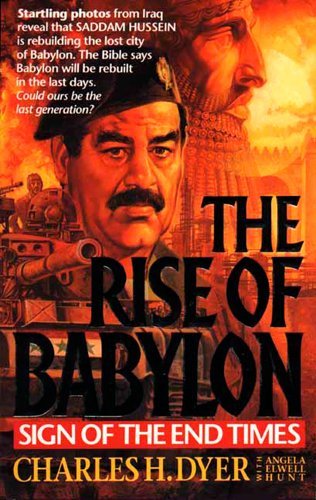
As I mentioned in a prior post, my wife and I don’t read many of the same books. I rarely recommend a book I’ve read to her, and when I do, she rarely reads it. She recommends books to me more often, and when she does, I seldom read it. One she did recently and that I read was The Rise of Babylon: Signs of the End Times by Charles H. Dyer with Angela Elwell Hunt (1991, updated 2003). First, a little about how we happened to have this book.
My sister Norma sent this to our dad in March 1991. It was one her church in Indiana was studying. Lynda and I were relatively newly returned from Kuwait (in July 1990), Iraq had invaded Kuwait (Aug 2, 1990), and the USA had led the coalition that liberated Kuwait (Jan-Feb 1991). Hence, the book had family interest. We must have taken this from Dad’s house upon his death in 1997, but tucked inside it was a letter from Norma to Dad transmitting the book, along with a photo of Norma. I have no way of knowing if Dad ever read the book or not. Since Lynda read the paperback before me, it had the signs of having been used.
I read this over about a 10-15 day period ending a week or so ago. I found it to be an easy read, helped along by excellent layout and typesetting. Dyer wrote this between the waning days of the Iran-Iraq war (which was 1980-88) and the invasion of Kuwait on 2 Aug 1990, although with a few changes to reflect its publication in Jan 1991. Dyer had, on several occasions, been in Iraq in the second half of the 80s as a guest of the government to witness how Iraq, at the instigation of then-leader Sadaam Hussein, was working on rebuilding the ancient city of Babylon. I believe Dyer’s intention was to demonstrate how Hussein’s intentions for Babylon were a movement to the end times as predicted in the Bible.
While the book is informative and interesting, I don’t think Dyer achieved that aim. He tried to do too much in one small-ish book. He started with the pre-biblical history of Babylon from various extra-biblical sources. That was well done, though a bit short of detail for my historically minded mind. He also failed to give a simple list of the ancient sources, forcing his readers to make their own list from the handful of footnotes and other research. But what the book contains, assuming it is a faithful extraction from the ancient chronicles, is good.
Dyer then gets into the Old Testament era, dealing with people groups and mentions in the historical and prophetic books. Once again, there is almost too much there for a book of this length. I felt that the treatment was shallower than I wanted.
The last part of the book was based on mentions in Revelation, and how judgment will yet fall on Babylon, how the ancient ruins Hussein was desperately wanting to rebuild to his own glory, touting himself to be the new Nebuchadnezzar, would be annihilated before the return of Jesus foretold in Revelation. Once again, I felt that this part of the book was shallow. Dyer presents his case (interpretation of the prophecies) well, but not in enough depth to allow me to really sink my teeth into it.
I read the 1991 version of the book, which must have been written mostly before the events of 1990. The 2003 updates might be interesting to read. But, I repeat that the book is trying to accomplish too much in too little space. Either a larger book or two volumes or more references to other sources would have been most helpful. I must say though that the book has spurred me on to want to do more research, so in this sense it succeeds.
Yet, from me it has earned only 3-stars. It is already in the donation box, and our over-stuffed bookshelves are just a little thinner.