I finished writing Documenting America: Making The Constitution Edition in mid-June. I let it sit a little, then began the editing process. The editing took a while as I didn’t go overly fast. Plus, in late June I finally decided I should write and publish my Bible study, Acts Of Faith, and so pulled off DA for a while. I meant to have it published in August. Alas, with only nine days left in the month, I think that’s unlikely to happen.
But where do I stand with it? I have completed all passes of edits. On Wednesday I ran Chapter 5 through our critique group, and have a few comments to go over and perhaps make changes. I’ll do that today. The next step will be the cover, which I’ll do myself using G.I.M.P. I already have the series theme, so all I have to do is change the title and use a new center image, which I already have picked out. I may need to load G.I.M.P. onto this computer. Doing all that is a tomorrow task.
That cover work, of course, is for the e-book cover. Before I can do the print book cover I have to format the print book so I know the thickness. The interior formatting will be the next step. I might do the e-book formattings (one for Kindle, one for Smashwords) on Sunday, or it might slip to Monday. At that point I may upload the e-book to the platforms, thus getting it published in August. Then I’ll tackle the print book formatting. That always takes longer, and I’ll have to dedicate a day or two to that. I hope I get it done before the end of the month so that I can order a proof copy.
So, when will the next Documenting America be published, you ask? With any luck and sufficient diligence on my part, before the end of August for the e-book, and before September 15 for the print book. Stay tuned. I’ll announce it here. I’m working simultaneously on the leader’s guide to AOF, so we’ll have to see how the time goes.
Sometimes I pick up a used book and place it in my reading pile. Years may go by before I pick it up and read it. I don’t know how many times I never get to a book, or it will be years before I’m looking for something to read, dig deep in my pile, find something, and decide “This is the one for right now.”
A good book. If it weren’t falling apart, it might find a place in my library. Difficult call.
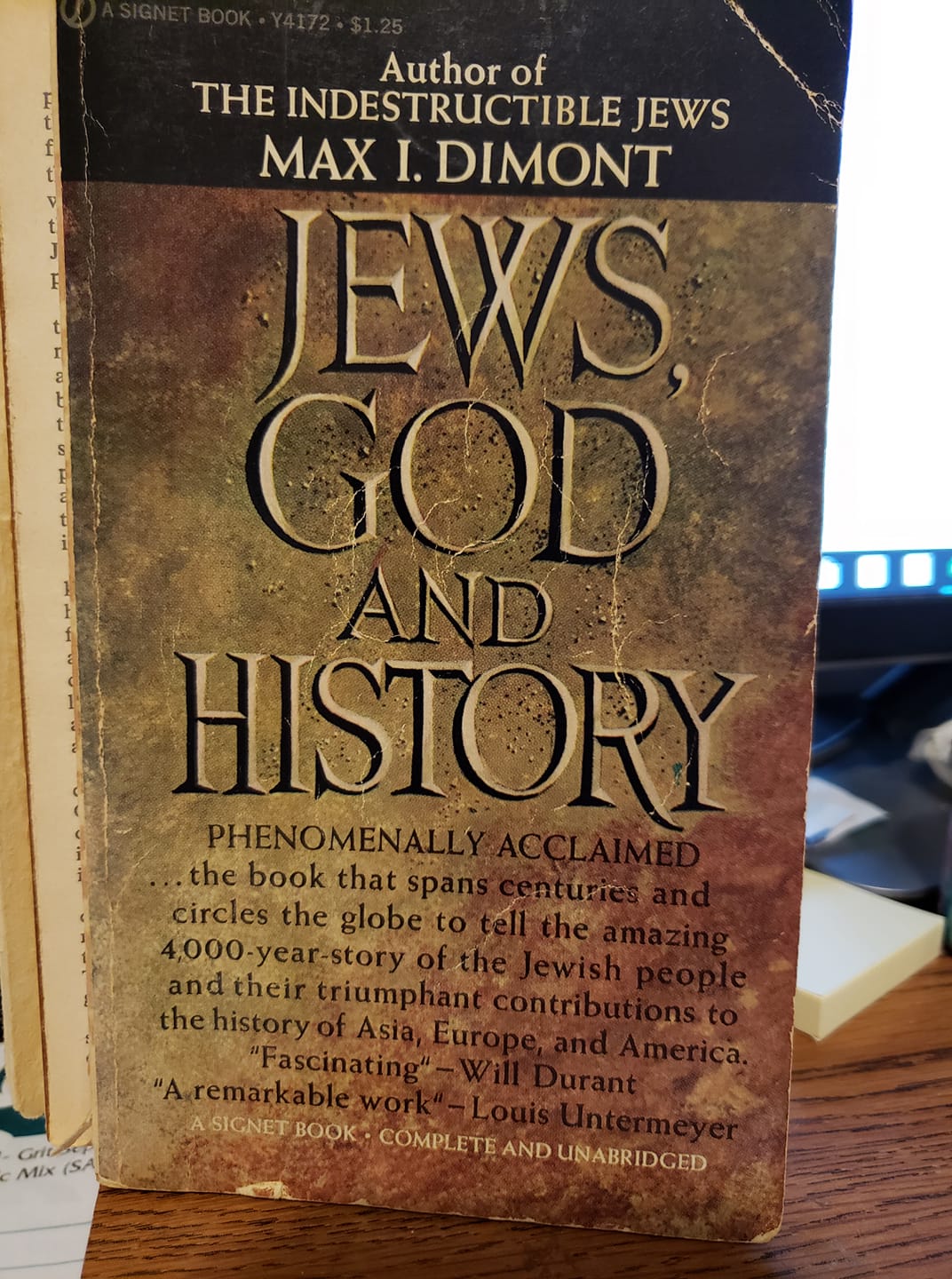
That was the case with Jews, God and History by Max I Dimont. When I pulled this from the pile, I found no label on it. Inside was a very faded receipt. I can just make out that I the receipt says I bought three books at Helping Hands, a local thrift store with a great books section, paid a total of $2.00 cash for all three. The purchase was at 10:42 a.m., but the date is too faded to read.
This is a mass-market paperback with cheap binding. While I was reading it, it fell apart into two sections. So much for such books printed in 1962.
This was an informative book. Dimont is a skillful writer. He gives much information, not statistics and data, but sweeping narrative about the Jews throughout over four millennia: where they were, what influenced them, who they influenced, what their motivations were. In 421 pages of 10-point font, Dimont gives a comprehensive documentation of this amazing people.
I have a couple of criticisms of the book, however. By the time I was done with it (two months elapsed between my starting and finishing it), I had pretty well forgotten what had come at the beginning. In other words, while I was impressed as I read, the writing didn’t stick with me. I sometimes, when I finish a book, go back and re-read the Introduction to see if the writer achieved whatever goals were stated there. In this case I haven’t yet done that, and don’t think I will.
My other criticism is that the book is totally unsourced. Along with the information given, Dimont makes sweeping judgments on the why of the history, not just the what. Here’s an example of one of those:
Like a Freudian libido flowing through the unconscious, attaching itself to previous psychic experiences, the Haskala flowed through the body of Judaism, attaching itself to former Jewish values and creating new ones. It attached itself to Hebrew and Yiddish, creating a new literature. It attached itself to Jewish religion and created Jewish existentialism. It attached itself to politics and created Zionism. Zionism fused the Jews in Eastern and Western Europe with the Jews in the United States and created the new State of Israel. This vast transformation and fusion began with a few Talmudic students fighting the Hasidists, who were preaching a return to primitivism of feeling as a way of relating themselves with God.
To me, such broad statements need to be sourced. Where did these ideas come from? Are they the author’s interpretation? They are stated as fact when they seem to be opinion. I would have liked it to be clearer.
Those criticisms aside, I thoroughly enjoyed the book, if being maddened at it a few times. I certainly don’t regret taking time to read it. It will not, however, have a permanent place on my bookshelf. I don’t think it would even if it hadn’t fallen apart.
However, while the book is unsourced, it does have an extensive Bibliography. Pages and pages of published works are listed, many of them look inviting. I’m tempted to tear these pages from the weak binding and find a permanent place for them in my library, being a list of potentially valuable sources for future research. The only thing making me think I should do that is the thought: How will I ever find those pages again?
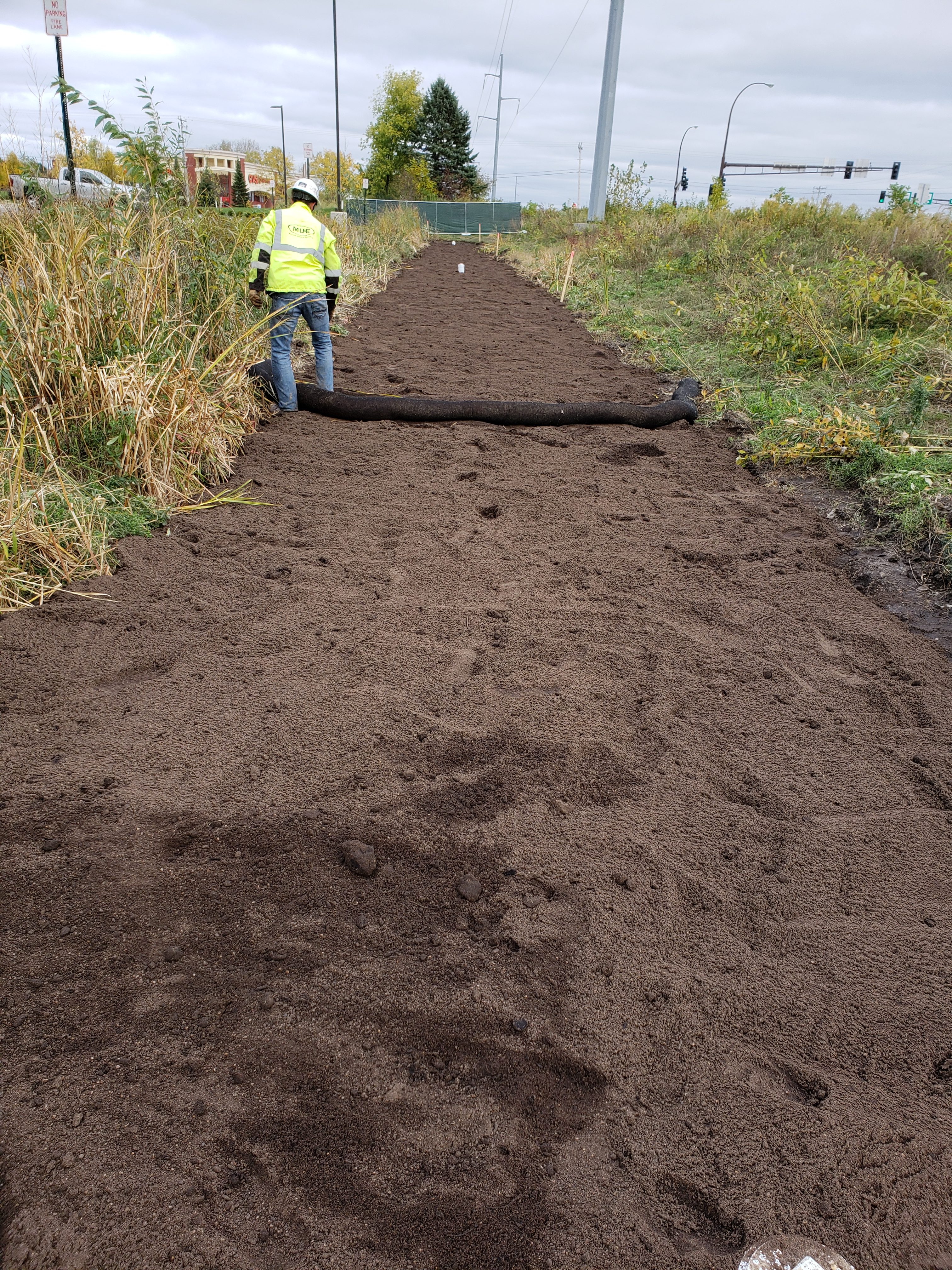
The pond being rebuilt in Minnesota looked good once it was done.
While I am retired, I’m under contract to my former company, CEI Engineering Associates, Inc., to provide services when called upon. These haven’t been too many, as for the most part they are getting by just fine without the old man.
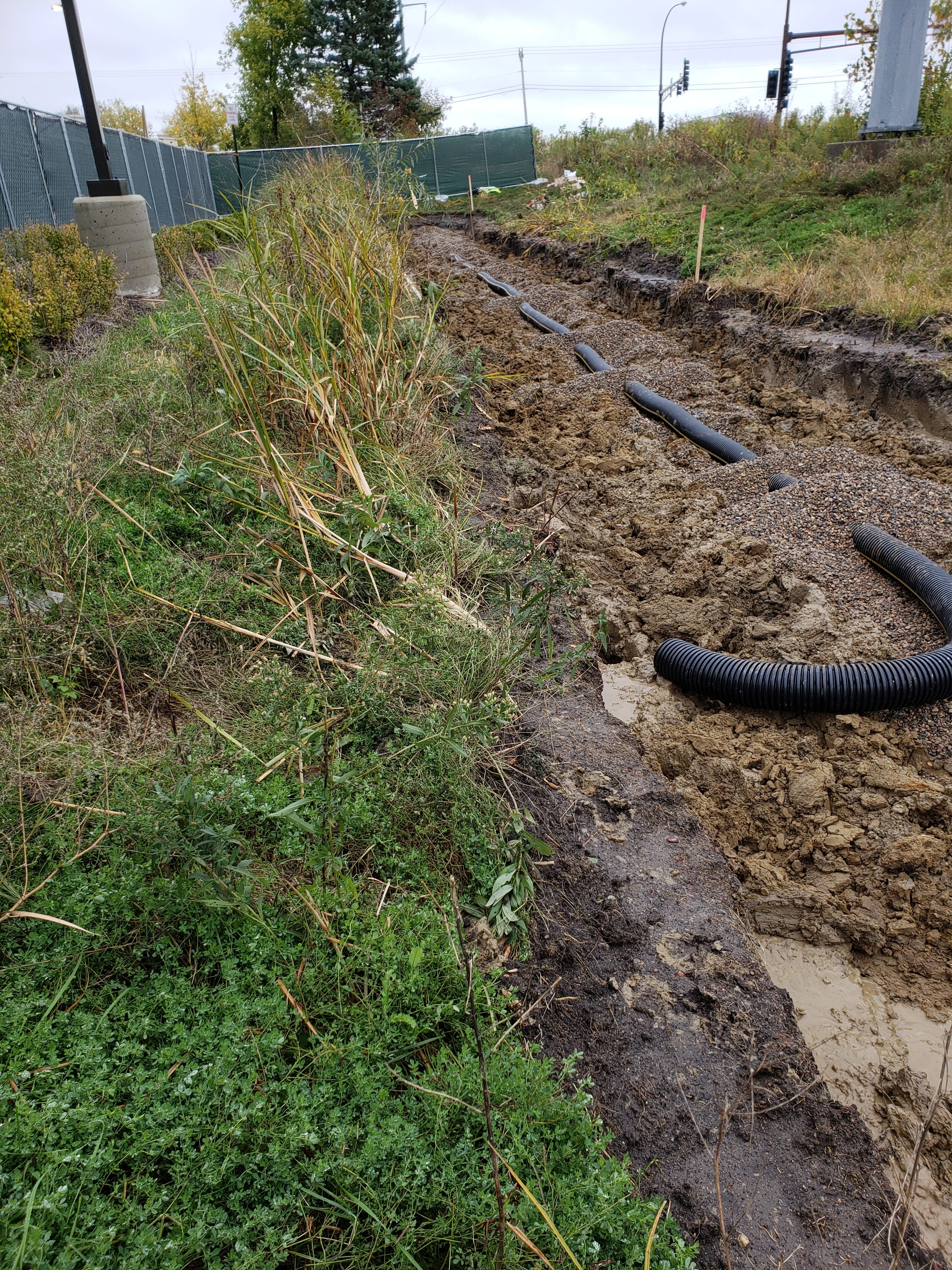
I left two things hanging when I retired January 1st. They were both Children’s Learning Adventure facilities, one in Minnesota and one in Missouri, outside St. Louis. These were projects started by another project manager at the company. They bogged down in construction, each having problems with the storm water treatment pond. The other project manager, who was very good, wasn’t an engineer and couldn’t deal with the issues that arose. She was significantly over-loaded with many projects. To help off-load her, I got these two projects in November 2017, along with three others that weren’t as critical.
Turning an infiltration pond, which didn’t infiltrate, into a filtering pond. A significant rain shortly after it was completed showed it worked well.
For the last year of my fulltime career, this work took up a lot of my time. The project in Minnesota came together first. The issues were clear. Two ponds had to be redesigned and reconstructed. Of course, it included working with the City and the Watershed District, both of which had jurisdiction. We received approval from them, and moved forward with construction in Sept-Oct 2018. As this was a working childcare facility, the work had to be done on the weekends. I spent three weekends in Minnesota, overseeing the work and doing some facilitating to keep it from stretching out to a fourth weekend. We had a final inspection in November, and all that was left was a warrantee period inspection this summer, which another man with the company handled.
The St. Louis area project was tougher. We fought the contractor over that. He said the pond was designed incorrectly, that it didn’t account for adjacent groundwater flow, etc., etc. I had data that showed some layers of the pond were the wrong material, or perhaps contaminated material. The contractor finally said he would rebuilt the pond, but winter season was upon us by then. When I retired, the other man at our company was up-to-speed on this, but planned on bringing me in to visit the site while the rework was going on.
The contractor said he’d rebuilt the pond, but that it wouldn’t make any difference in performance since it was our error. Well, in May-June of this year, while I was away in Texas and unable to go to the site, they did rebuild it. I talked with the other engineer recently, and he said the pond is now working perfectly. It wasn’t a design error at all, but a construction problem. While I would have liked to have seen it during construction, I’m glad it all was done.
Meanwhile, back in the real world of 2019, the company continues to call on me from time to time, mainly for City of Centerton work. The engineer I trained and mentored for two years to take over this work has been promoted to department head, and is very busy as a result. More and more she is calling on me. I spent over four hours on that work on Tuesday, going into the office for it. We had a conference call with FEMA on one project, then I spent close to two hours going through accumulated construction reports for several developer projects for which we serve as city engineer. I filed the reports and photographs, and prepared the e-mails for archiving. Next time I’m in the office I’ll do the archiving.
In my reviews, I found items that will have to be put in a change order by the design engineer (another firm). I also found a couple of failing tests, which the geotechnical engineer acknowledged and addressed. Still, it’s something our construction folks will need to be aware of. I sent an e-mail to all of them so they are aware of the problems. I also sent an engineer to that other firm about preparing the needed change order.
The department head has asked me to be that main one to review the reports going forward. That means when I check company e-mail on my cell phone and see emails come through with attachments, I’ll have to drag out the company laptop and deal with them. It will be a daily 5 minute task, the time for which I will accumulate and bill in 15 minute increments. It’s good money, good enough to pay a bill or two every month, but shouldn’t be so much that I get dinged by the IRS for making too much. Now, if one of my books catches fire and begins selling, that will be a different story.
I still have my engineering licenses in Arkansas and Missouri, my Kansas license being retired last April. Missouri comes up for renewal the end of this year, and I will most likely retire it at that point. Arkansas is good until December 2020. We’ll see what happens then. They may finally have weaned themselves from the old man.
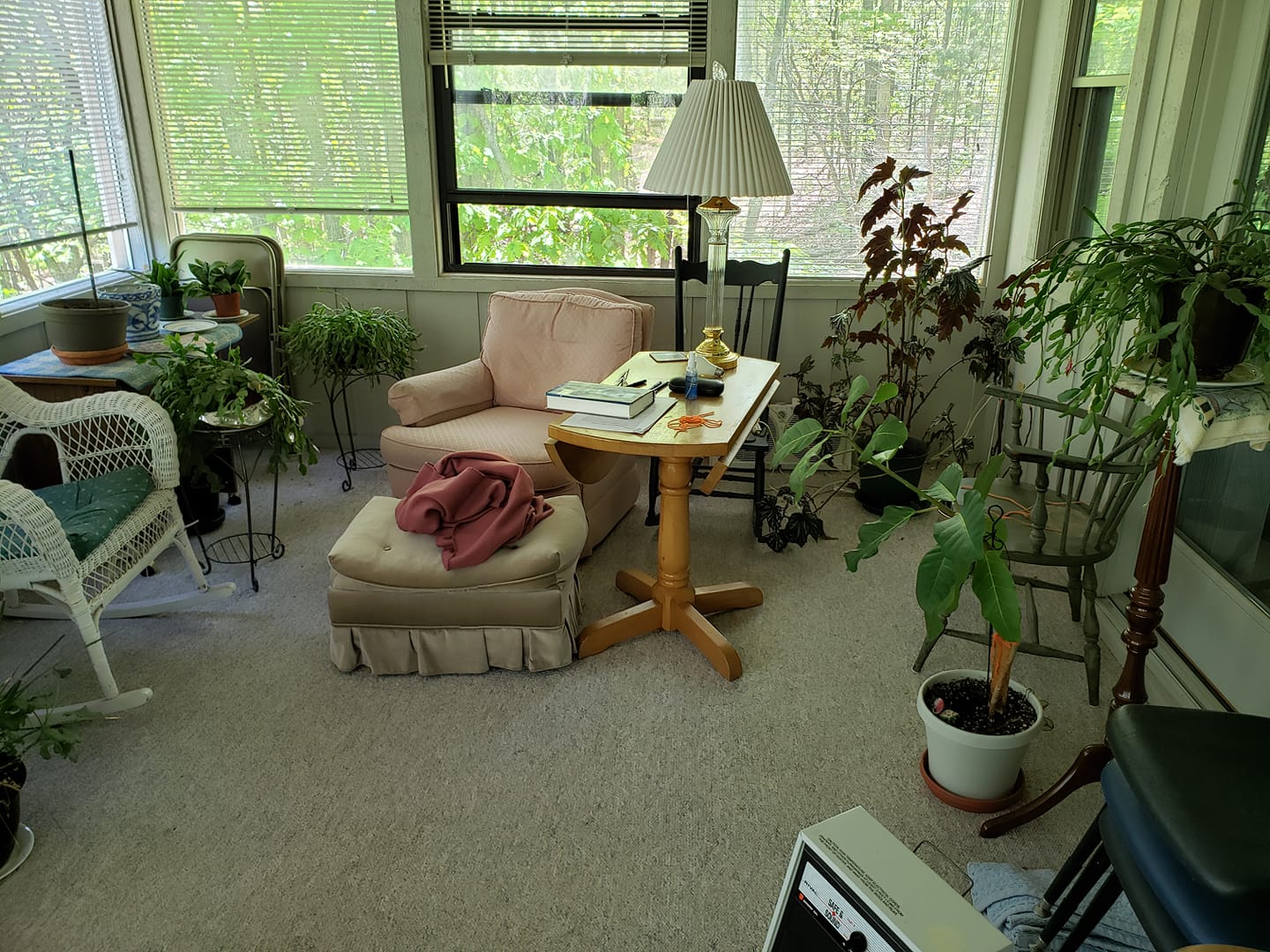
Here’s what I looked out on from my chair on the porch.
Or, rather, back in my chair, at my computer, with my books and tools around me, ready to write—or in the week, mainly edit.
My wife and I were away for a little over a week. This was scheduled, then changed. Our son-in-law was to go on a mission trip to Mexico and we were to go to Big Spring, Texas, and help our daughter with the kids. The mission trip was canceled, a fairly last minute thing, due to not having the minimum number of people necessary to make it happen. They decided to get away for a few days instead and asked us to join them. We agreed, with the time commitment being a little shorter than the mission trip would have been.
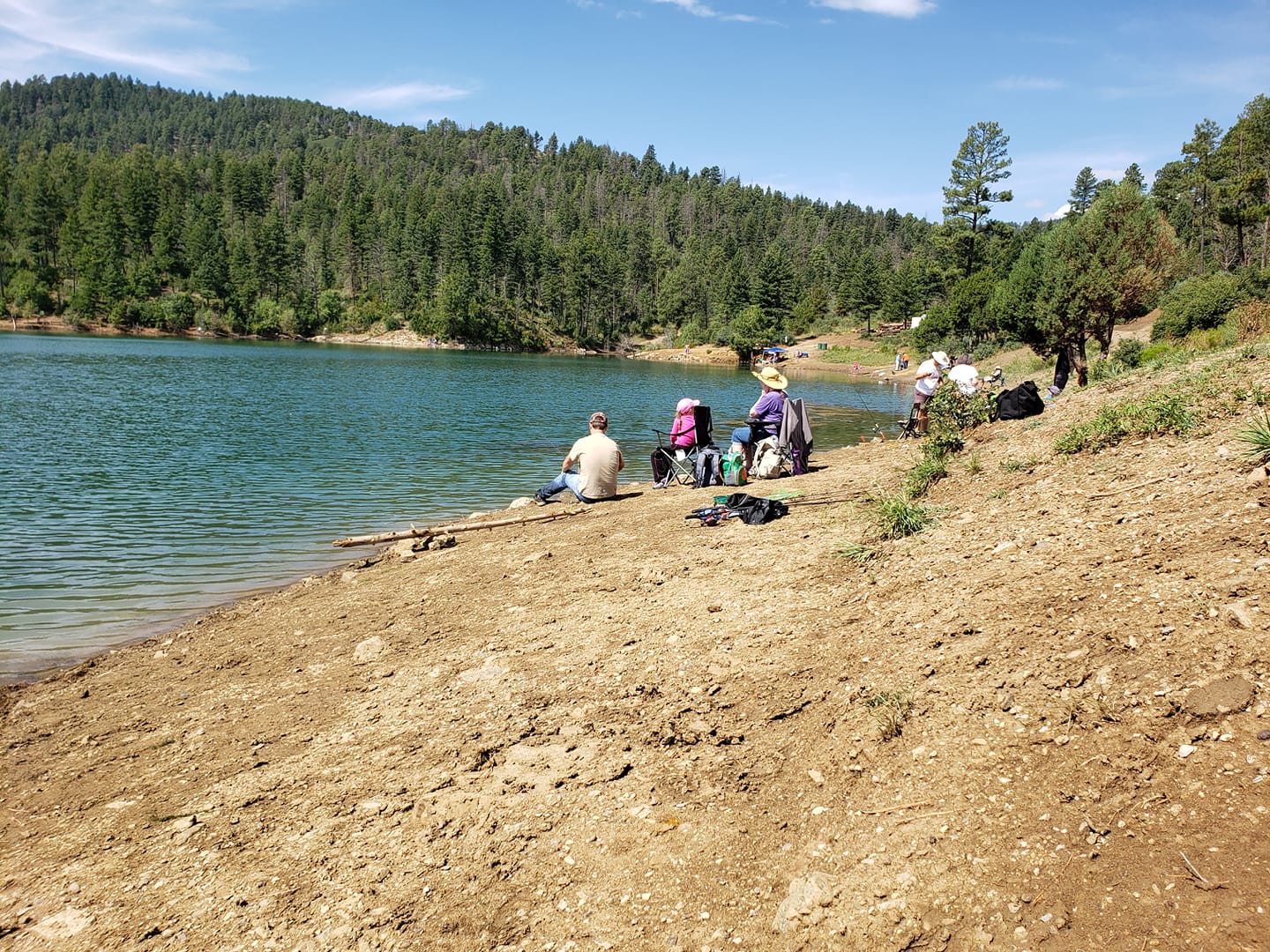
Fishing wasn’t what I most wanted to do.
The trip was to Ruidoso area in New Mexico. I had never heard of this resort area, up in the mountains. South of Albuquerque, west of Roswell, it’s pretty high up. We had a rental house at elevation 6950 feet. It’s monsoon season, and we had rains all but one day. It didn’t really slow us down at all. Daytime temperatures were 75 to 85 when it wasn’t raining, nighttime lows were 57 to 62. Very pleasant.
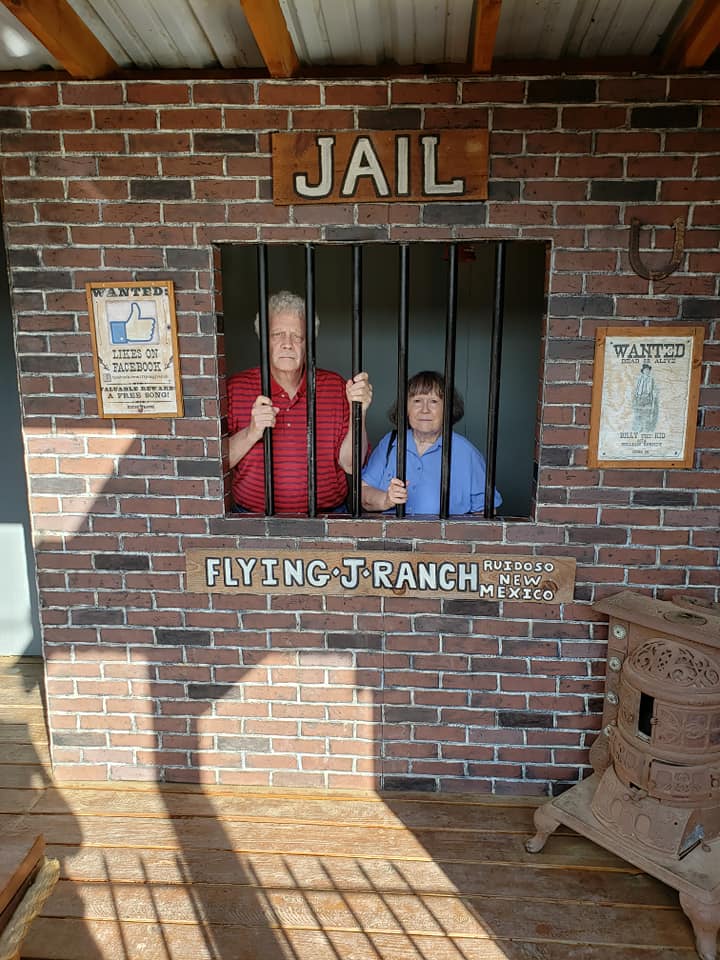
We had fun at the Flying J Ranch.
The wife and I did very little planning for this trip. We were supposed to drive to Texas on Friday August 2 then drive with them to New Mexico, a five hour drive, on Saturday August 3. But at the last minute we left the afternoon of Thursday Aug 1, intending to pull up at their door after midnight. A wrong turn in Wichita Falls means we didn’t get in until 3 in the morning. Alas.
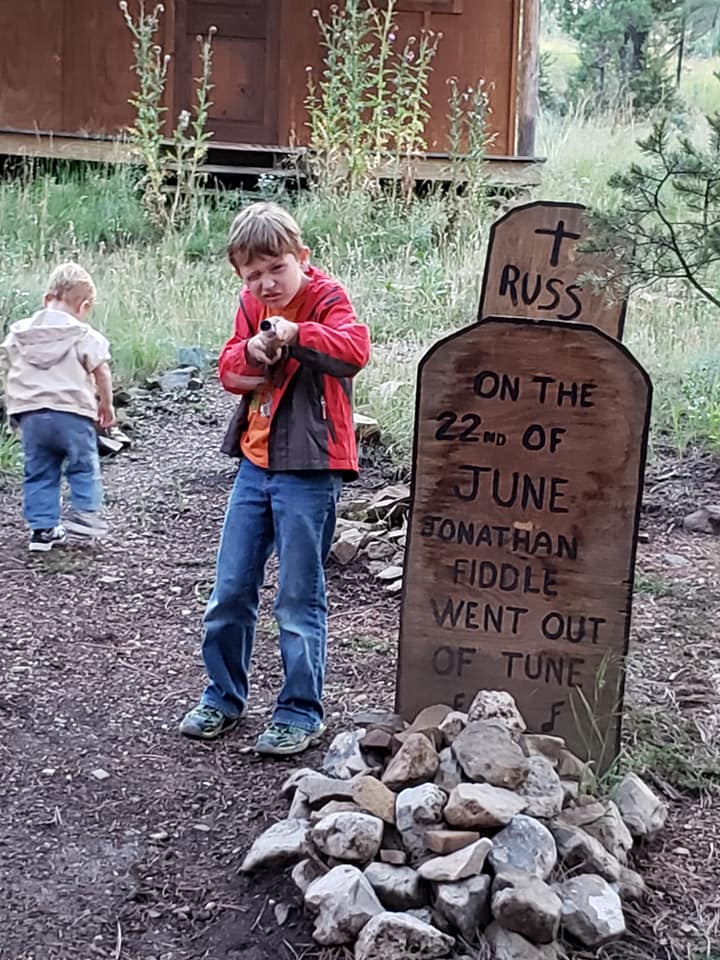
Ah, yes, jail the outsiders.
The trip was nice and relaxing. Our rental house was just the right size for us. Richard took his older boys fishing a couple of days. I’m not into fishing so didn’t join them. I wanted to hike. I went on four of them all together. One on Sunday in the neighborhood with grandson Ezra, 1.57 miles. One Monday at Grindstone Lake with my daughter, her two youngest, and my wife, 2.45 miles. One Tuesday at a Federal recreation area, with most of the family, 1.56 miles. One Wednesday (the day we were leaving to
Elijah panning for gold at the Flying J Ranch.
come home), up a hill near our house with the two oldest grandsons, 1.25 miles without a trail. And a different one back at that recreation area, 1.61 miles. None of them were overly strenuous, but had uphill segments where I had to stop on occasion.
The house with the red roof is the one we rented, as seen from the nearby hill we hiked up on Wednesday.
On Sunday we went to a church, not knowing it was next to one of our denominational campgrounds and that they were just finishing a week of family camp. So we attended a camp meeting type service. We then drove up to a ski area to ride the gondolas, but they had closed due to rain. I’m not a fan of mountain roads, but we did okay.
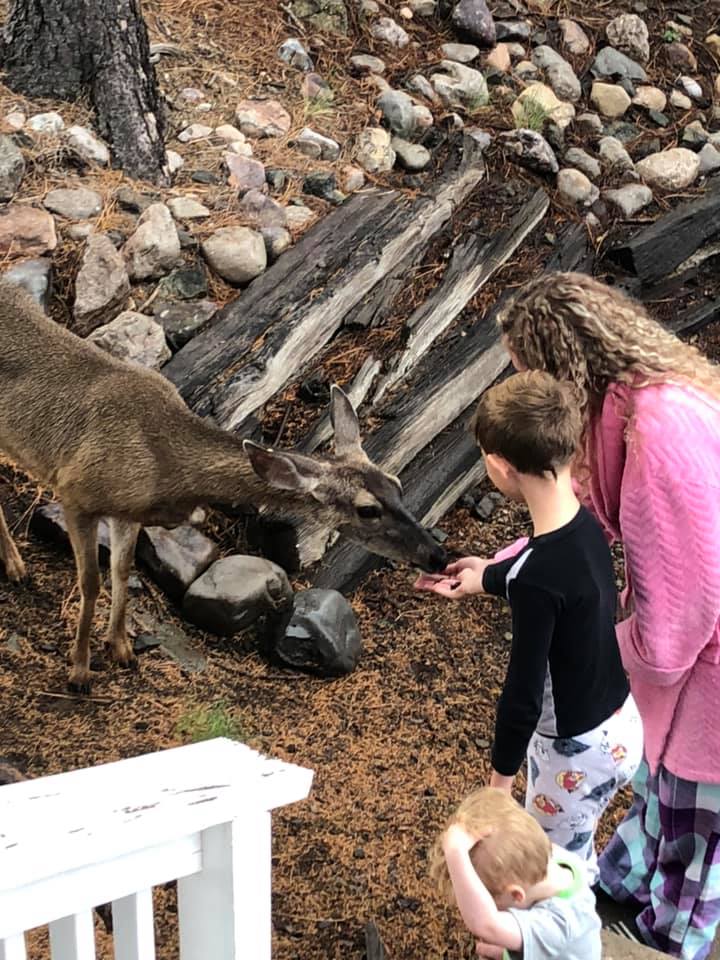
Plenty of deer came by our cabin, this one right up to be fed.
When not engaged with grandkids, I did a little editing in my completed books, did some reading (as described in my last post), though I found the reading hard going, too intellectual, I suppose, for reading in somewhat distracted conditions. Still, I enjoyed cool mornings or evenings on the porch, coffee and book or e-reader at hand, soaking in both knowledge and clean, mountain air.
I was on the hike too, but took the photo.
Ruidoso is a place I would like to go back to. We found out what was available in the Smokey Bear Ranger District, specifically the Cedar Creek Recreational Area, which included camping, picnicking, biking, and hiking. Several longer trails are available which I would like to hike. Perhaps we’ll go back some day, and make some more memories.
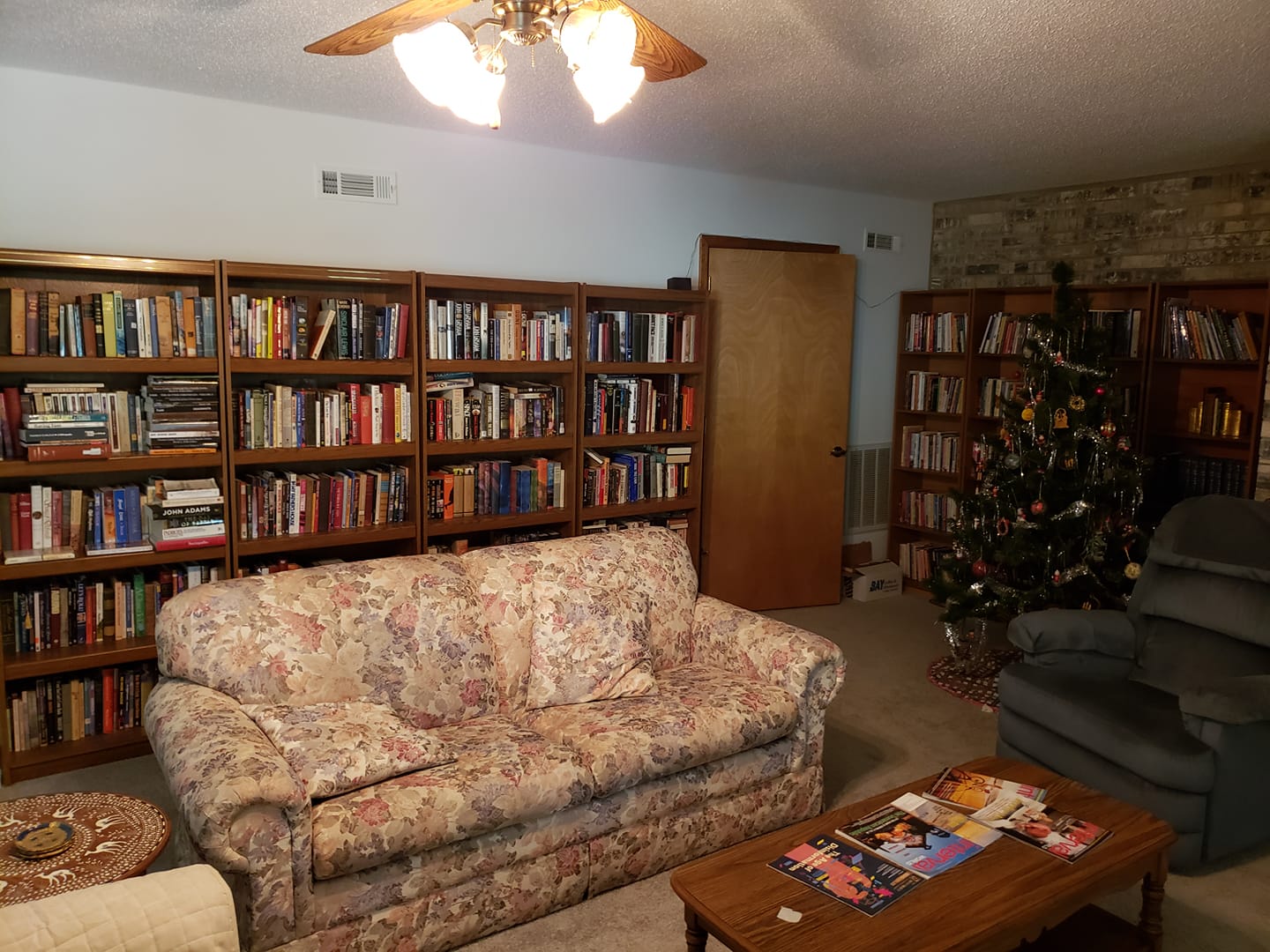
Eight of the fourteen bookcases in The Dungeon. Just a fraction of what we have. How am I ever going to get through all of these?
As I write this, I’m nearing the end of two books I’m reading, and am about halfway through a book I’m re-reading. It won’t be long before I’m ready to choose something else to read. But what will it be?
The books I’m just about finishing are:
Jews, God and History by Mix I. Dimont; down to the last 20 pages
Savage Beauty: The Life of Edna St. Vincent Millay by Nancy Milford; about 120 pages to go in this 610 page book
The book I’m re-reading is:
The Inklings of Oxford: C.S. Lewis, J.R.R. Tolkien, and Their Friends by Harry Lee Poe and James Ray Veneman; 60 pages into this 102 page book, reading on my smart phone.
While I’m pleased to have a number of C.S. Lewis books, I don’t have enough. May more purchases be in my future? These three are definitely on my sooner-than-later reading list.
So, again I ask myself, what’s next? I should shift to fiction, as most of my reading this year, or maybe all of it, has been non-fiction. I’d like to get back to the Dune series by Frank Herbert. Alas, I don’t have the next one in the series and I’d really like to read them in order. I should just bit the bullet and order it on my Amazon gift card or go to Barnes & Noble and buy it. I have so many books already in the house, though, I hate to bring another book in.
Other fiction I could read is try to get through some of JRR Tolkien’s works. I read the first book of The Lord Of The Rings, but struggled with it and am not anxious to try again. I also have the prequel to that, The Silmarillion, but, again, I find Tolkien hard to get through.
If I stick with non-fiction, I have a number of things to choose from. For one, I should really finish The Federalist Papers. I spot-read this as research for Documenting America: Making The Constitution Edition. The last few I read held my interest, so I’m thinking I should try it again and get it read. That’s a major commitment due to length, so I don’t know.
I should also go back and re-read some of John Locke’s Treatises on Government, since I read them in a distracted, less-than-optimal state. Or, I should read some of the things he referenced. It’s quite possible that the next book I write in the Documenting America series will be Run-up to Revolution, in which case I need to be reading what the Founders were reading. That’s research, however, and I’m really thinking of pleasure reading.
If I were to shift to poetry, I should read some of Edna St. Vincent Millay’s poems. I have two compilations of hers. Or, I should get back to Robert Frost or Wallace Stevens, both of whom I started reading but didn’t finish. But, I’m not sure I’m ready to read poetry right now. It makes me too anxious to then write poetry, as my Sidelines Syndrome kicks in, and all I need is another distraction from my prose writing.
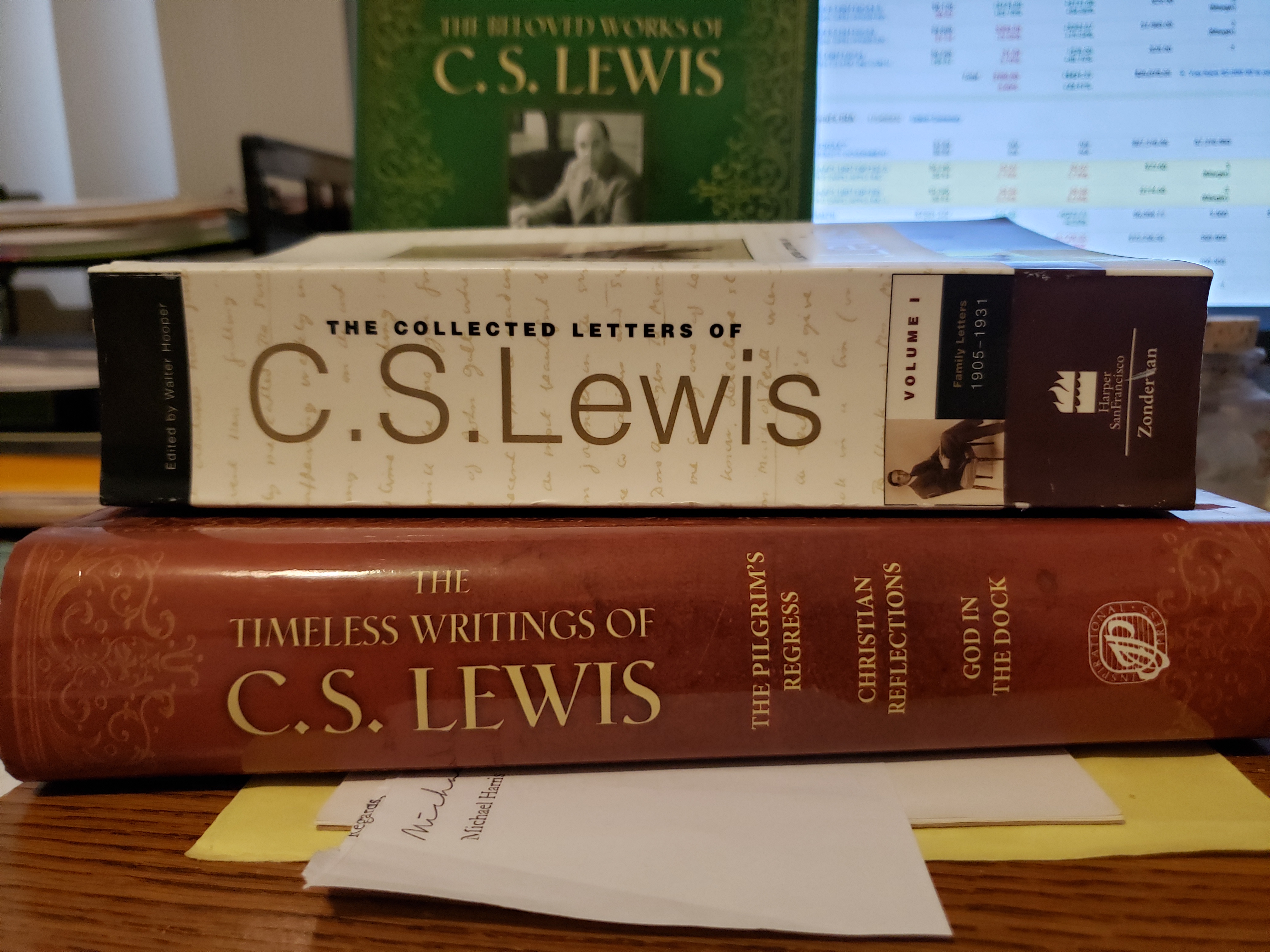
Then again, I haven’t read any letters for a while. Still on my work table is volume 1 of The Collected Letters of C.S. Lewis. It’s 1024 pages, so I sure wouldn’t read it cover-to-cover without a break. I’m thinking I’ll read it in a few key areas, concerning Lewis’ conversion first to theism then to Christianity. Or, I could get back to Thomas Carlyle’s letters, though that would be on-line reading. I also have a couple of C.S. Lewis compilations yet to read. They are scholarly essays, and I think I would enjoy them.
Thinking of fiction again, I have Lewis’ space trilogy at hand. Hmmm, maybe I should read the first of that and see how I like it. Or, I have a thousand novels in the house, either picked up from sales or passed on to me from my mother. I could grab any of them off the shelf and easily fill a couple of weeks of pleasure reading, finding out if these are any good by modern standards.
So many books, so little time. I haven’t talked myself into any of these yet, but will have to make a decision soon. Perhaps I’ll report back here.
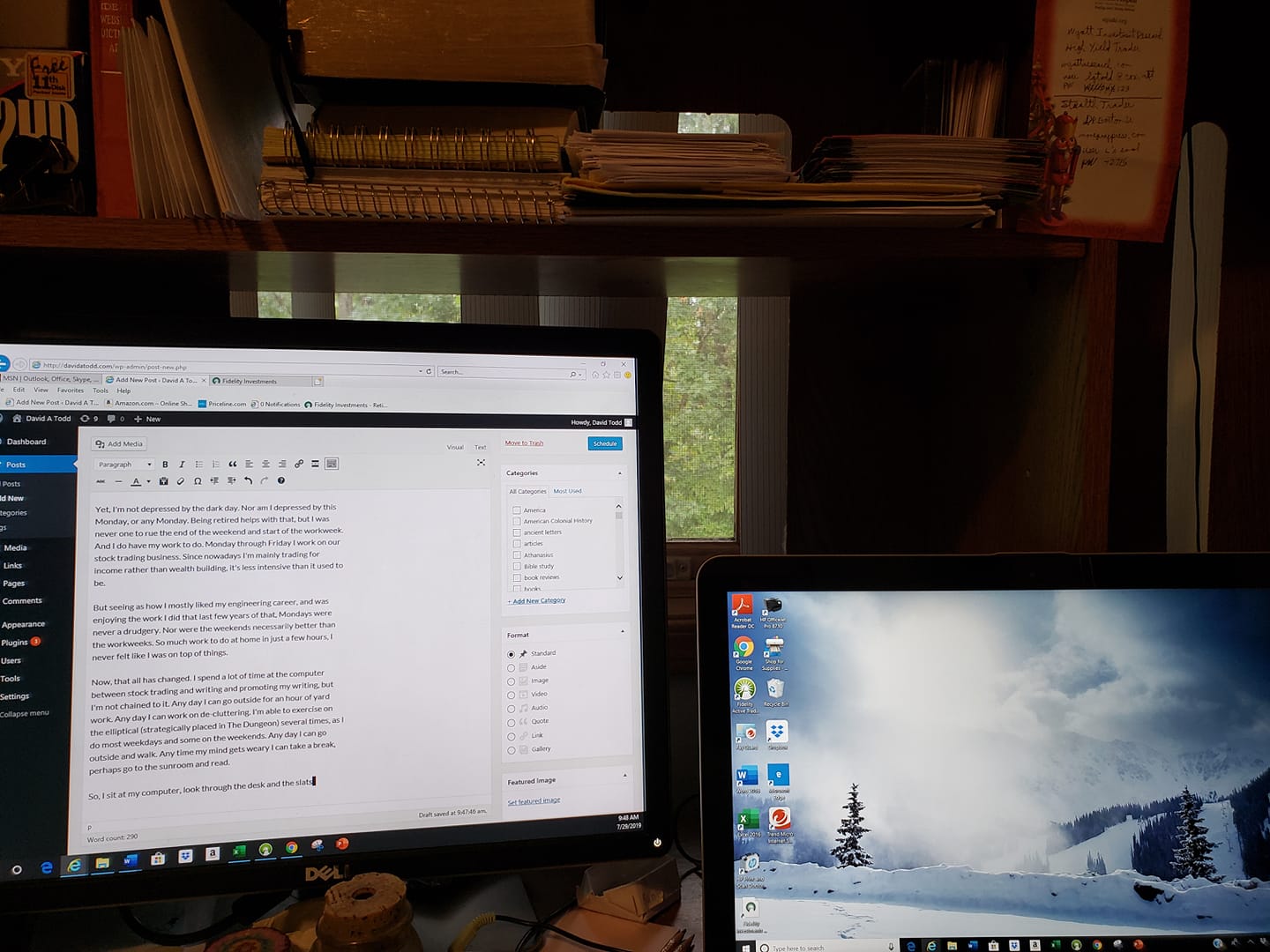
The Carpenters had a major hit with their song “Rainy Days and Monday“, the lyrics saying that they “always get me down.” As I look out The Dungeon window, through an opening in my computer desk, through the vertical blind slats, through the glass and the screen, I see a cloudy day. When I awoke at 6:30 a.m., a gentle rain was falling. The rain has mostly ended now.
Exactly what I see out The Dungeon windows as I type at my computer.
Yet, I’m not depressed by the dark day. Nor am I depressed by this Monday, or any Monday. Being retired helps with that, but I was never one to rue the end of the weekend and start of the workweek. And I do have my work to do. Monday through Friday I work on our stock trading business. Since nowadays I’m mainly trading for income rather than wealth building, it’s less intensive than it used to be.
But seeing as how I mostly liked my engineering career, and was enjoying the work I did those last few years of that, Mondays were never a drudgery. Nor were the weekends necessarily better than the workweeks. So much work to do at home in just a few hours, I never felt like I was on top of things.
Now, that all has changed. I spend a lot of time at the computer between stock trading and writing and promoting my writing, but I’m not chained to it. Any day I can go outside for an hour of yard work. Any day I can work on de-cluttering. I’m able to exercise on the elliptical (strategically placed in The Dungeon) several times, as I do most weekdays and some on the weekends. Any day I can go outside and walk. Any time my mind gets weary I can take a break, perhaps go to the sunroom and read.
So, I sit at my computer, look through the desk and the slats, and am encouraged. This morning, after my Bible reading and prayer time, rather than write I decided to update my writing income and expense spreadsheet. I had last done this in early to mid-May, so I wasn’t too far behind. My mileage is entered; my inventory purchases are entered both in expenses and on the inventory sheet; my sales amounts are entered. I have an exact picture of where I am profit and loss wise. And, since the spreadsheet sums everything and auto-fills lines for Schedule C, may taxes due next April are mostly calculated—so long as the IRS doesn’t change the form.
I have a few more writing related business tasks to do, which I’ll do as soon as I finish this blog post. Tomorrow I’ll do the same thing with the stock trading. That is mostly up to date on a spreadsheet, but I need to transfer it to my income tax spreadsheet. That will only take 30 minutes, and I’ll be way ahead of where I typically am come January.
So, time to get back to other work. I have two books—one finished, one nearly so—that are begging for my attention. I hope everyone will be able to find today productive and enjoyable.
Dateline: July 29, 2019, for posting on August 5, 2019
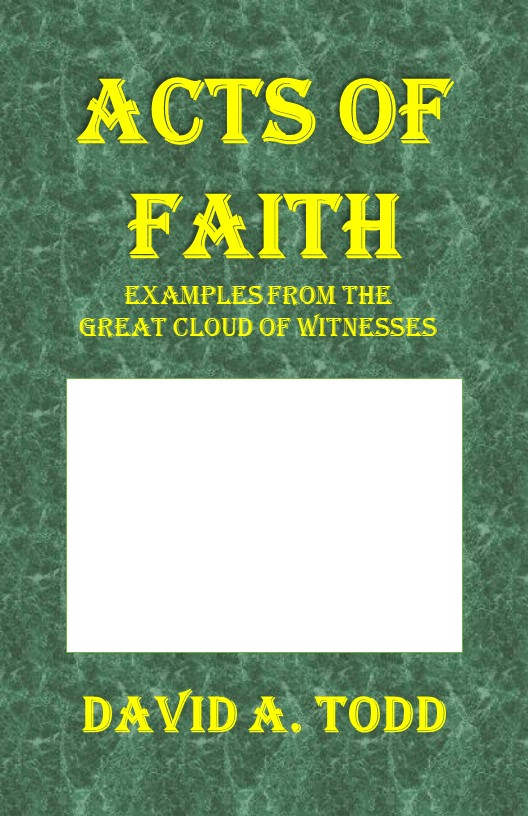
It’s not too early to be thinking about a cover. I’m thinking simple, establishing a theme for what may be a series. Not sure what would go in the whit box.
I’ve talked about this several times before, but never fully. I’m talking about the Bible study I’ve been writing since finishing Documenting America: Making The Constitution Edition in mid-June. Back on June 28 I posted about my writing choices. That post indicated that I had written a couple of chapters of this study, that it felt good, and that I had decided that would be my next book to write.
The first writing of it was on June 25, 2019. This past Tuesday, July 30, I completed the first draft, coming in at 35,574 words in a little over a month. That’s pretty fast. I’m wondering if, considering how fast it came together, if it’s any good.
But it’s not as if I started from scratch on June 25th. No, I had thought about this for a long time. I’d say it was maybe two or three years ago that the idea first came to me. I re-read Hebrews Chapter 11, the faith heroes chapter, and, as always, was inspired by it. Then I read Hebrews 12:1, “Therefore, since we are surrounded by such a great cloud of witnesses….” The idea came to me: a Bible study where a Bible example of faith and a Christian example of faith were together in each lesson.
I’m responsible for choosing the curriculum for study in our adult Life Group (a.k.a. Sunday school). I try to stay a few months ahead. I had curriculum planned out to near the end of September 2019 (this was back in late fall 2018, I think). What to do after a long, partial Easter study and a video-based Psalm 119 study? I had a couple of Bible studies in mind, things that had been brewing in the gray cells for some time, Acts Of Faith being one of them. I developed an outline, deciding it would be a viable study. So I penciled it in on our teaching schedule.
Then I thought, this would be a better study if it were in book form, not something my co-teacher and I had to develop our own notes for. So sometime early this year, maybe in January, I listed it as one of my possible writing works. As the year went on, I was more and more impressed that this was indeed what we should teach later this year, and that I should do my best to have it ready in book form if at all possible.
So, when Documenting America was done, as I posted a little more than a month ago, I shifted right to this. The writing wasn’t laborious at all. It came together easily, I’m sure in part because I had brainstormed it so much. Still, the relatively short time to write it surprised me. I wrote that I hoped to have it written by August 1, and I achieved that. I suspect maybe three or four weeks to edit, followed by two weeks to publish, and I’ll be done with it at least two weeks before we start the study, which right now is targeted for September 26th.
Preparing and teaching a Bible study is one thing. Publishing one is another. If you’re teaching in a class, discussion often takes over, and your notes go out the window. You prepared six hours for a 30 to 60 minute discussion, so you’re essentially over-prepared. At least that’s the plan. But publishing it means it has to all be out there. Make a mistake and the theologians or professional practitioners of the faith could be all over you. You have to get it right. Opinions are okay, but not mistakes.
Thus, I reached out to two ministers in our congregation about the viability of the study. Feeling like I needed more, I reached out to a retired pastor I know from an on-line writing group and got his input. The consensus was that I should proceed, that I wasn’t making any grave errors, and that possibly people would find themselves challenged by the study.
And now it’s written. It consists of seventeen chapters. If taught to a class, each would be a week’s study. If studied individually, I suspect it’s a two-week read. I originally programmed fourteen chapters. Then I thought, if this was taught around Christmastime, I needed some Christmas story chapters. So I added three of those, giving me seventeen chapters in the finished product. I know, I know, they say people nowadays don’t like studies that last that long. Six weeks, eight weeks is about all you should do. Well, I wrote what I wrote. If a teacher and class want a shorter study, they can pick and choose among the chapters.
Each chapter begins a Bible story that illustrates faith, saying how faith is shown by some act. Chapter 1 concerns Noah and the building of the ark, showing how he was acting out his faith all along. The second part of each chapter is a story of someone in the Christian era who also acted on faith. As best I could I tried to get the Bible example of faith and the Christian example of faith to make sense together. I’m not sure I always achieved that, but I think I’m close. Noah is paired with Martin Luther. Both of these men have sort of the same story. At least, I see many similarities.
I changed the Bible story in the second chapter when I heard a sermon on the radio and thought, oh, wow, what a great story of faith that is. I never saw that before. I didn’t want to lengthen the book, however, so one pair of stories was gone. I found another Christian example of faith and shuffled some around.
What’s next? As I said, I work on editing this into final form, and I see if I can write a leader’s guide for it, trying to have both ready by the end of August. Will I get it done? We shall see. And, of course, I’ll report back here on what progress I make.
In my last post, I told about the de cluttering effort my wife and I are in. I spoke specifically about the multiple stamp collections I’m dealing with, as well as a few other de-cluttering activities.
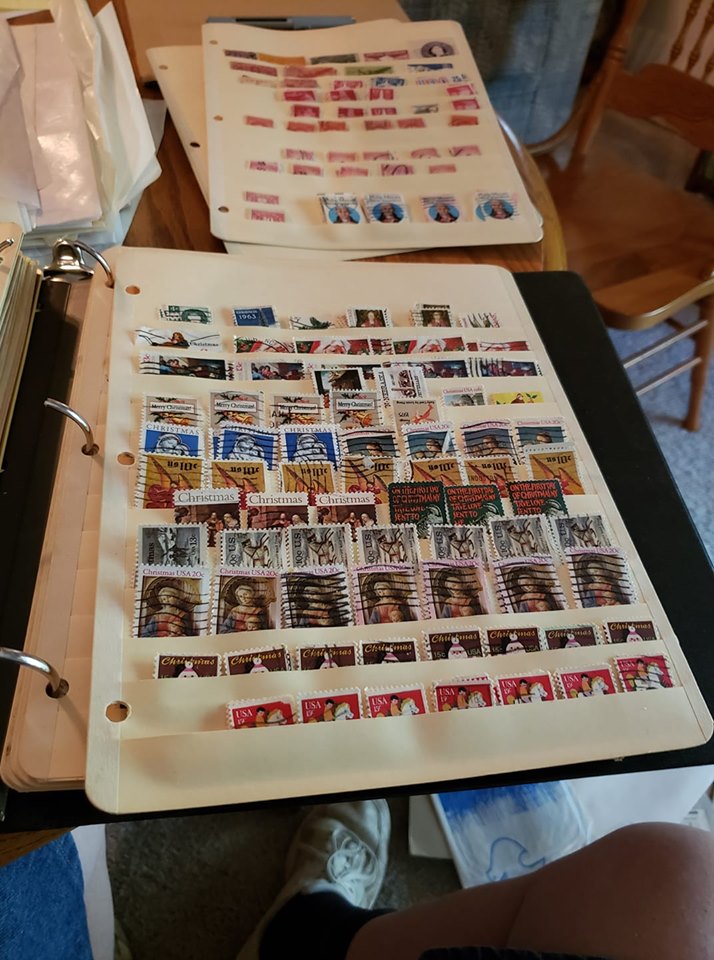
The stock book I worked on. I still have a few stragglers to add to it (which fell out before my work commenced), plus perhaps some re-distribution.
This weekend, while de-cluttering is still high on the priority list, so is what I call simply “getting things done.” It began on Friday, where I worked in The Dungeon for a good part of the day, doing my normal writing and stock trading tasks. In the evening I finally finished putting loose stamps into that stock book I mentioned in the last post, and on Saturday I gathered all the stamps in one place, while on Saturday and Sunday I put them all in a larger box and into their designated place in the storeroom. Check one item off the to-do list.
Our newer minivan was overdue for servicing. I finally called on that on Friday afternoon, learned they had appointments on Saturday, and took an early one. I learned of a sensor that’s gone bad; it will be replaced later this week under warranty. I also took that van to a nearby body shop for an estimate on fixing the rear tailgate after the fender-bender I caused in June. Ah, me. Much money to be spend fixing that small folly.
Friday and Saturday remained productive for the whole days. Let’s see what I checked off the list.
Elliptical and walking for Friday and Saturday.
Work on Acts of Faith each day.
Work on Documenting America: Making The Constitution Edition each day.
Clean up in the front yard, along with weekend weeding and deadfall pick up in the back yard on Saturday.
Seeing about accommodations for a trip we will soon be taking.
Making a haircut appointment. (I hate using the phone for things like that and always put off making such appointments, so when I do it it feels like a major accomplishment.)
Helping the wife make an omelet Saturday noon.
Household budgeting on Friday; balancing the checkbook on Saturday; catch up on trading accounting on Saturday.
Dusting the high corners near the ceilings.
Preparing to teach Life Group on Sunday.
Working on organizing the stamp collections, in place for better storage or, perhaps, selling within a couple of years.
I found time each day to just sit and read in the sunroom, and nap there one day.
I could probably add a few more things to the list, but I’d be getting into minutia if I did. Suffice to say the weekend was full, productive, enjoyable, and, if you can believe it, restful. Yes, I had time to watch TV (while working on the stamps and crossword puzzles), to sit in the sunroom and read, to get full nights’ sleep, and to gather with God’s people in worship and study on Sunday.
Whether every weekend will be so enjoyable and productive remains to be seen. This one was, and I thank God for it.
This is less than half of the total volume of stamp collections I’m dealing with.
About a year ago Lynda and I came to the realization that we had to begin decluttering. Maybe that realization came longer ago than that, but it wasn’t strong enough to begin taking actions toward making it happen.
Then, in May of this year, when we had to move a bunch of stuff to make way for workers to do a certain task, we saw the stuff being moved was the fruit of over-accumulation and un-noticed hanging on. De-cluttering was suddenly real. We couldn’t just talk about it and think that no longer accumulating meant we were de-cluttering. We had to actually get rid of stuff.
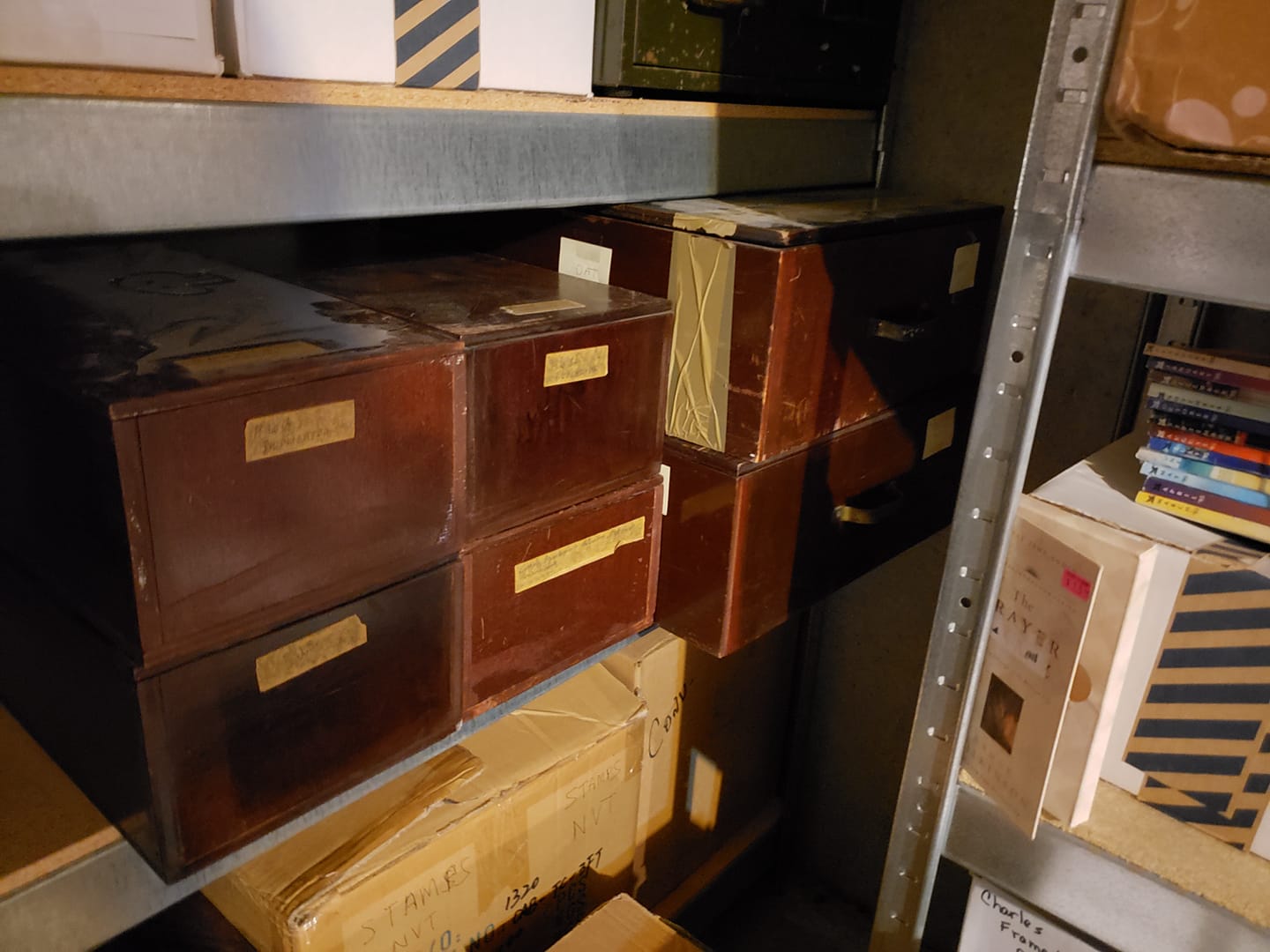
The stamp boxes Dad made. When the collection goes these will stay, and be repurposed.
So, since then, we’ve actually been getting rid of some stuff. Perhaps not fast enough and not enough, but we are actually getting rid of stuff. We put out an old exercise bike for a special trash pick-up this week. It’s a bike that worked but which we never used as we have a better one. Wednesday I took a load of electronic items to the County solid waste center. I also took the old microwave that died back in April. That felt good.
About two weeks ago I started tackling the stamp collection. Or rather, collections, for I have three here. I’ve written before about how stamp collecting was a big part of our growing up. From the time I was 8, for the next ten years barely a day went by that we didn’t work on stamps. Our albums grew large. Dad built stamp boxes out of old TV cabinets from Uncle Kenny’s shop. Before long these overflowed, as did our large Harris Citation albums.
I continued collecting into adulthood, but not in a very organized way. We bought the new stamps as they came out and “sort of” filed them. We bought used stamps from dealers and put them in albums. We saved all stamps that came into the house. We soaked stamps off paper and put them in shoe boxes. In short, we did everything we had done when I was growing up.
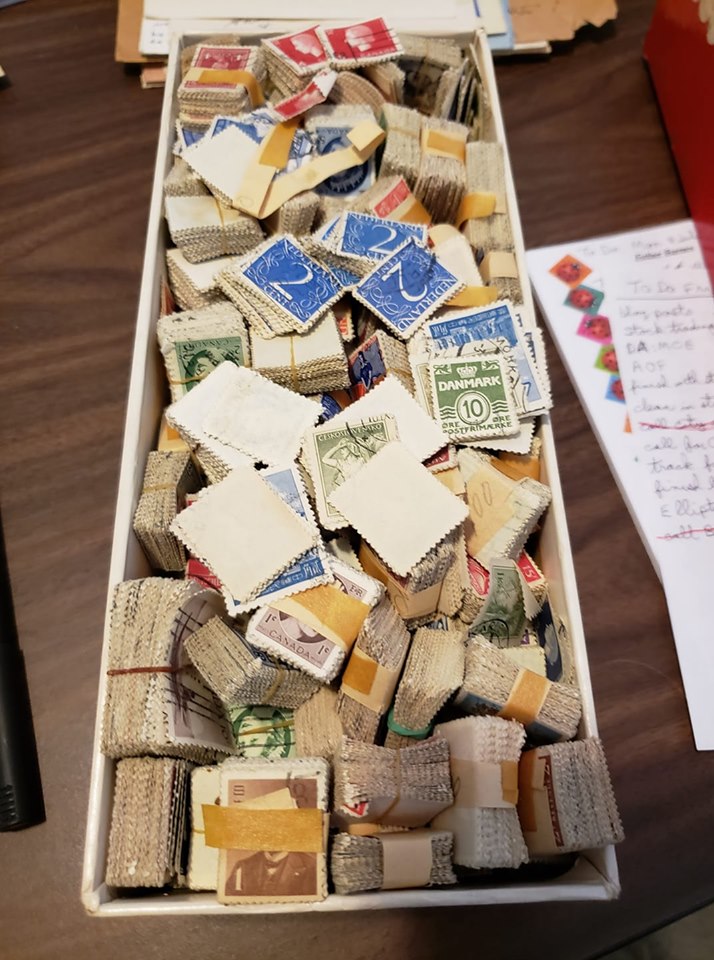
Mom used to sit by the hour and bundle stamps by the hundreds, which she used for trading with dealers for stamps we needed.
We couldn’t get our kids interested in it. I eventually lost interest when the pull of career and other interests came on. Two periods of overseas living, with the stamps in storage in the USA and us wondering if they would survive their boxed exile, helped to lessen the desire. By the mid-1990s the collection was in boxes, in closets or the garage, unseen and untouched.
Then, when Dad died in 1997 we had all the stamps in his house to deal with. I was the one designated by the will to handle the collections, so we packed them into our van and brought them to Arkansas, to rest beside their cousins in other boxes. Then, in 2001, my brother made a visit here and brought his stamp collection with him, asking me to sell it when I sold the others.
The stock book I worked on last night. I still have a few stragglers to add to it (which fell out before my work commenced), plus perhaps some re-distribution.
We’ve known since then that the collections would some day be sold, but sitting down to organize everything seemed to be so big a job that I didn’t want to devote the time to it. Every now and then I did some internet searches about selling stamps, but that was it as far as actually working on them. The stamps continued to sit. I decided there was no point in trying to interest the grandchildren it stamp collecting.
Fast forward now to May of this year. Stamps were pulled from different places. I realized the time had come to do something. The first task was to bring them all together. I did this, and found the work massive. But slowly I’ve been doing more on it. Over the last two weeks I:
Separated the catalogues and how-to books from the 1960s out and put them in a separate pile. I think it’s unlikely any dealer or individual who might buy them (if, indeed, I find there’s any market for stamp collections, which I’m questioning).
Separated out what are really nothing but recyclable materials, such as sheets of cardboard, old envelopes, plastic bins from old cookie boxes used for sorting stamps, etc. I have a pile of these that I’ll get rid of before long.
Putting all the sheets of new stamps together and then into a mint-sheet notebook or a small box. I got that done last week, realized the notebook was bulging and something else was needed. On Wednesday I came up with a better solution and completed that on Thursday.
Organizing a stock book of duplicates. I’m not sure why, some years ago, I put this book together. But now it’s over-stuffed and bulging. Yet, it had empty pages. Yesterday I tackled it and found that the bulging was due to a poor distribution of stamps in the book. Yesterday afternoon and evening I put all my time into reworking that book, and found the stamps all fit with only minor bulging—and I still have some empty space in it. I may be able to eliminate that bulging if I spend all my time this evening on it.
So, where does this leave me? I should have all the stamps organized and stored in one place by this time next week, maybe sooner. I’ll discard/place for recycling those things that are no longer needed. I’ll check with one person who I think might want my brother’s collection. Then, I’ll break off to do some other things. I have two books in progress that I’m doing a little on simultaneously, but a little more concentrated effort and I’ll be able to finish and publish them.
It was easy to accumulate over 45 years of adulthood and 43 years of marriage. De-cluttering, which really means de-accumulating, is proving hard. I’m sure I’ll shed a few tears when the stamps leave my possession, not to storage, but for the last time. At that time I’ll tell myself “Better with someone else than put in my coffin with me.”
I’d been wanting to read this for some time. It finally bubbled up to the top of the reading pile.
It wasn’t too long ago that I reviewedMark Lane’s Plausible Denial, a book about the JFK assassination. This was the first thing of Mark Lane’s I had read. I’d heard his name often, as he was an early critic of the Warren Commission often cited by other writers. I never read his first book on the subject, until now.
Rush to Judgment was published in 1966. Aside from articles in magazines, I believe this was the first book published critical of the Commission. Lane was in a unique place, having been hired by Marguerite Oswald, Lee Harvey Oswald’s mother, to function essentially as Oswald’s defense attorney during Commission deliberations. That’s a simplification. But it put Lane in some meetings and hearings, and allowed him to see things, that were denied to most not directly associated with the Commission’s work.
Lane, who died in 2016, was a lawyer. Much of Rush to Judgment deals with the minutia of legal issues. He criticized the Commission for not following rules of evidence and rules of cross-examination as you would have at a trial. He looked at evidence that law enforcement agencies had given to the Commission and found it wanting. For example, Lane spends a lot of time on the paraffin test applied to Oswald to show if he had recently fired a gun. The police said the test was positive, whereas Lane showed the inconsistency in the test and was critical of police statements, even before the test results were available, that said the test would be found positive.
No witnesses were subject to cross-examination during Commission hearings. Lane took transcripts of the testimony of many witnesses and picked it apart. A woman who saw the murderer of police officer J.D. Tippet is alleged to have identified Oswald as the man, but her statements and response to a police line-up were inconclusive. To Lane, she described a different man. While no official cross-examinations were make, Lane showed how lawyers for the Commission did critically question witnesses who told something other than what the Commission’s foreordained conclusion was.
Lane was critical of the witness list. Many witnesses were never questioned; others were questioned only by the Commission’s lawyers. These were witnesses who were in Dealy Plaza, or who knew Oswald, or who knew Jack Ruby, or who had other information about the three murders (Kennedy, Tippet, and Oswald). He makes a good case that the Commission’s work was sloppy and incomplete and that, had the rules of a courtroom been followed, the Commission never could have come to the conclusion it did.
The book is good. A couple of times Lane heads down rabbit holes, spending too much time on small items. A number of times Lane uses legal vocabulary that requires a dictionary. I looked a few of those up, but further into the book just skipped over them, doing the best I could based on the context. The organization of the book was fine, as was the length and the quality of the writing.
As this is an early book in JFK assassination research, it lacks some details that other authors brought out. One has to remember when it was written, however, in order form a judgment on the book.
As I have accumulated a fairly significant, though far from comprehensive, collection of JFK assassination books, I will keep this one. Will I ever reread it? I don’t know for sure, but maybe.