Category Archives: book reviews

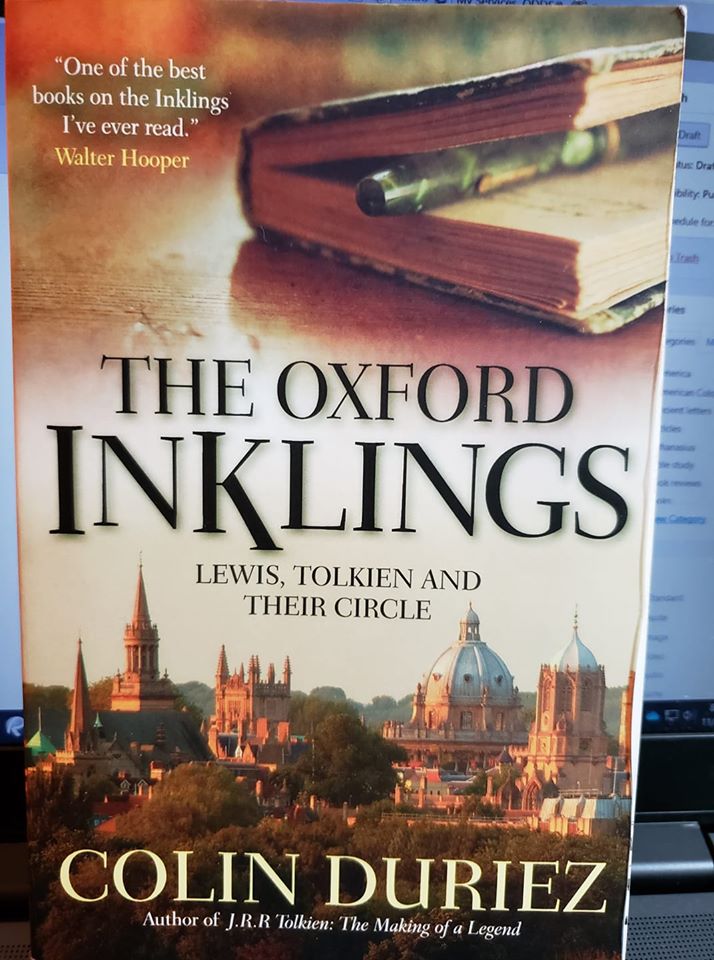
Book Review: The Oxford Inklings – revisited

Read it in 2014-15 and gave it 5 stars; re-read it in 2019 and haven’t changed my mind.

Four years ago I read The Oxford Inklings and posted a review of it. I put this book on the shelf and forgot about it. Forgot that I even had read it, though in the back of my mind I knew I had that book somewhere in my library.

Lately, with my interest in C.S. Lewis enhanced—not that I ever lot interest in him, but from time to time it bubbles to the top of my thoughts and I have to read a book by or about him. Well, after having trouble a while back trying to find something from a Lewis book to go into Acts Of Faith, I realized I needed to consolidate my Lewis books into one place. As I was doing that, almost accidentally I saw The Oxford Inklings hiding in a place I never would have expected it. I looked at it and couldn’t tell if it had ever been read. So I took it up to the sun room and decided I would read it right away.

I remembered a story late in the book, or thought I did. If I get to that part and that story is in there I would know I had indeed read this. Rather than look ahead and try to find that, I decided to just read it straight through and wait until I came.

As I read the book, it seemed new to me. Although I thought I had read it before, reading it now I felt like it was a new book. Had I read it or not? I found it gave me good information. I was about to say no, I hadn’t read it before. As I got close to the end, it began to feel familiar.

At last I came to the period that described Lewis’ declining health, and there was the scene I remembered. Yes, I had read it. Obviously I hadn’t retained it as much as I should have.

I see I gave the book 5 stars before. I stand by that. It does a good job of describing the Inklings and how the group revolved around Lewis more than the others. Members came and went. The three with the most time in the group were Lewis, J.R.R. Tolkien, and Lewis’ brother Warren. Others were there for a few years, or for a longer time but not attending each time they met. A few didn’t write and were there just to critique.

We aren’t the Inklings yet, but we are helping each other improve and move our writing forward.

Their goal was to make their writing better. They read works and received criticism on the spot. Back then easy means of printing and copying weren’t available, so their criticism was through listening and commenting. How different it is now. Our writing group, Scribblers and Scribes of Bella Vista, has the advantage of receiving works ahead of time and taking time to read and make comments in writing. We also read and comment at our monthly meetings (soon to be twice a month), but typically have copies of what others are reading.

But, I must go back to the book and close. If you’re interested in C.S. Lewis, J.R.R. Tolkien, their books, their circles, how writers go about their business, this is an excellent read. I highly recommend it—again.

Book Review: Dietrich Bonhoeffer: Opponent of the Nazi Regime

Since Dietrich Bonhoeffer was one of the great cloud of witnesses I included in Acts Of Faith, and since I didn’t read a full biography of him in preparation for writing that half-chapter but rather relied on snippets of information gleaned from a couple of places, I decided I should read a biography of Bonhoeffer. I figured, if what I had already written was somehow off the mark or lacked vital information, I could add it and re-publish the book. So I looked in my library and, sure enough, found a suitable book.

Dietrich Bonhoeffer: Opponent of the Nazi Regime was written by Michael Van Dyke, published in 2001. It is part of Balfour Publishing’s Heroes of the Faith series, comprised of [then] 44 volumes. A short biography at 205 pages. In fact, it really isn’t biography per se. Rather, it is more creative non-fiction, for it contains much dialog between Bonhoeffer and others, dialog that could not possibly have been preserved to be able to reproduce in a book such as this.

That didn’t affect my enjoyment of the book. It was simple, meant to be understood by almost anyone. It didn’t go much into his early years. Starting at World War 1, the book describes an aristocratic lifestyle for the Bonhoeffer family. In the opening chapter, Walter, the oldest of the Bonhoeffer siblings, was killed fighting in France. This set the tone for the book.

The Bonhoeffer home was strict, Christian, and loving. Dietrich was studious from the beginning. He went to university and excelled there. Always a Christian based on his childhood memories, he still found a need to have an encounter with God, and for God to become personal for him. As the book says:

The one thing missing from Dietrich’s life during these pears of intense theological and philosophical study, though, was a warm heart of true faith. He was learning everything that had ever been said about God, and yet he never spoke to God himself. He never prayed or read the Bible in order to hear what God was saying to him personally. Growing up in a highly intellectual atmosphere, he had absorbed the assumption that expressions of religious fervor were something of the ignorant masses did. It was the province of those who lived according to their hearts, not according to their minds.

Bonhoeffer eventually found that experience with God. It was, perhaps, less emotional than some people experience. He came to believe that:

Christianity was the daily experience of God, both individually and corporately, to the furtherance of God’s glory alone.

Most of the book deals with Bonhoeffer’s relationship to the Nazis after they came to power. He tried to get the church to see that Hitler and his accomplices were evil and that the church should oppose them. He lamented that instead the church either embraced Hitler or acquiesced to the Nazis’ impositions on the church. He spent much time in theological studies and reflections trying to figure out what the correct response of the church and Christians should be to someone like Hitler. Bonhoeffer was a believer in non-violent resistance in the mode of Gandhi. How would that work against the Nazis?

Then World War 2 came. Bonhoeffer was of age where he could be called into the service. His brother-in-law was a member of an organization, the Abwer, that allegedly conducted counterintelligence but essentially was working to overthrow the government, either by a putsch or by assassination. Bonhoeffer joined. The violent intentions of the organization troubled him, but he went ahead with it. This is what eventually caused him to be sent to prison and, ultimately, executed.

The part of the book dealing with Bonhoeffer’s time in prison was very good. Interrogations, dealings with other prisoners, prison letters, relocation to different prisons. It’s all there.

At some point I will want to read a more comprehensive biography of Dietrich Bonhoeffer, but for now this will do. I’m not sure if I’ll keep this in my library or not. My wife may want to read it, so I suppose I will keep it for now.


Book Review: Savage Beauty


This 2001 biography, 51 years after the poet’s death, took almost 30 years of research.

Savage Beauty: The Life of Edna St. Vincent Millay by Nancy Milford is an authorized biography of the poet. I must admit to not having read a lot of her poetry. What I have read I find to be excellent, though typically touching on things that don’t interest me. Still, that’s like reading 5 percent of someone’s works and saying they don’t interest you. Maybe less than 5 percent. It’s not a fair assessment.

Millay was an enigma. Raised in a sheltered lifestyle in small-town Maine, she eventually adopted a Bohemian lifestyle in Greenwich Village. She had a number of lovers, including openly after she married.

Somehow, her poetry spoke to young women, maybe to older women as well. It was mostly formal poetry, rhyming and in meter. Here subjects included women’s liberation and sexual freedom. I was surprised to find three different books of her collected poems in my library. One was my sister’s, left at our dad’s house and moved to mine with all the books. One I remember picking up second hand. The third I don’t remember acquiring at all. I don’t imagine I’ll keep all three, but I will for sure read in some.

Back to Savage Beauty. The title comes from a line in one of her poems.

I was waylaid by Beauty. Who will walk

Between me and the crying of the frogs?

Oh, savage Beauty, suffer me to pass,

That am a timid woman, on her way

From one house to another!

That’s not supposed to be double-spaced, but I can’t figure out how to get it single-spaced and put the line breaks in. Ah me, I must learn more about Word Press and html.

This photo was on the cover of her first book.

The most disappointing thing to me about Savage Beauty was that, while the series of events that changed Millay from naïve schoolgirl to promiscuous woman were given, no why was suggested. Nor was any negative reaction from family mentioned. She graduated Vassar College at age 25, having started later than most young people, and moved straight to the Greenwich Village area of New York City. She supported herself by her poetry. She also wrote, produced, and acted in some off-Broadway plays. She found that men were instantly attracted to her and she could have any of them she wanted. Before long, she was having them. She fended off several marriage proposals. She made an extended trip to Europe, all the while maintaining the loose lifestyle.

She eventually married a man with some money. They bought an estate in the New York Berkshires and sort of lived there. I say “sort of” because they seemed to be gone much. With each book Edna went on a long promotion and reading tour. It’s said her voice was mesmerizing, and audiences filled every hall she read in. Besides the tours were frequent stays in New York City, trips abroad, and occasional summers at an island off the coast of Maine.

Millay drank and smoked to excess, and began having health problems from it. An auto accident, where she was thrown out of the car, caused her much pain and led to her addiction to morphine and other drugs. In 1950, at age 58, she met her death at her home. The description Milford gives in the book makes it possible it was either a tragic accident or suicide. Millay was alone when she apparently fell down a long flight of stairs and wasn’t found for twelve hours or more.

All the tragedy of her life, all her lifestyle, was unknown to me before reading this. I knew only that she was a renowned poet of the 20th Century. It’s good to know about her life, though I don’t know that I feel particularly enlightened. I think saddened is the reaction I take away from the biography.

So the question now is: Does Savage Beauty stay on my bookshelves? I can at a minimum move it from my reading style to a permanent shelf. But will I ever read it again? I think it unlikely I’ll re-read it, so it should go for donation to a thrift store. But, if I paid full price for it, I hate to do that. What to do, what to do? I think, in the spirit of de-cluttering, out it goes.

Book Review: Jews, God and History

Sometimes I pick up a used book and place it in my reading pile. Years may go by before I pick it up and read it. I don’t know how many times I never get to a book, or it will be years before I’m looking for something to read, dig deep in my pile, find something, and decide “This is the one for right now.”

A good book. If it weren’t falling apart, it might find a place in my library. Difficult call.

That was the case with Jews, God and History by Max I Dimont. When I pulled this from the pile, I found no label on it. Inside was a very faded receipt. I can just make out that I the receipt says I bought three books at Helping Hands, a local thrift store with a great books section, paid a total of $2.00 cash for all three. The purchase was at 10:42 a.m., but the date is too faded to read.

This is a mass-market paperback with cheap binding. While I was reading it, it fell apart into two sections. So much for such books printed in 1962.

This was an informative book. Dimont is a skillful writer. He gives much information, not statistics and data, but sweeping narrative about the Jews throughout over four millennia: where they were, what influenced them, who they influenced, what their motivations were. In 421 pages of 10-point font, Dimont gives a comprehensive documentation of this amazing people.

I have a couple of criticisms of the book, however. By the time I was done with it (two months elapsed between my starting and finishing it), I had pretty well forgotten what had come at the beginning. In other words, while I was impressed as I read, the writing didn’t stick with me. I sometimes, when I finish a book, go back and re-read the Introduction to see if the writer achieved whatever goals were stated there. In this case I haven’t yet done that, and don’t think I will.

My other criticism is that the book is totally unsourced. Along with the information given, Dimont makes sweeping judgments on the why of the history, not just the what. Here’s an example of one of those:

Like a Freudian libido flowing through the unconscious, attaching itself to previous psychic experiences, the Haskala flowed through the body of Judaism, attaching itself to former Jewish values and creating new ones. It attached itself to Hebrew and Yiddish, creating a new literature. It attached itself to Jewish religion and created Jewish existentialism. It attached itself to politics and created Zionism.  Zionism fused the Jews in Eastern and Western Europe with the Jews in the United States and created the new State of Israel. This vast transformation and fusion began with a few Talmudic students fighting the Hasidists, who were preaching a return to primitivism of feeling as a way of relating themselves with God.

To me, such broad statements need to be sourced. Where did these ideas come from? Are they the author’s interpretation? They are stated as fact when they seem to be opinion. I would have liked it to be clearer.

Those criticisms aside, I thoroughly enjoyed the book, if being maddened at it a few times. I certainly don’t regret taking time to read it. It will not, however, have a permanent place on my bookshelf. I don’t think it would even if it hadn’t fallen apart.

However, while the book is unsourced, it does have an extensive Bibliography. Pages and pages of published works are listed, many of them look inviting. I’m tempted to tear these pages from the weak binding and find a permanent place for them in my library, being a list of potentially valuable sources for future research. The only thing making me think I should do that is the thought: How will I ever find those pages again?

Book Review: “Rush to Judgment”

I’d been wanting to read this for some time. It finally bubbled up to the top of the reading pile.

It wasn’t too long ago that I reviewed Mark Lane’s Plausible Denial, a book about the JFK assassination. This was the first thing of Mark Lane’s I had read. I’d heard his name often, as he was an early critic of the Warren Commission often cited by other writers. I never read his first book on the subject, until now.

Rush to Judgment was published in 1966. Aside from articles in magazines, I believe this was the first book published critical of the Commission. Lane was in a unique place, having been hired by Marguerite Oswald, Lee Harvey Oswald’s mother, to function essentially as Oswald’s defense attorney during Commission deliberations. That’s a simplification. But it put Lane in some meetings and hearings, and allowed him to see things, that were denied to most not directly associated with the Commission’s work.

Lane, who died in 2016, was a lawyer. Much of Rush to Judgment deals with the minutia of legal issues. He criticized the Commission for not following rules of evidence and rules of cross-examination as you would have at a trial. He looked at evidence that law enforcement agencies had given to the Commission and found it wanting. For example, Lane spends a lot of time on the paraffin test applied to Oswald to show if he had recently fired a gun. The police said the test was positive, whereas Lane showed the inconsistency in the test and was critical of police statements, even before the test results were available,  that said the test would be found positive.

No witnesses were subject to cross-examination during Commission hearings. Lane took transcripts of the testimony of many witnesses and picked it apart. A woman who saw the murderer of police officer J.D. Tippet is alleged to have identified Oswald as the man, but her statements and response to a police line-up were inconclusive. To Lane, she described a different man. While no official cross-examinations were make, Lane showed how lawyers for the Commission did critically question witnesses who told something other than what the Commission’s foreordained conclusion was.

Lane was critical of the witness list. Many witnesses were never questioned; others were questioned only by the Commission’s lawyers. These were witnesses who were in Dealy Plaza, or who knew Oswald, or who knew Jack Ruby, or who had other information about the three murders (Kennedy, Tippet, and Oswald). He makes a good case that the Commission’s work was sloppy and incomplete and that, had the rules of a courtroom been followed, the Commission never could have come to the conclusion it did.

The book is good. A couple of times Lane heads down rabbit holes, spending too much time on small items. A number of times Lane uses legal vocabulary that requires a dictionary. I looked a few of those up, but further into the book just skipped over them, doing the best I could based on the context. The organization of the book was fine, as was the length and the quality of the writing.

As this is an early book in JFK assassination research, it lacks some details that other authors brought out. One has to remember when it was written, however, in order form a judgment on the book.

As I have accumulated a fairly significant, though far from comprehensive, collection of JFK assassination books, I will keep this one. Will I ever reread it? I don’t know for sure, but maybe.

Book Review: Arthur Conan Doyle: A Life in Letters

A nice addition to my letters collection—if I keep it. Read on to see.

Some time ago, perhaps measured in half decades, my wife and I started reading the Sherlock Holmes books and stories of Arthur Conan Doyle aloud. We bogged down about halfway through, mainly due to difficulty reading the somewhat archaic language aloud. Years later I finished them on my own. So, sometime in 2010, on a trip to Barnes & Noble, I was pleased to find on the mark-down table Arthur Conan Doyle: A Life in Letters. How could I not snatch up the beautiful looking hardback? I was reading Doyle, and I love reading letters and biographies.

The fact that I set this book aside for a while doesn’t mean I didn’t like it. Life circumstances moved me in other directions.

At that time I made a marker for each book I read out of scrap paper and recorded my reading progress; I still do that sometimes. I started reading on 24 March 2010. After three days the next entries are in August 2010, which took me up to page 82. A gap in the entries doesn’t tell me when I read, but when I picked this up in April this year, I started reading at page 359. I think I read those other pages back in 2010.

That I put this book down for some years is not indicative of the enjoyment I derived from it. As I said I love reading collections of letters. This one was no exception.

I don’t know how many of Doyle’s letters have been collected. Since most of his literary life was in the days before telephone, you would think he had a lot of letters—to publishers, editors, other writers, investment advisors, etc. For this book, the three editors chose to mainly use letters between Doyle and his mother. She seems to have kept all that he sent her. They are valuable in terms of understanding Doyle’s life as a writer, for he told her what he was working on, how it was received by publishers, how new works were received by the public, etc.

The early years were a struggle. Doyle studied to be a doctor and became one, though the medical profession in the 1880s-1890s was quite different than today. Learning about that was informative. While he was struggling to make a living from medicine he was also struggling to become a writer. Two careers, simultaneous struggles. Doyle’s descriptions of that were fascinating.

Sherlock Holmes lives! And always will.

We know now that his main success was in writing, with the Sherlock Holmes stories being his biggest hit. Knowing little about Doyle except for Holmes, I was amazed at how many other works he wrote, most having nothing to do with the detective genre. Maybe Doyle had a bit of Genre Focus Disorder long before I created the term. It seemed to work for him, however, as many of his other books/stories met with success.

Doyle tired of Holmes and “killed him” at the falls. Public demand was so great, however, that Doyle found a way to bring him back, with stories that preceded his struggle at the falls with Moriarty, and then showing that he hadn’t actually died. Close to half the Holmes stories were written after Doyle wanted to move on to something else.

The editors did a good job of using their words to illustrate what the letters were saying. It was a good mix of Doyle’s words and the editors’ commentary. I would have liked to have had more correspondence than just the letters to his mother. The book had a few others, but well over 95 percent of the 684 pages were Doyle to his mother. Adding letters to others would have been interesting, but would also have changed the nature of the book.

If you like Arthur Conan Doyle, if you like Sherlock Holmes, if you like letters, this book is well worth reading. Since I got it from the bargain table, I don’t know that it’s in print any more, but you could try to find it.

The big question is, will I keep this? I have so many books, and I’m far enough along in this earthly life that I really should get rid of all books I don’t believe I will read again. I’m not sure why I would re-read this one. Well, maybe to re-read some of the early years struggles, and what he wrote about creating his most famous character.

Or maybe just so that my collection of books of letters is more complete. There, I’ve talked myself into it. For now it goes back on the shelf.

Book Review: Through the Magic Door

Many years ago I began reading Arthur Conan Doyle: A Life In Letters. I picked that up at Barnes and Noble, off the bargain table, and immediately began reading it. But, as way so often leads on to way, I got a couple of hundred pages in then set it aside. This months I finally finished it. From 2010 to 2019 is a long time to read a book.

A relatively short and worthwhile read

I’ll be doing a report on that book, but not today. In it Doyle mentioned in a letter that he wrote a book of literary essays. That sounded interesting to me. Coming from 1907 it would be in the public domain, so I looked for it and found it. Through the Magic Door was published in 1908. it consists of a discussion, not strictly about authors, but about books on Conan Doyle’s bookshelf. This was a favorite bookshelf, I assume, one that had his favorite books on it. In this it differs from other books of literary essays, which at that time tended to concentrate on the authors, not on their books.

I obtained this at no cost on Google Play and put all else aside and began the book. The opening lines drew me right in.

I care not how humble your bookshelf may be, nor how lowly the room which it adorns. Close the door of that room behind you, shut off with it all the cares of the outer world, plunge back into the soothing company of the great dead, and then you are through the magic portal into that fair land whither worry and vexation can follow you no more. You have left all that is vulgar and all that is sordid behind you. There stand your noble, silent comrades, waiting in their ranks.

This is a wonderful opening. The book at hand almost lived up to it. Doyle starts out with his Macaulay book, his English history. This was his largest work and his last, actually not being completed. I’ve tried to read it but was put off by it, most probably the dated language and style. Doyle was writing only five or so decades after it was published, so it was much fresher to that era.

Macaulay’s essays also find space in Doyle’s book. These I’ve had more success with. I’m far from finishing them, but the ones I’ve read have held my interest and informed me. That’s good enough praise for things written in the 1820s and 1830s.

After this, the further you get into Magic Door, Doyle seems to degenerate. From entire chapters on one author he changes over to entire chapters covering entire shelves. He rushed through descriptions of books by author’s I’ve never heard of. It was good to hear about them, but Doyle didn’t give me enough to make me want to go out and find and read them. Pity. I’m sure they would be good to read, but I just don’t have enough to draw me to them.

Through the Magic Door was good. Had I this book in hard copy, I believe I would keep it and note it as one to be read again in the future. Doyle is a good writer. This volume is a good companion to Sherlock Holmes and, perhaps, other of Doyle’s writings I hope someday to pick up.

Book Review: John Locke’s “Two Treatises on Government”

John Locke significantly influenced key leaders of the American Revolution.

Last week I posted my book review on John Locke’s first treatise on government, promising to come back “soon” for a review of the second treatise. Here I am for that purpose. I made a slight digression, as I obtained Filmer’s Patriarcha and have allowed myself the distraction of reading it some.

In his second treatise, Locke is trying to say why government is established, and how, and how it is changed. I found his descriptions tedious. Again, how much of this was the archaic language and structure, how much my distracted reading, how much my small-screen device I don’t know. A future, second reading is on the unwritten to-do list.

Detected and overthrown? Locke was certainly confident about the success of his arguments.
Photo reference: Public Domain, https://commons.wikimedia.org/w/index.php?curid=399928

Locke started by saying his first discourse had proven that Adam had no special authority to rule over all the earth, nor did his immediate or later heirs, that there was no right of succession, and that even if there had been a right of succession we have lost the line of succession; hence, what do we do? Did he prove that? I’ll have to re-read the first treatise to decide.

His conclusion, however, I can agree with: “…it is impossible that the rulers now on earth should make any benefit, or derive any the least shadow of authority from that [Adam and the right of succession]” and thus “all government in the world is the product only of force and violence, and that men live together by no other rules but that of beasts, where the strongest carries it, and so lay a foundation for perpetual disorder and mischief, tumult, sedition and rebellion….” Therefore, mankind  “just of necessity found out another rise of government, another original of political power, and another way of designing and knowing the persons that have it, than what Sir Robert Filmer hath taught us.”

Locke then sets out to describe and prove this process in 219 pages (in my copy). In chapter 2 he describes the State of Nature. In chapter 3 it’s the State of War. He discusses Slavery in chapter 4. This interested me. On the slavery-freedom continuum, where Filmer came down on the end that is slavery, Locke comes down on the end of freedom.

“The natural liberty of man is to be free from any superior power on earth, and not to be under the will or legislative authority of man, but to have only the law of nature for his rule.” Locke’s Second Treatise, Chapter 4, section 22

I like Locke’s position. Given opposite ends of the continuum, all men are slaves (except for the king) or all men are free, I agree that all men are free. This seems more natural than that all men are born slaves, subject to the one man who has dominion over all.

I could go on and on. Locke talks of Property in chapter 5 and the right to defend it. His discussion of Paternal Power in chapter 6 is a blur to me. Moving to Political or Civil Society in chapter 7, Locke held my interest a little more. This phrase, “man in society”, shows up in the writings of our Founding Fathers. It’s the buzz word of the day for mankind not living alone, but with other men, and thus having to modify behavior so as to live at peace.

The latter is part of Locke’s system of government that I need to know better. I’m sure I’ll re-read this book. I may, perhaps, read Filmer all the way through first, and maybe Hobbes, now that I have both in my possession.

The American Founding Fathers liked Locke. I need to too. I’m not really there yet. As I re-read some of the second treatise in preparation for this review, it seemed clearer to me. I was able to focus on Locke’s premises and arguments, rather than just read the words. Maybe there’s hope for me yet in understanding these books.

Do I recommend anyone else read these books? I don’t, at least not yet. Perhaps in a few months, or maybe a year, I’ll have finished a second read and will revisit this in a post.


Book Review: Modern Arms and Free Men

Some time ago I made a review about Fletcher Prouty’s book on the JFK assassination. In that I wrote that I was somewhat surprised how Prouty went back in time and spent much of his book talking about events from 1943 up to 1959, before Kennedy was in the presidency. After reading that, I wanted to read some other book that dealt with some of this time period.

The dust jacket kind of crumbled as I read. Oh, well, back to the garage sale box with it.

And I remembered that, out in my book boxes ready to sell at our next garage sale was the just the book I wanted. Modern Arms and Free Men, by Vannevar Bush, was published in 1949, so was likely written 1947-48. It is subtitled A Discussion of the Role of Science in Preserving Democracy. It is a book I found in my dad’s house after he died. I couldn’t tell if he ever read it.

Dr. Bush was an engineer, inventor, and science administrator. During World War 2 he was head of the Office of Scientific Research and Development. For a while this included administering the Manhattan Project. Here’s a link for his profile on Wikipedia.

I found the book to be somewhat strange. Bush certainly knew military weaponry. He knew how our scientific advances helped us to win the war. He also credited advances by the British, and was quite critical of Germany’s failure to make scientific advances. This he attributed to the fact that Germany was a dictatorship, all things flowed from Hitler, and if Hitler didn’t want to put resources into weaponry advances (other than the V1 and V2 rockets—and jet planes, though too little too late) then it didn’t happen.

This isn’t true in a democracy, or in a republican government based on self-determination Bush says. Here, where many people are involved in innovation, changes do occur. Are those changes improvements? Bush seems to think so.

The book covers weapons development during the war, in the period immediately after the war, and looks ahead to what might be coming. For each type of weapon, he talked about the defense that could be developed to oppose it. In all situations except for biological weapons, the defense always seemed to win in Bush’s mind.

He spent time on nuclear weapons. At the time of writing, America was the only nuclear power. The USSR hadn’t yet developed a nuclear warhead. They exploded one in 1949, about when the book was published. The next nuclear power was the UK in 1952. Bush looked ahead to when our enemies would have “the bomb”, and how we might defend against it, and they against ours.

One thing that surprised me about the book was Bush spent almost no time on aircraft carriers. This, despite the fact they played such a pivotal role in the naval war. He did, however, spend a lot of time on submarines. He saw subs as playing a critical role going forward.

And Bush’s book is mainly a forward-looking book. Yes, he spent time on WW2 developments, then so fresh on everyone’s minds, but he tried to project ahead, into the weapons that might be developed in the near future. In that regard, the book seems almost to be a sales pitch for the military-industrial complex that Ike would warn us about a decade after Bush’s book.

So the question should be asked, how well did this book suit my purpose, of following up on Prouty’s book to learn more about the Cold War period? Not a whole lot, honestly. I’m glad I read Bush’s book. It gives me some new perspectives on the immediate post-war world. He made a good case of how we must keep innovating our armaments to remain free men. But, it was written so early in the Cold War that there was little in it to mesh with Prouty’s book.

Should you find this 72 year old book and read it? You could. It’s cheap on used book site. But, if anyone really wants it, let me know and I’ll mail you mine for the cost of postage. I don’t plan on keeping it. Later today it will go back in the yard sale box. More likely, it will go to a thrift store in a month or so.

Book Review: JFK: The CIA, Vietnam, and the Plot to Assassinate John F. Kennedy

For some time I’ve been aware  of Fletcher Prouty, and that he had a story to tell in the JFK assassination. He was mentioned in Oliver Stone’s movie JFK (Donald Sutherland’s character “X”). He’s been in other books or articles about the assassination. Yet, I’d never read anything he actually wrote about it.

A disappointing read, though it will stay in my library for a while.

So, when I was at Barnes & Noble one time and saw his book JFK: The CIA, Vietnam, and the Plot to Assassinate John F. Kennedy, I naturally bought it. I had it for close to a year before it found its way to the top of the reading pile, a pile I haven’t had much success at reducing recently.

Alas, I was disappointed in it. All this time hoping he wrote about the assassination, only to find his book was barely worth reading.

First, his story. Prouty was in the Army Air Corps in WW2, having a variety of assignments during the war and right after. During the Cairo and Teheran conferences in late 1943, he was pilot for delegations attending the conference, particularly the Chinese delegation—all except for the Chinese leader, Chiang Kai Shek and his wife. He starts his narrative there, saying decisions made at the Cairo conference had implications in Vietnam and later. The Cold War, he said, started at Cairo and Teheran, when the USA and England teamed with the Chinese in silent battle against the USSR.

Then, he says he was aware that, when the Japanese surrendered, all the war materiel being accumulated on Okinawa had to go somewhere, and it was all taken to Hanoi to help Vietnam, then one country and led by Ho Chi Mihn, in its war against the lingering French colonists. That materiel would eventually be used against the USA.

The problem, Prouty said, was the US intelligence services, first the OSS then the CIA, ventured far outside the field of intelligence gatherings into covert operations. In Vietnam, those operations were keeping things fomenting in a country that was, at best, loosely a country in fact, so that attention would go there. The domino theory of nations falling to the communists was but a smokescreen for the CIA’s real work, says Prouty.

It’s all tied in to the military-industrial complex that Eisenhower warned us about. The CIA keeps things roiling in different parts of the world. The USA needs to be prepared, so keeps buying military hardware. Industrialists thus profit, and taxpayers lose. That sort of makes sense, but I don’t believe he fully makes the case.

My father-in-law took this photo in Houston TX on Nov 21, 1963, the day before the assassination. He snuck in with the press photographers.

As I’m reading, I’m wondering how this ties to the JFK assassination. Prouty finally gets to that. He makes a big deal about a National Security Memorandum which shows that Kennedy was withdrawing from Vietnam, a slow withdrawal from our troop strength of 16,000 down to none over a three year period. This went against what the CIA, by this time a strong power in the government, wanted. So they assassinated Kennedy, who had said in casual conversation he was going to break the CIA into a thousand pieces.

Prouty doesn’t make his case well. Oh, he talks about this agent and that, this operation and that, showing how they weren’t meant to do anything but promote unrest in Vietnam. But he doesn’t say how the CIA accomplished the assassination. How was Oswald involved, or was he involved at all, if it was a CIA plot? Who were the shooters, and how did they get away unseen? How is it that the Warren Commission uncovered none of this? An enquiring reader wants to know.

Prouty’s book is poorly written. The NSM mentioned earlier is covered over and over in the book. Each time Prouty gives us the full story about it. He’ll say something like “…as covered in NSM #268, which concerned troop withdrawals from Vietnam by the end of 1964…” He does this over and over. It’s as if he doesn’t trust his readers to read about this NSM the first time and understand what it covered thereafter throughout the book. He does this over and over, acting as if his readers were two yea- olds who needed to have the same thing explained to them many times. He does this with many things in the book.

He had some important things to say, but, having finished the book back in August of this year, those important things are already fading from my memory. And that’s not a good testimony for a non-fiction book.

If I could talk with the author, I would say, “Mr. Prouty, sir, you blew it. You had a good story to tell—at least I think you do, but you got off in the weeds and didn’t trust your readers. Hence, I can’t recommend your book.”

Who should read this? Only die-hard Kennedy assassination researchers and students who want to leave no related book unread.

This book will stay on my shelf, with other Kennedy books. I might even read it again, in my retirement, and see if I can glean more and better information from it. For right now, it’s going to get a mere two-stars from me on an Amazon and Goodreads review.