Category Archives: book reviews

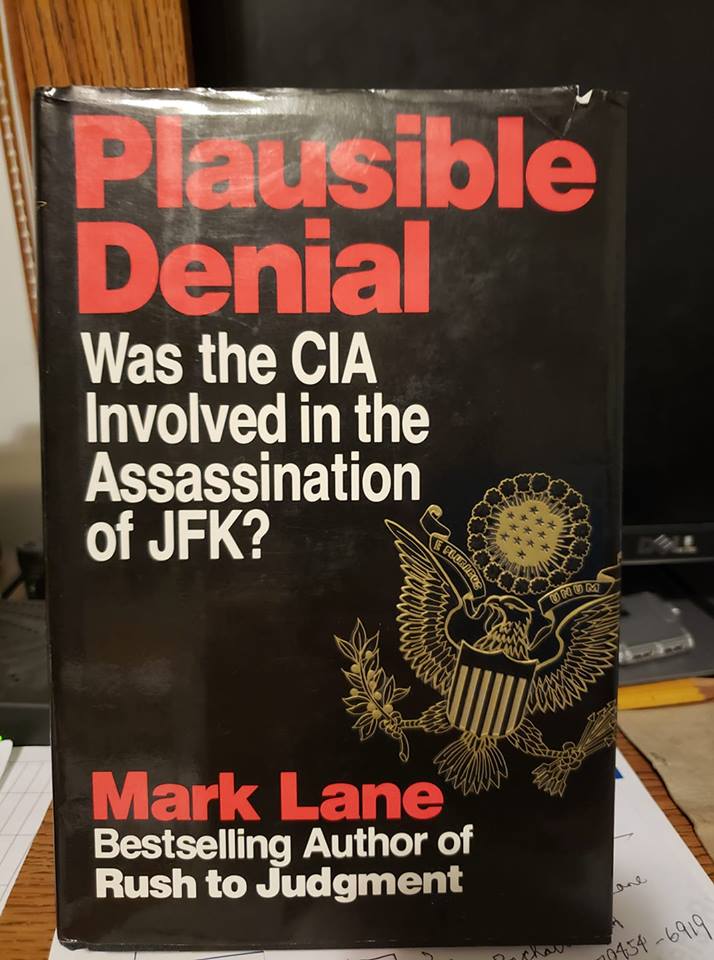
Book Review: Plausible Denial

This one is a keeper. It’s not perfect by any means, but it’s a keeper.

Some time ago (meaning at least a year) I picked up a copy of Mark Lane’s Plausible Denial: Was the CIA Involved in the Assassination of JFK? The price on the dust jacket is $22.95, but I know I didn’t pay that for it. It was published in 1991. I imagine I got it at a thrift store for a couple of bucks.

Was it a good purchase? Absolutely yes, so long as the price was under $5.00. I’ve read a lot of Kennedy assassination books. And I’ve known of Mark Lane for a long time. He was first into the market, in 1964, with a book-length critique of how the assassination investigation was being handled. Rush To Judgment is highly thought of by those who are convinced that the Warren Commission got it wrong.

The book is about a trial that was held in 1985, when E. Howard Hunt, former CIA agent of Watergate fame, sued the organization Liberty Lobby for an article that appeared in 1978 in their magazine Spotlight, the article saying that Hunt was in Dallas the day Kennedy was killed. The issue had been tried before, in 1981, with a verdict for Hunt and an award of $650,000.

But that verdict was set aside on a technicality. In the re-trial, Lane represented Liberty Lobby. The jury returned the opposite result this time: Liberty Lobby didn’t defame Hunt by publishing the article.

Lane’s approach was different than the first trial. First he had to set aside a ruling that the defense agreed Hunt wasn’t in Dallas that day. This he did successfully. Then he argued a strategy that Hunt almost certainly was in Dallas that day. Or, if he wasn’t, he couldn’t remember exactly where he was when he first learned about the assassination, and the memories of his three children, who at the time were old enough to carry those memories with them to adulthood, were aghast at what their dad might have done.

Lane’s conclusion: Hunt wasn’t with his children in the hours after the assassination. Where was he? Lane argues “in Dallas”. Doing what? Probably not pulling the trigger, but somehow superintending or aiding in the conspiracy to kill the president.

Lane, a practicing attorney at the time, goes somewhat deeply into the legal issues, the rules of evidence, the effect first trial decisions had on the second, nuances of depositions and cross-examinations. It was a little long for my liking, but not excessively long. I think Lane could have ditched about twenty pages of legal processes without hurting the book.

I found Plausible Denial informative. I learned a number of things I didn’t before. I’ve known for a long time that the CIA has been suspected of taking out the president, but didn’t really know why people thought that. Thanks to this book, I do now.

Lane’s argument to that: Hunt was CIA (before and after working at the White House for Chuck Colson); he was well-versed in covert operations; if Hunt was in Dallas that day but didn’t have a reason to be there such that he needs to hide the fact, then it must be a CIA operation. Lane makes the case much better in his 384 pages than I have in this paragraph.

On Amazon, I will give this book 4 stars. One star is removed for the excess legal discussion, and for the lack of sources. Some of Lane’s discussion comes off as speculative rather than factual. Still, it’s a good book.

Who should read it? If you’ve not read anything about the JFK assassination, this is NOT the book to start with. Any number of other books would be better. But this could be third or fourth on your list.

For me, this is a keeper, along with my other books on the subject (which includes Rush To Judgment, which I’ve yet to read). I will likely read it again during my retirement, when I will put my JFK library in a pile and read them back-to-back.

A Quiet Evening

I’m writing this Thursday evening, and will schedule it to post on Friday, my normal blogging day.

Although, if you’ve missed four consecutive, normal blogging days, can you say you have a regular blogging day? I hope so, and I hope to be back on a more-or-less normal schedule going forward.

You ask “What has kept you too busy to blog?” A number of things, which have taken both body and brain power. Around the time of my last blog I was assigned to help with a quick turnaround project at work. It was right up my alley: writing the scope of a water and wastewater masterplan for a downtown district, and us getting paid to do it. This was made more difficult, however, when a key player in the larger project of which this forms a part turned in his resignation. He’s still here, but a greater burden fell on his main assistant, and other work she was doing for which I was assisting fell back to me. So that tied me up.

Then, I’m managing our project manager training program, which is being taught mostly by others. But I’ve had to do a lot of paperwork with it, juggling class schedules and teachers. I wouldn’t quite say it’s a nightmare, but definitely a bad dream.

Time outside the office has been taken up by yardwork and moving my mother-in-law into her permanent assisted living quarters (from a temporary, respite one). That included helping my wife through quite an adventure of buying a used table. Perhaps someday that will be a story to tell. I might even adapt it for the next volume of The Gutter Chronicles.

Speaking of books, I continue to make progress on my work-in-progress, Adam Of Jerusalem. Two weekends ago, after helping my wife get on the road to visit the daughter, son-in-law, and grandkids, I managed to add just over 3,100 words on one long day. Then, last weekend, Labor Day weekend, I set a goal of adding 10,000 over Friday to Monday. I did that. Sticking to my chair, minimizing breaks, and working through previously uncertain plot lines, I quit at 3:00 p.m. Monday having added 10,100 in four days. That puts me at 48,400 words. The book is running a little short, so I have only 22,000 to go.

All these things have left me quite brain dead in the evenings. Two evenings recently I had evening meetings, and didn’t get home in time to do much.

So, what does the near future look like? This weekend I hope to add 6,000 words. That will take me about through the sagging middle and at the brink of the ending action. Rain is forecast for Friday-Saturday, so I think I’ll have fewer distractions.

Alas, I have trips scheduled. A warranty project requires me to be in Minneapolis two consecutive Thursday-Saturdays. That may be next week and the week after, or it may delay a week. At least one time I’ll fly up on Wednesday and back on Sunday. Plus, I’m supposed to fly to West Texas next weekend for a family thing and drive back with my wife on Monday or Tuesday. That part is a little iffy right now, due to the Minnesota thing.

That means lots of distractions, lots of body and brain energy that might keep me away from my self-appointed blog duties. I have a book review to do, two writer interviews I’m waiting on, and a handful of other things to write about. No shortage of topics; just shortage of energy and gumption.

We’ll see, though. Tonight, I feel much better in both body and mind. Maybe I can power through this and get some things done on the road. That would be really nice. I’d love to get AOJ published before the end of the year. That window is slowly closing, but I’ll keep hoping for now. And hope for the future is what keeps us busy today.

Book Review: Frost: A Literary Life Reconsidered

A book to keep in my library.

Robert Frost being my favorite poet, I’m always on the lookout for books by or about him. Back in July 2010, in Carver, Massachusetts, I visited Books & More, a bookstore there, and picked up Frost: A Literary Life Reconsidered, by William H. Pritchard. It was a used copy, costing me $3.5 plus tax, even though the price sticker on the book was $5.00. Must have been a sale. Of course, when this hardback came out in 1984, it probably cost $5 or a little less (the bookstore cut off the original price from the jacket.

My Frost collection isn’t very large. I have his latest collected poems, from about 1970 (posthumously), a smaller collection that fits nicely in a glove box, and…I think that’s it, along with this one. I’ve read some other stuff on him from libraries. As the title promises, this isn’t a simple biography. Each chapter, dealing with phases in Frost’s life, is divided in two parts. The first tells us what he was doing, where he was living, what his life was like at that point. The second half tells us what he was writing or publishing, complete with analysis of what he was achieving. In fact, the “what” of his writing was more in the first half of the chapters, and the second half was almost all analysis.

Pritchard treats every Frost poem as if it were something about Frost himself. It seems Pritchard must think poetry is always autobiographical, but told through metaphor and simile. Whatever poem he’s talking about, he takes it quatrain by quatrain, or couplet by couplet, quoting the lines, then letting us know what the poem is really saying. Which, of course, is about Frost. I suppose at times he doesn’t say that a given poem is autobiographical, but rather, gives us insight into Frost’s mind right then. Frost’s first book of poems, A Boy’s Will, published in England while Frost was living there, sounds autobiographical. And the poems within it have what I recognize as autobiographical possibilities. The first poem, “Unto My Own”, for example, starts

One of my wishes is that those dark trees,
So old and firm they scarcely move the breeze,
Were not, as ’twere, the merest mask of gloom
but stretched away unto the edge of doom.

Yes, I can see that as Frost speaking of himself, perhaps even about his temporary “escape” to England; or maybe about his escape to the Great Dismal Swamp in a pique of unrequited love (from his future wife) when he was a young adult. But I would never be dogmatic about it and say “this has to be about Frost himself.” Why must poems be autobiographical? Not all of mine are. Some are, true, but I have purposely looked for subjects that are not about me. Even my poetry book Daddy-Daughter Day, is not autobiographical. It doesn’t tell the story of a day I spent with my daughter (pity; though we did have enough good times to make up the equivalence). It is a generic story of a day a dad and his daughter spend together. I wrote it to be generic to suit a wider audience.

But I’m getting away from Frost and the book. As could be expected, the book is essentially chronological (except for the first chapter. Without going much into his pre-writing days, Pritchard shows Frost as the reluctant farmer, then the expat, then the shameless self-promoter, then the university poet-in-residence (it’s hard to call him a professor), and finally the aged poet. He also follows the books that correspond to each era in Frost’s life, taking five to ten poems from each for his analysis. I’m impressed by Pritchard’s compact language, as he gets a lot in those 280 some pages.

Is it a good book? Yes, I’d say so. Worth reading for a Frost devotee? Yes again. Enjoyable? Yes and no. I enjoyed the biographical parts much more than the analysis parts, and found myself reading the latter without truly comprehending what Pritchard was saying. Keep it in my library or dump it? I will keep it for now. Some of my reading was in a distracted state, and someday I’ll want to read it at leisure with more concentration. And, as I’ve read less than half of Frost’s published to this point in my own literary life, I may find the analysis parts to be more enjoyable some years from now.

Book Review: The Complete Short Stories of Mark Twain

Mark Twain, truly an American writer, wrote many short stories through the years.

I began reading Mark Twain’s complete short stories over eight years ago, as I’ve reported before on the blog. I started on them, found them too intense to read continuously until done, so put it aside. Picked it up again after a few years, put it down. I then established a pattern of getting it out whenever I finished another book and reading a few stories in it before I started a new book.

The brought me to 2017, with only one story left to read. The problem was, it was 80 pages long. “The Mysterious Stranger” looked too daunting to tackle. That’s not a short story, I thought: that’s a novella.

But I knew I needed to read it, or have another unfinished book hanging around. I finally started it on May 23 and finished it on May 28. So, the whole volume is read.

For my review though, I just want to concentrate on that last story. It’s fresh on my mind, and it’s…odd. The mysterious stranger is named Satan, and he claims to be an angel, the nephew of the more famous fallen angel of that name. He materializes in the forest, in Germany to three teen boys, and enchants them. They feel happy in his presence and sad when he leaves.

Satan tells them man isn’t the highest animal, but the lowest. The problem is man’s “moral sense,” which causes him to apply right and wrong to his actions. Most of the time, though knowing the right, man chooses the wrong.

Other animals don’t have that problem. They don’t do wrong because they have no concept of right and wrong. They just do, and have whatever natural consequences there may be.

Satan shows no concern for man. He seems willing to kill them, which gives him pleasure because it saves them from years of dealing with right and wrong. He tells how everyone’s life is fated to be something, based on a whole series of minor choices, one choice leading to another. He will cause a person to change a minor action, which might lengthen or shorted his or her life by decades.

Twain tends to paint Satan in a good way. His words always seem to be not only soothing but also logical. It makes me wonder if Satan is giving us Twain’s views of Christianity, which can only be characterized as disdain. Methinks that is the case.

So, was I enriched by reading “The Mysterious Stranger”? Or reading Twain’s stories as a whole. For sure I was. I wanted to read them, not only to help me in my short story writing by reading the one of the masters, as well as for my efforts to go back in time and read things I’d skipped for years. I’m glad I did it.

Although, I’m not sure they qualify as stories that were so good I need to read them again. In fact, I’m not going to keep the book I read. It’s a mass-market paperback. The covers came off, and the pages are beginning to crumble, all since it was printed in 1983. I have books from the 19th century that are in better shape than this. No, I won’t keep it. The stories are all in public domain now, and I can easily access them if I ever want to read them again.

Book Review: Beyond Words

Some time ago I bought Beyond Words, a book of poetry by internet friend, Poppy White-Herrin. After the purchase, I let the book sit a couple of months before digging in. Then, I read the book slowly, one or two poems at a time.

Available from Amazon, it is a book well worth having in your poetry library.

In fifty-seven poems, Poppy tells us a story. Oh, the poems aren’t necessarily “linked” into a story, but I sense they are linked nevertheless. You’ll find quite a bit of angst in this book, angst over a relationship that has gone bad.

Or, maybe, it’s about a relationship developed then shattered. In the poem “Fantasies of True Love”, coming early in the book, Poppy closes the poem with this stanza:

Dreams of you like stars glistening in the night,
dangling among the darkness overcasting.
Soar through the clouds unto heaven
where true love is everlasting.

In these excellent lines, I sense hope. Maybe it’s not a current relationship, but rather the dream of one.

Two poems later, in “I Am To You”, we sense the relationship may be going bad in these lines:

you cannot abandon me
to wither in sunlight
for I am your need
to receive bounty.

Not much further in the book, in “Love in the Winds of Rapture”, we are still seeing hope:

Now I know your faults, yet I am still beguiled.
I see the flare of love in your reflection by the light of my own,
it leaps to high winds of rapture, making its presence known

Alas, right after this poem, the next two, “Lukewarm” and “Release” turn the story around. The first gives us this:

We walk between youth’s fire
and the bitter cold of old age,
embrace what seems like defeat.

and the second gives us this:

Let me go,
please…

I don’t want to fly away,
I simply need to breathe.

I love those last two lines, which say much in so few words, giving the reader lots to think about. And we’re only 15 pages into a 57 page book at this point.

Did the poet mean to tell a story? Did she mean to give the progression from starry-eyed love to “embrace what seems like defeat”? Was it all planned out for maximum effect on the reader?

Or, did this all happen by accident, the poet choosing poems from her larger collection, poems intended to gain an editor’s notice and lead to publication, with the story being unintentional? I would never ask the poet this question. Better to let me, the reader, ponder what the poet wrote, what voice her narrator uses, and let the poems speak to me as they do. Who knows: maybe the next time I read this book the poems will speak an entirely different message to me.

With all my reviews, I always askif the book is a keeper, and will I ever read it again? Yes to both questions. I have a shelf of books of poetry in the downstairs library annex (a.k.a. the storeroom). I keep them there because no one but me will likely be interested in them. Poppy’s will be on the shelf, along with Frost, Wordsworth, Thomas, and many others. Perhaps I’ll pull this out again in five or ten years, and again enjoy these poems in a variety of forms, along with some excellent free verse.

Who knows the message it will say then?

Book Review: The Day of Battle

During World War 2, my dad had an interesting story. Older than the average G.I. at 26 when the war broke out for the USA, he found himself in North Africa, staging to go on the invasion of Italy. Just before he embarked, he was transferred to the Stars and Stripes, the G.I. newspaper and on his way to Algiers to set type. Before long he was in Italy, setting type on the mobile unit of the paper: within sound of the guns.

Rick Atkinson is an excellent war historian and writer.

So, some years ago I found The Day of Battle: The War in Sicily and Italy at some discount store, I grabbed it. It sat in my reading pile for a couple of years, until I finally read it beginning last fall and ending in early January.

I’m glad I did read it. Rick Atkinson has done a wonderful job of making the war in these areas come alive. He deals with the generals and the soldiers. He helps the reader see what it was like to be pushed forward by Patton. Or how impossible missions were undertaken in Italy and men slaughtered as a result. I had never read any detailed information about the campaign in Italy. Atkinson brought it alive for me.

I’ve read some of the reviews on Amazon. Most are positive, though a few are that are negative. At least one criticized Atkinson for using obscure words. He did have a few of those, but, in my mind, not many. I only looked up one or two. I was able to pass over the others without loss of meaning. A few seemed to be military technical terms.

This book is a keeper. I have a fair collection of WW2 books. Most I’ve never read, and those I’ve read I haven’t retained as well as I wish I had. Someday in the future I might pick this one up again, and re-read it. Or, if I ever do get around to writing that memoir of my mom and dad, this could be source material for the conditions Dad worked in.

If I review this on Amazon, I’ll give it 4 or 5 stars.

Book Review: Perfectly Imperfect

The book has a companion, of imperfect people in the New Testament. I imagine I'll read it someday.
The book has a companion, of imperfect people in the New Testament. I imagine I’ll read it someday.

Last June I picked up a copy of Perfectly Imperfect: Character Sketches From The Old Testament in the bookstore in the exhibit hall during the quadrennial General Assembly of the Church of the Nazarene. I finished reading it last weekend, not having started reading until the last week in September. Dr. Busic’s point, that God uses imperfect people, is well made in the book. In each of 13 chapters he focuses on people and how they formed part of God’s plan, despite having flaws.

On the bookstand, it looked attractive to me as a possible Life Group study series. The author, David A. Busic, is a General Superintendent in the Church of the Nazarene. While I had the book tucked under my arm and was still browsing the bookstore, my pastor walked up to me, and we began talking. He asked what I was buying. I showed him, and said I was buying it in hopes it could form the basis for a Life Group lesson series. He said he’d read it, and it would make a great Life Group book. In fact, he said, he had used it for some sermons, and as I read it I might recognize some things he’d said in sermons. On that recommendation, I bought the book.

So now, having read it, two questions come to mind: How do I rate it? And will I use it for a Life Group series?

I have a hard time rating this. Busic gave me reasons for lowering my review, and some for raising my review. Here are some specifics.

  • Forward and Preface are present, and a little long. Lose 1 star. Dr Busic is well enough known that no Forward is necessary, and it’s presence is distracting. As for the Preface, it was more Acknowledgements than Preface, and was also distracting.
  • Conversational style of writing. Lose 1 star. Now down to 3 stars. Maybe some people like that conversational style, but not me so much. I believe the book was written for Gen Xers and Millenials, not a crotchety, aging Baby Boomer. That’s okay. All books can’t appeal to all people.
  • The treatment of Abraham’s willingness to sacrifice Isaac. Lose 1 start (down to 2 now). This a passage I’ve studied and studied, taught in Life Group more than once, and heard sermons on about every two years. I disagree with some of his interpretation. Sorry, Doctor Busic, but that’s how it is. Explaining exactly what would take more words than this review should be.
  • The chapter on Elijah and things I believe were left out. Lose 1 star (in oh, down to just 1 now). Again, this is a passage I’ve studied much, taught on, head in sermons much, and pondered. I was disappointed at things I believe Dr. Busic left out. Saying what would take a lot of time and too many words.
  • His denigration of my home state, Rhode Island. Lose 1 star (Amazon won’t let you rate a book 0 stars). Yes, in Chapter 13, pgs 174 and 176, he talks derisively about Rhode Island, using it to represent weakness. I guess he knows there aren’t many Nazarenes in Rhode Island, so he figured he wouldn’t have many Little Rhody readers. Well, he got this one, and he loses a star as a result. Actually, Busic uses RI in a playful manner, not a denigrating manner. Still, as a Rhode Islander (I may have left the state 43 years ago, but I’m still a Rhode Islander), I have no choice to deduct a star. And, I’m being a bit playful myself with this comment.
  • Incorrect use of the logical concept “Beg the Question” on page 105. Lose 1 star. C’mon, Doc. You don’t know what “beg the question” means? It doesn’t mean “demand the question be answered,” or “bring the question to the table for consideration”, which is how you use it. It means to avoid answering the question. Common usage by ignorant people is resulting in a cheapening of this important logical concept, and you just jumped on the bandwagon. Shame, shame.
  • Excellent treatment of Esau, Isaac, and Stewgate. Add 1 star. Yes, Chapter 4 is well written, informative, illuminating. Good work.
  • Excellent treatment of Nehemiah and the wall building project in Jerusalem. Add 1 star (back up to 1 star in aggregate). He brought out some things I’d never considered, and has spurred me on to study the passage more.
  • Good discussion on Nabal, Abigail, and David in chapter 10. Add 1 star (back up to 2 now). I won’t say “excellent”, because I believe some concepts are left out, concepts another Bible teacher has focused on that I agree with. I think the chapter would have been stronger with a couple of paragraphs added on these things, but the chapter is good as is. While I could say that this only adds half a star, I could also say that the star I took away concerning the sacrifice of Isaac also should have been just half a star—so it washes out.
  • Moses and the glory of God in Chapter 6. Add 1 star (up to three). We did a comprehensive study on Moses in Life Group a few years back, and it is still much on my mind. Dr. Busic covered this well. I enjoyed this chapter, perhaps best of all in the book.

As to such things as length of chapters, length of book overall, layout and design, ease of read, etc, the book gains another half star. So, I rate it 3.5 stars out of 5. Since Amazon and Goodreads won’t allow half stars, when I post the review there it will be a 3-star review.

This book will remain in my library, though how much I’ll re-read it in the future is a question. After reading the book, I felt that turning into Life Group lessons will be harder than I expected. Still, I’ll do the lessons, and will keep the book, for now.

Book Review: All The King’s Men

This isn't the cover to the edition I read. Surprisingly, I couldn't find an on-line photo of that cover.
This isn’t the cover to the edition I read. Surprisingly, I couldn’t find an on-line photo of that cover.

It’s probably a dangerous act to review a Pulitzer Prize winning book. But that’s what I’m going to do. Some years ago my son gave me a copy of All The King’s Men by Robert Penn Warren. Published in 1946, it won the Pulitzer in 1947, and was made into a movie in 1949 and again in 2006. I haven’t seen either movie.

Alas, I didn’t like the book. I would almost say I hated it, but that would be too strong. If I were going to review it on Amazon, I’d rate it only 2-stars.

Sacrilege! This book was judged by a panel of experts to be the best novel in 1946. On the back cover of the copy I have, it says many judge it to be the best novel ever on American politics.

Maybe so, but that doesn’t mean I have to like it. The book opens in a very complicated manner. Jack Burden, the protagonist, is working for someone called “Boss.” We learn Boss is the governor of the unnamed Southern state, Willie Stark. Willie was a small town lawyer who became governor. They are being driven by a driver called Sugar Boy, a stutterer who seems to be uneducated, but can drive fast and expertly. The present in the book is sometime during the Great Depression, when Willie is somewhere beyond his first term as governor. Those in know say Willie Stark is patterned after Huey Long, once governor of Louisiana. What I know about Long, I can see that in Stark.

Herein lies my biggest problem with the book. What is the time frame? It starts in one year, jumps back to some time I could never figure out, jumps forward but not to the time it started at, jumps back again but not to where it did the first time. By the end of the first chapter, which is at least 60 pages long (as are all the chapters in the 650 page book), I was so confused I set it aside, not sure if I would pick it up and read it or not.

In the author’s defense, I must say that I often read in distracting circumstances, and I did so for most of this book. The TV is on. The phone rings, and even if it doesn’t produce a conversation, it takes me out of the reading for a short while. People are wanting my time, I have a to-do list that’s so long I know I shouldn’t be reading, etc. But that first chapter…I felt as if I was on a rollercoaster, or the Wildcat back at Rocky Point Park, a ride I hated—and never rode it again after the first time. As an author, I understand how flashbacks are effective, and flash forwards are too. But backwards—half-forwards—half-backward—somewhere I don’t know where…well, this just leaves me with whiplash, and a queasy stomach.

This was especially so because of the long chapters. I can’t dedicate a large enough chunk of time to reading to read a 60 or 70 page chapter in one sitting. I’m lucky to get 10 pages done, and I usually set that as an evening’s goal. But with the first ten pages leaving me hopelessly confused, the next ten pages not clarifying anything, and the third ten leaving me wondering why I was reading it, it’s a wonder I kept on.

Often, when I finish a book, I go back and reread the first chapter. I’ve found that authors often have clues in the first chapter as to what will come. Or, something confusing in the first chapter will have been clarified later, and by re-reading it I have a better understanding of the book as a whole. I should probably do that with this one: if not the whole first chapter, at least the first twenty or thirty pages. But, I don’t think I have the strength.

I appreciate the gift of this book, but it’s not a keeper. Before I toss it into the garage sale pile, I’ll check with my son to see if he wants it back. If not, goodbye Willie and Jack. Goodbye Sugar Boy, and love interest Ann Stanton. I’d like to say it’s been good knowing you, that I was entertained and enlightened by your antics. But I wasn’t.

Book Review: Last Chance For Victory

For research purposes, I picked up a used copy of Last Chance For Victory. The subtitle is Robert E. Lee and the Gettysburg Campaign. The authors are Scott Bowden and Bill Ward. Bowden has written many books on military issues, especially the Napoleonic wars. I didn’t check into Ward’s credentials.

Lee was a professional soldier, who fought for the honor of his state. But since the cause he fought for was so wrong, his legend will always be tained.

I began reading this sometime in 2014, when I began writing my book Documenting America: Civil War Edition. As I said in a prior post, I knew I would be including a chapter on Gettysburg, so I thought this would be good research for me. The paperback copy I read is 529 pages long, not including one tabular appendix, but including the many, many pages of end notes for each chapter. I read the first five chapters (221 pages) back then, then put it aside when I put my book aside. But, this April, I went back to work on my book, so went back to reading LCFV, in early May. I think I remembered the gist of what I’d read three years ago.

This is a very good book. Bowden and Ward make a good case that Lee handled himself very well in the Gettysburg campaign, from recognizing the strategic need for it, to planning it, to executing it. Yes, the Confederacy lost this battle, but not because of Lee, they say. In their last chapter, they list 17 causes for the Confederate loss. A couple of them were things that the Union did, or their generals did. Except for that, the authors missed no opportunity to show their disdain of the Northern soldier and his generals. Concerning Lee, they listed only two faults:

  1. failure to keep a large enough headquarters staff to do all that a commanding general needed done; and
  2. failure to take tactical control on the third day of the battle, when it was obvious that two of his three corps commanders (and, they actually make a case for all three) failed to execute Lee’s orders, either to the level of incompetence or insubordination. Even the oft-praised General Longstreet came in for harsh criticism for his performance on the third day of the battle.

Everything else, Lee did flawlessly. That cavalry general Jeb Stuart misread Lee’s orders and went gallivanting in Pennsylvania, far enough from where Lee concentrated his army to be absent the first two days and ineffective the third day was Stuart’s fault, not Lee’s. They go into great lengths on this. Their arguments are fairly convincing. It appears Stuart didn’t follow orders, though I can see some ambiguity in the orders. That Ewell’s corps didn’t take Culp Hill on the first day was Ewell’s fault for over-emphasizing the words “if practicable” in the order. On this, I think Bowden and Ward have good grounds for criticism of General Ewell. Many military victories (so I’ve read) have happened when a field commander took the initiative and fought for and took the hill, then held it until reinforcements arrived.

But, they don’t find fault with Lee for failing to come to the front lines on the second day, when the en echelon attack was in progress, and kick his corps commanders in their sorry rear ends and get their divisions and brigades into the action as they’d been ordered to do. Instead, Lee stayed in his headquarters, watching or receiving reports on the action. If he had just taken one of General Hill’s divisions and shoved them to the front, the entire battle would have been different. Maybe.

I have a couple of criticisms of the book. The main one is that the authors fixate on a point and beat it to death. The en echelon attack is the main one, along with the failures of Ewell, Hill, Stuart, and to a lesser extent Longstreet. These were covered in the chapter of that part of the battle, then mentioned in the next chapter, the next chapter, and left beaten to death in the summary. They could have done with much less of this, either covering other things, or making the book shorter. I also found a few more typos than I would have liked. One map for the action on July 1 was labeled as for July 2. But, overall, I would say the typos didn’t bother me.

The comments on Amazon indicate this book is controversial, in that it gives too much credit to Lee, overlooks some of his shortcomings, and fails to say that the Union army and generals had something to do with the Confederacy losing. Since this is my first book to read on Gettysburg, I really can’t say much to that. For sure it is highly favorable to Lee. Whether he deserved those laurels for this battle, someone else will have to determine.

I bought this book for a whopping $0.50, probably at a thrift store. I don’t know that I’ll ever read it again. If I read more on Gettysburg it will be other books. But, for now, I’ll keep it as a reference book. I might have to refer to it again.

Book Review: The Greatest Generation

I'm glad I finally pulled this from my reading pile and read it. Time well spent
I’m glad I finally pulled this from my reading pile and read it. Time well spent

Back in 2012, when I was writing The Candy Store Generation, I went looking for books about generational identity. Of course I was familiar with Tom Brokaw’s The Greatest Generation. As I did my study, I found that just about everyone had adopted Brokaw’s appellation to that bunch of Americans born between 1900 and 1924. Some extend it all the way to 1939 or so, but Brokaw is clearly talking about those who experienced the Great Depression and led the effort in World War 2, or who fought in it. Yes, many born after 1924 also fought in it, as teenagers. I wouldn’t argue against including them.

As I was studying, I picked up a used copy of TGC, read enough of it to be able to pull some information from it, then set it aside and went back to higher priority stuff on my reading pile. After finishing A Generation of Sociopaths, I decided the more opportune time had come. I found TGC in my reading pile, and went through it in a little more than two weeks.

It’s an excellent book, and its place in the history of America’s story won’t be enhanced or diminished because I review it. The reading is easy, and Brokaw does a good job of weaving short bios of men and women who served in the war into the war story itself. He doesn’t stop there. He tells us something of their lives before and after the war. In some cases  the post-war story was much longer than the description of the war service.

I do have a few criticisms, however. Almost everyone described in the book was an officer. A few began as enlisted men, then were promoted in the ranks. I would have liked to have learned something more about the experiences of the dogfaces in the battle line. Then, the field of journalism is over-represented among the stories. In the part about famous people who served in the war, such as politicians and CEOs, he pulls almost half of them from the ranks of famous journalists. I suppose that’s understandable, given that Brokaw is a journalist. He would of course have more contacts in his own field, and would have an easier time getting those stories, and a greater interest in them. Still, knowing more about a few policemen, construction workers, bus drivers, and factory workers would have been nice.

One the other hand, Brokaw does a nice job of covering issues of racial prejudice, in the country and the military, as well as the limited opportunities for women to serve. He does this in a non-critical way, yet makes it clear he wishes it had been otherwise, and is glad that progress has been made in both areas. I thought this part of the book was very, very well done.

Thinking again about the officers vs enlisted men, or the famous vs the obscure, I offer up my dad as an example. He started out the war as a dogfaced private. Shipped first to England then to North Africa, he wasn’t in the first wave. He was scheduled to be in the invasion of Italy, but was pulled off the LSI in Tunis at the last minute to go work the Stars and Stripes, setting type for them—his pre-war occupation. His service the rest of the war was for his fellow soldiers, getting the news to them, helping them to keep up morale.

A wartime portrait, probably 1944. HIs "Stars & Stripes" insignia shows.
A wartime portrait, probably 1944. HIs “Stars & Stripes” insignia shows.

Dad was closely associates with Bill Mauldin, the cartoonist. For a good amount of time they were in the same S&S office, I think in Italy, but for sure in southern France, and at the end of the war. Mauldin is famous for his Willie & Sam cartoons, of two common privates who found humor in war situations. It’s said that General Patton didn’t like those cartoons, for they showed soldiers who were not our best. Yet, the S&S brass must have realized the soldiers loved them, for the cartoons continued.

My dad played a part in this, as Mauldin often had Dad pose for him. Most likely another soldier was involved as well. I can’t look at a Willie & Sam cartoon and help but wonder, “Did Dad pose for that one? Is that a drawing of Dad?” Dad spoke of Bill often, yet I don’t believe they had contact after the war. After Dad died in 1997, I thought of trying to find Mauldin to let him know, but never did. He died in 2003, the same age as Dad.

I’ve rather gotten off the track here, haven’t I? This is supposed to be about TGC, not my dad. I thought of it because, in the last chapter, Brokaw touches on Mauldin’s work at S&S during the war. That made me think of Dad, and since I was already thinking Brokaw had somewhat shortchanged the enlisted man, made me further think it would have been nice to have had Dad’s story in that, or one of the other 8 million like him.

If you haven’t read TGC, I recommend you do so. It will give you a greater appreciation for those who came before us, and in some cases were our parents. I’m starting to reduce my library, and am being more selective about the books I keep. This one I’m keeping, however. Hopefully Lynda will want to read it. I don’t expect I’ll read it again, but you never know.