Category Archives: book reviews

Book Review: A Generation of Sociopaths

Mine is self-published, and the quality of my graphics, compared with Gibney's, demonstrates that.
Mine is self-published, and the quality of my graphics, compared with Gibney’s, demonstrates that.

In my 2012 book The Candy Store Generation, my last chapter is titled “Had Enough”. My premise there is that the Boomers won’t fix the mess they made, and it will fall to a future generation to come to the point where they’ve had enough of the Boomers, and somehow right the ship. I’m hoping it’s the Gen-Xers, maybe in combination with the younger Boomers. I said I was more than ready for the Had Enoughs, whoever they will be, and suggested they may have to take drastic measures.

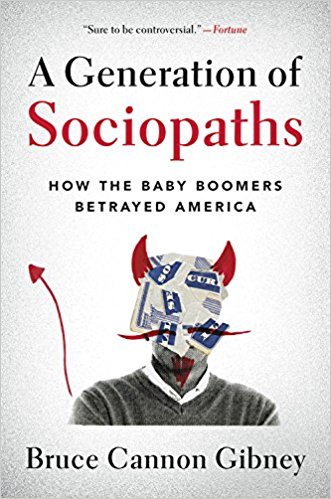
I just read a book that I’ll call the first salvo from the Had Enoughs: A Generation of Sociopaths: How the Baby Boomers Betrayed America, by Bruce Cannon Gibney. It came out this year, and Gibney’s been doing lots of media to promote it, though I always seem to miss him. When I learned about the book, and researched it as best I could, I reached out to Gibney’s publicist, requesting to interview him on my blog. She said he had no time for that, but that she would send me a review copy of the book. I jumped on that.

Gibney is a Gen-Exer, I think of the Disco Wave of that generation, giving him a fair amount in common with the Disco Wave of the Boomers. I say “I think” because I can’t find out his age. He may be 51, making him younger than the Disco Wave. In calling the Boomers “sociopaths”, Gibney goes much farther than I did. He says we Boomers, as a lot (though there will be exceptions) are antisocial, in the sense that we care nothing about society, caring only for what benefits us, what furthers out position. He quotes extensively from the Diagnostic and Statistical Manual of Mental Disorders to show how Boomer traits are anti-social.

I think Gibney's cover is horrible. But his book's selling better than mine, so what do I know?
I think Gibney’s cover is horrible. But his book’s selling better than mine, so what do I know?

Maybe so. I’m not willing to go there. I just think the Boomers are running everything into the ground through inability to manage anything. Business, government, households, pensions, all are being mired in unpayable, unserviceable debt. That’s the premise of my book. Gibney agrees. He spends a lot of time on that, though attributing Boomer failure to their sociopathic tendencies. History can judge between us.

Gibney talked about how the Boomers were raised, how they reacted to the Vietnam War, and has much to say about “neo-liberalism”. I really can’t figure out what that is, but he says it’s a bad thing, and the conservatives are guilty of it. I’d have to read the book again to better understand that part of his argument. Gibney’s book is much better researched than mine. I got a lot of data from Congressional Budget Office, and used Wikipedia to determine ages of Congress and know when the Boomers took over. My graphics are only fair; Gibney’s are much better, though I would have thought that, with the budget of a major publisher behind him, they would be stellar. They are not—only much better than my inferior ones. I also used my experience of having been a Boomer (of the Beatles Wave) and having lived through it all, something Gibney can’t do.

I disagree with much of what Gibney says, not the least of which is his definition of the Baby Boomers. He says they are those born between 1940 and 1964, they are white, and native born. I know of no other book that have the Boomers other than born in the years 1946 to 1964. I don’t know how you can exclude Black or Hispanic Americans from the Boom. Methinks Gibney is feeling a lot of white guilt. That’s okay. He made his millions investing in startups such has PayPal (started by his roommate at Stanford), Facebook, Palantir, Spotify, and more. I guess when you’re younger than 50 and worth millions, you can indulge in guilt, no longer having to worry about where your bread is coming from.

I also think Gibney focuses on some wrong items. For example, he blames the Boomers for things that happened in the 1960s and 1970s, even the 1980s, before they were in power. He kind of forgets who was in power then. But he says that those in power were catering to the Boomers, who were a large voting and purchasing block. So, it’s the Boomers’ fault that their predecessors screwed up certain things. No, I disagree. It’s the Boomers’ fault that they didn’t right the ship when they had the chance, instead letting it drift into stagnant waters and, their future being secure, didn’t try to make things better for those who would come after them.

Gibney writes with an Eastern Megalopolis view, slanted by California elitism. He is a product of the city. So am I, though my time in the Midwest, overseas, and the south for three decades has hopefully given me a more rounded perspective. Yet, having looked at the same data, come to more or less the same conclusion, we there depart the most in saying what needs to be done. Gibney says we should stop sending funds to rural areas; the cities need them. We should stop throwing so much money after the health care of the elderly (the Boomers beginning to be there), stop doing extreme procedures to extend life, instead letting the sociopathic Boomers just die and stop burdening the young. He wants to borrow $8.6 trillion to immediately fix what the Boomers ruined, and pay for it by growth, which he believes will happen once the Boomers move out of leadership positions.

My conclusion was the Boomers screwed things up by wanting benefits but not wanting to pay for them by taxing themselves, instead borrowing their children’s retirement funds and their grandchildren’s college funds. My solution: quit borrowing, reduce benefits for those who didn’t pay for them. His solution is to move the Boomers out of leadership ASAP, raise taxes, fix what they broke, and put it all on a sound footing. It’s hard to believe that, from the same data, we come to such different conclusions.

It hurt to read Gibney’s solutions. I got angry at them. Then, I remembered what I wrote in my last chapter: “They [the Had Enoughs] will embrace what Thomas Jefferson had to say about inter-generational debt, and will see entitlements as one generation unjustly imposing their will upon a later generation. What will be the first to go? A reduction in Social Security benefits will probably be first…. The Boomers will counter…. The Had Enoughs will laugh at them, and ask, if those retirement and health benefits were so important to you, why didn’t you put them on a more stable footing? Why did you squander trillions of dollars on corporate welfare to save companies you mismanaged?”

Yes, I said I longed for the Had Enoughs to make their appearance. Perhaps in Gibney they have. If so, the next two decades are not going to be pretty.

Reading Sherlock Holmes

Last weekend I finished the Sherlock Holmes stories. This has been a four-year journey, I think. I’ve blogged about it before, but, to be honest, I don’t feel like searching my archives and linking to the earlier story. Perhaps I’ll add it later.

An original Sherlock Homes illustration, by Sidney Paget.

My wife and I started reading S.H. about four years ago. I picked up the two-volume set produced by Barnes & Noble from their bargains table. I would have preferred to get the three-volume set published by Norton, for they have the chronological order of the stories identified—the order that Holmes’ adventures took place, that is, not the order they were written in. But I bought the B&N ones, so that’s what we read in. I also have a paperback of some of the stories, and I downloaded a couple of files for my Nook. As we started, we passed the B&N book back and forth and read aloud. As we got further into them, and a story was in an alternative volume, I read from that and my wife kept the other.

At some point our joint reading petered out. The language isn’t archaic, but you can tell it’s not quite modern. References in the stories aren’t always clear, so you have to decide to plow (or ‘plough’ at Watson would write) on with limited understanding or consult the endnotes. Whatever the reason, we got through the first volume and a little way into the second before we quit.

I don’t like to leave a book unfinished, so at some point I picked it up again. I read 1/3 of it, set it aside, and about a month or two  picked it up again, and, as I said, finished it last weekend.

My judgment of it…doesn’t matter. Holmes has been around for 125 years; his position in the legion of detective heroes is solid; A. Conan Doyle’s standing among authors couldn’t be higher. So whether or not I liked the Holmes stories doesn’t matter. But, this is a blog that includes my opinions, so I’ll give it. I liked the Sherlock Holmes stories, but not as much as I expected to.

The way detective stories are written has changed over the years. Now writers give clues in the story so that the reader can figure the story out along with the detective-hero. Doyle didn’t do that. Holmes has knowledge the reader doesn’t. He sends telegrams we don’t know about till after the fact. He goes places and sees people the reader knows nothing about. Partly this is because Watson is the point-of-view character. The story is always solved, but the reader is unable to assist.

If I were rating the Sherlock Holmes opus on Amazon, I’d give it 3.5 stars. But the big question I always answer about the books I review here: Will I keep it in the library, and will I read it again? I will definitely keep it. If life gives me enough years, and enough time in those years, I’ll read it again. For sure I’m going to re-read the second Holmes novel, The Sign of the Four. I must have been reading or listening without comprehension on much of that, for at the end of the book I couldn’t have told you much about it. As for the rest, re-reading will be when leisure and interests converge, sometime in the future, probably the distant future.

Book Review: Leonardo da Vinci

If I’m like many people, knowledge on the life of Leonardo da Vinci is severely lacking in the U.S.A. Popular culture believes da Vinci is a great man, a giant of the Renaissance. We know him as the painter of The Last Supper and the Mona Lisa. And as the drawer of the Vitruvian Man. But how much do we know about his entire life? What were the sum of his accomplishments aside from these few well known works?

Somewhere, sometime, most likely at a thrift shop, I picked up a copy of Leonardo da Vinci: The Tragic Pursuit of Perfection. It’s a hard copy published in 1938, a translation from a work in German. The original author is Antonina Vallentin, and the translator was E.W. Dickes. The hardcover I read doesn’t indicate the date of the original work, just the translation. The book is 537 pages, not counting the Endnotes, Bibliography, and Index. Quite a lengthy work that took me well over a month to read in eight to ten page chunks.

As I said, my knowledge of da Vinci was pretty slim when I started reading this. I learned quite a lot from the book. How da Vinci was from Florence (which I may have known); that he spent most of his most productive years in Milan (which I didn’t know); that he left behind a lot of works that would be classified as products of military engineering (which I didn’t know); that he made a poor living from his art (surprise, surprise) and had to rely on the patronage of dukes and kings, of wealthy merchants and popes to survive (as to be expected).

He felt rejected by the powers that be in his native Florence, so he moved to Milan. There he entered into the service of Lodovico Sforza, preemptive duke of Milan, and for him worked up great plans for public works, for military works, and for monuments honoring the duke. One was of a great horse, which da Vinci labored long over, and finally completed the model for what was intended to be cast in bronze. Alas, at the time of war the bronze was sold and the statue was never built.

That situation, of a work started but not finished, is the story of da Vinci’s life as presented in the book. He was always going off on studies. He was commissioned to paint a battle scene on the wall of some building, and made many sketches of of what the painting would be. He studied horses minutely so that he could be accurate in his painting. Sketches upon sketches survive in his files. Alas, the painting was never completed, in fact may never have been started. That scenario is presented over and over in the book.

Known more for his art, da Vinci left relatively few artworks that can be positively identified as his. But he left a great treasure of his written works. These show a man who was a thinker, who produced deep thoughts, wrote them down, prepared a plan for thinking them through to a scientific breakthrough—and then never finished what he started. He studied anatomy (dissecting many human corpses) of humans and animals. He studied plants. He studied rivers and marshes and developed means of re-channeling and draining them to recover land. He studied the heavens and tried to present them in a logical way to the Renaissance world. All of these he wrote out in notebooks, or sketched on paper, but never finished.

As I progressed through the book I got the distinct impression “Wow, this guy never finished anything!” A biographer has much leeway in how they write, and in the facts they decide to feature and those they decide to suppress. Ms Vallentin’s picture of da Vinci, as translated by Dickes, is not what I would call flattering. It is the story of a misunderstood and under-appreciated genius. His family never understood or appreciated him, so he moved to Florence and had little to do with them. The artistic community didn’t appreciate him.  Sforza didn’t appreciate him, and failed to follow through on the many projects da Vinci proposed. Actually, there was one area in which the duke and other patrons used da Vinci, and in which he followed through: to create temporary artworks for grand festivals. None of these survive, of course.

Two paragraphs near the end of the book provide a good summary of the book, and of the impression it leaves with me of da Vinci:

His masterpieces destroyed or decaying, his vast knowledge un-utilized, the immense mass of scientific material he had been collecting all his life preserved only in chests and boxes, in incomplete records written in a secret script and, in their existing form, quite inaccessible to mankind…Leonardo began to ask himself whether they ever would come to light. He no longer had the illusion that he could complete his many works for publication in his lifetime. He began to admit that he had attempted a superhuman task, to realize that he was defeated.

Thus was the grandest effort ever made by any man to explore and interpret the universe defeated by this man’s mortality. His unique career, a lifetime devoted to research in every field of knowledge, ended without the publication even of fragments of his conclusions. Mankind was to have to discover afresh what he knew already, to explore afresh the paths he had trodden and mapped, to fall into his errors after he had recognized them, to struggle out of all the traps he had evaded.

I suppose had I just read the subtitle I would have known what was coming: The Tragic Pursuit of Perfection. In scattering his efforts in shotgun fashion, rather than rifling in on and finishing work in narrower fields of thought and experimentation, da Vinci left the world a vast knowledge base, 90 percent complete in a hundred fields of endeavor, none of them completed. Even though he had a number of notable triumphs, it’s still sad.

The book is well written and informative. I bogged down some on the many Italian names—me, who grew up in Cranston, which is now designated one of the Tri-Guido Cities for its Italian influence and culture. But I did. I enjoyed the book, but doubt I’ll ever read it again. So out to the garage, to the shelves of books that will be sold or given away, it goes.

Book Review: 110 People Who Are Screwing Up America

I had heard about this book by Bernard Goldberg for a long time. I see Goldberg from time to time on Fox News Channel, always on the program The O’Reilly Factor, and believe him to be a thoughtful individual, who doesn’t form opinions in a knee-jerk manner based on an overall ideology, but rather thinks them through on a case-by-case basis and makes the conclusion he feels right. I like this kind of intellectual honesty.

Yet, I wasn’t about to spend money on this kind of book. Yet, when I saw one in a thrift store for 50  cents, I decided to make the investment and buy it. It’s sat on my storage table at work, in a box with twenty other books, for at least two years. Finally, looking for something to read that I could read in short spurts, ten minutes on the noon hour, five minutes on break, I chose this one.

The bottom line: I’m glad I read it, won’t ever read it again, won’t put it in my library, and will probably throw it in the trash rather than donate it back to the thrift store. It’s not a bad book, but it’s simply not worth keeping. Of the 110 people in the list I had heard of 54, I think, but knew specifics on only 2/3 of those. A lot of them I agree with; some I didn’t know enough to either agree or disagree, and Goldberg’s opinions stand without my approval or disapproval.

So what’s wrong with the book? It’s so outdated. Written around 2005, published in 2006, it misses ten years of our nation’s change. It might have been more useful immediately after being written, but now not so much. If Goldberg were to write that book now, I imagine at least 30 percent of his entries would be different.

candy-store-ebook-finalI was interested in this book because I also wrote about this topic in my book The Candy Store Generation: How the Baby Boomers Are Screwing-Up America. Of course, I focused on a whole generation rather than try to pick out a few individuals. Still, the similarity between my book and Goldberg’s helped to heighten my interest. I hope, however, that I did a better job with mine to have meaning for a greater span of years.

Book Review: Reasonable Doubt

I don’t know how many people who read this blog know that I’m a skeptic when it comes to accepting the official version of the death of president John F. Kennedy. I’ve read most things about it that I can get my hands on. My collection of books concerning this subject is fairly large.

So I was glad when I was in a thrift store and found one I hadn’t seen before. Reasonable Doubt, by Henry Hurt, is a 1985 book that purports to be an overview of the entire assassination theories up to that point, say until 1983. Thus, it is a somewhat older book, with much research having been done since then.

The book is good, not great. It covers the major theories about Kennedy’s death: Who did it? Was it a conspiracy? If so, whose conspiracy? Did Oswald have anything to do with it? Was he just, as he claimed, a patsy? If it was a conspiracy, how could it have been pulled off, and why haven’t some conspirators come forward and proclaimed their stories? All good questions.

The book covers very little new ground, though I think I learned a little something in each chapter.  The one thing that was new to me was the alleged participation of Robert Easterling. He approached Hurt in the early 1980s, wanting to tell his story. Easterling’s supposed part in it was very low level, driving some people in and around New Orleans, and in Dallas. As Hurt tells Easterling’s story, he was supposed to be the getaway driver for Oswald the day of the assassination, but Oswald didn’t show.

The Easterling connection seems very thin. Hurt describes it as such. Easterling had problems in his life, and wasn’t a source that could be believed without having corroboration. It seemed quite far-fetched that he had been used in this manner, and that the people he was “in contact” with either existed or, if they were real people, were involved in a conspiracy to assassinate the president.

The chapter on Easterling helped to lower the book in my estimation. The rest of it was good. For sure, if you were just getting involved in wondering about the murder of JFK and if the government was telling the truth about it, this book would be a good one to start with. Three stars out of five. It would have been four except for the Easterling chapter.

Book Review: Narrative of the Life of Frederick Douglass, an American Slave

Some time ago I picked up, at Barnes & Noble, a copy of their Classics edition of Narrative of the Life of Frederick Douglass, an American Slave. Of course I’ve known about this book for a long time, and perhaps should have read it a long time ago.  Alas, no matter. It’s read now.

I give it an unqualified 5 stars, and will do so on B&N soon. Not that the book needs my review. It’s staying power for over 150 years speaks for itself. The things I like about the book:

  • It’s well written; the English is clear, especially considering how little education Douglass had had by the time he wrote this. A little training in reading, and a whole lot of self-study did wonders for him and his book.
  • The book gives insights into the slave life that I haven’t read before. And I’ve read a fair amount on slavery. I realize he was in Maryland, not the deep south, and that might account for some of his experiences and how slaves lived as not being quite what I would have imagined. That’s a good thing.
  • The length was about right.
  • Although the book was an inexpensive volume, the quality is good. After reading you can barely tell I read it, the wear is so little.

What I didn’t like about it:

  • It doesn’t tell any details about his escape. I realize that when the book was originally printed he couldn’t give those details, so that those who helped him would not face consequences. I wish, however, years later he had added some of those details.
  • The Introduction was waaaaaaay too long. It was written by Robert O’Meally. I read it first, along with a review that was contemporary to the book. O’Meally wrote much too much. In hindsight I should have just read the book, then come back and read the Introduction.

This is a keeper, at least for now. I’m not sure I’ll ever read it again, but I may. It can also serve as a reference book for my work-in-progress, Documenting America: Civil War Edition. After that, we’ll see. I think, however, I’d like to pass it down to my grandchildren. The further away we get from the Civil War, the more we need books like this.

Book Review — Soul Shift

Recently our church had an all-church study of the book Soul Shift: the Measure of a Life Transformed, by Steve DeNeff and David Drury. Our pastor preached sermons from the book and our life groups studied it during Sunday School hour.

If I had to describe the book in one word, I’d say “disappointing.”

It is essentially a discipleship book with a cute title. DeNeff and Drury identified seven ways in which a practicing Christian’s life should change to be wholly devoted to God:

  • from Me to You
  • from Slave to Child
  • from Seen to Unseen
  • from Consumer to Steward
  • from Ask to Listen
  • from Sheep to Shepherd
  • from Me to We

Each of these is given a chapter in the book.

While there’s nothing wrong with the book, I suppose I was disappointed because there’s nothing new here.  It’s the same old discipleship stuff packaged differently, perhaps for a different audience.

The book is well written, though possibly a little boring in places. Also, whenever the authors used first person, they always indicated which of them that first person applied to. This was a minor annoyance that I was somewhat able to ignore as I got through the book.

I don’t think I’ll be keeping this one, nor will I likely ever read it again.

Book Review – The New Testament Documents: Are They Reliable?

It was at a thrift store, I think, that I picked up The New Testament Documents: Are They Reliable? by F.F. Bruce. Originally published in 1943, the small paperback I bought was from July 1971, and a printing of the 1959 revision of the book.

I had seen this book referenced in various other writings about the New Testament. Other writers always made it sound like a book I’d like to read sometime. When I finally found it on those mixed shelves, I was surprised at how small it was. 120 pages is all. Sure, the font is small, but still it’s a fairly short book. I haven’t done any reading into Bruce’s background, and why he would write this book and what his qualifications are to do so. That research remains in the future for me. For now the book stands on its own without me knowing anything about the author.

As, perhaps, it should be. While we want to know for most non-fiction that the author knows what he’s talking about, whatever they write should make sense regardless of who wrote it. Bruce’s little volume does.

I was surprised to see that such a small book was so highly prized and referenced. Yet, as I read it, I could see why. Bruce makes an excellent case that the New Testament is reliable both as “a witness to God’s self-revelation in Christ” as well “as a record of historical fact.”

I’m already a Bible believer, so Bruce was speaking to someone who was anxious to have his current beliefs reinforced. He didn’t disappoint me.  Starting with why it matters whether they are reliable, he moves on to the probable date the books were written and how they came to be accepted into the canon of the scripture. From there it was on to the gospels, a special chapter on the gospel miracles, thence to Paul’s writings, then Luke. He digs into the archaeological evidence for what the New Testament says, and concludes with looking at contemporary and near-contemporary writings to show how they testify to these scriptures. All this packed into 120 pages.

Bruce certainly doesn’t waste words. Nor is this work boring, though it is scholarly. I think Bruce was writing to the average Christian of the 1940s, to give them confidence, in a world that was beginning to question, that the documents upon which their faith rested were indeed reliable. He achieved that aim, in my not-so humble opinion.

This book is a keeper. Perhaps someday I’ll re-read it; or maybe go back into it as a reference for something else I’ll write in the future. If you have a chance to read it, by all means do so.

Book Review – The Oxford Inklings

I’ve known about the existence of the Inklings, the writers group to which C.S. Lewis and J.R.R. Tolkien belonged, for some time, and have wanted to read a good book about them. I had bought one for my Nook, but it turned out to be mostly a picture book—some words to support it, but not an in-depth analysis like I was wanting. For years I’ve been aware of Humphry Carpenter’s book The Inklings (1978), and have intended to read it, but have never been able to find it.

I finally found that analysis by searching, and came up with The Oxford Inklings: Lewis, Tolkien and Their Circle, by Colin Duriez. Ordered it at Barnes & Noble; it came in in March, and I read it in April.

I give this book 5 stars, and highly recommend it to others who want to know more about this group.  The book is scholarly, yet at the same time very accessible, easy to understand. Duriez has obviously done research, and knows what he writes. I learned much from this book, such as:

  • How large the Inklings were, much larger than I realized. While Lewis and Tolkien were the core, almost two dozen other writers took part in the group at various times.
  • How long they lasted, from the mid-1930s till Lewis’ death in 1963. The main years were from 1940 till 1960.
  • Exactly what kind of group it was, for improving as writers and for the fellowship only fellow writers can enjoy.
  • How important C.S. Lewis was to the group. Duriez presents him as the glue that held the group together, or perhaps better described as the rock around which the group revolved. Tolkien was as well known, and as active in the group, but Lewis more central to the group’s history.
  • The other things C.S. Lewis had going on in his life, such as the Socratic Club, his tutoring, and his lecturing. It’s been a while since I read a Lewis biography. Perhaps I read some of this before, but if so I’d long forgotten many of the details.

Suffice to say that I enjoyed this read. As a writer myself, who has been a member of several writers groups, mostly short-lived, it was of great interest to see how this group did it. I’m going to keep this on the shelf, in my growing Lewis collection. My only caution to other readers is that, if you have a good background on the biographies of Lewis and Tolkien, you might find this a little too elementary in places.

Book Review – Pollution and the Death of Man

I’ve read a couple of books by Francis A. Schaeffer, and heard/read much about him, so when I saw his book Pollution and the Death of Man at a thrift store, I bought it and put it at the top of my reading pile. I finished it about a month ago. Today I’ve finally gotten around to writing a review. My verdict: 3 stars only; not recommended to others.

The book dates from 1970, at the height of the early environmental movement. Shaeffer was living in Switzerland at that time, and looked from afar on that movement in the USA. He attempted to write a Christian response to these issues. As always Schaeffer’s writing is clear and easy to read. My problems with the book, which keeps me from rating it higher and recommending it to others, are:

1) poorly stated premises and intent.

2) no clear conclusions drawn, i.e. what then should Christians do.

3) over-reliance on two magazine articles, to refute them.

The book I have is a paperback, published in 1992 by Crossway Books. It includes an added chapter to what Schaeffer originally published, written by “Udo Middleman”, as well as reprints of the two articles. The book itself, that is the material provided by Schaeffer, is less than 100 pages.

As I read that material, I had a hard time telling the difference between what Schaeffer declares is the way things are, as opposed to how he suggests it ought to be. This led to some confusion. The book appears to have been written to refute claims in the two articles from the late 1960s which said that, at least in part, Christianity was to blame for the environmental crisis, what with their “have dominion over the earth” mentality. Not so, says Schaeffer. A Christian is a steward of the earth, a protector, and should act accordingly. That is the gist of what I took away from the book.

Some excepts and comments:

So pantheism is not going to solve our international ecological problem. Lynn White’s position [one of the articles] is not going to solve it because it is obvious in practice that man really does have a special role in nature that nothing else has. And, third, a Platonic view of Christianity is not going to solve it.

He came close to losing me with his discussions of pantheism and Platonic views. I had to plow through this part, the only part of the book that was difficult to understand.

The value of a thing is not in itself autonomously, but because God made it. It deserves this respect as something which was created by God, as man himself has been created by God.

I agree with this completely. The creation of all things by God is what gives them value. Nature has value because it was created by God and forms a vital part of what man is.

He made me as I am, with the hungers of my spirit and my body. And he has made all things, just as he has made me. He has made the stone, the star, the farthest reaches of the cosmos. He has done all this!

Again, I agree. Well stated, Mr. Schaeffer.

It is the same when we have dominion over nature: it is not ours. It belongs to God, and we are to exercise our dominion over these things not as though entitled to exploit them, but as things borrowed or held in trust. We are to use them realizing that they are not ours intrinsically. Man’s dominion is under God’s dominion.

Again, well stated. This is the closest Schaeffer comes to stating a solution to environmental problems.

…a truly Biblical Christianity has a real answer to the ecological crisis. It offers a balanced and healthy attitude to nature, arising from the truth of its creation by God. It offers the hope here and now of substantial healing in the nature of some of the results of the Fall, arising from the truth of redemption in Christ.

This is a good summary, although it really offers no specifics for how a Christian should deal with the environmental crisis, if indeed in 2015 it is still as dire—or if it is worse—than it was in 1970. Schaeffer may have been trying to make his book timeless, but in so doing he lessened the value of it by presenting no practical solutions.

For here is our calling. We must exhibit that on the basis of the work of Christ the church can achieve partially, but substantially, what the secular world wants and cannot get.

A valid statement, I think, though I’m not sure he has really made his point in the book.

When we have learned this—the Christian view of nature—then there can be a real ecology; beauty will flow, psychological freedom will come, and the world will cease to be turned into a desert.

This is perhaps a stretch. So i agree with his somewhat soft conclusion, that the Christian should be a steward of all that God has given us. This includes nature and the natural environment. Schaeffer spends too much time on visual pollution and the spoiling of the picturesque beauty of nature’s appearance, rather than on the structural aspects of environmental degradation.

The bottom line is: The book isn’t bad, but I suggest you not waste your time on it. Find a better book dealing with environmental protection. I don’t plan on reading this a second time, and so it will go in my giveaway pile.