I rarely, rarely, start a book and don’t finish it. Sometimes I put it aside for a while, either because another book requires I read it, or because the book is not to my liking and I have to be in just the right mood to finish it. But I have just laid aside a book, unfinished, and placed it in the sale/donation pile. I won’t pick it up again.
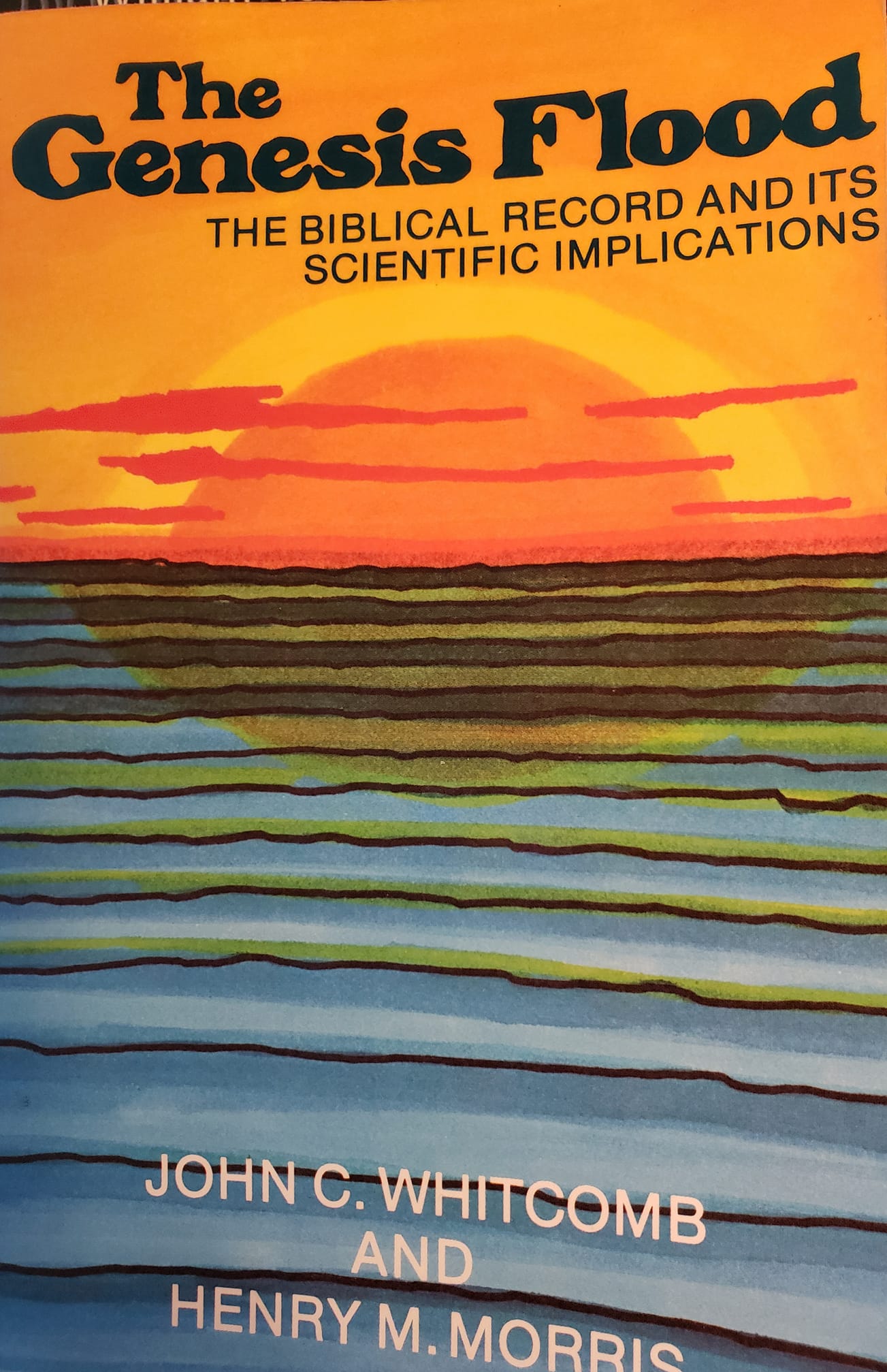
Sorry, Messieurs Whitcomb and Morris, but your book didn’t speak to me. I abandon it and exile it to the sale/giveaway table.
A while ago I went looking for a book I was pretty sure was in a certain spot on our downstairs bookshelves, about the biblical book of Genesis, one I’ve been planning on reading but had kept putting off. But when I looked, I couldn’t find it. Another book was more or less in the place I thought that book was: The Genesis Flood. Fine, I thought. I’ll read that one since I found it and worry about the other one later.
Big mistake. TGF turned out to be a difficult book to read. It is filled with scientific names. It is also, to a great extent, composed of quotes from many sources rather than the authors’ own words. I have read books like that before, and large blocks of quotes tend to make the book difficult. Maybe boring.
I think the authors were building up to the creation of the world as having taken six literal days, rather than six periods of time. I think. They were holding their conclusions close to the chest. They began the book by looking at the different theories of historical geology, and how geologists have interpreted data throughout the ages, and why these different interpretations were insufficient to explain the data. I found this section not as well written as I would have liked, and was glad it was over.
But the next section, where they started to explain how the biblical flood explained the inconsistencies in the geological data wasn’t any better. I concluded these authors weren’t writing for me, or to be a popular book, but rather a scholarly book for geologists. I’ve read a couple of such books before. I finished them, but found them most difficult to get through.
Will I ever find the book I was looking for? Maybe I’m confusing The Genesis Flood for the book I was looking for. Or maybe it’s in a box somewhere. Ah, well, I have plenty of other books to read, so no need to spend a lot of time searching right now.
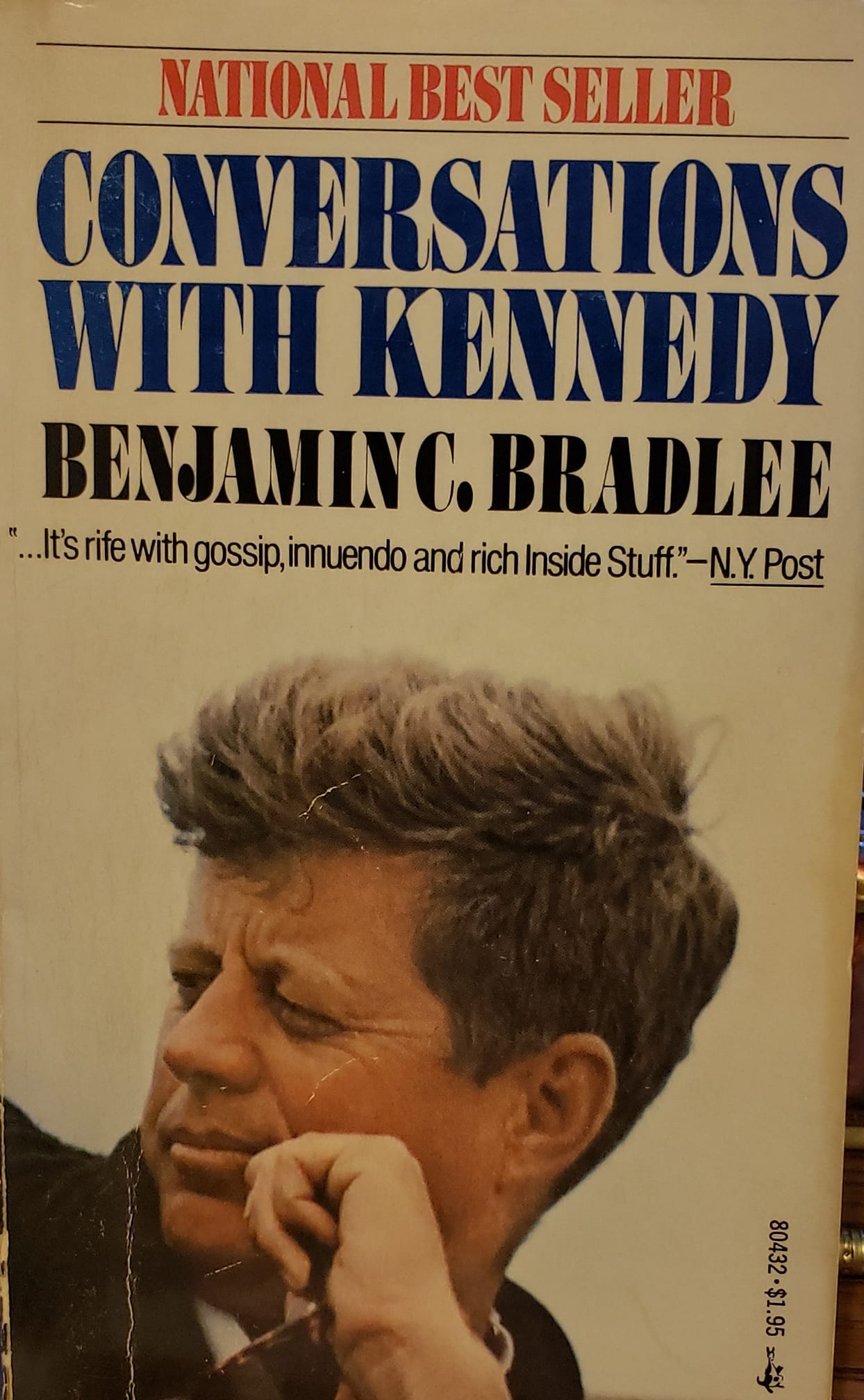
The conversations took place from about 1957 to 1963, but the book was published in 1975.
I have a fairly good collection of books about JFK, most of them read, several reviewed on this blog. One I hadn’t read yet was Conversations With Kennedy. It’s by Benjamin C. Bradlee. At the time the events of the book took place, Bradlee was a columnist with Newsweek magazine. Later he would go on to be managing editor of the Washington Post newspaper, a sister publication, and gain fame in the Watergate era.
When JFK was a senator from Massachusetts in the 1950s, recently married to Jackie, he was a neighbor to Bradlee, a few houses away in the Georgetown area of Washington D.C. Similar in age, similar in political views, and from relatively the same social circles, the two men became friends. They met socially, sometimes with their wives, sometimes alone or with Robert Kennedy or others. At some point in the relationship, fairly early on, Bradlee began taking notes on their conversations, realizing they could well be of historical significance. This continued when Kennedy became president in 1961.
Now, this arrangement sounds unethical to me. How could Bradlee, who wrote on politics for Newsweek, sometimes on JFK himself, befriend the person he’s supposed to stay neutral on? He could pick up behind the scenes info that no other reporter could get. But, if JFK was his friend, could Bradlee really write objectively on him?
Kennedy knew what he was doing, however, and I’m sure cultivated the friendship to foster positive press. Sure, he probably genuinely liked Bradlee and his wife and children, but still, the relationship smacks of unethical behavior by both men. But should reporters and journalists be required to give up or avoid friendships just because of their jobs? I wonder.
The book is well-written. Most of the chapters are short, as the notes were not extensive. Bradlee is a good writer. The information is of importance in history and is worth knowing. I’m glad that I read the book.
I rate this book 5-stars. But is it a keeper? It’s a mass market paperback, cheaply made, and a few pages at the front are falling out. On the other hand, I have an extensive collection of JFK books. I think for now I will add this to that collection, but I’m seriously thinking of getting rid of them all, selling them as a lot. I have one more to read (I think only one), after which I may just sell them. So this will go on the shelf for a short time.
This thin, mass-market paperback was an okay read, but is not a keeper. I have another, more complete collection of her poems.
Almost all I know about poetry I learned by myself. A series of secondary school English teachers covered poetry every year, and I’m afraid I was a poor student of it. About all I learned was the names of the major poets, and a little of what era they were in.
One of those names was Edna St. Vincent Millay. I knew of her, but nothing about her. That changed after I began studying poetry about twenty years ago. I read somewhere (probably Wikipedia) a short bio about her, and read a few of her poems in different anthologies. Then I picked up a biography of her and read it, telling me something about the woman. Finally, in my library, on my poetry shelf in the storeroom, I found Collected Lyrics of Edna St. Vincent Millay. This little mass-market paperback belonged to my sister, for she signed it and put her homeroom down. it was published posthumously in 1959. This particular printing was from 1966.
Lots about poetry confuses me. What do they mean by “Lyrics”? They mean lyrical poems, I realize, but how do lyrical poems differ from other poems? I tried to figure that out some years ago and failed to grasp the difference. I do note, however, that this book contains none of Millay’s sonnets. So I reckon sonnets are not lyrical poems. I’m starting to think that lyrical poems are poems that don’t fit into a prescribed form—although I’m sure that’s not right.
No matter. The poems collected in this book run the full length of Millay’s poetic career, from Renascence in 1919 to Huntsman, What Quarry? in 1939 and scattered poems after that up to her death in 1950. She was quite a gal. I won’t go into her background. Let’s just say it’s well worth reading a biography about her.
As to the poems, I have a mixed reaction. I would for sure say she is not among my favorite poets. I had difficulty finding meaning in many of hers. Because of her background, one first attempts to read her poems as autobiographical. Maybe they are, maybe they aren’t. I prefer to assume any poet’s poems are not autobiographical. But so many of hers I just can’t figure out. To keep from glazing over as I read her poems, I read the book slowly, a few pages at a time, over almost a year. Maybe it was more than a year. In hindsight that may not have been the right decision.
I tried to read the poems carefully, not glossing over them. Many I read twice, having come to the end of one and thinking “What did I just read?” Alas, most of the time the second read made little difference. I still had little understanding of the poem.
So my two questions I try to answer in these reviews: Should you read this, and is the book a keeper? Reading poetry is a good thing; Millay is a major poet from the not too distant past; so yes, you should read her. Whether her lyrics taking in isolation from the rest of her work is another question. I think maybe a different of her books is in order.
As to keeping this, that’s a harder question. Or is it? So far, I’ve not sold any of my poetry books. But I have another book of Millay’s poems, one that is more complete than this one. I don’t know that I need two. So, off it goes. I’d return it to my sister but I’m sure she won’t want it. Nope, into the sale/giveaway pile it goes. Goodbye, Edna. See you in another book.
This is like a time capsule of Christian fiction around the turn of the millennium. Well worth the read for anyone writing Christian fiction.
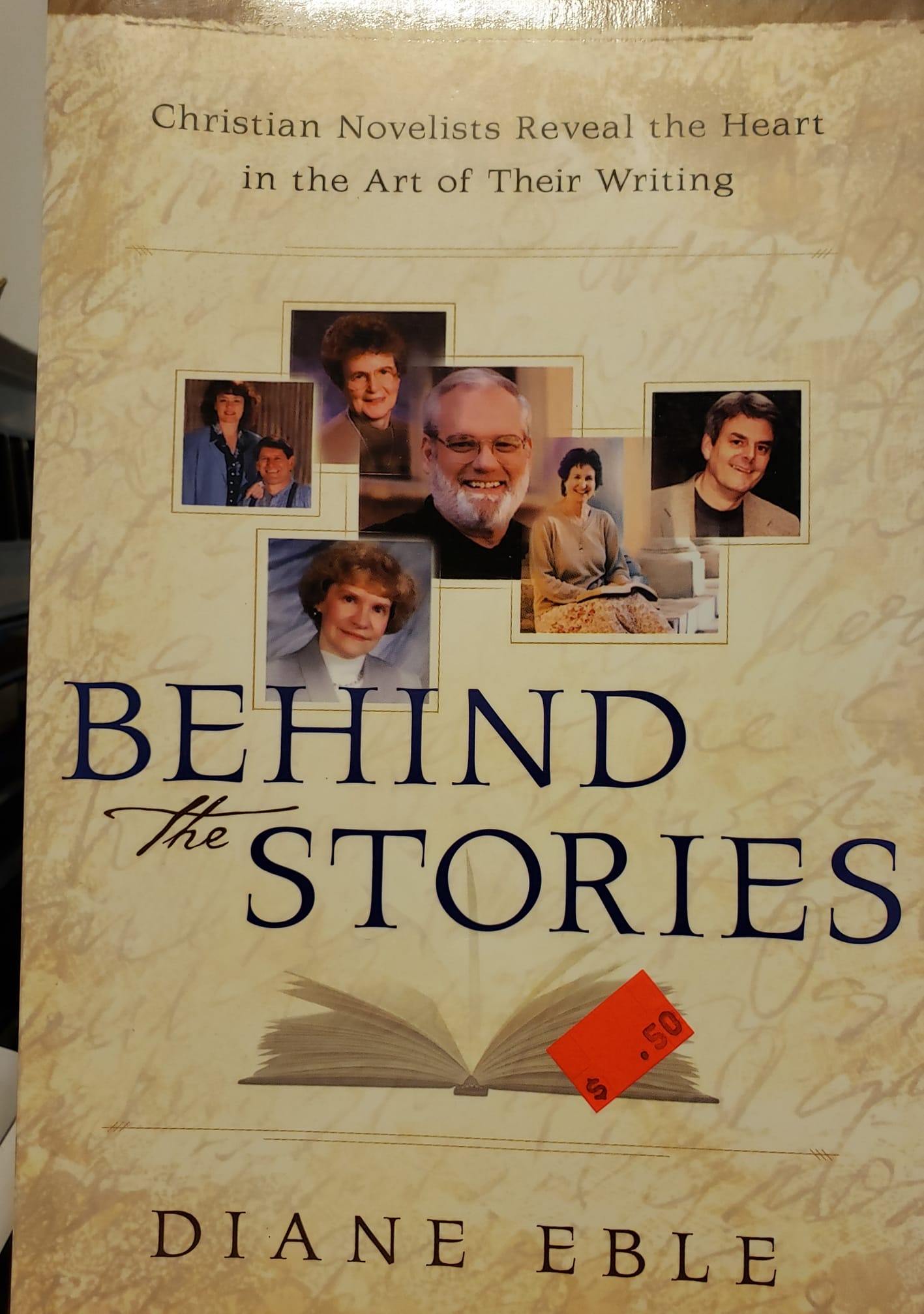
Some time ago (as in a couple of months), having finished reading a book and wanting to find one to read that I wouldn’t keep, thus reducing my inventory, I found on the bookshelf tucked in my close Behind The Stories: Christian Novelists Reveal the Heart in the Art of their Writing. I don’t know where I got this, but suspect I picked it up at a thrift store. Nor do I know how long I’ve had it, but I suspect ten years. The copyright date is 2002. I have a fair number of books for writers on writing and publishing, and I need to work through them, read the ones I haven’t read and decide if any of the ones I have read I shouldn’t keep.
That makes it almost a time capsule type of piece. The author is Diane Eble, though in some ways she is more of an editor than an author. The book covers three to four page stories from 40 Christian novelists. This is as things existed in 2002, or a year before that based on publication schedules. So it misses any that came to prominence before that. Many of the names are familiar: Jerry B. Jenkins, Karen Kingsbury, Janette Oke, Bodie Thoene, Terri Blackstock, Francine Rivers, Beverly Lewis. Others are not as famous, but I actually met some of them at writers conferences: Robin Jones Gunn, Alton Gansky, Angela Elwell Hunt, Deborah Raney. They cover the full spectrum of types of Christian fiction.
It was encouraging to read their stories. Almost every one of them went through some kind of trial. Maybe it was a difficult childhood. Maybe it was a struggle to find their voice. Maybe it was the busyness of life. Each persevered and found authorial success. That is an encouragement for me.
I rate the book 4-stars. It loses a star for something I can’t quite put my finger on. And, it is not a keeper. Next time I leave The Dungeon, I will go out to the garage, and take it to join the other books for sale. Maybe someone else can find meaning in these brief stories.
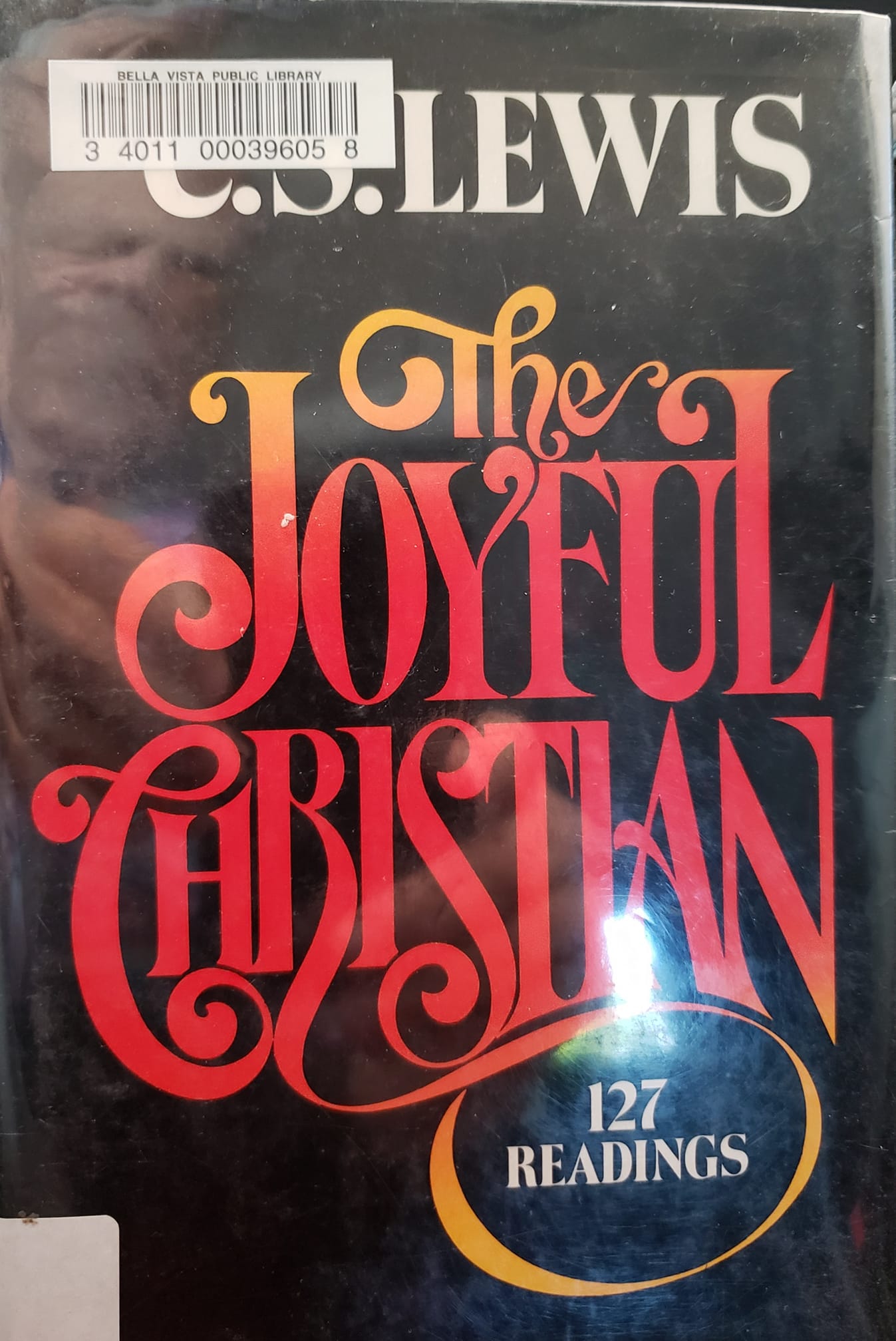
A posthumous compilation of excerpts from a number of Lewis’s writings, this was a little hard to get maximum value from.
When you get a library book you are under a deadline to read it. Oh, sure, sometimes you can renew it, but you can’t count on that. In early August we went to the Bella Vista Library, mainly to get some novels in a certain series. I browsed (after taking a look through the large, recent expansion that seems to have doubled the library’s size). Nothing struck my fancy, as I have many books at the house I’ve yet to read
But I found this C.S. Lewis book, The joyful Christian: 127 Readings. I’m a sucker for anything by C.S. Lewis, and it’s a shame to go to a library and not bring something home, so I checked this one out. Three weeks to read it and get it back.
C.S. Lewis, however, is best read when you have plenty of time and no distractions. I wouldn’t say I had plenty of time to read this, but I had enough time. The readings were pulled from many of Lewis’s writings. At the place in the book where the writings were, the publisher/editor didn’t provide from which of Lewis’s writings the reading came. You had to go to an index of writings and look under the title given to the reading. I did that for a while, but found it unfruitful and quit before I got 1/3 through the book.
The book was a little weird, what with the readings coming from so many works. I didn’t think they all fit the theme of “joyful Christian”. But it was good. I don’t think I’ll read it again, but it was good.
It’s now back at the library. I wasn’t prepared to spend time there, so I just left it in the outside book drop. Now, back to my own library.
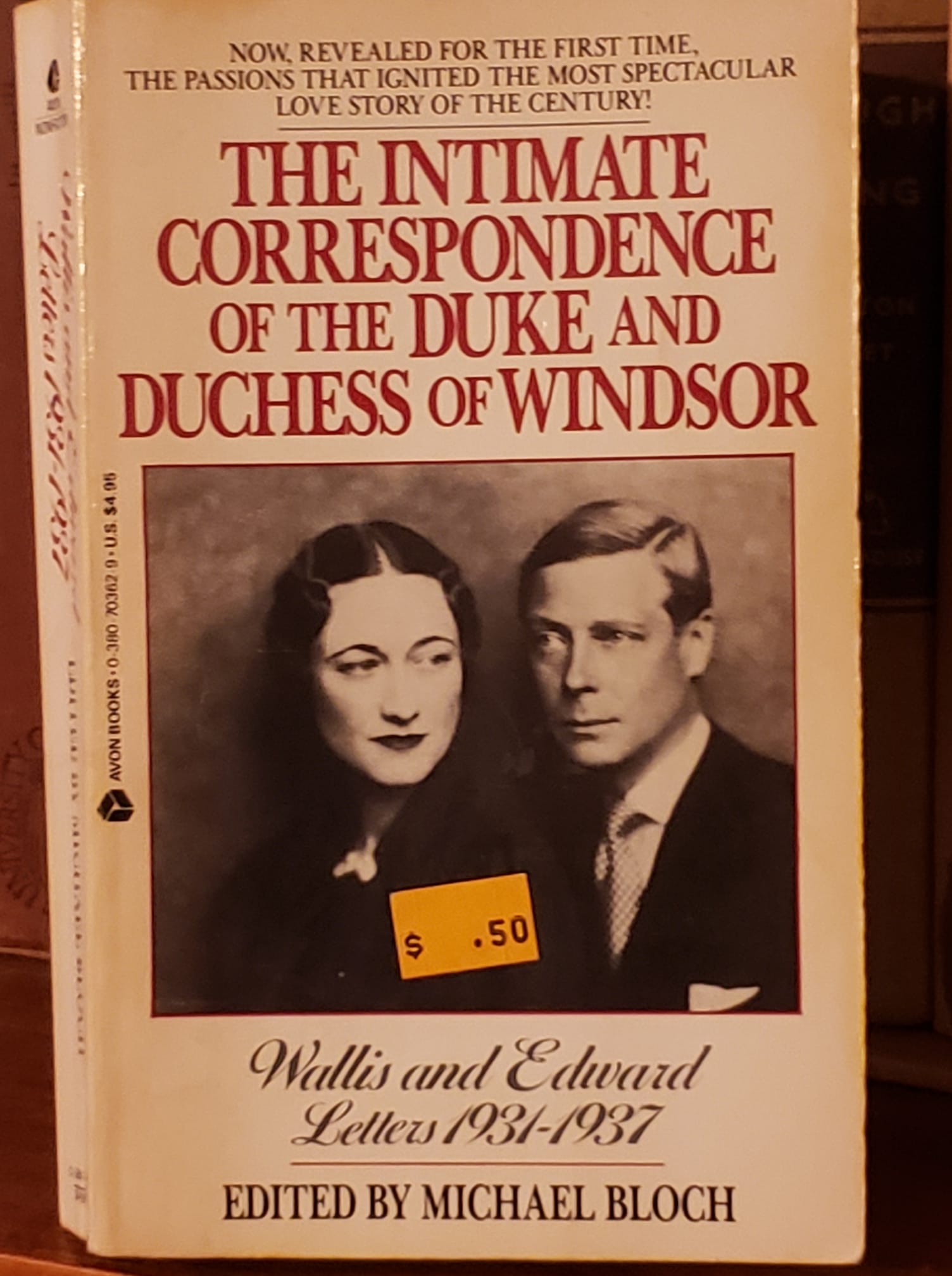
Their relationship, an affair or not, rocked the British world in 1936 and had repercussions for years afterwards.
About a month ago I made a deep search through my reading piles that sit on a bookcase in my bedroom closet. I added a fair number of books to this pile some years ago and have been slowly reading those books. So having finished another book, I went there to see if one on the shelves would be suitable for my next read.
I found the book The Intimate Correspondence of the Duke and Duchess of Windsor. The subtitle is, I guess, Wallis and Edward Letters 1931-1937. I say “I guess” because the layout of the cover is strange, and it’s not clear to me that this is the subtitle. I picked this book up at a thrift store many years ago. Now, I’m not a big fan of the British monarchy and their whole system of nobility, but I love letters. That’s why I bought the book.
I won’t go into much of the history. Some people know it, some don’t. Edward was heir to the throne of England. Somehow he met Wallis Simpson, an American woman living in England. The were frequently together in social situations. The crown prince became enamored by her and, even though she was married (after a prior divorce), Edward ditched his girlfriend for her. Even though he was 37 when he met Wallis, Edward wasn’t ready to marry.
The letters in the book are mixed with a considerable amount of commentary. I was surprised that most of the letters weren’t between Wallis and Edward but between Wallis and her Aunt Bessie. They are interesting letters, tracing the development of the prince and her meeting, then getting to know one another, then becoming dependent on one another. The letters between Edward and Wallis begin only after several years of their relationship. And, they are not intimate in the sense we think of today. They don’t give salacious details of secret rendezvouses and trysts. They mainly consist of cute little things like “oh wasn’t that a great dinner party last night, my love?” As the relationship grew, the letters were more and more how he couldn’t live without her, how she loved him, but that it was all so futile.
Two things came out clearly to me from the letters, mainly the prince’s. He was terribly immature. Raised by governesses and tutors, with little involvement from his parents, Edward sounds like an 8th grade schoolboy as he writes to Wallis. All he knows are parties and pubs. Oh, he had duties, I realize, but they are rarely mentioned. Edward had regular, somewhat small parties at his country home and rarely interacted with his family. Wallis became more and more estranged from her husband, who was also a friend of the prince. Eventually Mr. Simpson has an affair with her good friend, giving her grounds for divorce.
Just in time, too, because Edward’s dad dies and he becomes king on Jan 20, 1936. And here the second thing that came out clearly begins. Naturally, all Britain wanted the king to marry, be happy, give them a queen, and hopefully produce an heir. But the king wants to marry a soon to be twice-divorced woman—an American to boot—and parliament won’t allow it. It was around September 1936 that the existence of Mrs. Simpson comes to the awareness of the British public. The prince has already been discussing this with the prime minister. He says Edward can’t marry Wallis. She will never be queen. If he does marry her, the entire cabinet will resign. Parliament will never agree to grant her any royal title. And this is what is so bizarre to me. The ministers and parliament—the government—have to approve who the head of state marries? That’s absolutely absurd, and it’s one of the reasons I think monarchy is ridiculous. Edward decides he can’t be king unless Wallis is by his side. See how immature he is? He gives up his throne and must leave the country in disgrace and exile.
But I prate, and have moved away from the book. While the letters were not quite what I thought they would be when I paid 50¢ for the book at a thrift store, I found it all captivating. It’s history, whether the persons involved are attractive to me or not. I found myself able to read many pages a day and rarely skipped anything. Yes, the commentary was more than I’m used to in a collection of letters, but it was not too much. I think the editor, Michael Bloch, got it about right.
I give this book 4-stars. Sorry, but I can’t give one about British royalty a full 5. But is it a keeper? I have a nice collection of letters, a number of which I started but few which I finished. The answer is no, it is not a keeper. I don’t see myself ever reading this again. So out to the donation pile it goes. Or I’ll sell it or give it away if one of my readers (you know who you are) wants it.
Why not keep it to have a broader collection of letters? That’s a good question, but ultimately why do I need to keep a collection of collected (or selected) letters? I don’t. They would be one more thing for my heirs to have to deal with when I’m gone. No, Edward and Wallis go out to the garage. I hope to recover the 50¢ for them, but will gladly see them go without recovering my investment. They were worth that price for sure.
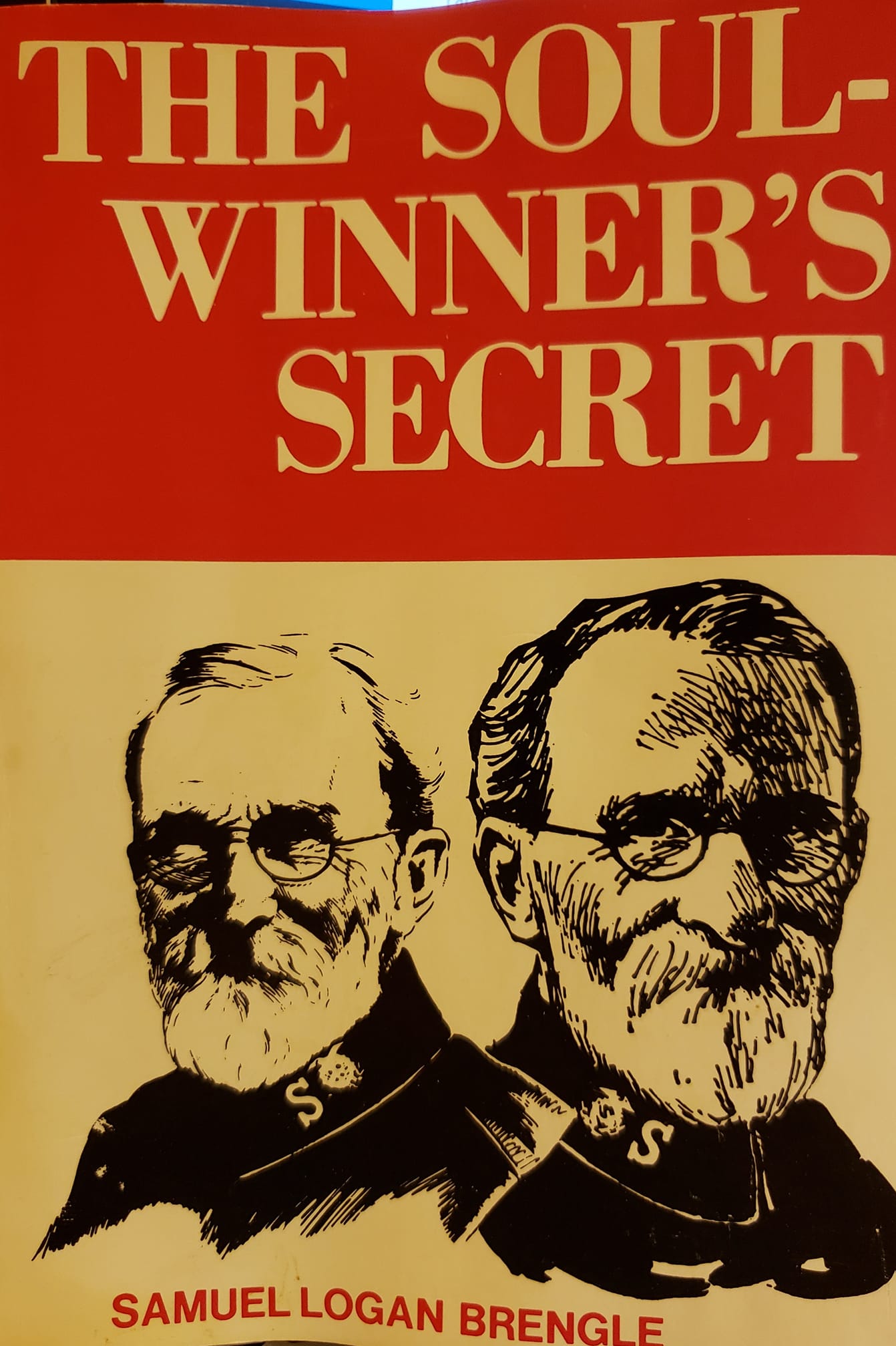
Back in May I reviewed a book re-published by the Salvation Army entitled Love Slaves. I was critical of it, though admitted it did me good to read it. I said in that review that this would be a book for sale or donation. What I didn’t mention was that I had another book in the same series to read. That I did, finishing it last month in my wife’s and my reading aloud in the evenings time. This one is titled The Soul-Winner’s Secret and it’s by the same man, Samuel Logan Brengle of the Salvation Army.
Not one of a pair as I first thought, but one of a dozen or so. They will all be going for sale or donation.
Originally published in 1903 and re-published in 1984 (the date of this copy), my review could be nearly a carbon copy of the last review. The language is just old enough to be archaic. Sentence structures are often convoluted, with multiple levels of defining clauses, requiring re-reading, leaving out the inserted clauses, to find out what the meat of Brengle’s message was.
The message of the book is good. Winning souls for Jesus doesn’t happen by chance. The one who wants to see people added to the kingdom of God on earth must go about it deliberately, with much preparation, prayer, follow-through, and renewal. Chapter titles include:
The Soul-Winner’s Personal Experience
Be Obedient
Prayer
Zeal
Spiritual Leadership
What to Study
Personal Health
Prepare to win souls. Study to show yourself approved. Continuously renew your commitment and knowledge. Mind your own health (spiritual and physical) as you do so. Keep at it. Don’t lose your zeal.
As with the other book, this one, while good, is not a keeper. The next time I need a refresher course in my own role in expanding the kingdom of God, I will find a more modern book that is relevant for conditions in the world today. My rating on it is 3-stars, the markdown coming mainly due to the language issue.
But, a funny thing happened when I planned to put this and the other one out on the donation/sale table. About a week before we began reading this, I went to our basement family room, where the biggest part of our library is. Shelves line the west and half of the north wall. But some of those north shelves are hidden by the Christmas tree we keep up year round (it’s a long story). I reached behind the tree one day in June or early July to grab a copy of John Wesley’s Journal, and on the shelf below it I found a whole series of these books, identical binding and covers except for the title. Maybe twelve books in all including the two we read.
How did these two get separated from the set? The shelf I saw the series on was the bottom shelf. Back in 2010 or 2011, we came home from vacation and found our basement wet due to a hot water heater gone bad. The books on the bottom shelf of three book cases were damaged. Rather than throw the damaged ones away, I put them on a table by my computer desk and slowly, while waiting for something to happen on the computer, would open one of them and separate pages. These two books must have been the only ones of that set that were damaged.
I believe I’ve read enough of the set. The two books, which were barely water-damaged, will find their way back to their brothers and thence to the donation/sale table. But, if any of my readers want them, I’ll be happy to send them to them for just the cost of shipping. If you want to know all the titles first send me contact information and I’ll be happy to give you the list.
It took me at least ten years to finish this. A combination of many things to do and read, and maybe some repetitive boring passages and extraneous material caused me to set this aside for most of that time.
If you start reading a book, get 3/5th of the way through it, lay it aside, and pick it up again and finish it ten years later, does that say something about the book or about you?
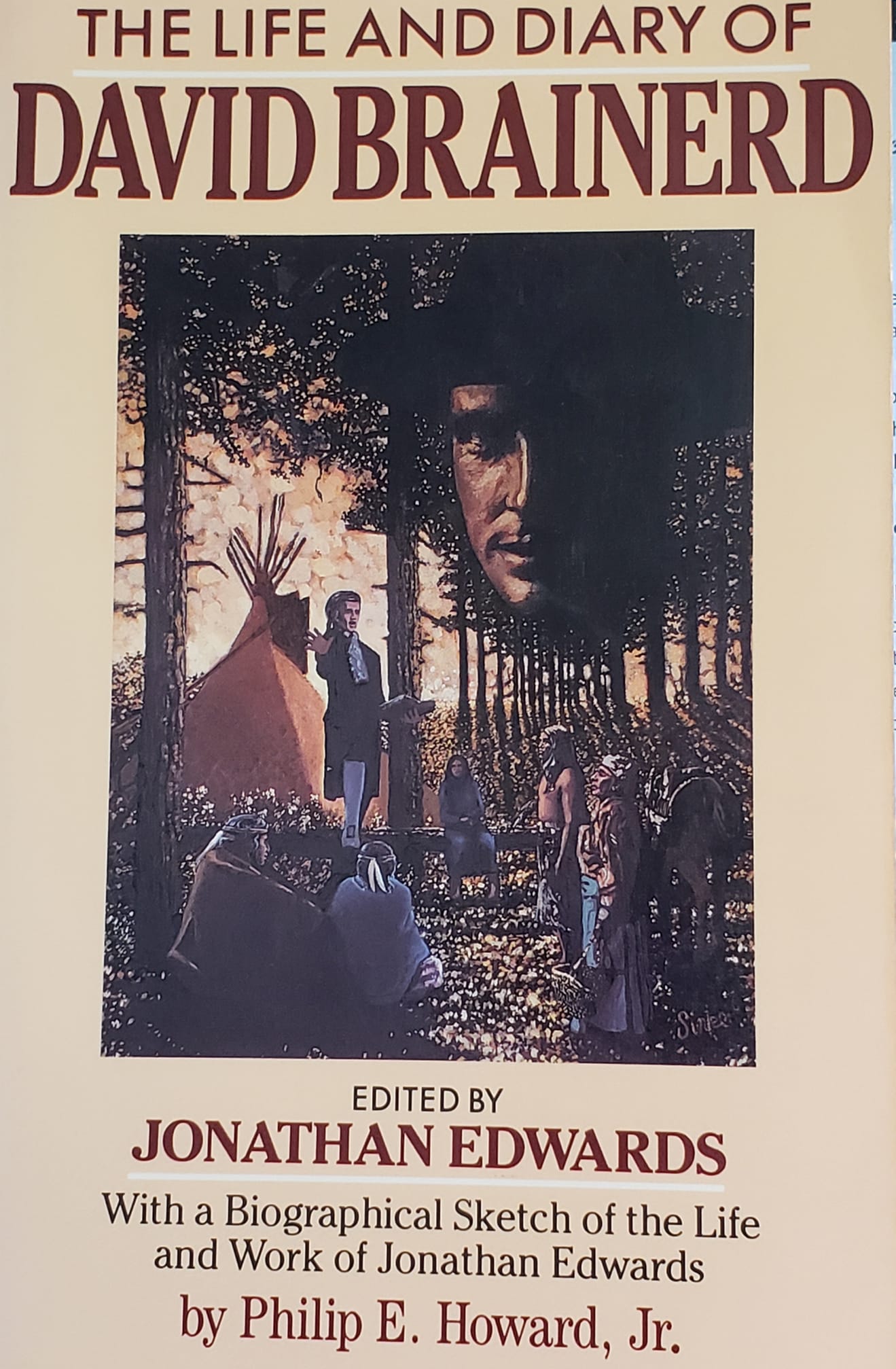
That’s what happened to me with The Life and Diary of David Brainerd. It might actually be more than ten years, though for sure less than twenty. My edition of this book was printed in 1989 by Baker Book House, a reprint of the 1949 edition, edited by Philip E Howard, Jr. The original diary and life dates from 1749, first written and edited by Jonathan Edwards, the famed preacher.
Brainerd (1718-1747), from Haddam Connecticut, attended Yale University then became a missionary to the Indians, specifically the Delaware Indians of northern New Jersey. But he was a sick man, suffering from what modern scholars believe was tuberculosis. He had considerable success in his evangelistic efforts.
Brainerd kept a diary and journal at various times during his ministry. Sometimes this was required by the organization that sponsored his ministry. Sometimes he wrote of his own accord. After his death following a lengthy decline, Edwards, in whose house Brainerd spent his final months, had all the younger man’s journals and edited and published them, along with biographical material that Edwards wrote.
The journal is, like many journals are, somewhat boring. Brainerd wrote much the same thing from day to day. At least he did at certain times. At other times, especially in his last three years, he had more substantial and varied writing. It was more interesting. He was quite a man, working through poor health to evangelize the Indians. He took part in their everyday lives, not just preaching to them. It seems that the Indians loved him and regretted his parting from them when his health no longer permitted him to work.
Why did I put this book aside all those years ago? Like I said, it was somewhat boring. That was just the early part. Had I persevered, I would have come to the last third, which was considerably more interesting. I was also put off by the lengthy biography of Jonathan Edwards included. Philip Howard used 30 pages for a bio of Edwards, then two pages of a list of Edwards’ works. That left 320 some pages of the Life-Journal-Diary. I remember thinking that, if I wanted a bio of the fiery Edwards, I would have read a biography of him. For me, at the beginning of the book, it was wasted.
I picked up the book again about a month ago and finished it. I did so because I don’t like to abandon a book I start. Also, because I figured the book wasn’t a keeper. I wanted to finish it, then put it out for sale or donation. Finish it I did. And, as I thought, it isn’t a keeper. Once I finish this post, off to the garage it will go for disposition, one more book read and off the shelves.
I probably sound too negative. It’s a good book. If I were to rate it I’d give it 3 or 4 stars. It’s just not something I see myself ever reading again.
While we were in Orlando in May-early June, we took a morning to go to a Books-a-Million store near where we needed to pick up some first aid supplies. Lynda cut her foot on a barnacle-encrusted rock at the beach and had stitches. I also needed to take care of something at the pharmacy. Our errand completed, we went around the corner to the book store.
This book has an important message for the USA, but they way that message is presented rates it 2-stars from me.
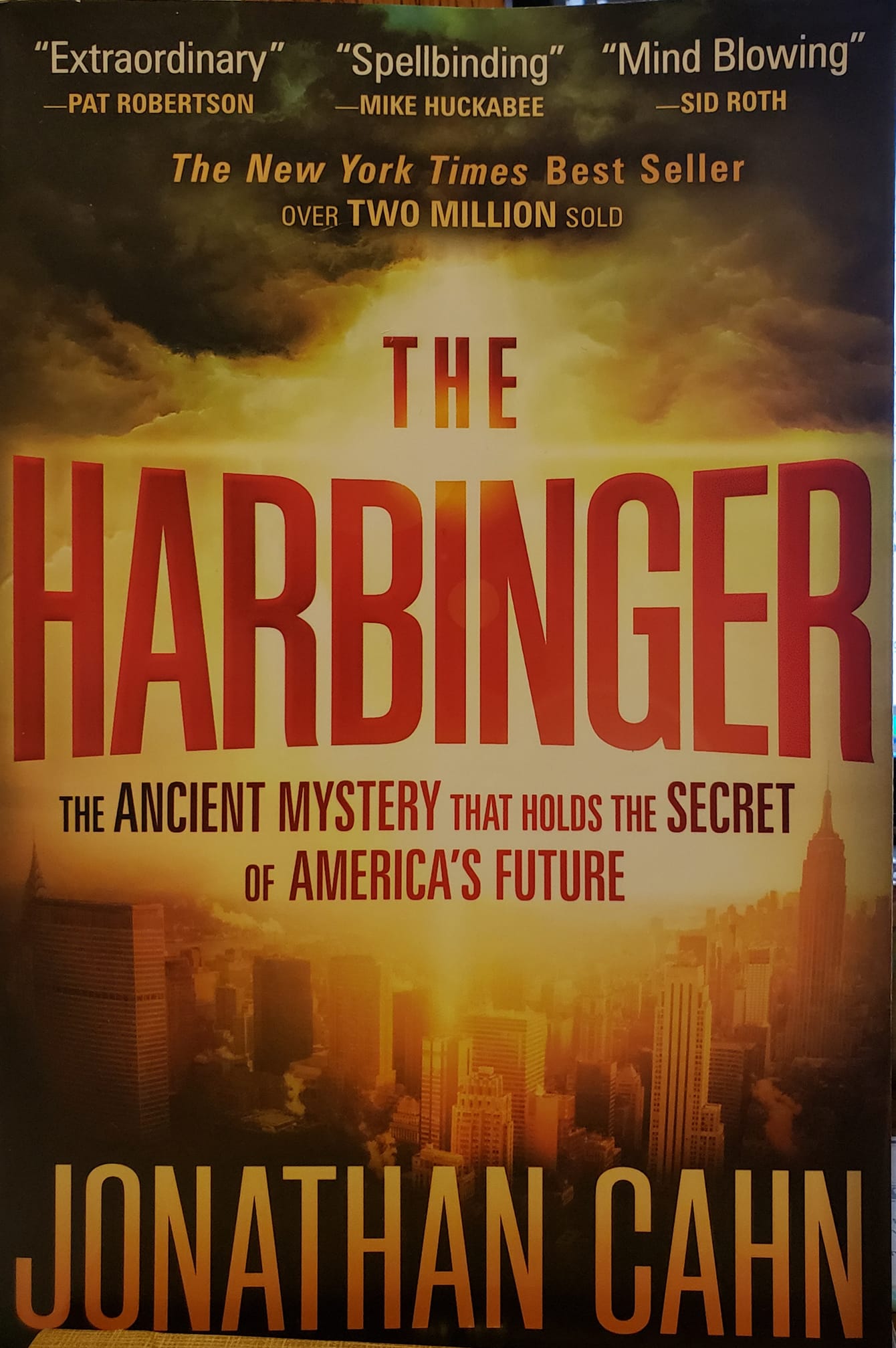
That’s a favorite activity of mine, to go to a book store (or a library works just as well) and browse, select, read while drinking coffee, and probably not buy. On this day I bought a writer’s magazine, and Lynda bought The Harbinger by Jonathan Cahn. Cahn is a Messianic Jew, and Lynda listens to his podcasts. I’ve listened some too, but haven’t heard them enough, or paid attention enough (I’m always multi-tasking) to get a good feel for what his message is. This book was our evening reading for much of June.
The subtitle of the book is “The Ancient Mystery That Hold The Secret of America’s Future”. The book essentially draws out parallels that Cahn sees between Isaiah 9:10-11 and the events of 9-11 and the years since then. It’s a warning—a harbinger—for America, to turn back to God.
In Isaiah, God’s protection was prophesied to be removed from Israel (the Northern Kingdom) and, because their response to God’s rebuke was incomplete, another judgment would fall on Israel. This happened to Israel, just as Isaiah prophesied.
The literary technique used by Cahn is a dialog, or actually two dialogs, between Nouriel and 1) an investigative reporter named Ana and 2) an unnamed prophet. It was this prophet who gave Nouriel a series of seals. Nouriel had to investigate what the seals meant. As he followed the clues, the prophet would suddenly appear and help him to understand what the seals meant, what Israel went through, and what the USA was going through.
I find it difficult to find any fault with what Cahn says in the book concerning the fate of the USA. He could well be right that we are on a declining leg of our up and down history, and there may not be a future up leg. Our zenith may indeed have happened and it’s all down from here. Cahn doesn’t lay out a litany of what’s wrong with America. Simply that we as a nation have turned away from God; that 9-11 was evidence that the hand of God’s protection has been removed from us; that we did not respond to that warning with repentance and turning but with defiance and bravado; that other judgments have come upon us and are still coming. I won’t say he’s incorrect about any of those. The book was copyrighted in 2011, and much has happened since then.
However, Cahn’s literary vehicle was not good. In fact, I’d call it bad. The dialogs between Nouriel and the prophet and Nouriel and the reporter were tedious and repetitive. The seals were a contrivance to build the story on. A simple statement of the message Cahn wants to give (Wake up, America! Wasn’t 9-11 enough? Wasn’t the Panic of 2008 enough?) could have been given in 100 pages or less instead of the 253 pages in the paperback we read.
He could have avoided the silliness of the seals. He could have spared us the endless dialog, and scenes of lower Manhattan or of various places in Washington D.C., where Nouriel and the prophet met up. Rabbi Cahn, if you read this, those things detracted from your message, they didn’t add to it.
It seemed that every night as we read, and I waded through the dialog or descriptions of what was on a fictitious seal, I would say aloud, “Well, he just lost 5 stars,” or “No way I can give this 4 stars.” In fact, if I post a review on Amazon, I will likely give it 2 stars. It would be 1 star for organization and writing, but higher for message.
In my mind, this book is not a keeper. I don’t ever plan on reading it again. Lynda will likely want to keep it. So on the shelf it will go.
As we continue to try to whittle down our inventory of books by pulling some off the shelf or out of piles that look like they will be good to read but not necessary to keep, my wife pulled Daniel off the shelf. It’s a Bible commentary volume by J. Vernon McGee, based on his radio “Through The Bible” broadcasts.
Every now and then I would catch McGee’s program while driving in the Kansas City area back in the late 70s/early 80s. Years and years later, in the first decade of this century (I think), I would catch it again sometimes. I enjoyed the program. The latter round was just a re-broadcast of the earlier programs, with a new intro added. I think Lynda picked up this book at a yard sale or thrift store. I know we didn’t buy it new.
It was an okay book. McGee’s broadcasts were for the layman and, since this volume is said to be more or less a transcript of his broadcasts (slightly modified as would be needed for a book), it’s easily read and provides some good information and explanations of the book of Daniel. I’ve read many other commentaries as I do my Bible studies and prepare to teach adult Sunday school, and find them almost written for scholars by scholars, not for laymen. This aspect of the book I liked.
I found the organization difficult. Where Daniel had his visions or where he interpreted the dreams of others, McGee put the commentary of the interpretations with the dreams/visions, rather than hold them for the verses of the explanations. Then, when he got to the verses of the explanations, he had nothing to say but to repeat what he had already said. It seems to me that if the Bible is clear, the commentator shouldn’t have to say much. Of, if the Bible repeats itself (as it sometimes does), the commentator should say little. McGee did that to some extent, but perhaps not enough.
In his defense, it’s a tough thing to write a commentary in a repetitive situation. I don’t think I could do any better. McGee also did a good job sorting out the historical context. The Bible doesn’t give a list of the Babylonian kings, or those of the Medes and Persians. That has to be obtained from non-biblical sources. McGee gives that info—a good thing.
Right after reading McGee’s book, we got out the Matthew Henry concise commentary and Daniel read that, sort of as an exercise. When I’ve used Henry’s commentary before, I found it different than others, having more of a insights for living a Christian life feel to it than just a technical explanation of the Bible. I thought, therefore, we might gain some of those insights. Alas, it wasn’t as good for that purpose as I hoped it would be. It’s still a good commentary; just not something you can read as sort of a devotional.
I’m glad we read McGee’s book. I give it either 3 or 4 stars. But it is not a keeper. Today it will go on the sale/donate table. Nor will I go out of my way to acquire any others in the series. It’s good, but not good enough in our era of dis-accumulation.