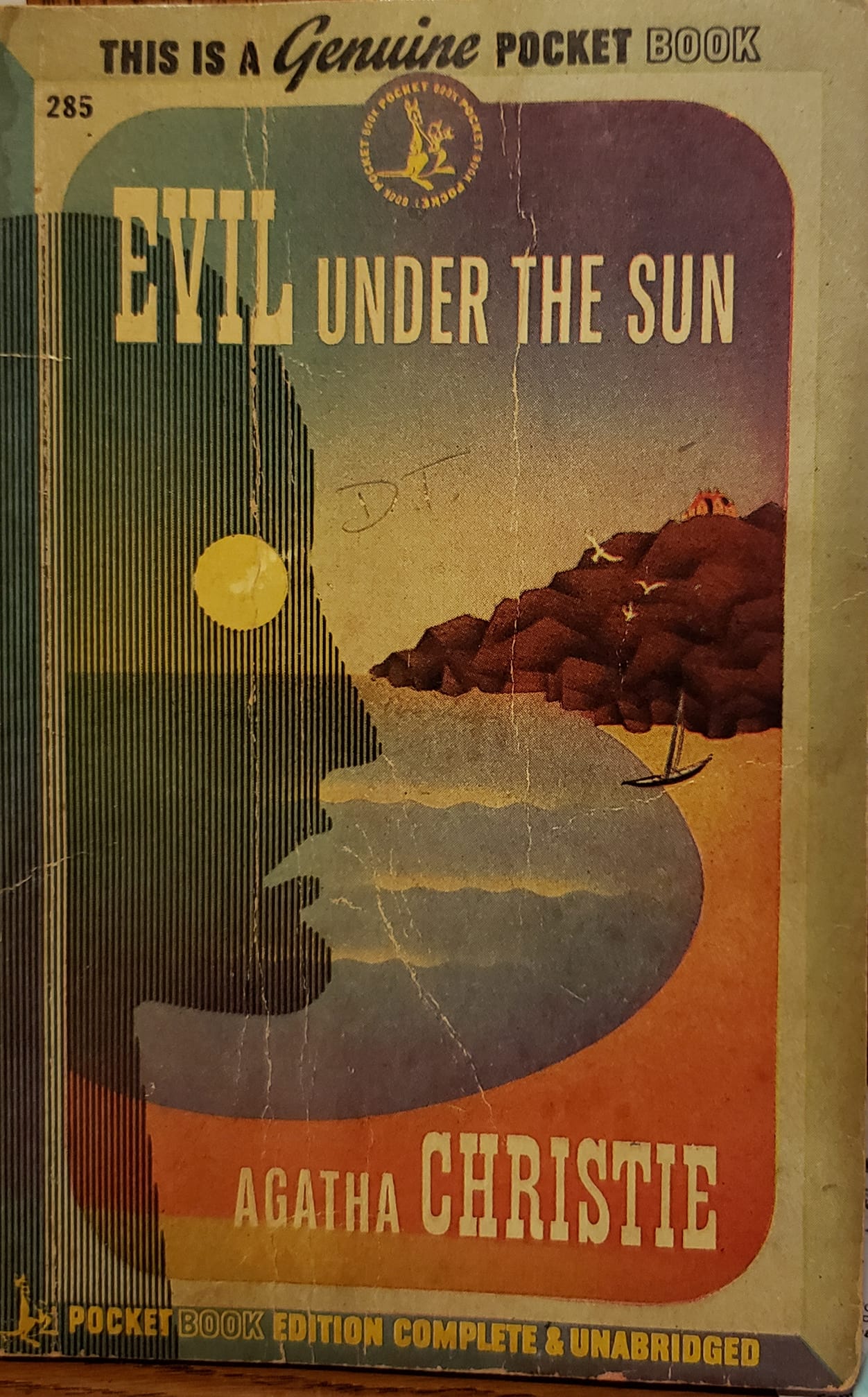
This war-time book was cheaply made, but it has survived almost 76 years and is still in the family.
Our, my wife’s and my, evening reading aloud has included several Agatha Christie books. At first I planned on doing these in the chronological order they were written and arranged them so in the box. But Lynda pulled one out at random. We read that and the pattern was shot after only two prior reads. So when I went to get the next one, I chose Evil Under The Sun. We had just seen the 1982 movie of this with Peter Ustinov. When I say “just” I mean as in the last year.
The book was good, though perhaps not as good as the movie. The plot differences were significant. Since I knew who the murderer and accomplices were I kept looking for the clues Christie must have put in the book to lead us to them. Alas, the clues weren’t there. Poirot’s ending discussion of who the murderer was and how he determined it was not as good as in other Poirot mysteries. I guess that’s what happens when you see the movie first and read the book later.
While I had a few reservations about the book, it’s Agatha Christie, so it’s obviously worth reading. This won’t be my favorite of hers, but it’s worth reading.
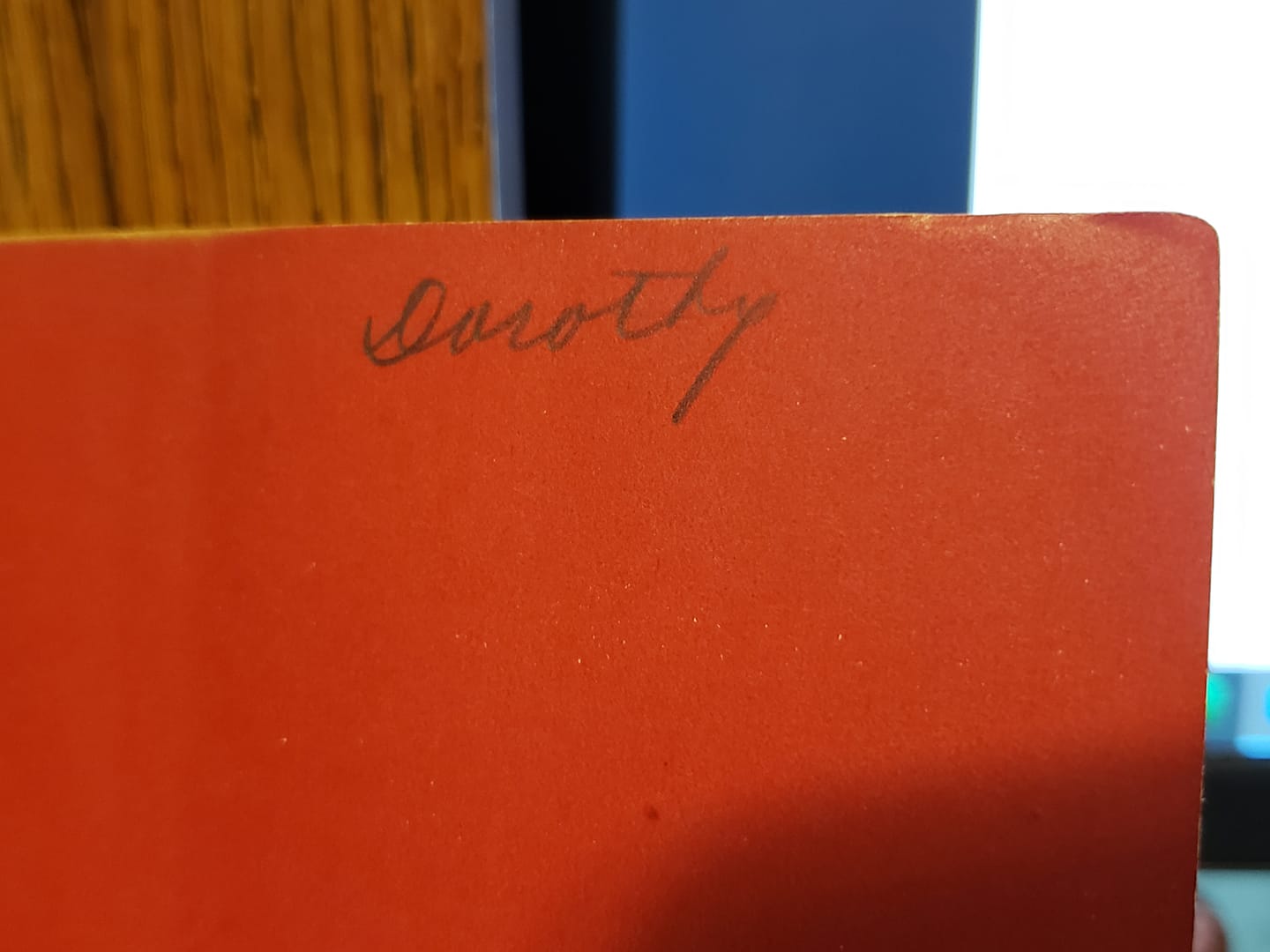
Mom signed most of her books, but usually with her first and last name.
One other thing about this particular book. Our A.C. collection, all paperback, we thought were mostly ones our son bought and left here, no longer wanting them. Turns out that’s not the case. Some of them were our son’s, but others appear to have other origins. Some have garage sale stickers on them. One has my grandfather Todd’s name written in it, so must have been his. This one is a cheap paperback printed in August 1945 (a wartime book, printed so as to consume fewer resources), and it turns out to have my mother’s name in it. Just “Dorothy” with no last name. That’s unusual for her to write only her first name in the book, but given the date of publication and what was going on in her life, it makes sense.
This will go back in the box of A.C. books. Someday we’ll get through them and get them to our daughter, which is where they are intended for.
I believe I mentioned on a previous post that I have a few book reviews to catch up on, smaller books that Lynda and I read aloud in the evenings, books that look interesting but that, once read, are not keepers. This book falls in that category.
The concept behind the title is good: by voluntarily uniting with Jesus was joyously become a slave for him. However, in the current times, perhaps this isn’t the best title.
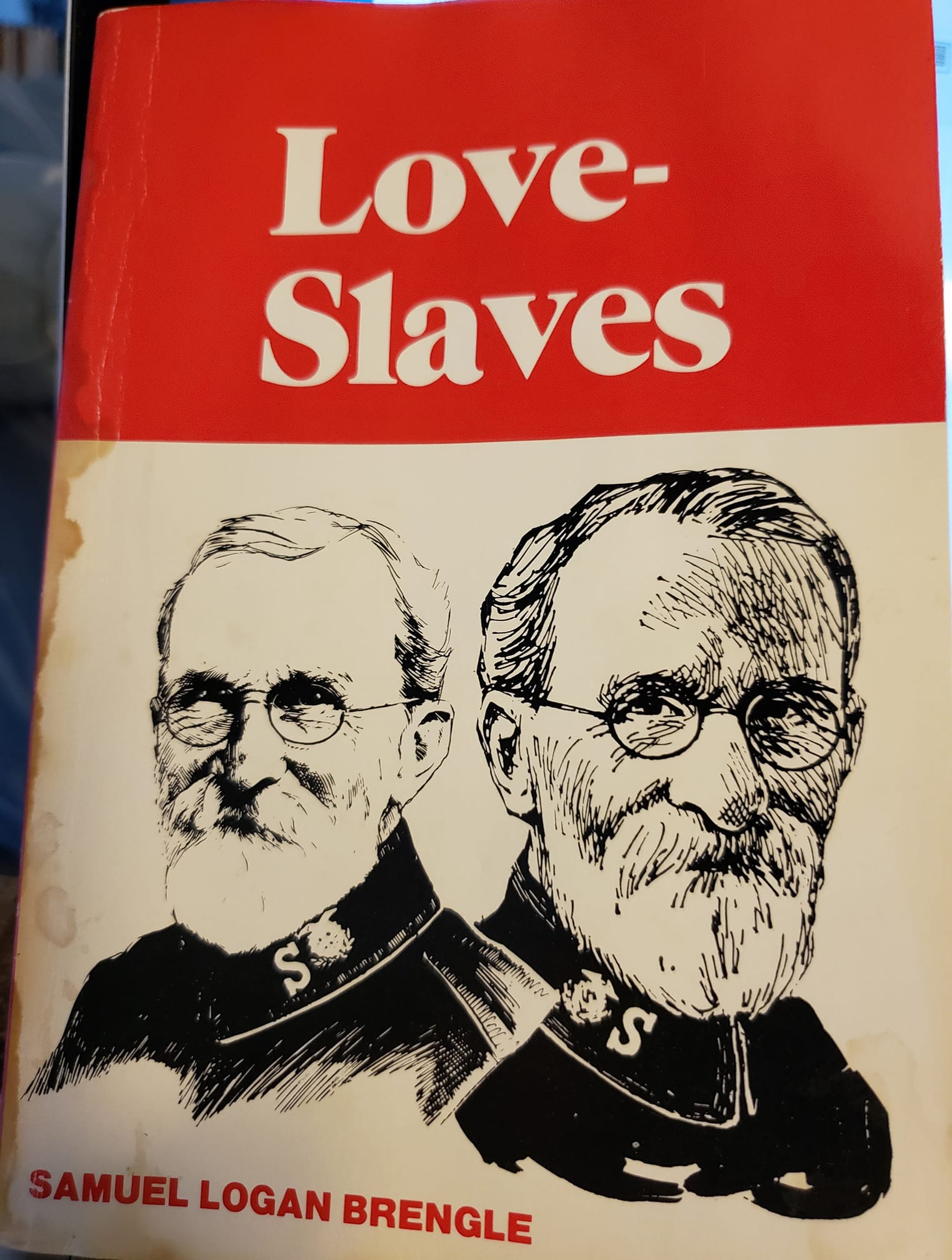
Love Slaves by Samuel Logan Brengle was first published in 1923. Our copy is a mass market paperback from 1982. Brengle was with the Salvation Army, a man of considerable rank in that organization that took its titles from the military. The back cover copy describes that book this way.
Here is an encouraging message—calculated to incite us to seek the highest. Side by side there goes the force and light of love…words to clear the thought as well as to strengthen the Will and guide the Heart.
Alas, the book fell a little short of this intended goal. At least for me it did. The description indicates this is a discipling book, aimed at making Christians more aligned with the message and work of Jesus Christ. It does attend to that goal, but for me there were two main problems with it.
The language was archaic. Thought written in the early 1920s, the English use—especially sentence structure—was from a period a century earlier. Now, I’ve read a lot of works from the early 19th Century, so I’m no stranger to difficult English and have learned to pull the message from it with no problem. This book was more difficult to do that. I bogged down often with the long sentences and the strange way of saying things.
Since this is a Salvation Army book, which we probably picked up at a yard sale or thrift store, it includes terminology and practices unique to them. Thus, the book didn’t really seek to make the reader a better Christian but to make the reader a better Salvationist, as they call themselves.
I don’t want to mislead anyone. It’s not a bad book, just not as good as I was hoping for. If you want to read a discipling book and improve your Christian walk and service, I think you have a choice of a thousand books more modern than this that will help you more.
Thus, my original expectation was met. Not a bad book, but definitely not a keeper. Off to the garage it goes for sale or donation.
The name of David Livingstone has been famous for years. I was a boy when I learned it, understanding him to have been an explorer. Stanley’s famous line, “Doctor Livingstone, I presume”, while perhaps not historical, was familiar.
An introductory biography is just the thing for learning a little about a life your only marginally familiar with. This book filled that need.
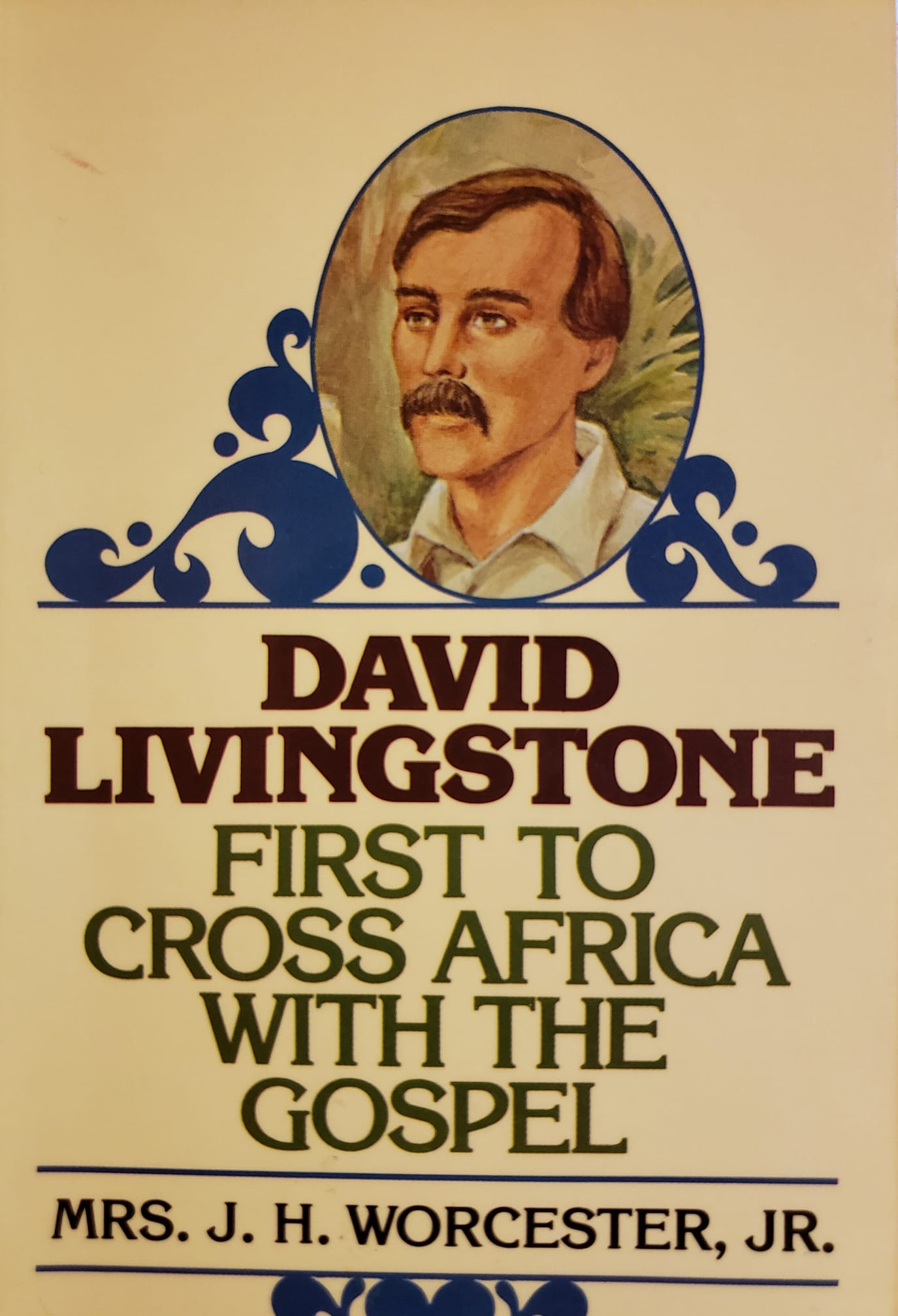
So, when my wife recently gathered up some small books for our evening reading, I was glad to see that she pulled one about Livingstone from our shelves. David Livingstone: First To Cross Africa With The Gospel, by Mrs. J.H. Worcester, was first published in 1888, fifteen years after his death. We read a 1987 mass market paperback reprint of it by Moody Press.
Having said that Livingstone was practically a household name at one time, I have to admit to being ignorant of details of his life. This book provided them. Born in 1813 in Scotland, he had first thought to go to China as a missionary, but that nation closed due to war, so he went to Africa instead in 1841. There he married Mary, the daughter of fellow missionary Robert Moffat, who had inspired Livingstone to go to Africa. They would have six children together.
Livingstone’s work in Africa began as a Christian missionary for the London Missionary Society. Over time, the mission work was mostly turned over to others and Livingstone became an explorer of the interior of Africa. His reason for doing this was, at least in part, because of the horrors of the slave trade. Even though most European countries and the USA had outlawed it by the time Livingstone arrived in Africa, it was still going on in large numbers. He thought if he could help Africans have different economic opportunities they might cease cooperating with the slave traders. But the alternate economy required ports and roads to the interior. Livingstone looked for these.
This was an excellent little book (125 pg) that I highly recommend. I normally like to read more in-depth biographies, but this was a good entry point into the life of Livingstone. I told Lynda we needed to find a larger and more detailed biography. Then, while looking on the bookshelves in our basement family room, I found one. An inch and a half thick, it should be just the thing.
The small book, thought good, is not a keeper. Off to the garage it goes to sell or give away. While a modern reprints of the 1888 book are not hard to find, you ought to be able to find images of the original at several places on-line.
Not a bad book, but I can’t give it any more than 3 stars.
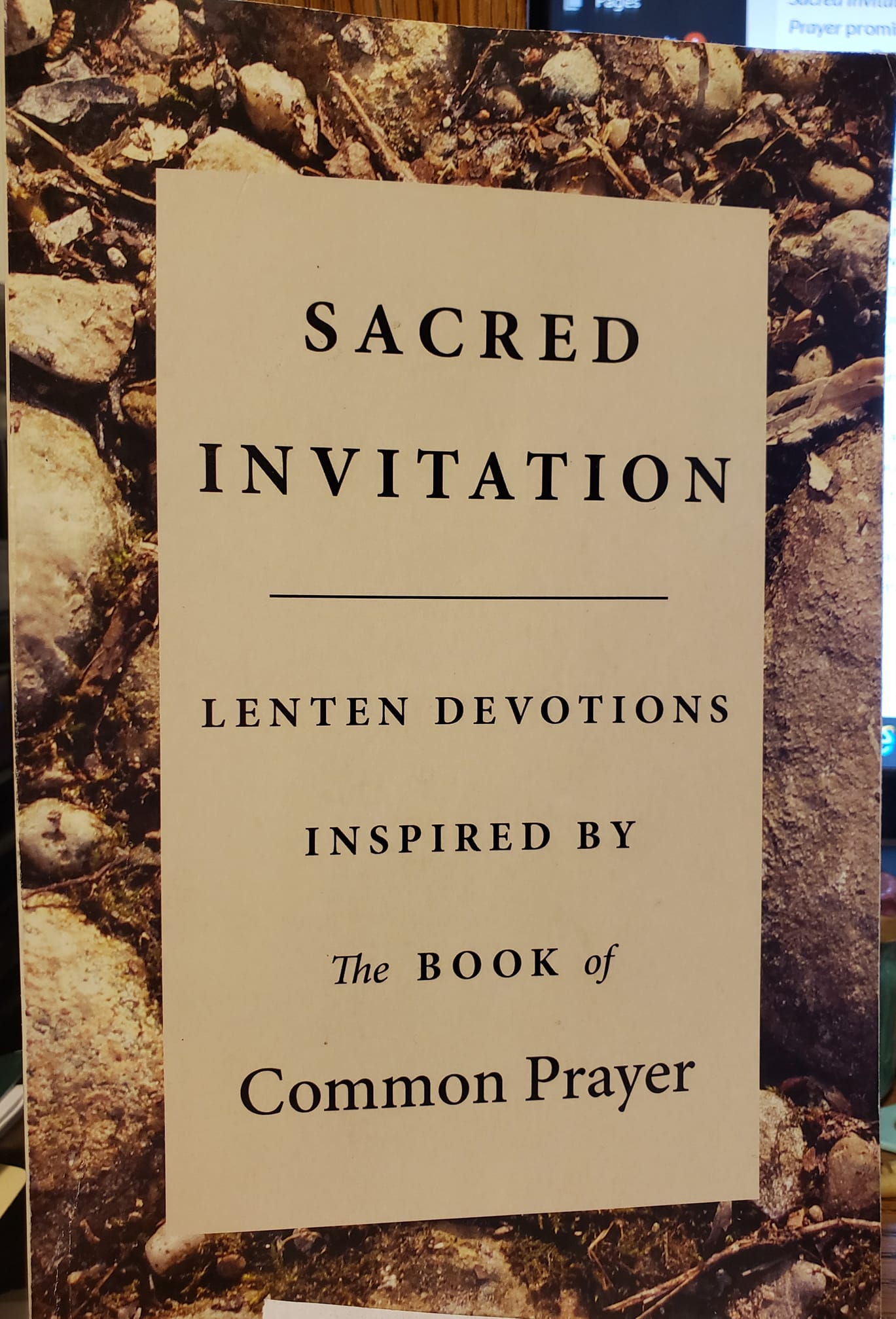
I didn’t plan on buying our denomination’s Lenten devotional book this year. We’ve bought them the last couple of years and, while helpful, we are trying not to add to our possessions and I thought maybe we could do without. But I relented and bought it.
Sacred Invitation Lenten Devotions Inspired by The Book of Common Prayer promised something different than past years. The Book of Common Prayer is an old thing, and old things aren’t always that bad. I was looking forward to it.
Each day included scripture reading: morning pslam[s], evening psalm[s], Old Testament Scripture, gospel reading, epistle reading. Then a devotional tied to those scriptures (most typically to the gospel reading for the day), a series of probing questions, and a prayer. My wife and I read these aloud, me doing the reading, her listening. Mostly in the evenings, and not timely. We lost a number of days when our grandchildren were here. I think we finished it two or three weeks after Easter. We read all the scriptures for the day and the book contents for the day at a single sitting.
The book was better than past year Lenten devotionals our pub house put out, but somehow, for me, this still didn’t get the job done. I give it just three stars. The scriptures chosen were mostly not from Holy Week, or the buildup to it. They were more anticipation scripture passages, or maybe preparation. That’s fine, I guess, as Lent is a season of preparation in anticipation of Easter.
The devotionals, I thought, were much better written than past years. Except both of the two authors seemed to go out of their way to avoid using the male pronoun for God. If I can find an example, I’ll edit it in at this point.
What puzzled me is how this book ties in to the Book of Common Prayer. The prayers weren’t from it, the devotionals weren’t from it, the probing questions weren’t from it. I assumed the scriptures had to be. But I think they are not. The Psalms chosen, for example, included many repetitions. As I read them I often said, “This is just about like one I read before.” When we finished the book I checked and, sure enough, many of the Pslams were repeated, one five times. I don’t expect that the Book of Common Prayer would repeat like that.
So, where does this book stand? I’m glad we read it, but it is not a keeper. It will go out to the sell/giveaway place in the garage. After four disappointing years in a row with these books, I think I will skip next year’s.
I really enjoyed this books and am glad I invested the reading time and the whole 50¢ purchase price in it.
About a month ago I finished whatever book I was reading and searched my shelves for what to read next. Should be easy, right? I make it a little complicated, however, in that I want to read books that interest me but which I don’t want to keep permanently. I want to be able to get rid of them when done. The book I had just finished was a keeper, so for sure I wanted to go on to a non-keeper. As I say, should be easy, but with thousands of books in the house it isn’t. The volume makes it harder and, alas, I don’t have a prepared non-keeper pile.
But I searched and found this in the Essays of E.B. White. While he isn’t a household name, White wrote Charlotte’s Web. Of interest to writers and perhaps English majors, he collaborated on later editions of Strunk’s book The Elements of Style, a short book about improving English composition. Some time ago, measured in years, I picked up White’s Essays from a used book or thrift store. It has sat on my literature shelf in the basement, waiting for me to notice it again. The perfect book to read now, I thought. ‘T’will be interesting to me but not one I want to keep.
And so it is. I actually know fairly little about White but learned much through his essays. First, he’s a New Englander, like me, having spent much of his life in Maine (though with sojourns in New York City and Florida). He was a newspaper columnist. Some of his essays were culled from his columns. I didn’t get a feel for who he wrote for (a particular paper or syndication), nor what type of column it must have been. In his writing I found: satire, though I wouldn’t call him a satirist; humor, though he’s not a humorist; irony, though he’s pretty down to earth; concern for the planet, though he doesn’t seem to have been an environmental writer; politics, though he was not really a political writer or pundit.
So what kind of writer was he in these essays? Interesting. Sorry, Mrs. Abrams, my 12th grade English teacher. I know that’s an unacceptable response, but I have to say it. The essays were a mix of all of those things in the last paragraph, and the variety held my interest. He wrote about the life in rural Maine and of farm chores and events. It gave authenticity to Charlotte’s Web. He wrote about apartments in New York City. He wrote about harm being done to the planet by different human activities. He wrote about Democrats and Republicans not getting along and, except for the names of the individuals involved, those essays could have been written today.
Reading these essays tickled me into a case of Sidelines Syndrome, and I felt the urge to write essays. I came to my senses pretty quickly, however, as I have too many writing projects going on right now. I suppose if a writer spurs another writer to emulate him, that writers has done well.
Now, two questions remain: Should you run out and try to find a copy of this and read it (published 1977, my paperback published 1979)? And, is it a keeper after all? The answer is no to both. First, it will be hard to find. Second, it will be somewhat boring, I think, to anyone who doesn’t currently read essays. Third, as far as keeping it, for me it’s a I’m-glad-I-read-it book, no regrets at investing some time in it, but I don’t see myself ever reading it again.
So, into the sale pile it will go. The binding is partly broken, the cover has a fold in it. I don’t see it ever selling, either in my yard sales or in a thrift store, but I can’t bear the thought of throwing it out. So to the garage sale shelf it goes.
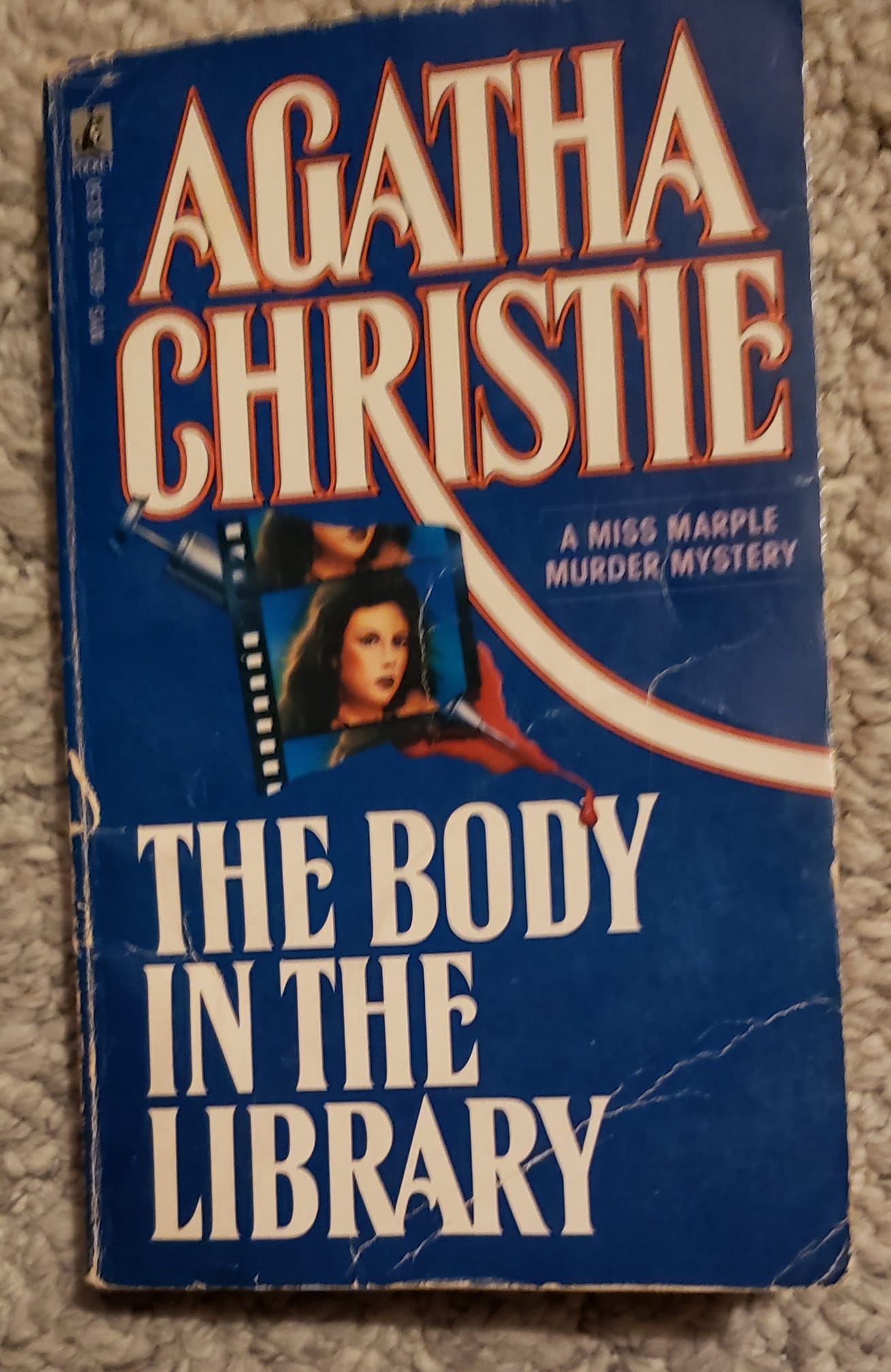
A good Miss Marple Book, but not a keeper. We will be passing it along.
Continuing with our reading books in the house that look like they would be good to read but not necessary to keep, my wife pulled The Body In The Library from the Agatha Christie box and we read it. This was the first of her books featuring Miss Marple that we’ve read.
It’s a good book, as all of hers have been. A servant, in the midst of her morning duties, finds a body in the library of a manor house. She tells the lady of the house, who doesn’t believe her at first. Finally the lady goes downstairs and sees for herself. Before long the police are called. The lady knows Miss Marple, who is from that village, and calls her to come over. She arrives before the police do. Her reputation as an amateur crime solver is already well established in the village, which seems to have an above average murder rate for cute English villages.
Since Miss Marple will be the one to solve the crime, I figured the murderer had to be someone she comes in contact with. She’s there at the manor house and encounters three people, plus the police. The story then moves away from Miss Marple and follows the police as they do their work. The dead woman is identified as an 18-year-old professional dancer at a hotel in a nearby town. She’s newly studied at a dance school. Her older cousin has a solid position as a “mingler” with the guest of the hotel, dancing and playing bridge and being friendly with the guests, who are mainly upscale tourists.
Miss Marple has a number of other contacts. A retired Scotland Yard man is called in on the case, and he knows and thinks highly of Miss Marple. It isn’t long before another woman is found murdered—or presumed murdered—in a burning car. When this happens, Miss Marple is then certain who committed the first murder. Actually, she was pretty certain of it even in the first meeting at the manor house.
My main complaint about this book is it was difficult to tell how much time passed from one event to the next. Most of the action took place in the same day, or at least I think it did. Yet, there seemed to be too much going on for it to be happening in one day. Perhaps a second read would help sort that out.
I did not have the murderer correct. My thought process as to who it would be was correct, but I chose the wrong person. In my defense, the clues were not as well laid out in this book as they were in the previous Christie books we read.
I give it 4-stars. A good read, well worth the time it took. It’s not a keeper, however. I see no chance of ever reading it again.
My little gray cells were not, alas, sufficiently cognitive to solve this murder before all was revealed.
Once again, in the interest of reducing our possessions, my wife and I read a book we will want to read but will be willing to part with afterwards. For this we chose The Murder of Roger Ackroyd by Agatha Christie. When we found the A.C. books in the basement, belonging to our son but being given by him to his sister (in his own effort of dis-accumulation), along with some other of her books in the house having come to us from various sources, I put them all in order based on what I thought was the order Christie had written them. I thought this one was the next.
It didn’t read like that, however. In this book, Hercule Poirot has retired incognito to the charming village of Kings Abbot. Alas, two deaths in the two most prominent families in the village—one an apparent suicide, one a murder—result in Poirot being called in to investigate. The result is an amazing story. I, of course, don’t want to give away who the murderer is. Suffice to say I didn’t get it right, though I had an inkling into it. A weak inkling.
This book is Christie at her best. Poirot speaks often of the “little grey cells” and his “little ideas”. He muses, ponders, engages other people to help him, and keeps his cards hidden. As the story unfolds, all suspicion is on one person. After the butler is ruled out that is. (It’s always the butler, isn’t it? Unless it’s the footman, but in this book there aren’t any footmen.) But other people also had motive and means. Opportunity was a difficulty, as the apparent time of the murder was fairly precise and as alibis abounded. Two people didn’t have them. One of those disappeared. As the stories are told, it looks like everyone could have done it.
While the writing is a bit old fashioned by today’s standards it is not archaic. On occasion I had to re-read a sentence or paragraph to make sure I understood what was being said in dialog or narrative.
In detective novels earlier than Christie, such as the Sherlock Holmes series, the author did not give sufficient clues to the reader for them to figure it out. But Christie came much closer to that. When we came to the end of the novel and all was revealed, we decided to go back to the beginning and read it again, to see if we missed such clues (or “clews” as this book has it). Yes, they were there, but very subtle. I don’t feel badly for having missed them.
So this book is 5-stars. I probably won’t bother to review it on Amazon or Goodreads. Agatha Christie’s reputation is solid with out my few words. The question I always ask in all of my reviews is: is it a keeper? Alas, no. Too many other books to read or re-read to pick this one up again. Once we get through the A.C. books, they will go to our daughter as our son wanted. Too many books, too little time to keep Christie on our shelves permanently.
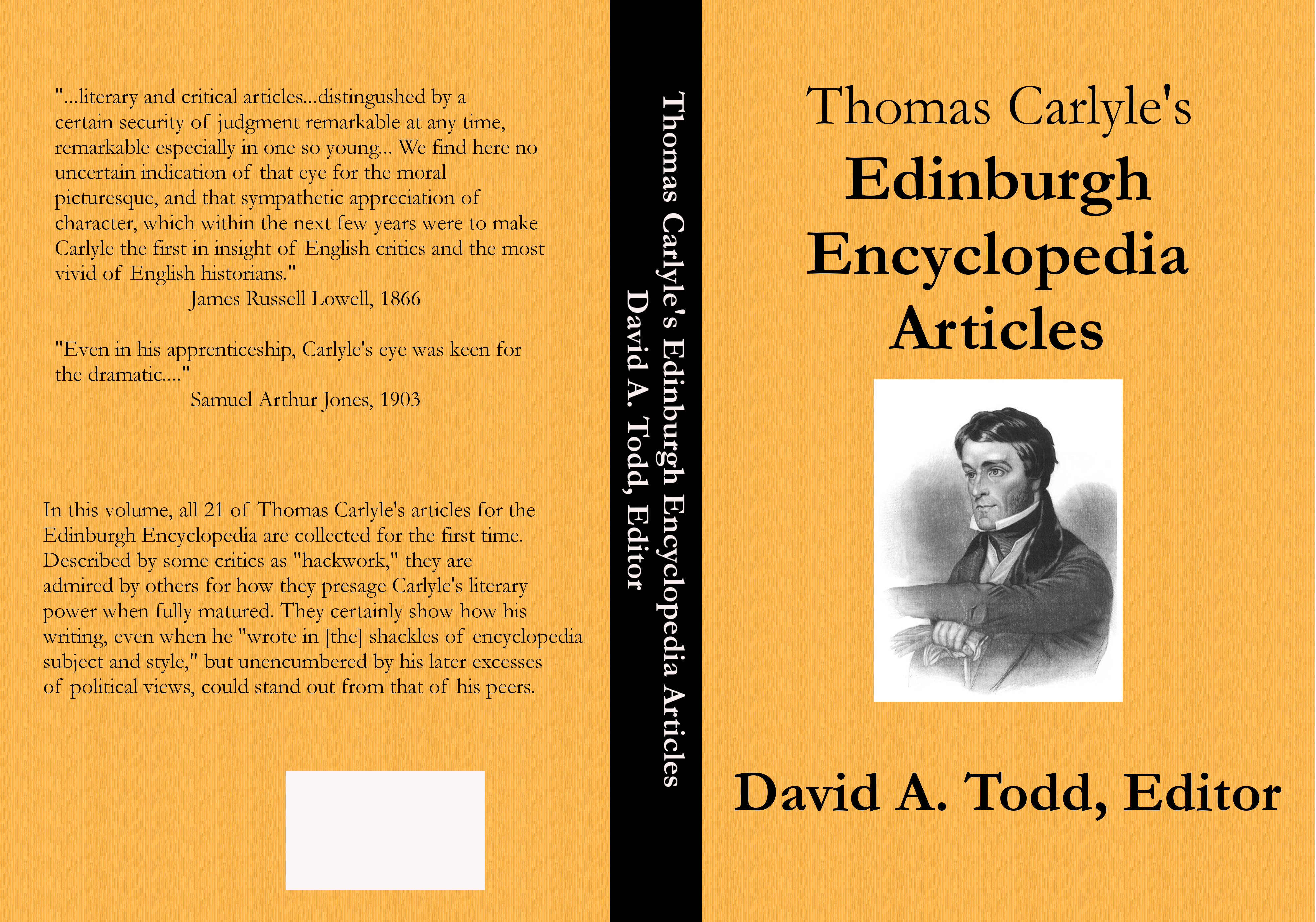
I have one Carlyle book published and two more started. And essays about him on my mind. It’s probably an obsession that I ought to get treatment for.
Of the many books, essays, and articles written by 19th Century British author Thomas Carlyle, perhaps none is more iconic than Sartor Resartus: The Life and Opinions of Herr Teufelsdröckh. Written in 1830 and 1831, serialized in 1833-34, published in the USA in 1836 and in Great Britain in 1938, Carlyle’s life changed from landed poverty to the beginning of success by the time it came out in London. Throughout Carlyle’s life it grew in popularity. The year he died it sold seventy-thousand copies in an inexpensive edition. For the life of me I don’t know why.
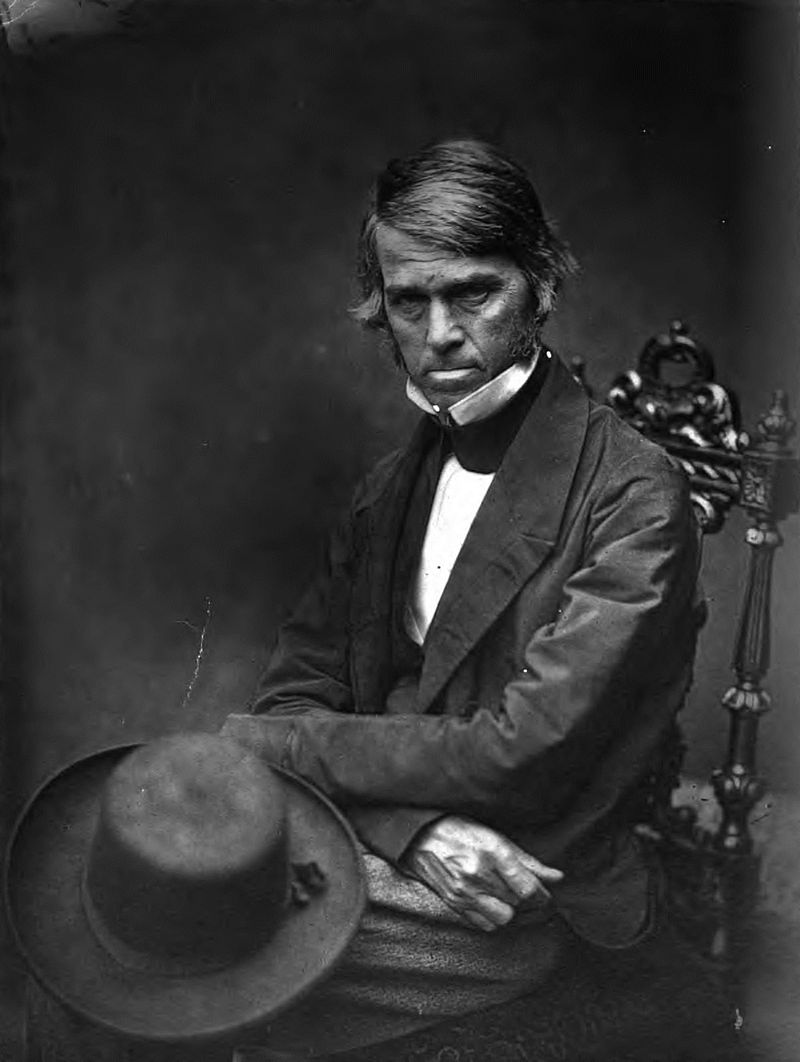
This photo shows Carlyle perhaps close to the age when he wrote “Sartor”.
I’m slowly working my way through Carlyle’s works, in the chronological order they were written. About five weeks ago I came up to Sartor. Having read little bits of it and knowing it was a hard book to understand, I waited a little while before tackling it. Finally I did, reading an e-book version. At times I read with good concentration; at other times I read in distracted conditions. Generally when I did the latter, I went back and re-read the section again in a quieter time. Did I understand it better? Alas, no. The more I read, the more I determined to stick with it and understand it, the more I would zone out after five or ten minutes.
I have no idea what the purpose of the book is/was. The fictitious professor, Diogenes Teufelsdröckh, is said to have written a (fictitious) book on the philosophy of clothes. That much I knew before I read it. But in the book, I found precious little about clothes. D.T.’s life history is given. His lost love is described. Endless words describe…endless nonsense. Or so to me it seems like nonsense.
I purposely didn’t read commentary on Sartor before reading it, allowing me to get it for myself. But I didn’t “get it.” I found the flow of ideas almost unintelligible. I think Emerson said it well in his first letter to Carlyle in 1834: “I have now received four numbers of the Sartor Resartus…has literature any parallel to the oddity of the vehicle chosen to convey this treasure? I delight in the contents; the form, which my defective apprehension for a joke makes me not appreciate, I leave to your merry discretion. And yet did ever wise and philanthropic author use so defying a diction?” If Emerson had problems with it I guess I’m in good company. To give you an idea of the difficulty of reading Sartor, go back and read the second sentence in this review. I purposely made that complex. Yet, it would be one of the simpler sentences in Sartor.
Carlyle’s early works I understood well. The further into his career, he found his “diction” and “style” and became less understandable. His pivotal work as to style was his essay “Novalis”. I had to read and reread that to understand what Carlyle was saying. I read it all thrice and parts of it four times and felt that I came to a basic understanding of it. The essays between that and Sartor were a mix of difficulty and clear writing. But Sartor made “Novalis” seem like a Little Golden Book.
I can’t give Sartor any more than 2-stars. Perhaps, if I read it again as planned, and come to a better understanding, I’ll come back and edit this review. If I had a paper copy of Sartor, I would keep it as part of my larger Carlyle collection, but not because I think it’s good. I’ll re-read it again someday, probably in the near future. Perhaps I’ll even understand it.
We thought this would be a discard, an author we didn’t know but happened to have his book. But it is a keeper. Someday I hope to re-read this.
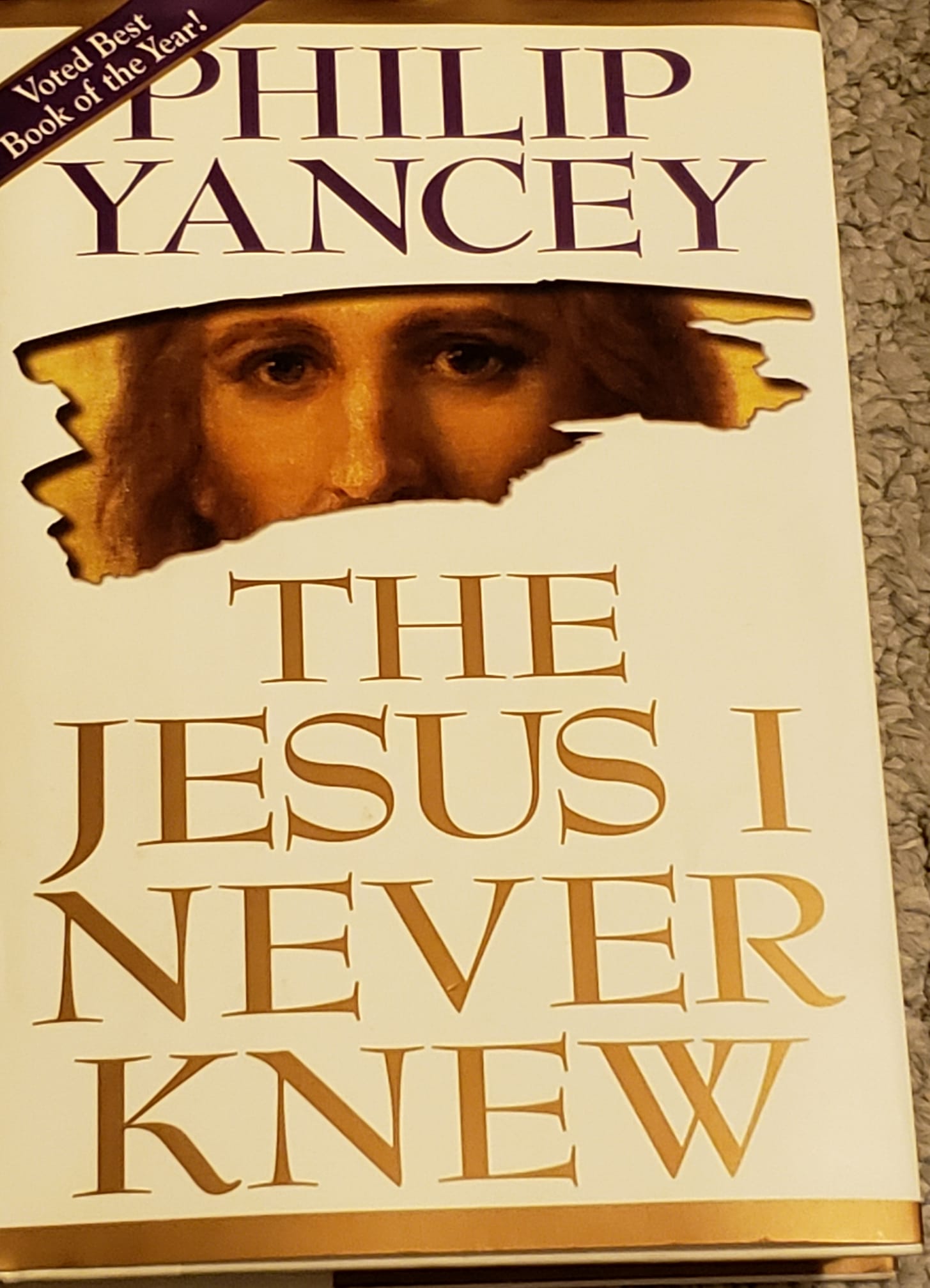
For our evening reading aloud, Lynda and I are looking at books on our shelves that look like good reads but which probably aren’t “keepers”, which, after reading, can be sold, donated, or discarded. Lynda found one such on our shelves, The Jesus I Never Knew y Philip Yancy. I said sure, let’s read it.
We did this over about two weeks. Our hardback copy has 275 pages not including notes. Yancy is not a writer I was familiar with, but the book sounded good and so we dove in.
Wow, what a good book! Yancy covered aspects of Jesus’ life, teaching, and ministry that I had never thought of. Makes sense, given the title. With chapters such as “The Jesus I Thought I Knew”, “Beatitudes: Lucky Are the Unlucky”, “Kingdom: Wheat Among the Weeds”, Yancy looks as the raw words of the gospel and, without an historical or political filter, tells us about the biblical Jesus.
I’m not going to quote from the book or give specific reasons why I liked it so. Instead, I urge everyone to read it [Amazon]. Published in 1995, it is still fresh and relevant in the third decade of the 21st Century.
One interesting anecdote about our reading it right now: I had never heard of Yancy. A new literary agent posted what she was looking for and said she was looking for the next Philip Yancy. Clearly, he has a degree of notoriety that escaped me for years. Not any more.
We intended to read a book that we would discard, but we are agreed that we should keep it and read it again sometime. Consequently, back on the shelf it goes. I give this an enthusiastic 5 stars.
This is an Advent devotional book worth reading, but it won’t become a permanent part of my library.
Here I am a day late with my blog post. Sorry to all of you who came here yesterday looking for it. I knew what I was going to write and post, but just let the day get filled up with other things, other good things, and, well, I didn’t get it done. But here it is.
Every year, for several years at least, our denomination has published a book for the Advent season. Normally the pastor of our congregation preaches a four or five week sermon series that goes along with the book. This year, the book was Let Earth Receive Her King: An Advent Devotional. I’m one of those who reads all the front matter, and I was surprised to not see who the author was. It wasn’t on the cover, the spine, the title page, or the copyright page. I figured the church didn’t want us to know who the author was. The Introduction was written by T. Scott Daniels, but that didn’t say to me that he was the author of the entire book. I figured it was a book written by “staff” and quit worrying about who wrote it. But then, as I got further into it, the book became more personal, with a lot of first person illustrations. Obviously, “Staff” was a person, but who?
The book was good. Well written, clearly written, with stated themes and points well made. I would say it’s better than the Advent books from recent years. My wife and I read it aloud in the evenings, me doing the reading. We did it every day from Dec 1 to Dec 24, skipping only one day due to extreme tiredness but making that up the next and keeping going.
As to whether I recommend the book or not, I can say I do, with a couple of exceptions I’ll state in a minute. When we finished the book, I turned to the back cover, realizing I hadn’t read that before starting the book. There it clearly said that T. Scott Daniels was the author, giving a short bio of him. I guess the pub house figured everyone reads the back cover and having the author name there instead of the front cover and title page sufficed.
The book is organized around the Advent candles that have become a Christmas tradition. Each week in the Advent season you light a candle of a certain color. One stands for joy, one for peace, etc. This is a new tradition to me, one my family didn’t follow in my childhood, one I never established with my own family. In fact, I don’t remember ever seeing it done in church until maybe the last twenty years. When and how did this become a tradition? Was it one 60 years ago and somehow our Episcopal family missed it? Perhaps it is a long-standing evangelical tradition. Since it’s not my tradition, the organization around the candle themes is meaningless to me and did not enhance the book for me. C’est la vie. I’m sure others found that not only useful but enjoyable.
The other thing that prevents me from being able to enthusiastically recommend the book is the dual emphasis on mourning and exile. Perhaps emphasis is too strong a word. But several times Daniels talked about Advent as a season of mourning. For example, on page 78 Daniels writes:
“In Advent, the church grieves and awaits the return of the bodily absent Lord. Yet, in the meantime we pray and work….”
Sorry, but I don’t see it that way. Advent is, to me, a season of anticipation and joy. Mourning during Advent would be a new interpretation to me and, well, you probably can figure I don’t cozy up to new interpretations.
As to exile, I note from the bio on the back that Daniels is the author of the book Embracing Exile. This was popular a few years back. Our pastor preached a sermon series on the theme, using the book as an outline. Since our Life Group was already engaged in another study when that one started, we didn’t participate. But I see this theme of exile creeping in a number of places. In the recent study from the book Kings and Presidents, the authors kept emphasizing how the book of 2 Kings was written while the Israelites were in exile in Babylon. I haven’t studied that, but have trouble believing it. Much of 2 Kings reads like a contemporary history, not a history told decades or centuries after.
Should you buy and read this, and is it a keeper? Sure. It should help you prepare for the Christmas season. It is well written, also well designed and laid out. I especially liked the left-only justification, as that is much easier to read than full justification. But, it goes out to the sell/giveaway pile—after I skim it some more and try to find those mourning entries.