All posts by David Todd

Holiday Weekend

Saturday, I wrote two letters, printed them, and made them ready for mailing.  The plan was to mail them on Sunday when we drove by the post office going to and coming back from church. In doing so, I totally forgot that Monday was a federal holiday and the P.O. wouldn’t pick up the letters. No matter; I got that little task done.

So here it is Monday of Memorial Day weekend. I’m caught up with my correspondence. I set out chicken to thaw for supper. Rain continues to fall, with occasional breaks, so outside work isn’t easily possible.  So today will be an inside day of work and relaxation.

With some remembrance of those who fell in battle, fighting because out country asked them to. In our family, Lynda’s great-uncle, Lee Thompson, died on the first day of fighting at Guadalcanal in 1942. He is the only one that I know of in her family and mine that died in battle. Others served with distinction but lived to rejoin civilian life after war. I take this moment, as one who did not serve, to salute Lee and those others who gave their lives for the USA.

As to filling the day, I started with some work on my deceased father-in-law’s letters. He was a letter writer and saver (as I am) who spent lots of time in his last three or four years writing long letters on his computer. He saved them in notebooks and on floppy discs. At some point we need to get rid of one or the other of these, so I’m taking time to organize the notebooks. Possibly I’ll computerize them, then get rid of either the hard copies or the discs, or possibly both.

Last night I updated my book sales spreadsheet. As I did so, I learned it’s become somewhat unwieldy and needs revamping. Not sure if I’m going to do that today. But today I plan to update my financial spreadsheet, something I let drop after my seizure back in December. I need to see where I stand financially overall. I also hope to update my checkbook. Since my handwriting is still very difficult since my stroke in September, I now keep my checkbook on a spreadsheet. And, yes, I still keep my checkbook, probably an anachronistic practice in this electronic era.

I have a lot of papers scattered over my work area in The Dungeon. I hope to, if not reduce them in number, to at least better organize them. That also goes for a few 3-ring binders on my shelves. We are very close to finishing with deciding what to do with the mass of photos from Lynda’s dad’s family. We could finish those today with an hour or two of effort. I’m anxious to see that completed.

But otherwise, I will mainly read. About 15 minutes is all that’s left on one magazine. It would be good to get more than my 10-page quota read in the literature and missions books I’m reading. Maybe the evening will find us watching an Agatha Christie movie on Britbox or U-Tube. And, the Carlyle Letters Online are always there should I need something to fill up a half-hour. As is my too-long neglected journal.

The Surprise at the Hospital

All this with no warning, no ability to plan my time.

Tuesday this week I was scheduled to go to Washington Regional Medical Center for an EEG test. This was my second of this test. I had one scheduled for January. It was a follow up to my Sept. 3, 2024 stroke, but a couple of weeks before that I had my first seizure. Thus, the EEG might also give them information about what happened with the seizure.

For that test, I had to be awake 24 hours before, with no caffeine, so that the test, consisting of 1 1/4 hours prep and 45 min test would be in a sleep deprived state, with me falling asleep for most of the test period. That test worked well.

After my second seizure, on April 17 (treated at the ER of a different hospital), I contacted my neurologist’s office, which is associated with WRMC, to see if they wanted to see me. After some delay, they contacted me to say they wanted me to first have another EEG. We found a mutually acceptable date, Ma7 20, and Lynda and I made the 45 mile drive. This time, the instructions they gave me, through calls with both the hospital and my neurologist, was to go without caffeine. Sleep deprivation was not part of it.

I got to WRMC, and as the EEG technician was walking me back to the room, he said this test would last two days. I would leave the hospital and go home with 20 electrodes stuck to my head, covered by a tight-fitting skull cap, and a 2-pound electronic unit in a bag slung over my head and shoulder. Don’t go near water, but otherwise go about life as usual.

Right. I take it that technician has never undergone this test. Look at the photo.

With all respect to the hospital and the neurologist, I feel like I should have been informed about the nature and duration of the test before it—I mean long before it. I had outdoor work planned for Tuesday afternoon, but no way I could do it carrying this pack. Had I known, I could have done the yardwork in the morning and saved my indoor writing work for after the test started. We are about out of groceries, which I planned to go for on Wednesday. But no way I’m going to Walmart carrying this pack, looking like an idiot. Had I known, I could have gone for groceries on Monday.

I was really hacked on Tuesday, and gave the tech an earful. It wasn’t his fault, but he was the hospital’s representative at that moment, and his organization either dropped the ball in keeping the patient informed or, possibly, purposely withheld that info so I wouldn’t back out of the test.

Having the test is good. The way the hospital and doctor failed to help me to prepare for it is a big failure. 1-star reviews for both.

Trophies

The trophies have to go.

So, in the interest of decumulation, I’m getting rid of books—even cutting deep into books I would like to keep and read someday, I’m getting rid of photographs. They don’t take as much space as books, but they are more numerous, are a burden rather than a blessing, and someday will be a burden to our kids. What else can and should go?

Every now and then I take a “tour” of the basement storeroom, looking for what should go next after we finish with current decumulation projects (mainly the photos). I see boxes of old Christmas decorations we haven’t put out for years. Same for other holidays. I see a couple of boxes of old camping equipment that I’m sure we will never use.  At some point we’ll tackle them, but I don’t think the time is right just now.

The pants I wore to church yesterday seemed pretty big on me. I checked the size, and they are 42s, about 10 to 15 years old. I don’t know, but maybe I’ve lost enough weight that 42s are now too big and I should get rid of them. That, of course, brings up the whole subject of clothes and closets, which is a huge project. Do we tackle that en-masse or one garment at a time? I’ll be pondering that this week. It wasn’t too long ago that I stuck an old pair of 44 corduroys that were way too big in the donation pile and took them to Goodwill.

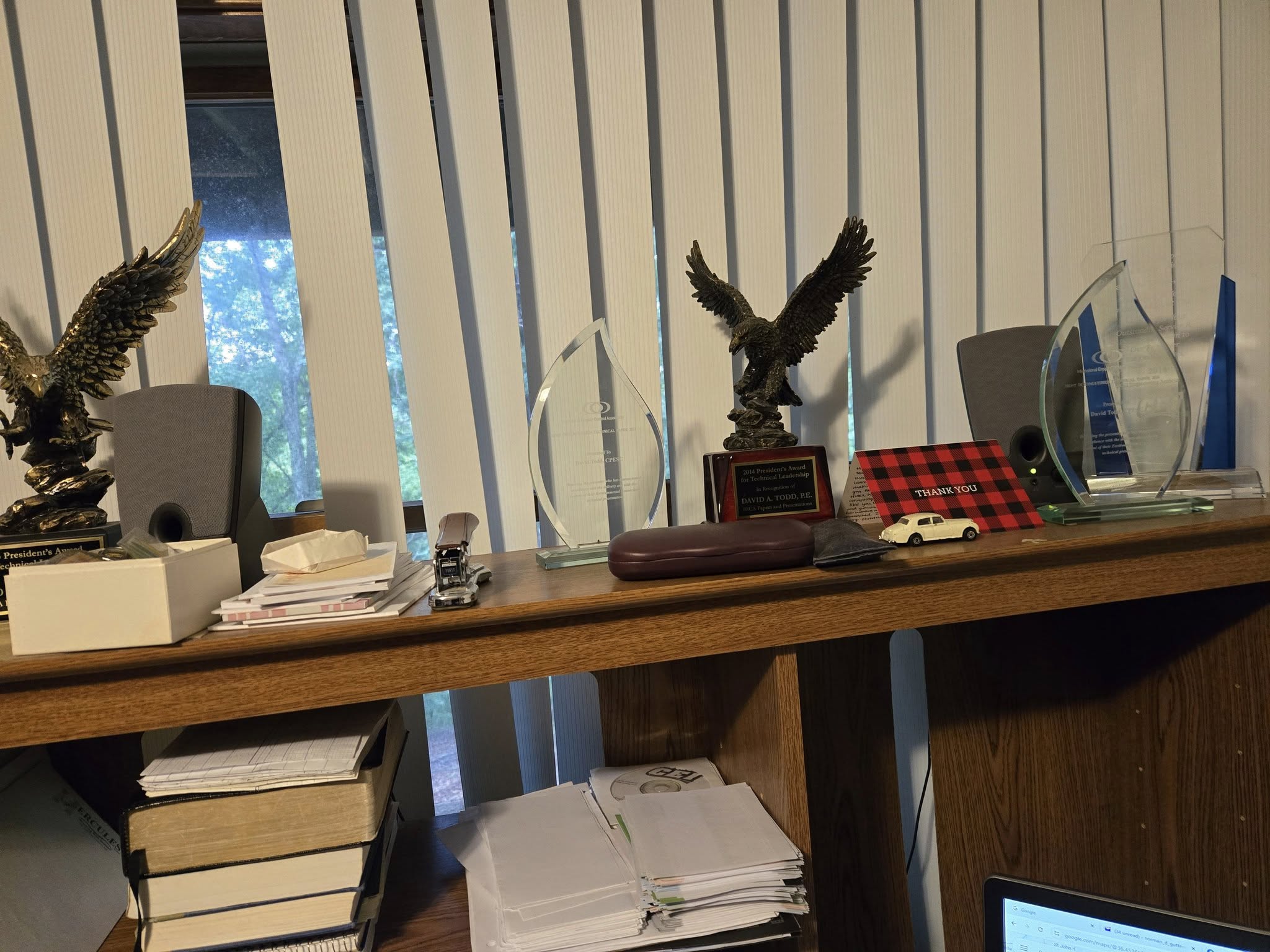
Last week, seated at my desk in The Dungeon, I looked at the shelf above my computer desk and saw it adorned with what I can only call “stuff.” Some of it is left over office supplies that I “might” use some day.  Some is misc. things. Not quite sure what to do with those. But one thing I noticed is my trophies. These are things I got for delivering technical papers at engineering conferences. One year my paper was awarded best paper at the conference, and I received a trophy for that (actually two, since the first came with a typo and they sent another). The company I worked for then awarded me trophies for writing the papers, as a means of encouraging others to do the same.

Those trophies sat on a shelf at my office. When I retired over six years ago, I stuck them on the shelf in The Dungeon and more or less forgot about them. But what good are they doing me now? None. So I have decided they will go in the trash on Wednesday. The shelf above my computer desk will be a little barer, a little less decorated, but a little close to being ready to be moved somewhere when moving time comes.

One small decumulation step; one giant leap toward downsizing.

The Burden of Photos

The infamous “Jacob’s Well photo”. One copy should be sufficient. The next generation will most likely toss it.

Of the many things our parents left us, or came to us in other ways, I think the most burdensome is photos.

Photos? Yes, photos. Those pesky little glossy things, or some matte finish, depicting people of long ago, houses once owned or lived in, vehicles once driven, and landscapes visited. No doubt those who left them to us thought, “What a treasure this is for our children (or grandchildren), to see great-aunt Matilda all dressed up for the derby. Oh how they will cherish them.”

No idea who these people are. Cool car, though.

Except nobody now alive ever met great-aunt Matilda. Only those who studied the family genealogy knows who she was and how she fits into the family relationships. And only those who ever will study genealogy will ever care.

This was the situation after a week’s worth of work on the 5,000.

Photos tend to add up. Just looking at the photos on Lynda’s side of the family, I estimate that we have 8,000 photos. No, I’m not exaggerating. That’s probably 3,000 from her dad’s side and 5,000 from her mom’s side. Just looking at her dad’s side, he was something of a hobbyist photographer. He inherited various family photos from his parents, who got at least some of them from their parents. He looked at those old photos, some as tiny at 2×3 inches, and had enlargements made; then multiple copies of the enlargements; then smaller copies having the developer play around with the tint and border and resolution. So one tiny old photo marked “Jacob’s Well” on the back was shown to be a photo of his grandfather’s family, showing two older men, one older woman, and seven children (the youngest not yet born)—some on horses, some standing on the rocky landscape.

Jacob’s Well is a feature in Clark County, Kansas, now incorporated into a park. Except we’ve visited the park—not every square inch of it, mind you—the landscape looks more like what you see at the family ranch in Logan Township, Meade County, Kansas. I could believe the photo is mis-labeled, except another family member in another branch that didn’t even know each other until 2015 has a copy of the exact same 2×3 photo and it is also labeled “Jacob’s Well.” What to do?

Is this photo a keeper? Surely it’s the Cheney family, but how do you identify the people? One of the older men is the father, Seth. The other is uncle Frank Best (most likely). The older woman is mother Sarah, the youngest child Rose, the older girl Cora. But which of the others are William, Clarence, James, and Walter? We can make an educated guess, based on size. But these people were all standing at least 20 yards away from the cameraman. There’s really no way of knowing who’s who.

The photo is from 1898, based on Charlie, the youngest child, being born in 1899. The question becomes: how important is it to keep this photo? And the multiple copies of the enlargement? And the multiple copies of different tints, borders, and resolutions?

This has come up now because another family member, who didn’t want the photos when Lynda’s dad died in 1996, has accused us of hoarding them because we didn’t drag them out every Thanksgiving and Christmas so that we could look at them “as a family.” Now he wants to look at them, divvy them up, and do so at a high school reunion in July. Even though we would have to impose on a relative for a venue. Even though Lynda was thinking she didn’t particularly want to go to the reunion. And actually, the demand to go through the photos included the 5,000 from the other side of the family. It is physically impossible. Reunions are times to see friends, swap stories, share meals. How will it be possible to sort through these photos and make decisions on their final resting place on a reunion weekend, even if you layover a couple of extra days? You can’t; it’s impossible. And some day, we’ll have to do the same with all the photos we took over the years.

So we are going through them. Album by album, box by box, folder by folder. After three weeks, we can see a little light at the end of the tunnel on the 3,000 (estimated) from the dad’s side, and have made some progress, at least to the point of knowing what we have, on the mom’s side. Duplicates have been identified and those we want removed from the overall collection as keepers. The albums have been checked and are currently being re-checked. Four other albums have been consolidated into two and are ready for re-checking. We are very close to boxing the non-keepers and shipping them to this family member with a note saying, “We’re so done with these; keep what you want, destroy the rest.” The other 5,000 will hopefully follow in about two more weeks.

Yes, destroy them. Our kids won’t want them. We don’t know anyone else’s kids that want them or even want to see them.

What was meant to be a blessing, and what served as a blessing to three or four generations and maybe 100 people, are now a burden. Let them die a peaceful death.

Book Review: Approaching God

Good book, but not a keeper.

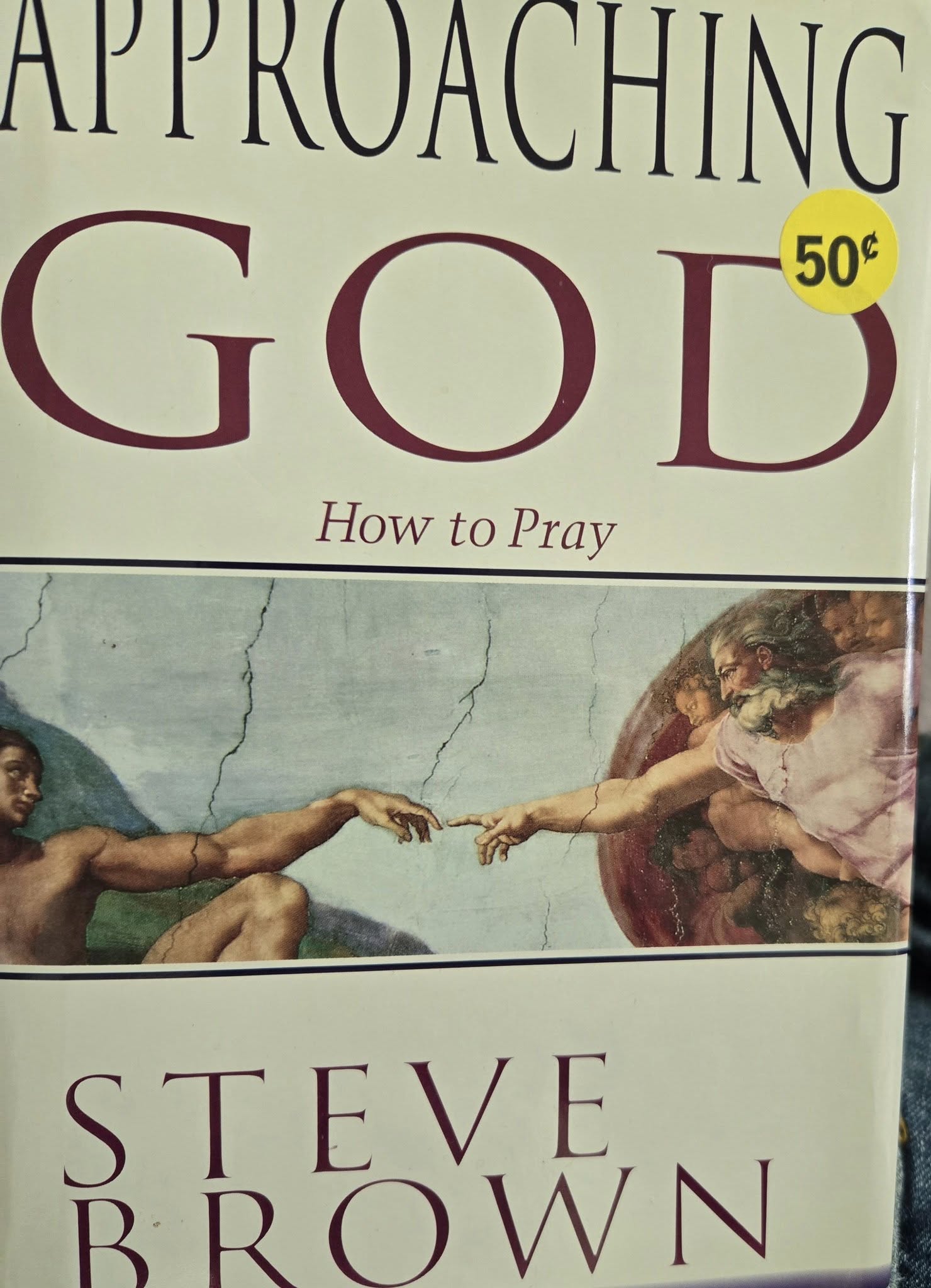
A few weeks ago I finished a book, Approaching God by Steve Brown, but am just now finding a hole in my blog post schedule to post a review. This one of those books we picked up used somewhere along the way, which finally popped to the surface of some pile in the house, so I grabbed it and read it.

Brown is well past his career, now a professor emeritus. He had a number of positions before that, including pastor. He comes from the position of Reformed theology, Presbyterian church.

The book is quite good, if a little bit dry and predictable. Of course, what new things can you write about prayer? So of course the book would be somewhat predictable. Our copy was a hardback, 213 pages, set in an easy-to-read font. I think it took mw only 10 to 12 days to get through it.

In terms of whether the book was good, the main measure of that would be did it help me in my prayer life? Did it make me more likely to pray, or less? Did it stimulate my desire to pray, give me ideas on how to do it better? My honest answer is “a little bit.” I can’t say that I had any major breakthroughs, but I do feel more motivated to pray. On that basis, taking time to read the book was worthwhile.

I give it 4-stars. But it is not a keeper. Once Lynda reads it, upon  coming to the top of one of her reading piles, out it will go.

The Saudi Years In Letters

The work is nearly complete on this non-commercial project. My proof copy should arrive by Wednesday next week.

Family, friends, and regular readers of this blog know that we lived in Saudi Arabia once upon a time. That was in mid-1981 to 1983. Our children were 2 1/2 and 5 mo. when we first went there. The company I worked for at the time, Black & Veatch, had lots of engineering work in the Saudi Eastern Province, and I was one of those sent there for civil-environmental engineering work.

At the time, the Iran-Iraq war was in its second year. The country was still rather primitive. The road network was good, and rapidly being improved. The shops were full of the world’s goods; you could find almost everything you wanted (except when all shipments of peanut butter were held up in customs for a month). Plenty of other expatriates lived and worked nearby, and we struck up fast friendships. And we had a church to go to, meeting with permission of the Saudi government on the condition that no evangelism of Saudi natives take place.

But the one thing we didn’t have was a telephone. That infrastructure was way behind in development, and only offices, stores, government offices, and probably a few wealthy Saudis had phones. We could go to the B&V office and make calls (frightfully expensive), or, if previously arranged, receive one.  So to keep in touch with the home front, we wrote letters. That seems almost anachronistic now, but a fair amount of our time was devoted to writing letters. I wrote about this before concerning our years in Kuwait from 1988-1990.

Transcribed in 2020-2022 and published in 2022, this was my first collection of letters to publish.

Back in 2020 to 2022, I spent a lot of time transcribing letters from the Kuwait years and making a book out of them. It was just for family members. I think a total of four copies were bought (3 by me) before I removed it from sale. My second-oldest grandson read it and seemed to like it. He enjoyed reading errors in his mother’s letters. She was 6, 7, 8, 9 years-old at the time. His family’s copy of the book is on the bookshelf in his bedroom.

Having completed the Kuwait years letters, I took a break for a while, other than bringing our letters-in-hand to a better state of organization. Then, in early 2024, while recovering from my first stroke and not getting out much or doing original writing, I decided to transcribe the Saudi letters. I had almost all of them done by September when I had my second, bigger stroke and my open-heart surgery. In October, our daughter visited us and began the process of selecting photos to illustrate the book and scanning them.

The letters, along with my 1983 travel journal.

I completed the scanning last month and cropped them and loaded them into the book document over the last two weeks, taking time to arrange the photos in some logical way relative to the text of the letters. I finished the process yesterday. A quick pass through the book showed that my pagination was acceptable. So, this morning I “slapped” a cover together and uploaded the book to Amazon. One photo needed adjusting, which I got done. The Zon then said the book was acceptable. I ordered a proof copy. I’ll use the copy to doing any proof-reading needed, and will have the finished product ready in a month, maybe less.

This book is more richly illustrated than the Kuwait letters book was. I’m coming to learn a little about working with photos and how to use the tools at my disposal. I’m far from an expert, but I’m for sure better at it now than I was three years ago.

I’m scheduled to make a presentation to our letter writers group on letter collections when we meet on June 10. My voice has not fully recovered from the stroke and seizures, but I think it has enough to allow me to make myself legible. Thus, I think I will present this rather than one of the letter collections I’ve read.

Next Bible Study Published

The first four volumes are now published—or will be as of tomorrow.

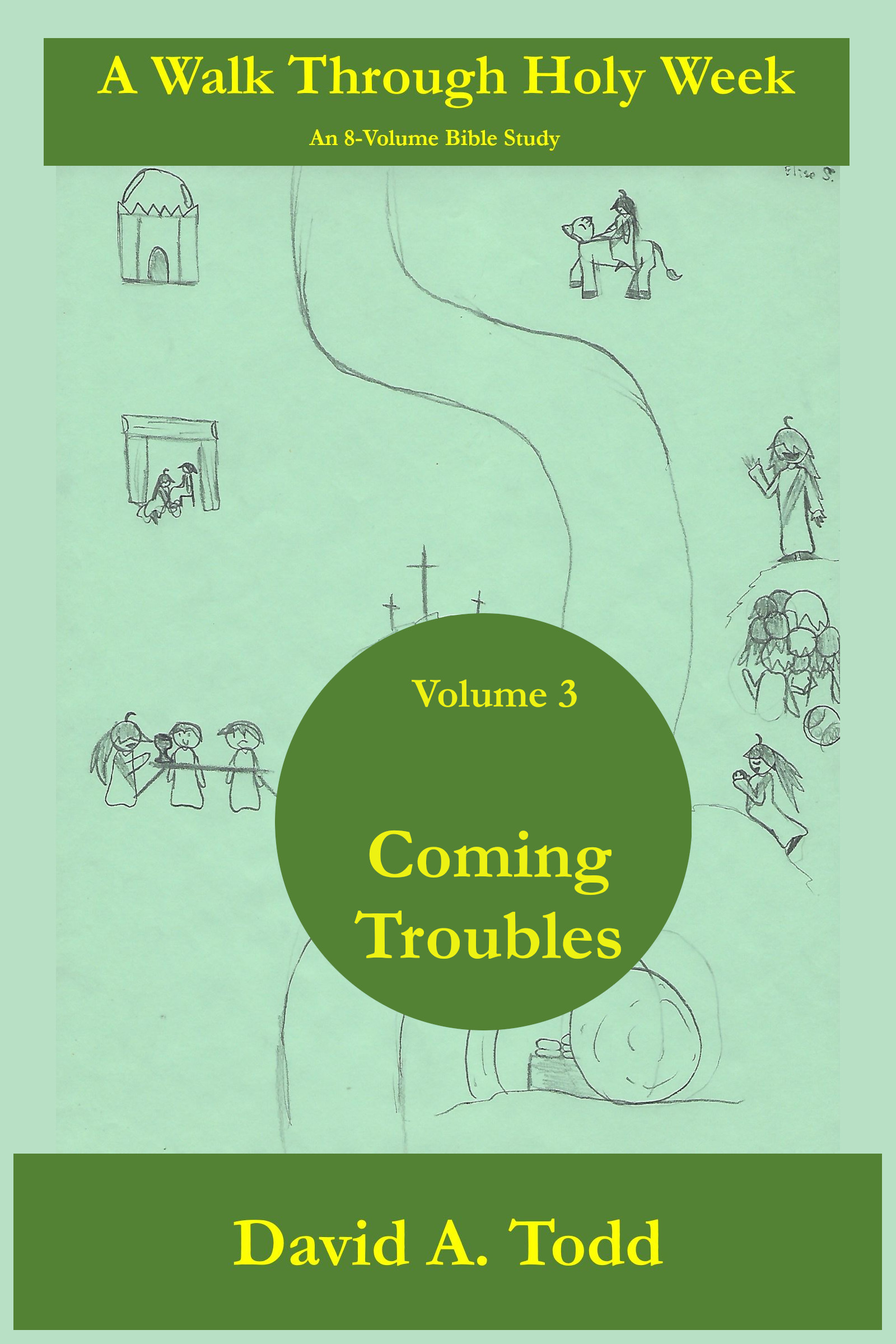
Over the last five or six days, I have published Volume 4 of my Bible study series, A Walk Through Holy Week. Titled A Difficult Meal, it covers the Last Supper as told in all four gospels. Although the fourth of eight volumes in the series, it was actually one of the earlier ones written, possibly the first. It has been patiently waiting in its folder for me to finish its brethren in order before it. Here’s the link to it at Amazon.

I set the publishing up to go live tomorrow, May 6. The e-book will be published that date, though it is ready for pre-order now. The print book was supposed to be ready the same day, but I’ve had some issues getting the print cover to meet Amazon’s requirements. I corrected it this morning and uploaded a replacement cover. If Amazon approves it, the print book should be available today or tomorrow.

I will now take a short break (a month or two) from publishing this series to do a few other key tasks. I’m not sure when I’ll do the publishing on Vols. 5 through 8, but it should be before the end of the year.

Goals for the Next Month

The first four volumes in this series are done, Volume 4 to be published in a few days.

It’s been a long time, close to six months, since I’ve posted monthly accomplishments and goals in my writing endeavors. The combination of health setbacks and travel kept me distracted and busy, not necessarily on writing things. But now I’ve finished my post-heart-surgery cardio rehab, and I’ve finished the PT regimen prior to potential knee surgery.

So my schedule is temporarily lighter and I’m able to think about goals for the coming months. I won’t say much about accomplishments, but I have completed some goals during the past half-year. I finished the last few volumes of my eight-volume Bible study, A Walk Through Holy Week, and published the first four of them. Vol. 4 will go live on Amazon on May 6.

Aside from that, my writing accomplishments were mainly in terms of organization. I found lots of loose papers from past writing efforts, and organized them into a permanent way. I don’t think I have many more loose paper stashes about the house.

So what’s up for the next month? I actually plan to work on a non-commercial product. Over the last couple of years, I transcribed the letters from our years living in Saudi Arabia, with the intent of publishing them in book form for our family. I illustrated it with photos from those years, but only a few photos. Full illustration was always part of my plan.

“The Saudi Years In Letters” will be the follow-up to this.

KYIL – print cover new size – improved 02While I was laid up from strokes and operations and our daughter came to help out, I had her sort through photos from those years and select and scan those she thought would be good in the book. She got through about half of them. In Nov-Dec, I was able to get through the rest of them. I also went through all the scans, crop them, and name them, and store them in findable places on the computer. I figure we have twice the number of photos scanned and ready to use as the book can reasonably support.

Therefore, the book it ready for the work of loading photos and arranging them in the books. I think this work will go fairly quickly, as I did the same work for the book of letters for our Kuwait years. I hope to start on this perhaps by tomorrow, and have a finished product by the end of the month.

That’s my only established writing goal for the month. I’ll see how it goes.

Photos

It’s so nice to have photos, isn’t it? Of family. Of the house. Of that big snowstorm in winter. Of the beautiful landscape scenes you see on summer vacation. Family Christmas celebration.

Then there’s the old photo album that your grandparents had and gave to your parents. Aunt Jane, great-aunt Elizabeth, photos of croquet games, unknown children. How great it is to have all that family history.

Until, that is, 50 years or more have passed. You are the only one still alive who remembers great-aunt Elizabeth, and you aren’t quite sure the woman you remember was actually great-aunt Elizabeth or a neighbor lady. You take stock after a cousin comes by with a box of photos and says, “Keep what your want and do what you want with the rest.” And you realize the box probably has 5,000 photos in it.

And you further realize you have similar boxes of photos of your own family, you dad’s family, your mom’s family, your spouse’s dad’s family, and your spouse’s mom’s family. Is it really possible that you have 20,000 photos in the house?

That’s where we’re at. We thinned out the book collection down to a manageable number for when we downsize. The photos come next. Digitize them, you say? That removes the stacks, but doesn’t really solve the problem. Someone, sometime, will have those digital files and wonder “who the heck are these people and why do I have these files?” No, they don’t take up a lot of physical space, but they are a type of clutter, a possession passed down that is not needed and probably not wanted. Something to leave to your children to make the decision on.

This is where we are. Probably 20,000 physical photos to do something with. At some point I’ll maybe count enough to see if my estimate is close.


Book Review: “Paul Orjala”

My reading has trailed off a bit lately, in part due to health issues and in part due to reading choices not panning out. I laid two books aside at the 1/3rd point when the subject and writing turned out to not hold my interest. I suppose general busyness helped to rob reading time, with some of the busyness due to medical appointments.

Looking for a short read, I grabbed a book my wife had recently read and recommended: Paul Orjala: The Man, The Mission. It’s one of series of annual missions books our church published (or used to), this one from 2009-10. I think I read it back then but did not in the least remember it, so it was a fresh read. The book was of special interest to me because I briefly knew Paul when I attended the same church as he and his family in 1974-75. At that time, Paul was back from the mission field in Haiti and teaching at our seminary in Kansas City. I didn’t get to know him very well. He was already an experienced missionary and professor; I was new to the congregation and denomination. We didn’t hang out in the same circles.

But I got to know him a little. He was a nice man, well thought of by all, and pleasant spoken. The book told about his boyhood in San Diego, call to missions, assignment in Haiti, years teaching, and a later in life assignment in France. In all things, Paul was a faithful and effective servant of Christ. Much of our missions education curriculum. Paul is almost a legend in our church for the effectiveness of everything he touched. That includes considerable musical talent, which I saw him demonstrate in church services.

I’m glad Lynda found this book in the house and brought it to my attention. It was a good, short read about an amazing man and his service for God. I won’t read it again, nor do I think we should keep it, but I’m very glad I read it.