August Progress, September Goals

I must be losing my mind, for I forgot that, at the change of the month, I was supposed to do my usual progress and goals post. No, not losing my mind, but totally absorbed in a research project. I finished that Friday (I’ll discuss it in the progress section below) and it was like blinders came off. I realized I needed to do this post. But, having already made a post on Friday Sept 3, I’m writing this on Friday but will schedule it to post on Monday Sept 6.

First, here are the goals I posted to begin August and what progress I made against them.

  1. Continue to tweak the church anniversary book. I can think of only two more interviews to do. I may add in photos this month. Well, I more or less did this. I tweaked the book. I did all the interviews I intend to do. I even reached out on the internet to find relatives of our church’s charter members, with some success. I added a few photos, but for the most part let the research of charter members overwhelm the tweaking/finishing the book, so it will be a September goal.
  2. Finish a short story in the Sharon Williams Fonseca series, tentatively titled “Foxtrot Alpha Tango”. I wrote four pages in July to share with the Scribblers & Scribes critique group when we met that month. With just under 2,000 words written, I believe it’s 2/3 done. I guess I did some work on this, since it sits at 3600 words, but it’s not done. Add it to September goals.
  3. Work on the middle grade novel I started in July. The Forest Throne is technically to be co-authored by my oldest grandson, though I’ll do most of the writing and he will edit it, helping me to understand what 10-13 year old boys like. I wrote the first chapter of this in July and sent it to him for comments, receiving his approbation of the sample. I’d like to add another 5,000 words to it this month to go with the 1350 written so far. I’ve brainstormed out most of the plot but not specific scenes. No writing on this at all. I brainstormed the plot some more (which is work and progress) and figured out how to solve another plot problem that I was uncertain of. Hoping to get back to this in September.
  4. Blog twice a week, as always. Did this, as always.
  5. Do some work on my website. I’m not sure what, but I have to overcome this technophobia and improve it. Nope, put this off again. I still need to do this. Oh, if I were only a techie!
  6. Attend meetings of my three writing groups, assuming they don’t get cancelled because of local corona virus outbreaks. Two of the groups cancelled, with the pandemic figuring in each. The Scribblers & Scribes of Bella Vista met, and I attended.
  7. If the cover artist gets the covers re-done, re-publish the three older church history novels, updating them for new copyright info and list of works, as well as link them in a series. The cover artist wasn’t able to do this, so my goal remains not done.

So, what are my goals for September 2021? Just about everything from last month, I reckon.

  1. Blog twice a week, on Mondays and Fridays.
  2. Wrap up my research project on our church’s charter member. I’ve come to a stopping point of sorts. What remains is to get my research notes into a useful format so that a future researcher, maybe at our 150th anniversary in 2071, will find the notes legible and useful and the research accurate.
  3. Finish “Foxtrot Alpha Tango”, the short story I’ve been working on for two or three months.
  4. Link the books in my Church History Novels series on Amazon. This is an easy process. I’ve been holding off until the new covers were done, but it’s time to just do it.
  5. I still have a few more tweaks to do on the church centennial book. I’m going to work on it after I finish this post and may finish them today (Friday afternoon).
  6. Attend my writers’ groups. At the moment all three are scheduled.
  7. Document one Bible study idea I had and put it in the queue.

That’s enough. I wonder if I can achieve much of this in September. See you in early October. October 1 is a Friday, so possibly I’ll post progress and goals on the 1st.

It’s Time To Modernize Citations

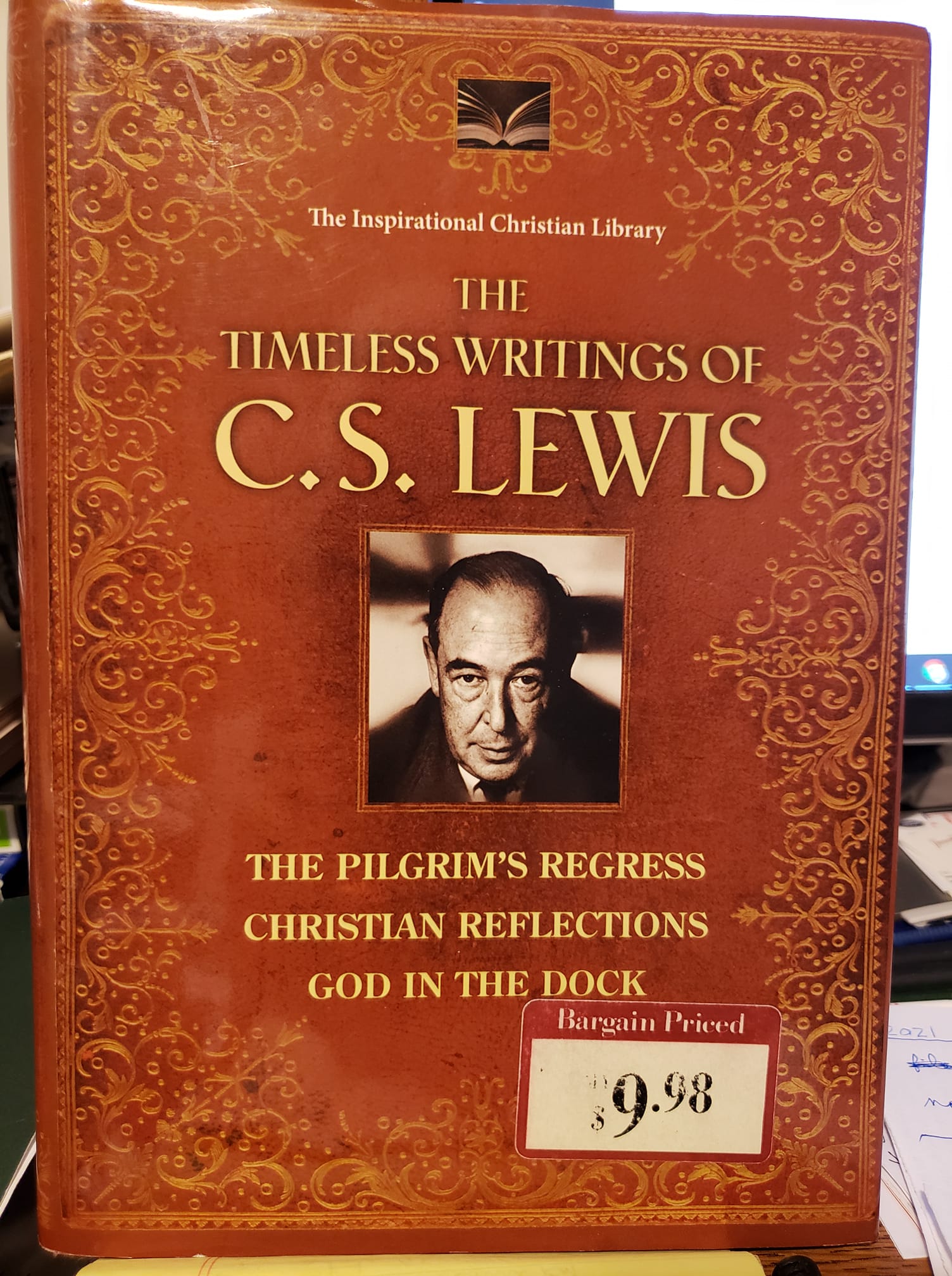
This is how I would like to see citations done. Kudos to the author and publisher. Pay no attention to the curving text. That’s a photographer’s error (meaning mine).

A couple of days ago, a Facebook friend I seldom interact with posted a C.S. Lewis quote. I’ve seen this quote before. It seems to be politically conservative, would seem to support certain memes you see on social media. The quote was not attributed except to say it was by C.S. Lewis. Having seen it so posted at least three times, I decided to not let it go this time. I asked the poster what the source was, where Lewis wrote this. She came back with a fuller quote and said it was from “God In The Dock: Essays on Theology and Ethics (1948).

Fine, I thought, I have a copy of God In The Dock. I’ll just go there and see if I can find the place. Alas, as I looked through it, I re-discovered (having seen some time ago but forgotten) that GITD is collection of essays. As I looked further, I discovered that not only was GITD the title of a book, it was also the title of an essay. “God In The Dock” was an essay from 1948. God In The Dock was a book, a collection of Lewis’s essays published posthumously in 1970. Which did she mean? Since she said 1948 in the source, I figured it was the essay. So I went to it in the book and…the quote wasn’t in the essay.

A little bit of searching—something I’m getting good at these days—revealed “The Humanitarian Theory of Punishment”, an essay that appeared first in an Australian periodical in 1949 and republished in an Australian legal journal in 1953. So her source as presented was technically incorrect.

All of which got me to thinking about sources, which in turn got me to thinking about footnotes and citations. I do a lot of reading and research in the older writers, those who are long out of copyright. You can find lots of their works on line at no cost, though not the more modern reprints. a book I’m reading right now has a lot of quotes and citations in footnotes. In quotes from the writings of John Wesley, they refer to a specific set of collected works. Here’s an example.

4. John Wesley, The Works of John Wesley, vol. 12 (Kansas City, MO: Beacon Hill Press of Kansas City, 1978)

If I wanted to find this particular quote, perhaps to read it in context and see if the author had used Wesley’s words correctly, I would have to go somewhere and get that specific set of his collected works and find the specific volume, the specific page—oops, he didn’t give the page. Shame on the author and the publisher. Let’s try a different citation in a footnote.

16. Wesley, Works, vol VI, 512

A footnote immediately prior to this one identifies which of Wesley’s collected works is meant. That’s a little more helpful, but, again, only if I have that specific volume. But, all of Wesley’s works are out of copyright. They are all available in a great on-line library called the Internet, both pictures of them from the 18th and 19th centuries and electronic versions newer than that. Why not just say where it’s found? Why not say, for example:

John Wesley, “Sermon No. 17”

or whatever of Wesley’s writing you need. How easy it would be to find the original document and do the research you want to do.

So I am making the proposal that we start modernizing citations and footnotes to recognize how data is accessed these days.

Back to the C.S, Lewis quote in question. Here are two ways to do that citation, first the old way, then my proposed new way.

  • C.S. Lewis, The Timeless Writings of C.S. Lewis, 2003 (New York, NY, Inspirational Press), 499
  • C.S. Lewis, “The Humanitarian Theory of Punishment”, 1949, paragraph 10

I ask you, which would be easier to find? You can go to whatever Lewis collection you have, find the essay, thumb to the paragraph, and read the quote. You can read the whole essay to get the context, and make up your mind if those posting the quote are using Lewis correctly. Or, if you don’t have it, you know what to look for in a library or a book store. Want a little more information? You could expand it as follows.

  • C.S. Lewis, “The Humanitarian Theory of Punishment”, paragraph 10. Anthologized in God In The Dock,

Since God In The Dock, the book, has been published several times in several formats, you don’t even need to give the year of publication of who the publisher is. The name of the book is sufficient for any reader or researcher of reasonable intelligence to find the work, verify the quote, and go on with whatever project had caused him to look the information up.

I followed this system, at least somewhat, in my two family history/genealogy books. I referenced works without getting into specific printed matter, publishers, and dates of publication. I like the way it turned out.

And, while I’m at it about citations/footnotes, how about we once and for all bury Latin references and abbreviations? Sure, I can look up what op cit and ibid mean and learn them. But with the cost of printing as cheap as it is nowadays, why not just repeat the work, perhaps in a slightly shorter form, and change the page number? Give complete references in a Bibliography at the end. This I also did in my two genealogy books.

Well, that’s my proposal. I don’t expect it to catch on in my lifetime, but I made it and put it out there for public scrutiny. I’d like to hear what everyone things of it.

Oh, to be fair, the book I’m reading for church does include some footnotes as I suggest. For example:

12. Wesley, “Sermon 85, On Working Out Our Own Salvation,” III.2

So maybe my proposal isn’t so far out.

So Tired Of Covid Protocol Arguments

“I’m not wearing a mask. I’m a free person and you can’t make me! The government can’t make me! I won’t be a sheep like you!”

“If you don’t wear a mask you are purposely killing people. Murderer!”

These are the two ends of the covid argument, and I’m sick of it. The rhetoric is way over the top on both sides. It’s the same for the vaccines, though, if anything, it’s even worse for the vaccines. People yelling past each other on each of these issues, not only on social media, but in real life as well.

I’m trying to ignore it as much as I can. I’m a reasonably intelligent person and don’t really feel like I need the government telling me what to do. They are a good data-gathering organization and, if they will just do that and make the aggregated data available and easy to find and understand, without hiding any data that might argue against some kind of prevailing wisdom. I can then make good decisions. I did that. I received a vaccine (J&J was the one being offered at the place where I went) and, since the resurgence in covid cases I’ve gone back to wearing a mask in public.

But the question I have is do people not know how to get what they want? It’s an old business adage: “Do you want to be right, or do you want to get what you want?” The idea behind this is sometimes you might be right and lose the argument or not get what you want. A hypothetical: You’re a Republican and want to put a campaign bumper sticker on your car. But you want to get business from a certain city and the mayor is a Democrat. So, to get what you want (more business and more profit) you don’t worry about being right (displaying a Republican bumper sticker). Don’t worry about being right; instead get what you want.

On social media, George Takei posted this:

Telling me you are proudly unvaccinated is like telling me you’re a drunk driver. You’re not a patriot. You’re not a freedom fighter. You’re a menace.

Does Takei really think this will convince people who have resisted getting the vaccine to now get it? Is this how you win arguments? I don’t think so. I suppose Takei feels pretty good about himself. In a witty way he called those who refuse the vaccine idiots. But he is, in fact, hurting his own cause. No one is going to decide to get the vaccine because George Takei calls them a menace. Because Takei speaks this way he will cause some who were on the fence to do the opposite of what he wants them to do. So I say to him, “George, learn how to get what you want rather than be right.”

I want to suggest an alternate approach. It’s the approach our church took. First, a little history. When the pandemic hit in March 2020, our church ended in-person services. Services went on-line. Sometime around June 2020, they began services in-person but continued on-line and did not encourage in-person attendance. The sanctuary that seats 600 was reconfigured to seat less than 100. Masks were required. Physical distancing was required. Life groups didn’t meet in person. Hand sanitizer was everywhere. Then, in September 2020, we increased seating in the sanctuary just a little. That’s when I went back to in-person church. Then, somewhere around Jan-Feb 2021, things opened up a little more. People started coming back in larger numbers. We still physically distanced, but masks were mostly done away with.

Then, somewhere around June 2021, covid cases began spiking in northwest Arkansas. A few people went back to wearing masks. A few vulnerable people went back to on-line church. In July the church re-instituted a protocol, a recommendation, to wear masks in any part of the church where you couldn’t distance from others. But this was all made voluntary with a request/strong suggestion that you do this. And, since that was re-instituted, we have had 100 percent compliance with these voluntary standards. 100 percent compliance. Maybe some who can’t wear masks or won’t wear masks decided to stay away or attend on-line.

Our pastor wrote a blog post about this. It’s worth reading.

An Open Letter To My Church

It’s a little long, but not so much. I hope you read it. Here’s the salient point in it.

I looked around the lobby this past Sunday and everyone was wearing masks, complying with the recommendation of our board. This happened not because you were forced, but because you believed the wellbeing of your neighbor was more important than your personal comfort or freedom.

My point is that beating up people, insulting people, shaming people, to convince them to wear a mask in public, be vaccinated against covid, or practice physical distancing won’t work. It won’t. But giving them information and explaining to them what you think is right, what you hope they will do and want them to do, for their own good and for the good of the community, will result in people doing what you want—to a much larger extent than shaming/insulting/belittling.

Remembering Kuwait As Afghanistan Crumbles

[Dateline 26 August 2021, the 24th anniversary of Dad’s death]

Remember the oil wells set afire by Iraq? It really happened. Here’s Lynda in June 1991 when she went back to Kuwait as a Red Cross nurse.

A mere five days ago, the Afghan national army collapsed. They’d been fighting the Taliban for years in a broad civil war, backed up by our equipment, money, and a handful of troops. Why did they cease fighting? I have a thought on why. Perhaps I’ll speculate on that in another post on another day.

In light of that, a massive air evacuation has been ongoing since then. News reports are saying as many as 90,000 people have air lifted out. If true, it’s a tremendous achievement. But it needed not have happened. Other courses wee available. Perhaps I’ll speculate about those in another post on another day.

Then, today, bombs went off near the airport in Kabul. At least twelve American servicemen are dead, and an unknown number of Afghanis and other foreigners. News reports indicate they were set off by suicide bombers, with detonation locations selected to inflict injury and embarrassment to us. News reports are horrific.

This is all so familiar to me. It was August-December 1990, thirty-one years ago, that Iraq invaded Kuwait. At that time we were residents of Kuwait, though we were in the USA on annual leave when Iraq attacked. Some of you might remember that, though because of our involvement, my memories are sharp. At that time you only had four news outlets, no internet, no social media, no You Tube. News was somewhat scarce. What had become of our many friends in Kuwait, American and foreign?

Negotiations with Sadam Hussein resulted in the release of some Americans while others were taken hostage to various military targets in Iraq, thinking that America wouldn’t bomb places where they knew their citizens were. The planes began arriving at our Airforce bases, and we watched people deplane. Every plane had people we knew on it. We even saw one of Lynda’s best friends, who had been Sara’s 2nd grade teacher, deplane in London.

Eventually, Secretary of state James Baker conducted other negotiations, and those who had been held hostage were released in early January 1991. On January 17 Operation Desert Storm began. The liberation of Kuwait was on. The occupation of Iraq, and trying to change it into a democracy similar to ours, began, Twenty-three years showed that they would never become culturally like us.

I went to Kuwait in Jan 1988, Lynda and the children joining me in March. In the six or seven weeks I was there without her, three different terrorist bombs went off in Kuwait City. I heard two of them. They were set off at a time and place where they made a statement but didn’t hurt anyone. The third bomb was being delivered when it went off, killing the two delivery men and burning a nearby palm tree.

We enrolled the kids in the American School of Kuwait for the completion of their third and first grade years. In the parents’ packet was information on where we would find our children if for any reason they had to evacuate the school property. That hit us hard. The Iran-Iraq war was still going strong. We sometimes saw tankers smoking out in the Persian Gulf. Lynda and I had a discussion: what would happen if the war spilled over into Kuwait? What could the US government do for us? We decided they could do nothing; we were on our own.

So here it is again Another Islamic country that we tried to help has blown up in our face. Iran in 1979, Iraq-Kuwait in 1990, and Afghanistan from 2001-2021. We send in our military, or our influencers and try to change them into a country that is culturally similar to ours. It doesn’t work. Their culture has been set for more than a millennium. I time of trauma followed by a decade or two of our influence is not going to change them. Once we are gone—and at some point we will always be gone—they will revert to their long term culture. If they oppressed women before we were there, stopped doing that while we were there, when we are gone they will again oppress women. We can’t change them in two decades.

They say we are getting out. I hope we are getting out. We could have done it better, a whole lot better. We should have done it better. I hope we don’t ever go back in.

Tied Up In Research

A congregational photo taken in 1925, the earliest photo I could find. We have identified a few people in the photo.

Well, I’m late with my post today. Often I write my Monday morning post sometime during the weekend and schedule it for 7:30 a.m. Monday. Alas, that didn’t happen. My Saturday outdoor work was interrupted by rain, so I worked inside. Besides the usual clean-up, such as dishes, vacuuming, kitchen counters, laundry, decluttering, I worked on the checkbook (yes, I still keep the checkbook and make sure it’s correct to the penny) and budget. I then switched off to continue some research into our church’s centennial book.

As I’ve said before, it’s complete as to the writing. Well, almost complete, I have one more interview to do, and I decided I wanted to add one small section. Photos are something the committee will help me select.

One task I have taken on concerning church history—well, two tasks I suppose—is expanding the list of charter members. From history passed down, we know we had 63 charter members back in 1921. Alas, the names of only 12 were recorded. In fact, the church didn’t establish a record book until almost 3 1/2 years after they started meeting. Fortunately, the pastor at that time wrote the names of all who were then or who had been members before his coming. It is about 170 names. Of those 170, 63 were charter members and the others what I call “early members”. I decided to take on the task of figuring our who the missing 51 were.

I delayed that because I knew it was going to be a huge task. I was right. I established some criteria, researched the names, and was able to identify 32 people who I thought could be added to the 12 known charter members. I passed that list two three different people to check the names and see what they thought. Yesterday afternoon I met with two of them for nearly three hours. We went over every name on the list. Most of the names they were not able to rule in or rule out. One family they ruled out, being pretty sure they joined a little after the church began. One other family they added, being sure, from church lore passed down, that they were in fact charter members.

So where does that leave me? I have 12 known charter members, 34 probable charter members, and 42 possible charter members. The rest of the ±170 I have ruled out based on the research criteria I’ve set. The 12 + 34 add to 46, leaving me 17 still to be determined. Somehow, if I am to be successful with this task, I need to decide which 17 of the 42 were most likely charter members. That is my current research task.

One related item I’m working on is cross-checking that old record book to make sure I didn’t miss any names or any clues. I’m also working on documenting my research better than I have thus far. It occurred to me that some future historian will write another church history, maybe at our 150th anniversary. I want that historian to have confidence in my research. So I’m going back over every family, every name on that early members list, and doing the research over, but this time documenting everything I find in a Word file. I’m being meticulous. It’s slow going. Yesterday evening I documented the one family added to the list of probable charter members. There were four or five in the family but only the parents were on the early members list. They are now fully documented and added to the charter member list as “probables”.

While this is tedious work, and will take me a couple of months to do, It is also quite satisfying. It’s a mix of detective work and genealogy. Once research is finished, it will give way to writing. I have a section in the book giving the 170 names on the early members list, a section I will have to rewrite once the research is done.

Will it ever be done? Just as I finished my afternoon research session, I took a look again at the “H” page (since the next family I’ll do begins with an H), and realized I may have misinterpreted what that pastor wrote long ago and have to add some more H names to the early members list. I’ll do that happily, to be as accurate as I can.

Of course, I am hoping to return to creative writing at some point, more than just sneaking an hour or two of it in from time to time. The end is in sight.

Book Review: Intimate Correspondence

Their relationship, an affair or not, rocked the British world in 1936 and had repercussions for years afterwards.

About a month ago I made a deep search through my reading piles that sit on a bookcase in my bedroom closet. I added a fair number of books to this pile some years ago and have been slowly reading those books. So having finished another book, I went there to see if one on the shelves would be suitable for my next read.

I found the book The Intimate Correspondence of the Duke and Duchess of Windsor. The subtitle is, I guess, Wallis and Edward Letters 1931-1937. I say “I guess” because the layout of the cover is strange, and it’s not clear to me that this is the subtitle. I picked this book up at a thrift store many years ago. Now, I’m not a big fan of the British monarchy and their whole system of nobility, but I love letters. That’s why I bought the book.

I won’t go into much of the history. Some people know it, some don’t. Edward was heir to the throne of England. Somehow he met Wallis Simpson, an American woman living in England. The were frequently together in social situations. The crown prince became enamored by her and, even though she was married (after a prior divorce), Edward ditched his girlfriend for her. Even though he was 37 when he met Wallis, Edward wasn’t ready to marry.

The letters in the book are mixed with a considerable amount of commentary. I was surprised that most of the letters weren’t between Wallis and Edward but between Wallis and her Aunt Bessie. They are interesting letters, tracing the development of the prince and her meeting, then getting to know one another, then becoming dependent on one another. The letters between Edward and Wallis begin only after several years of their relationship. And,  they are not intimate in the sense we think of today. They don’t give salacious details of secret rendezvouses and trysts. They mainly consist of cute little things like “oh wasn’t that a great dinner party last night, my love?” As the relationship grew, the letters were more and more how he couldn’t live without her, how she loved him, but that it was all so futile.

Two things came out clearly to me from the letters, mainly the prince’s. He was terribly immature. Raised by governesses and tutors, with little involvement from his parents, Edward sounds like an 8th grade schoolboy as he writes to Wallis. All he knows are parties and pubs. Oh, he had duties, I realize, but they are rarely mentioned. Edward had regular, somewhat small parties at his country home and rarely interacted with his family. Wallis became more and more estranged from her husband, who was also a friend of the prince. Eventually Mr. Simpson has an affair with her good friend, giving her grounds for divorce.

Just in time, too, because Edward’s dad dies and he becomes king on Jan 20, 1936. And here the second thing that came out clearly begins. Naturally, all Britain wanted the king to marry, be happy, give them a queen, and hopefully produce an heir. But the king wants to marry a soon to be twice-divorced woman—an American to boot—and parliament won’t allow it. It was around September 1936 that the existence of Mrs. Simpson comes to the awareness of the British public. The prince has already been discussing this with the prime minister. He says Edward can’t marry Wallis. She will never be queen. If he does marry her, the entire cabinet will resign. Parliament will never agree to grant her any royal title. And this is what is so bizarre to me. The ministers and parliament—the government—have to approve who the head of state marries? That’s absolutely absurd, and it’s one of the reasons I think monarchy is ridiculous. Edward decides he can’t be king unless Wallis is by his side. See how immature he is? He gives up his throne and must leave the country in disgrace and exile.

But I prate, and have moved away from the book. While the letters were not quite what I thought they would be when I paid 50¢ for the book at a thrift store, I found it all captivating. It’s history, whether the persons involved are attractive to me or not. I found myself able to read many pages a day and rarely skipped anything. Yes, the commentary was more than I’m used to in a collection of letters, but it was not too much. I think the editor, Michael Bloch, got it about right.

I give this book 4-stars. Sorry, but I can’t give one about British royalty a full 5. But is it a keeper? I have a nice collection of letters, a number of which I started but few which I finished. The answer is no, it is not a keeper. I don’t see myself ever reading this again. So out to the donation pile it goes. Or I’ll sell it or give it away if one of my readers (you know who you are) wants it.

Why not keep it to have a broader collection of letters? That’s a good question, but ultimately why do I need to keep a collection of collected (or selected) letters? I don’t. They would be one more thing for my heirs to have to deal with when I’m gone. No, Edward and Wallis go out to the garage. I hope to recover the 50¢ for them, but will gladly see them go without recovering my investment. They were worth that price for sure.

Two Changed Words Make a Big Difference

Dateline Sunday 15 August 2021

I’m having a restful Sunday. Took a nap or two this afternoon. It’s evening now, and I may try to write a little this evening. Or maybe I’ll continue to work on old e-mails, deciding what to keep, what to discard, what to archive. For some reason I find that a restful occupation. Right now I’m going through e-mails from 2011.

But this blog post is about a small writing success story that happened late last week. I think it was on Friday, but it might have been Thursday. This involves poetry. Now, years ago I wrote poetry, but I transferred away from that and concentrated on prose for a long time, with many works under my belt. From time to time over the last ten years I would try my hand at poetry, but none came to me, either by inspiration or perspiration. I have ideas for poetry books, but no means to make them happen.

So Friday evening, I had a minor breakthrough, a two word breakthrough. I wish I could explain how this happened, what  inspired me to bring this poem to mind and to figure out those two word needed to replace two unproductive words. I’ve been reading in three books: Behind The Stories, a 2002 book about a couple of dozen Christian novelists; The Joyful Christian, a library book that is a compilation of a number of Lewis’s writings; and, on my phone, The Collected Letters of C.S. Lewis, Vol 3. I think my catalyst may have been in the letters book. Lewis probably wrote something to someone about some poetry that person had sent him. As a result, the problem poem came to mind. It’s a sonnet I wrote in 2002, my 18th sonnet. But as I said, I was never happy with the closing line. I had emended it several times, maybe improving it, but never feeling that it gave the required punch the sonnet needed.

Well, the words came to me while I was reading. I didn’t have my computer open, so I wrote the revised line on a sheet of paper by my reading chair, and said it over and over to myself. I went to bed saying it, mulling it over and over. It seemed good. I’m going to paste in the poem here. I would type it, but I don’t know html and poetry lines don’t come in right on this platform.

A snip from my Word file. Alas, I don’t like the way poems format on this platform. If the poem isn’t readable, click to enlarge.


I’m not going to explain it. Native Rhode Islanders will understand, both the place references and the object references.

I’m not saying poetry is back for me. My mind is still mainly on prose: stories, novels, articles, letters. But I’m glad for a small poetic break-though. I leave it to poetry critics to explicate that last line and judge its worthiness. Now, back to my prose.

Morning Work

Some of the area already cut. I started at our mailbox (just out of the photo to the left) and am working my way uphill along the street and downhill toward the woods.

It’s hot out. Yesterday’s high was 97°. That’s actually around average for this time of year in Northwest Arkansas. I think our summer, overall, has been slightly cooler than normal—not by much, just a few degrees. Certainly within a standard deviation of normal.

In these temperatures, if I have yardwork to do, I go out immediately upon getting up and do it. This year I have yardwork every day. That’s anywhere from 6:30 to 7:00 a.m., depending on when I wake up and how fast I’m moving. Today it was 06:45, and I was out the door in just five minutes. I worked until 07:45, so just under and hour.

Some of the isolated blackberries. Still some weeds to cut away if I want to, but I’ll probably leave them. So long as I know where the blackberries are that’s good enough.

The front yard (a rock yard, not grass), is picked free of weeds; nothing to do there. Our unplanted flower bed needs to be picked of weeds again, but the lack of rain has resulted them being impossible to pull out; nothing to do there. The backyard (also a rock yard) needs much weed pulling. I think I’ve weeded twice this year. But I never blew the leaves off of it last year, which has prevented many weeds from growing. Still, that was a possibility.

However, I also had work to do on our wood lot. This is the lot south of our house. It’s our lot.  Over a year ago, the power company did a lot of cutting on their easement on this lot, clearing growth away from their lines. The shredded the smaller saplings and hauled off the bigger stuff. This left about 30 feet of a combination of grass and wood-covered bare earth. I raked down a bunch of the shreddings and put them on a brush pile on the lot. Naturally, plants have come up in that area. The favorable rains and temperatures have resulted in a lot of plants growing in this area, some as tall as 6 feet.

I’ll start working in this direction either tomorrow or, more likely, next week.

Most of those plants are weeds and grass. Some are wildflowers. A few are blackberry plants. Everyone knows I want more blackberries, and to have them growing on my own lot instead of across the street in the right-of-way would be great. So, to remove the unsightliness of the tall weeds and to isolate the emergent blackberry plants, I’ve been manually cutting weeds on this lot using hedge sheers. That’s my only option since my weed eater quit and I haven’t replaced it yet.

It’s not really hard work. I work from the downhill side so that I have to bend less. Still, it includes a lot of bending. Once I find a blackberry plant the bending increases, as I go slowly, cutting weeds and grass around it to isolate it. I have around six or seven viable blackberry plants isolated so far. I’m not sure if I’ll find any others, but I still have a long way to go, so I may.

The hickory is down. The clean-up remains. That will be tomorrow, along with raking down some of the cuttings of the weeds.

Another thing I’ve been doing in my morning outdoor work is cutting down a 4-inch diameter hickory sapling. This is growing right against an oak, and the two of them don’t need to be so close together. Until the power company did its clearing, I never noticed this tree encroaching on the oak’s territory. Again, I’m using manual tools: my ancient bow saw and my little folding pruning saw. Sawing is hard work, especially when bending or kneeling. No, 4 inches isn’t a lot to cut through. Hickory is a hard wood, however, so the combination of conditions meant I decided to do this over a few days—four days to be precise. Today, down it came after the last little bit of sawing. Now I get to do the clean-up.

If I had to guess, I’d say I have about five more mornings of work on the woodlot, a morning of work on the flower bed (once it rains), and at least five mornings of weed pulling in the backyard. By then a few weeds will have come up in the front yard and I’ll pull them.

All of this should be of no real interest to my regular readers. So in my retirement I get up early in the summer months and do yardwork. Big deal, right? It’s of interest to me, however. I figure I have another month of doing this, having a little less daylight each day.

This work, while it helps keep me limber and “young”—young being a relative term—it does cut into my writing time. My short story is sitting there, waiting for me to add the final conflict and last 2,000 words. The Forest Throne is sitting there, waiting for me to get beyond the first chapter and make a book out of it. Documenting America: Run-Up to Revolution is sitting there, waiting for me to move from completed research to writing.  And sorely needed updates to this website are begging me to get to them.

This too shall pass, and soon I’ll be back to starting my day off with writing, the yardwork either being completed or the days cool enough to do the yardwork later in the day. I’ll be glad for that time to come.

Four Hours of Ministry

These are the shoes we gave out. I’m sure we would have had fewer no-shows if they had given out Red Sox shoes instead.

Even though I’m retired and can do whatever work I want on whatever day, I still do more yard on a Saturday than on weekdays. This past Saturday I had big plans for two hours of specific work, finishing stuff I started Monday through Thursday. But I had already decided I wasn’t going to work in the yard, because our church had a special ministry opportunity, something known for a few weeks.

Each summer, in August, we have partnered with Samaritan’s Feet to provide shoes to needed children who would soon be back in school. It normally involves foot washing and giving a pair of socks along with the shoes. Last year we cancelled it due to covid concerns. We had it scheduled for this year when it seemed covid was under control. Our problem was construction adjacent to the church that has severely reduced our parking. Then, covid began to rear-up again.

However, since we had them (Samaritan’s feet) scheduled, our leadership reached out to our Hispanic church in Springdale, who accepted our church partnering with them and holding the event for them at their church. That happened this Saturday. We were supposed to sign up online for what job we wanted to do. All the volunteer slots were from 8:45 a.m. to 2:00 p.m. I signed up to be one of those moving shoes from the back “inventory” table to the front for access by those giving them to the recipients. That seemed like a nice indoor job (i.e. in air conditioning).

I arrived a little early, and saw people pulling things out of a trailer. The plans for the day included hot dogs, snow cones, cotton candy, small back of chips, and water for all recipients and their parents, as well as for the volunteers as available. Also included was an inflatable play house, but the kind where only two kids at a time enter and no one else goes in until they come out. That was a covid concession to not have the type of house where many kids are in it. They were just pulling them out of the trailer when I came, so I joined the work crew and we figured out how to set them up.

They were also putting up awnings to cover the different food areas. I helped with that, and helped moved the grill out of the trailer and find a place in the shade for it. Then I figured they would be ready to train the inside volunteers, so quickly went there. I was wrong. They were already halfway through with the training. As I listened and looked over the set up, it seemed to me they didn’t need four people to do the job I had signed up for. Two people could easily handle it. They had 400 people signed up to receive shoes, which sounded like a lot, but the system is so well set up that I couldn’t see that I was needed for that. Because of covid fears, the normal foot washing was suspended, reducing close contact between volunteers and recipients.

Back outside, I looked for a job to do. Because of covid they were going to individually wrap hotdogs. A few of us figured out a system for that and, as the delectable meat began coming off the grill we fell into a rhythm where three of us did the wrapping—wearing masks and gloves, of course, and making use of hand sanitizer.

Alas, the hot dog wrapping table was just outside the shadow of the awning. It was hot, and I wore down fairly quickly. I found a shady place to sit from time to time. I did some trash pickup. I went inside when supplies were needed—anything to get out of the sun.

Even with these steps, I was done by about 12:45. All the hotdogs had been grilled and wrapped and over 200 already given out. Most people who had signed up to get shoes had come and gone with their tote bag of shoes, socks, school supplies, and a small message card. Of the 400 who signed up, they estimated about 30 percent no shows. But people who didn’t sign up came by, and because of the no-shows they were able to receive shoes.

Also going on was a food pantry and a covid vaccine clinic. Both of those served a good number of people. The food pantry, mainly of bread products donated to the church, looked like it might be a regular part of their ministry. The covid clinic was something we arranged for to hopefully catch people who came for shoes but who had not availed themselves of the vaccine. That seemed to work.

I got home (a 30 mile drive) a little before 2 p.m. I tried to read awhile but my bum knee hurt too much. I went to the couch and, once I found a comfortable lot, was out light a light and slept close to two hours. I should have taken an extra pain pill because the knee prevented me from getting a restful night’s sleep.

Yes, I was tired. Yes, I paid for the extra activity. But it was worth it. The yardwork will still be there Monday morning and after. Hopefully I’ll be able to do this again next year. The construction next to our church will be finished, perhaps covid will be in check, and it will be a more normal set-up.

Thanks go out to Samaritan’s Feet and to our church leadership for figuring out how to make this ministry available in difficult circumstances. People (both recipients and volunteers were blessed) and the kingdom of God advanced a notch in the process.

But, I was busy enough I forgot to take photos of the event. This video will tell you a little. How’s your Spanish?

Book Review: The Soul-Winner’s Secret

Back in May I reviewed a book re-published by the Salvation Army entitled Love Slaves. I was critical of it, though admitted it did me good to read it. I said in that review that this would be a book for sale or donation. What I didn’t mention was that I had another book in the same series to read. That I did, finishing it last month in my wife’s and my reading aloud in the evenings time. This one is titled The Soul-Winner’s Secret and it’s by the same man, Samuel Logan Brengle of the Salvation Army.

Not one of a pair as I first thought, but one of a dozen or so. They will all be going for sale or donation.

Originally published in 1903 and re-published in 1984 (the date of this copy), my review could be nearly a carbon copy of the last review. The language is just old enough to be archaic. Sentence structures are often convoluted, with multiple levels of defining clauses, requiring re-reading, leaving out the inserted clauses, to find out what the meat of Brengle’s message was.

The message of the book is good. Winning souls for Jesus doesn’t happen by chance. The one who wants to see people added to the kingdom of God on earth must go about it deliberately, with much preparation, prayer, follow-through, and renewal. Chapter titles include:

  • The Soul-Winner’s Personal Experience
  • Be Obedient
  • Prayer
  • Zeal
  • Spiritual Leadership
  • What to Study
  • Personal Health

Prepare to win souls. Study to show yourself approved. Continuously renew your commitment and knowledge. Mind your own health (spiritual and physical) as you do so. Keep at it. Don’t lose your zeal.

As with the other book, this one, while good, is not a keeper. The next time I need a refresher course in my own role in expanding the kingdom of God, I will find a more modern book that is relevant for conditions in the world today. My rating on it is 3-stars, the markdown coming mainly due to the language issue.

But, a funny thing happened when I planned to put this and the other one out on the donation/sale table. About a week before we began reading this, I went to our basement family room, where the biggest part of our library is. Shelves line the west and half of the north wall. But some of those north shelves are hidden by the Christmas tree we keep up year round (it’s a long story). I reached behind the tree one day in June or early July to grab a copy of John Wesley’s Journal, and on the shelf below it I found a whole series of these books, identical binding and covers except for the title. Maybe twelve books in all including the two we read.

How did these two get separated from the set? The shelf I saw the series on was the bottom shelf. Back in 2010 or 2011, we came home from vacation and found our basement wet due to a hot water heater gone bad. The books on the bottom shelf of three book cases were damaged. Rather than throw the damaged ones away, I put them on a table by my computer desk and slowly, while waiting for something to happen on the computer, would open one of them and separate pages. These two books must have been the only ones of that set that were damaged.

I believe I’ve read enough of the set. The two books, which were barely water-damaged, will find their way back to their brothers and thence to the donation/sale table. But, if any of my readers want them, I’ll be happy to send them to them for just the cost of shipping. If you want to know all the titles first send me contact information and I’ll be happy to give you the list.

Author | Engineer