All posts by David Todd

Continued: “The Control of Nature”

The new volcano threatened to close the harbor that runs left to right in this photo. The harbor entrance used to be twice as large as it is in the photo.

In my last post, I began a review of the book The Control of Nature by John McPhee. I mentioned that the book had three parts, and that I would be doing a review in three parts. See the first part of the review here.

The second part is titled “Cooling the Lava”. This concerns a volcanic eruption in Iceland in February 1973. It’s now been over a month since I read this section (maybe closer to two months), and I don’t remember all the names involved. Basically, this was on an island named Vestmannaeyar on the south side of Iceland. It included a sizable town, an important port, and a valuable fishing fleet and the infrastructure to support this. The town was Heimaey. The volcano was a new one, coming up from nothing but the hot works below the nation’s surface. See the photo I clipped from Google Earth.

Almost from the minute the volcano appeared, the fire boats, engines, hoses, and water came out and people directed it onto the flowing lava. People in the country laughed at them. But as the lava increased, so did the hoses and water. The laughter faded away and fear came.

McPhee does a good job of explaining how mankind cannot always allow nature to have it’s way.

Many people fled Heimaey. Others came and joined the fire brigade. Slowly, the hose holders won the battle. The lava hardened at the surface and new lava, when it came, piled up higher and higher, but ceased to move forward. The harbor was saved. In fact, the harbor entrance width was cut in half, reducing wave intrusion from the sea but leaving plenty of space for ships and boats to get in and out.

McPhee does a good job of explaining what was done, how the lava behaved, and the aftermath. I especially enjoyed the later. The surface cooled enough to walk on, but stick a thermometer through the surface, and a few inches down you have temperatures that will boil water. The crust, though hard enough to walk on, is thin. This is true even years after the eruption.

My main complaint about this section of the book is the same as the first section: it was too long. McPhee went on and on. He shifted from Iceland to Hawaii, where they took the opposite tack from Iceland. They let the lava flow and hoped for the best. It was interesting to learn about the difference in approaches, but it really dragged out this section. Actually, the Hawaii part wasn’t too long. It was the Iceland portion. I don’t know what I would cut out, but something really needed to be cut.

This makes two parts of the book with the same opinion on quality. Stay tuned for the third part, and my overall conclusion. I’m not sure whether that will be on Monday, or perhaps later.


Book Review: “The Control of Nature”

McPhee does a good job of explaining how mankind cannot always allow nature to have it’s way.

Approximately 30 years ago, the head of our company gave me (as he did to others) a copy of the book The Control of Nature by John McPhee. I’m sure he thought that this would be a good book for civil engineers to read. Well, it took me a while to get to it, but I finally did, reading it over the summer. The reading ran a little longer than it probably should have. 288 pages long, I think it took me close to a month to read in ten page sittings.

The book is in three sections, each dealing with a case where man has battled what the natural world is doing in a place where man doesn’t want change to happen to his built environment. The first is where the Mississippi River, in its meanderings upstream of Baton Rouge, it trying to spill out into the Atchafalaya River, which is known as a distributary.

This illustration from Wikipedia shows what’s going on between the Mississippi and the Atchafalaya.

This is flat country. The river flows slowly, but it has a lot of water in it. Some of that water escapes from the Mississippi River watershed into the Atchafalaya River watershed. This has been going on for a long time (as in centuries), but is slowly accelerating. If nature had its way, just about all of the Mississippi would have, by now, been re-routed into the Atchafalaya. The Lower Mississippi will have ceased to be a major river, and New Orleans and Baton Rouge would have become untenable as major ports.

We can’t let that happen the Corps of Engineers decided over 60 years ago. So they built control structures. The first one worked, but wasn’t enough. So they built another, and another. Then the floods came, and everyone involved held their breath to see what would happen. The structures held. The “father of rivers” stayed in its banks. The control structures let water through, but just enough to keep the Atchafalaya flowing as it’s supposed to.

McPhee goes into great detail about how this all came about, how it is being maintained, and what the (then, around 1988) future was likely to hold. The structures had held up for a couple of major floods, though sustained wear and tear. What would happen in the future.

The area where the control structure are. They appear to still be working.

It occurred to me that if these structures were still standing I ought to be able to find them on Google Earth. Sure enough, there they are, though added to since McPhee wrote about them. They now include a hydroelectric structure on one overflow channel. The next photo, from closer in shows water flowing in the channels. The Corps couldn’t completely shut off the Atchafalaya, so the structures were built not to hold back the flow completely, but to allow just the right amount through.

The main control structure closer up.

This part of the book is fascinating. McPhee talked about the history of the rivers and the structures, but also about the present, that is the end of the 1980s present. He interviewed people who operated and maintained the structures. He interviewed those who lived nearby and how all of this affected them. And he interviewed those who were planning for the future.

In fact, those interviews give rise to my main criticism of the book. Sure, they were interesting, but they were too many and too long. They made into 90 pages what could have easily been told in 60 with no loss of interest, at least for me. And, as I go through this review, you’ll find that’s my complaint throughout.

But, I’m going to split this review up into three parts and won’t give my overall conclusion or rating until the end of the third part. I will say that, as an engineer whose career was mainly about the flow of water (sometimes sewage) through pipes and channels, this part of the book was fascinating to me. I also think non-engineers will find the book of interest. In fact, perhaps those many interviews will provide much enjoyment to those not so caught up in the engineering of the project.

Stay tuned for parts 2 and 3, coming at some point.

September Progress, October Goals

Yes, the last day of the month is here. Time to give a report of my stewardship of my time and reveal what I got done for the month and what I didn’t. Also time to set some goals for October. First, the progress.

  • Attend 3 writers group meetings, all in person, including making a presentation at the NW Arkansas Letter Writers Society on 9/13. Did this, and my presentation at the NWALWS went well, with reasonably good attendance.
  • Blog twice a week on Monday and Friday, as always. Got this done, with no filler posts
  • Concentrate my limited writing time on The Key To Time Travel. I won’t put a word or chapter goal. I’m in the middle of Chapter 2 currently. I worked very little on this. I looked at it, read it all over, made some edits. But I don’t think I added more than 200 words. Next month should be better.
  • Figure out how to make a trailer for my Bible study, Death Kindly Stopped For Me. It will be a simple trailer, but lots to study to make it happen. I worked on this, but wasn’t able to get it done. I have a power point done, but can’t figure out how to make it run automatically.
  • Hopefully, get back to work on the two Bible studies I set aside a couple of months ago. One needs only an introduction and maybe 1,000 more words in the narrative to be finished. The other I estimate at 70 percent finished. Sure would be nice to find an hour here and there to work on them. Did not work on this at all, other than to touch base with the retired pastor who is reviewing one of them, to see when I might have his input.

So, it wasn’t a very productive month in terms of writing. But, in terms of special project, it was productive. I finished the Stars and Stripes inventory on Monday. On Wednesday I had a very good day digitizing letters, and am close to the end of the notebook I’ve been working on. The overall project is a long way from being done, but progress is being made. I’m at the point where soon I’ll feel good about backing off somewhat and getting back to writing.

And so, here are my goals for October.

  • Complete some significant work on The Key To Time Travel. I will have four days (starting today) where I will be somewhat cloistered, and hope to write 4,000 words those days. For the month I’ll double that and set a goal of 8,000 words. With a little discipline, that is quite do-able.
  • Finish the Bible study A Walk Through Holy Week, Part 5. I should get a report on viability soon. Indeed, a preliminary report on that indicates it is good. Note that, if I’m not mistaken, this is a renumbering of the Bible study, splitting part 1 into two and renumbering those after it.
  • Attend three writers meetings, all in person. Actually, I may fit in a fourth meeting. I’m also considering joining in on an on-line group from time to time. Just considering, for right now.
  • Blog twice a week. I have a number of book reviews lined up.
  • Continue with special projects. That’s not necessarily writing related. In October, I expect to finish digitizing the letters notebook I’m working on, and to finish proofreading the Kuwait Letters book. I’d like to say I will also finish adding photos to it and reformatting it, but that might be a bit much.

So there it is. A little more ambitious than the September goals. We’ll see if I can pull it off.

Special Projects Interrupt Writing

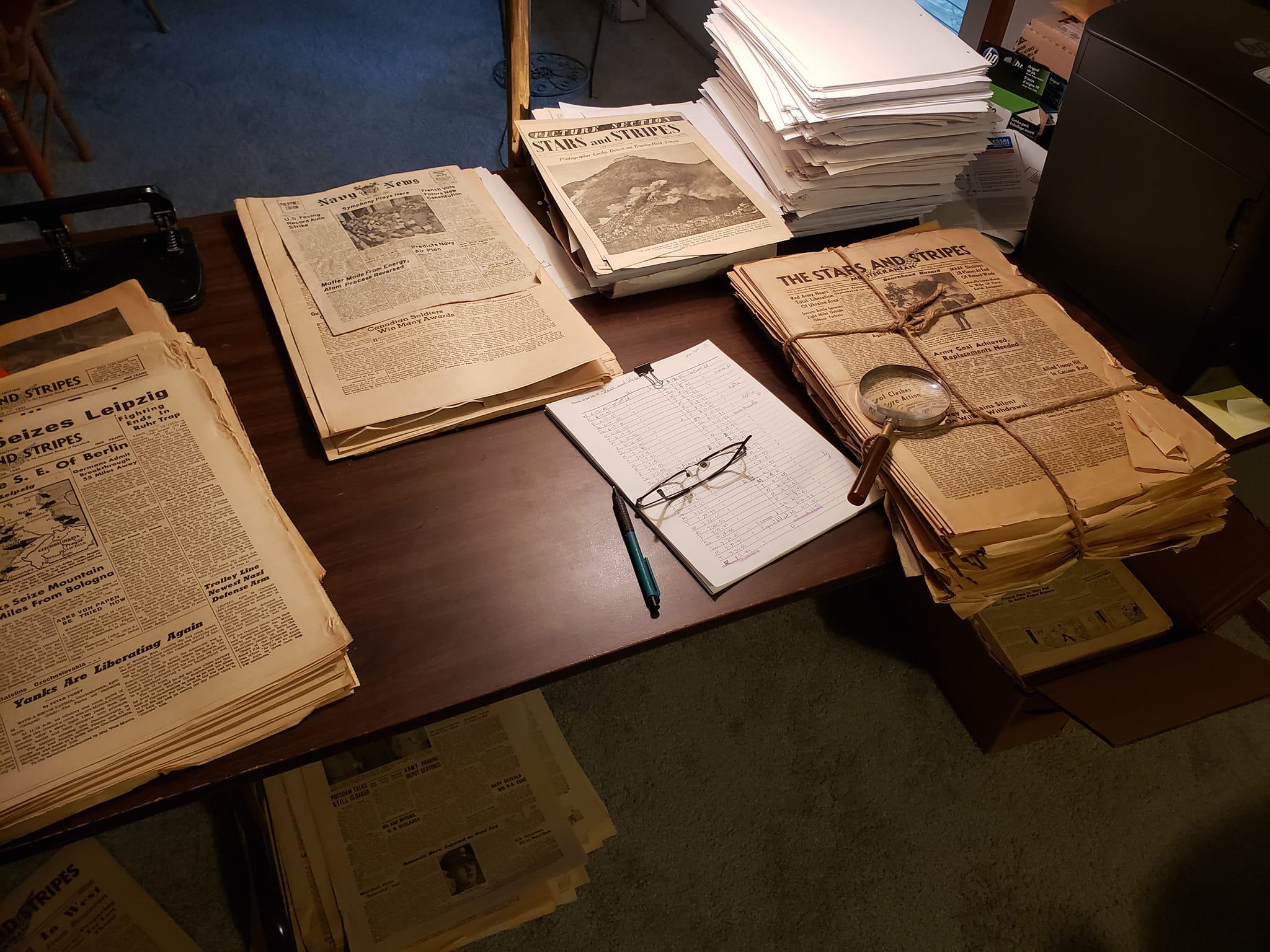
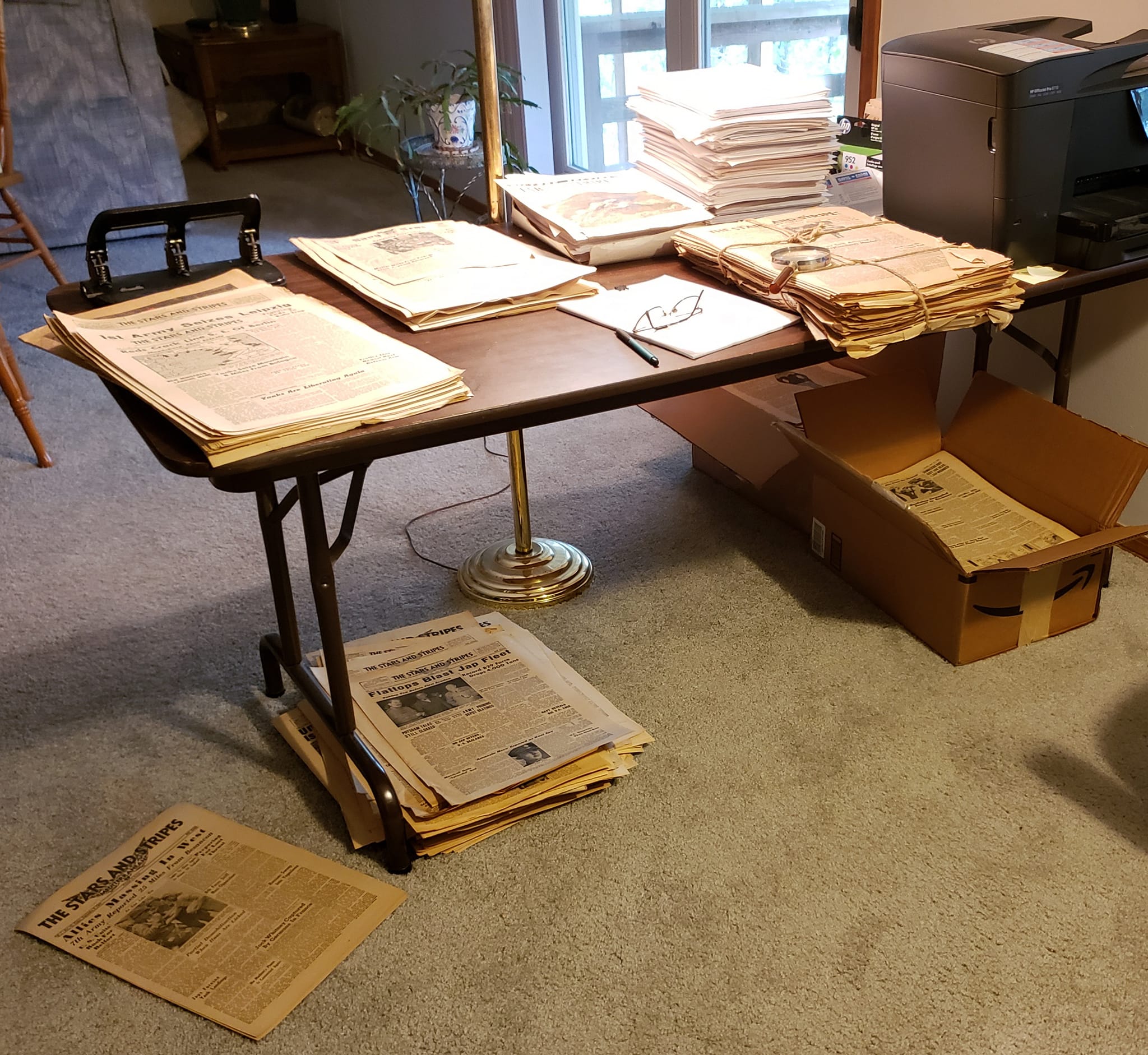
The newspapers have taken over my work table, as well as my writing time.

It has now been close to two weeks since I have done any significant writing. Why? Not writer’s block, but three special projects, things I’m doing that are capturing my time and will soon (hopefully) be done, allowing me to go back to putting words on paper.

I wonder if Dad modeled for any of these Bill Mauldin cartoons.

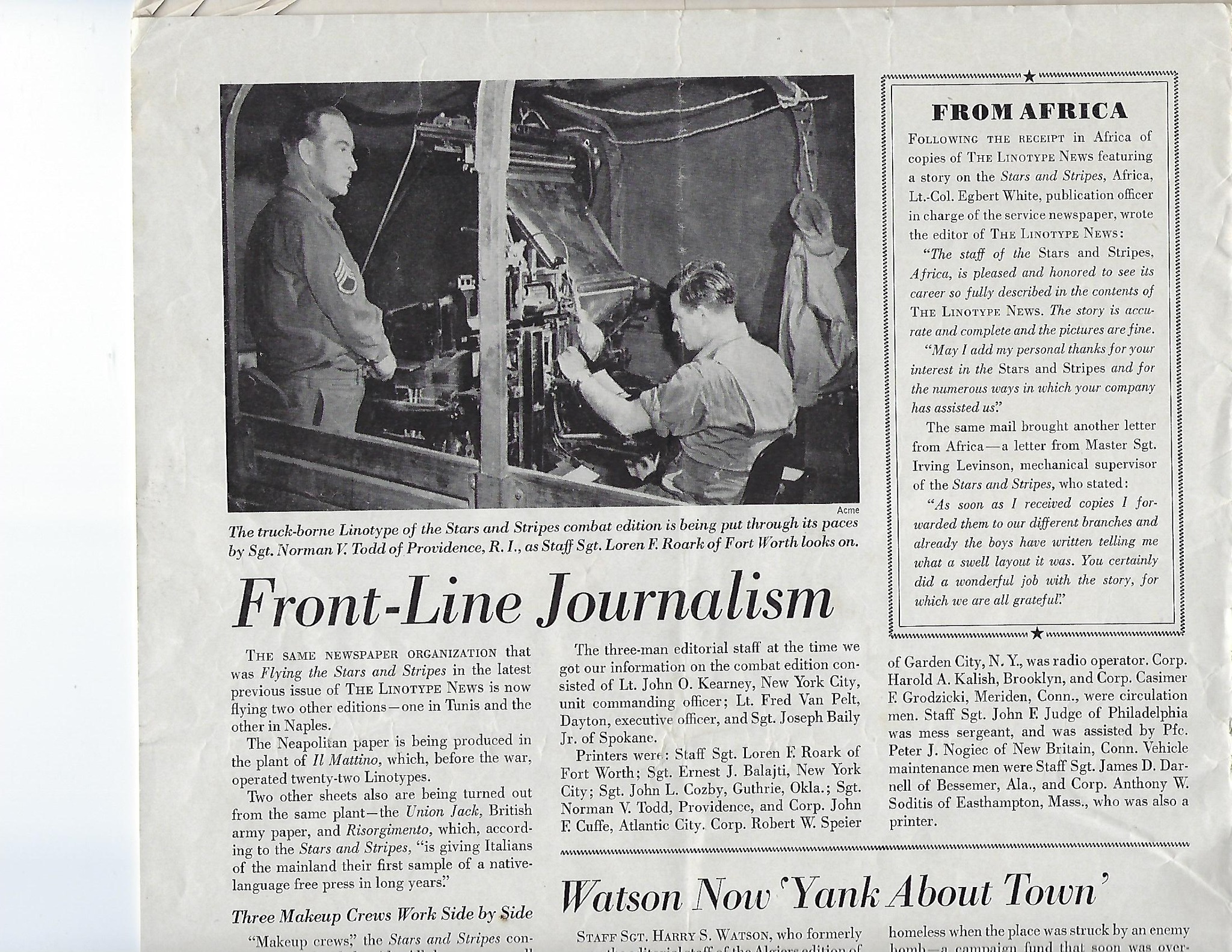
The first is going through my dad’s Stars and Stripes newspapers from World War 2. I’ve posted before about this collection. Dad, a typesetter before the war, was able to get a transfer from the invasion forces to the G.I. newspaper. In Africa, Italy, and southern France, Dad set type in war areas for more than two years. He sent copies of the papers home and his parents kept them. He took them when he came home and kept them till his death in 1997. He had told me they would be mine.

Publication locations of the “Stars and Stripes”, and the editions, changed during the war as US troops advanced.

I kept them for years, hoping to go through them, to learn more about the war and Dad’s part in it. Alas, too many years have passed without doing that. I’ve decided to donate the collection to the University of Rhode Island. They will preserve them, make them available to researchers. I was to do that in August when we were to drive back there but, alas, had to cancel that trip for health reasons. I decided I would inventory the collection (though URI told me I didn’t have to). At least that would give me a better idea of Dad’s movements through the European Theatre of Operations.

Starting with about 30 issues a day, I slowly did more and more. I’m now down to around 100 to 150 newspapers, having inventoried over 900. This has been hard work, but it’s almost done. The good news is I’ve found a fair number of duplicates, maybe 50 to 80 issues that I will be able to keep and distribute some day to Dad’s grandchildren. That is a manageable number to keep. I anticipate finishing this project before the end of September.

The next project is digitizing my letter collection. I’ve been at this for a year, and can see the end of it—sort of. I keep finding more letters to digitize. Two weeks ago I pulled a notebook off a shelf, a notebook I thought included some magazine essays (not mine) I had printed. Not so. They were copies of e-mails from the late 1990s, emails I had printed and saved then deleted the electronic copies. What was I thinking, right?

Now, to reduce possessions, I’m scanning them, saving them in an organized way. The process is slowed because sometimes the scanner doesn’t produce the letters exactly as they are. So I have to check the text to make sure it’s right in my new electronic file. Then, I’m also converting it to better fonts, spacing, and layout on the page, just in case I want to assemble them into books in the future. This project isn’t that close to being done.

I’ll finish with this notebook in about a month or a little longer. Then, I’ll get to start going through copies of handwritten letters. I’m not looking forward to that, and won’t start it right away. Gotta finish and publish at least one book first.

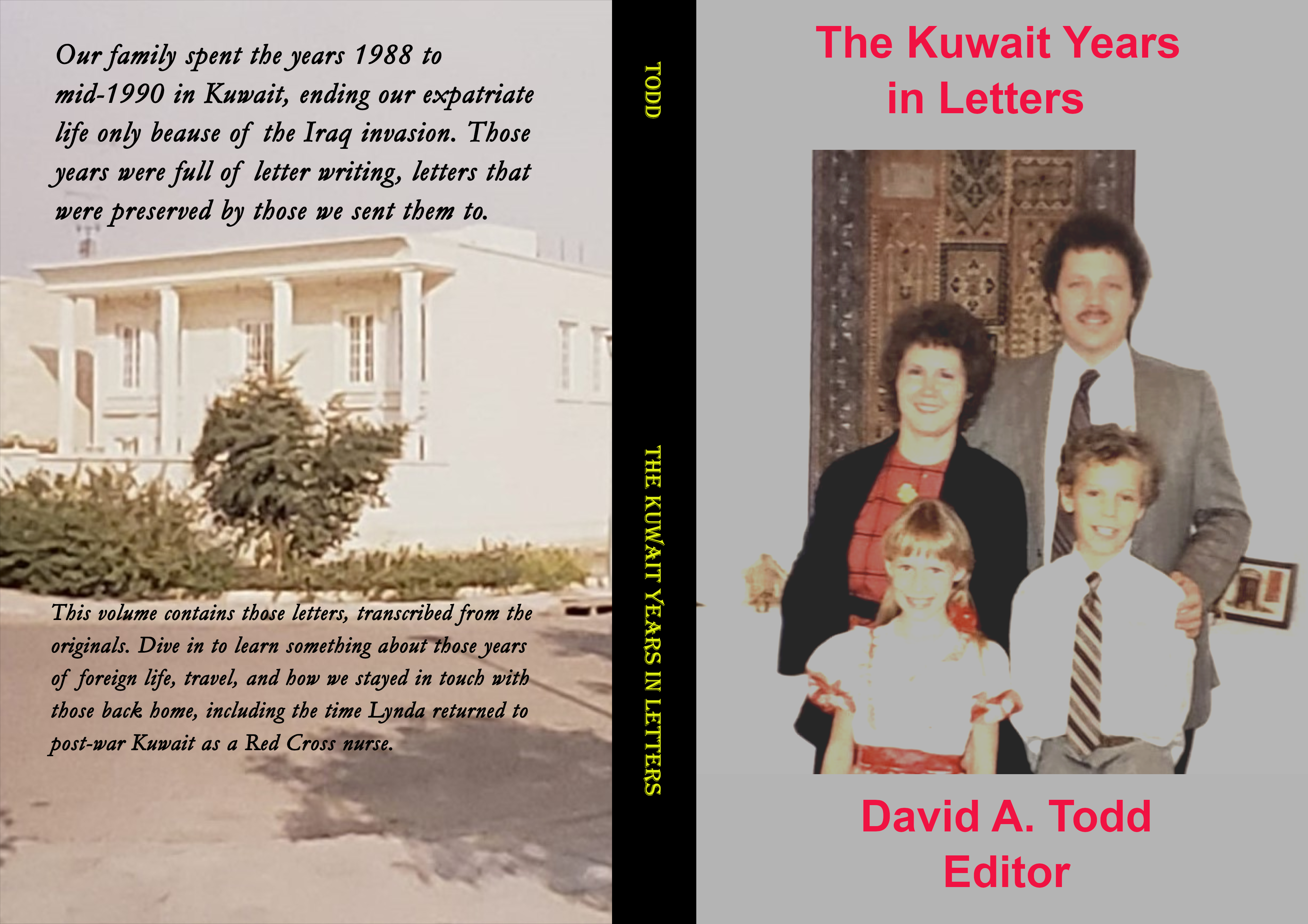
The end is in sight of this special project, proofreading our Kuwait Letters book.

The third project is also related to letters. Lynda and I are proofreading the Kuwait Letters book that I put together over the last two years. I ordered a proof copy of it, and saw a number of places where there were typos. Our son looked at it last month and suggested I add more photos to it. Our grandson Ezra read in it while he was here in July. One letter that his mom had written when she was not quite seven years old, looked wrong. I looked at the original and, sure enough, I had skipped a line when transcribing. How often had that happened?

So Lynda and I are proofreading it. She reads from the original letter, I follow along in the book and mark whatever changes are needed. There are too many changes needed, showing that I’m not the world’s best transcriber. We are a little over halfway through the book, able to do about ten pages in an hour in the evening. Only 14 or 15 more sessions to go.

Once that’s done, I’ll pick more photos, reformat the book, and see what I have. I also added in five lately found letters, including one taking six or seven pages. The current file is 325 pages. More photos will likely expand it to 340. No, we’ve found a couple of letters that need some editing either due to repetition or the nature of the material. Maybe only 337 pages. I see that all coming together around the middle of November.

Book Review: Wallace Stevens’ Poetry

I gave up on this book, something I hate to do. I couldn’t understand his poetry.

At some point, I bought a copy of The Palm at the End of the Mind, a collection of Wallace Stevens’ poems. Although it is said to be “selected poems”, it seems to be fairly complete. My paperback copy is 404 pages.

The editor is Holly Stevens, his daughter. She wrote in the Preface, “The poems included in this selection have been chosen to represent my father not only at his best but also in the full range of his imagination. They have been arranged in chronological order, determined from manuscript evidence, correspondence, or date of publication.” Although these are selected, it seems like a complete collection to me.

I’ve known about Wallace Stevens for some time but had read little of his poetry. He has some poems in anthologies that I have leafed through, but if I read any of his, they didn’t make much of an impression on me. Until this collection, that is. I bought this, I suppose, to try to have a more “rounded out” collection of poets’ works. Stevens lived from 1879 to 1955, so was a poet of the 21st Century. I assumed that would make him essentially a free verse poet, that assumption being informed by snippets about him that I had read in magazines or short bios.

Sure enough, that’s what I discovered as I read in this volume.  Almost everything in it is free verse. I’ve made no bones about it that I don’t understand free verse and can’t appreciate it. Thus, it’s no surprise that I didn’t like what I was reading in this book. The first poem seemed pretty good, however, and I read on. Alas, for me it was all downhill from there. I had great difficulty finding enjoyment in most of the other poems.

Heck, I didn’t understand most of them. They seemed to be a series of unrelated and disconnected images. I just skimmed through the book to find an example of this. Virtually every poem has those types of images and language, but I think I won’t quote them here.

So, I gave up with Mr. Stevens’ book. I hate to do that with any book. Before I did I got to page 100, 1/4th of the way through the book, so that I could say I gave it an honest trial.

And, as you can suspect, the book is not a keeper. I hate to break up my poetry collection, but with this one I start the process.

Henry, Izzy, and Me

Henry and Izzy knew they were going to meet me that day, but not that I was giving them copies of the book.

In my last post, I talked about the author events I had last week. I mentioned that on Wednesday, I went to John Tyson Elementary School in Springdale, Arkansas. The purpose of the trip was for me to meet and give copies of my book There’s No Such Thing As Time Travel (Book 1 in The Forest Throne series) to my two beta readers, Henry and Izzy, and their E.A.S.T. facilitator, Mrs. Jennifer Boogaart. I wanted to write about that more in my last post, but I was waiting on photos. I didn’t take any myself, so I had to wait until they were posted on the school’s site. Those finally were posted, so I’ll say a little more about that event.

I think Henry and Izzy’s EAST facilitator, Jennifer Boogaart, was as happy to receive a copy of the book as they were.

In Nov. 2021, Mrs. Boogaart reached out to a Facebook group I’m a member of, Arkansas Authors. This is a group for the purpose of putting writers and educators together. Mrs. Boogaart said she had two students in her E.A.S.T. class who were writing a book about JTE’s school recycling program. She was hoping to find an author who would discuss the writing and publishing process with them. I volunteered, and last year we had two or three Zoom meetings (the pandemic still keeping us apart). One of these meetings I suggested, since I was about to publish a short story and I thought they could watch the process as I shared my screen with them.

I hope to do some writing on the sequel to this this week.

In one of the Zoom meetings, we discussed if they would want to be beta readers for TNSTATT. I explained what this was, and they both answered yes. I sent it to them in January of this year. I did all this mostly e-mailing their teacher, who I asked to get permission of their parents first. They were the first people other than members of my family who read the book. As a result, I mentioned Henry, Izzy, and Mrs. Boogaart in the acknowledgment section of the book—again, with their parent’s approval.

So Wednesday I arrived at 9:00 a.m. The school district communication department was there, as was Izzy’s mom. Mrs. Boogaart took me down to the E.A.S.T. classroom. Henry and Izzy came in soon thereafter, and we sat and talked. I gave them signed copies and showed them where their names were in it. I talked with them about how the idea for the book came to me, and how my oldest grandson helped with the ideas and the plot. I also asked them more about their book, including where they stand in the writing process.

The communications people got some of this on video. They then asked each of us for a statement about how the work on this book felt to us. Meanwhile, others were also taking photos, including the teacher, the mom, and the assistant principal. The whole thing has been posted on the JTE E.A.S.T. Facebook page. It’s at the top of the page now; later you might have to scroll down.

This is not the typical author event. I didn’t sell any books. I didn’t bring any to sell. But it was a joy to work with the kids, and to be able to meet them and give them the book. My life was enriched, and I hope they and their teacher’s lives were as well.

Oh, wait, I figured out how to get the link to the E.A.S.T. post itself. Here it is.

Writer Events

We had a good critique group Thursday evening.

I said on Monday this would be a busy week, and it was, even busier than I thought it would be.

Tuesday, I made my presentation to the NW Arkansas Letter Writers Society. This was a repeat of my presentation “The Universal Postal Union: The Letter Writer’s Friend”. We were eight in number at the meeting, and attenders seemed interested. At the end of the presentation, we brainstormed other things I might talk about in future meetings.

Wednesday, I went to John Tyson Elementary School in Springdale, AR, and presented copies of There’s No Such Thing As Time Travel to my beta readers, Heny and Izzy, and to their E.A.S.T. facilitator, Jennifer Bogart. It was good to meet these two students and chat with them a while. The school had the school district media people there. There was a post about it on the school district’s website, but I can’t find the link now.

Then Thursday was the semi-monthly meeting of our critique group, the Scribblers & Scribes. We had five in attendance, one who was a new member and another I hadn’t met before. All five of us had some writing to share, and we went from 6 p.m. to a little after 8:30 p.m. It was quite a variety of writing to review.

I had a good time making the last-minute presentation to the homeschool group—and I sold a few books as well.

That’s what I had on the writer/author schedule at the beginning of the week. But Thursday I received a message from a woman I’d sold some books to (both used books and some of mine), saying I should look for a text. It was already there, asking me if I would make a presentation to a homeschool group at their Constitution Day, which was the next day, Friday morning—this morning. I said yes, of course, knowing I had only 24 hours to prepare. The meeting was at a park in Bentonville. The students were from ages 5-17, including a good group of teenagers, and all had a parent or grandparent with them. I made what I think was a good presentation, though mostly at the level of the older kids there rather than the younger. The parents all seemed to like it, based on comments I received afterwards. I sold a good number of books in my Documenting America series. And I got a few orders for books that people will want around November.

So now I have an easing in my schedule. Time to take care of car maintenance and yardwork and grocery shopping. And, perhaps, squeezing in a little writing.

A Busy Week Ahead

I hope to do some writing on the sequel to this this week.

It’s Sunday evening as I write this, multi-tasking as we watch the specials about 9/11. I’m looking ahead to tomorrow, and realize I don’t have time to write the type of post I’d hoped to have for Monday. Even Friday is a little iffy for a post that takes a lot of time.

This is a killer week. Not so Monday and Friday, but the other days have a lot of activities and appointments.

First, I have two “gigs” this week. On Tuesday, I will repeat my presentation on the Universal Postal Union to the NW Arkansas Letter Writers Society. I made this presentation in May, but almost everyone who normally attends was gone that day. So I’ll do it again. Fortunately, all I have to do is dust off my PowerPoint and run through it once or twice.

Then, Wednesday morning, I am to be at John Tyson Elementary School in Springdale (40 mile drive), where I will make a presentation of There’s No Such Thing As Time Travel to Henry and Izzy, the two students I had Zoom meetings with about a writing project they were doing, then had them be beta readers for my book. They don’t know I’ll be there and giving them the finished book. This will be at 9:00 a.m.

I have several hundred more of these WW2 newspapers to inventory.

Then, at 12:00 noon, I have an appointment with my cardiologist’s P.A. Hopefully I’ll learn how well the cardio rehab program went. Between those two appointments, I’m hoping to meet someone for coffee. We’ll see if that happens.

Then, Wednesday afternoon, Lynda and I have dental appointments. I’ll barely have time to get home after seeing the cardiologist to leave for the dentist. But, unless we head to church that night, that will end appointments on Wednesday.

At noon on Thursday, Lynda will have her MRI to find out what, exactly, caused her sciatica attach in July. That has been twice delayed, not because of us, but because of insurance and provider problems. Then, that evening, is a semi-monthly meeting of the Scribblers & Scribes critique group. I’ll have some preparation time required for that.

In addition to this, I have my normal activities, which at the moment include:

  • morning 2-mile walks
  • digitizing a minimum of 10 printed letters a day
  • inventorying a minimum of 30 issues of the Stars and Stripes
  • whatever writing I can squeeze in, most likely on The Key To Time Travel, though I have other projects to work on as well, if I want to do so.
  • A little bit of yard work, although the work I got done on Saturday puts me a little ahead of where I normally am.
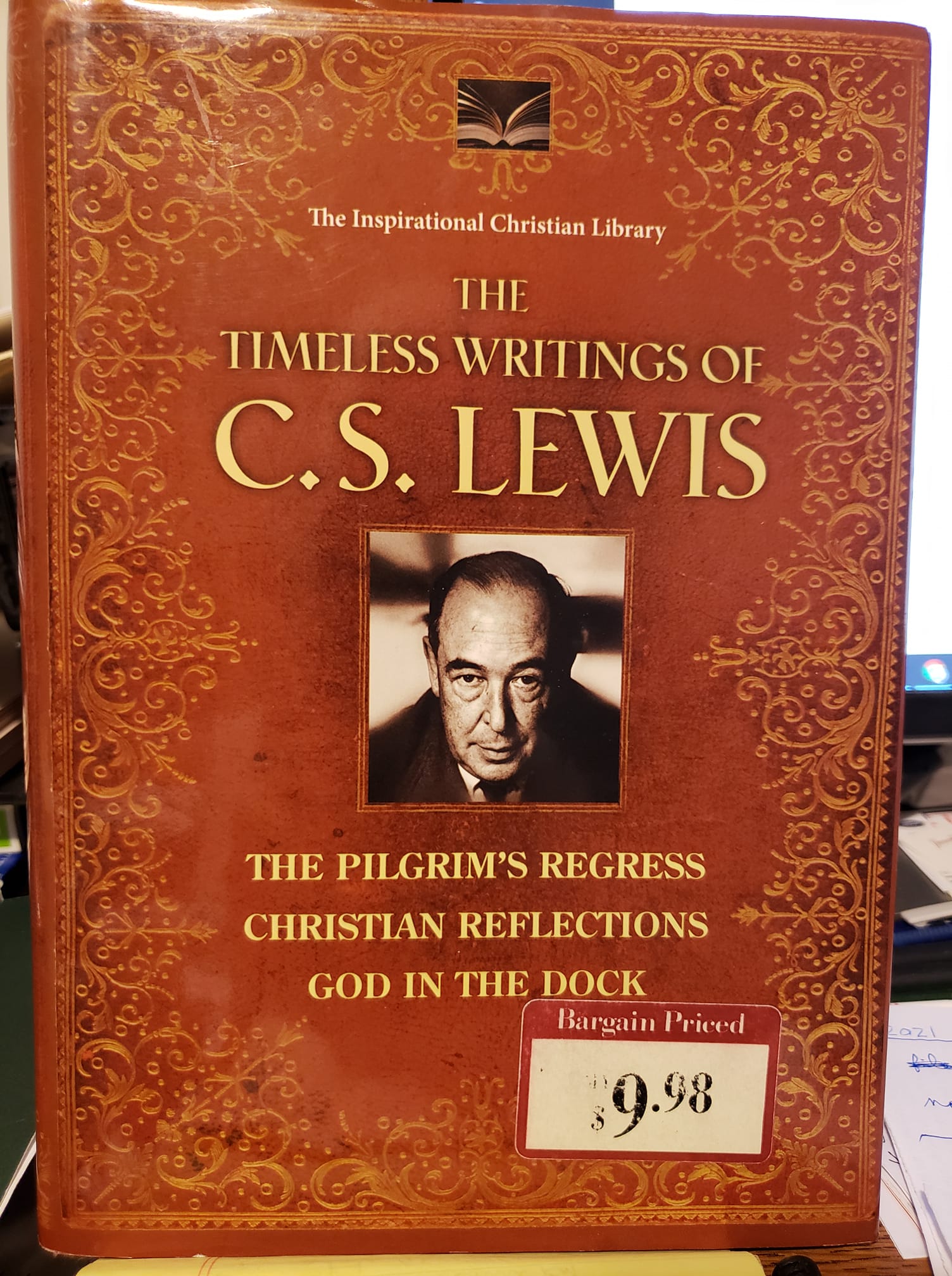
  • reading for research as well as for pleasure, including a couple of C.S. Lewis writings.

At some point, I need to begin the strength exercise program recommended in the cardio rehab program. I hope to begin that on Monday.

So yes, it will be a busy week. Hopefully I’ll be able to see progress on all my tasks.

Research As A Motivator

A period of intense research is what led to this book. What will come of this new time of research?

Somewhere, in the back pages of this blog, I’ve said that I love research. I find that it motivates me. But research, I have also found, has a dark side—at least for me it does—in that it can all too easily become all consuming.

Two research opportunities came up recently, and I am trying very hard to resist the urge to dive in fully.

One has to do with genealogy. This month, one of my few book sales is of my genealogy book, Stephen Cross and Elizabeth Cheney of Ipswich. That’s the second of these books sold since I published it in July 2020. Then, a day or so after that sale, I was browsing through my Google Books library, looking for a new download, and saw a copy of a two-years volume of The Essex Antiquarian, a genealogy and history magazine. The volume I downloaded and started reading years ago was from 1898. Of course I had to open it.

But rather than read on, I decided to search the book for “Cheney”, my wife’s maiden name. The family was in Essex County, Massachusetts for a while, some in Ipswich, including Stephen and Elizabeth Cross. I found several hits for Cheney, four of which were for John Cheney of Newbury, the immigrant ancestor of the family.

I’ve done a lot of research on John Cheney, and possibly he and his wife Martha will be the subjects of my next genealogy book. That book, however, is so far down the line that I don’t have dates for writing it. But, I had this opportunity: four items related to him published in a 1898 magazine were at my fingertips on my screen. I pulled up my John Cheney research document, and learned that two of those hits were new information. I dutifully made the new entries and did comprehensive source documentation. Beautiful. A pleasant 30 minutes spent.

That wasn’t good enough. I searched for other editions of that magazine, and found several more, available for full viewing. I did the Cheney search over several volumes, and found additional information about John Cheney that was new. Repeated the entries and documentation. A pleasant 2 hours spent.

The next day I repeated and expanded this, looking for information, not only for Cheney, but for other family names, including Cross.  I also found a longer article about a Newbury man that John Cheney supported in a controversy with the government. Rather than take time to read that (six pages), I made a note of where to find it again. Two more hours spent.

Within a year, these will be going to the University of Rhode Island library. While it will be sad to see them go, it will also be a joy knowing they will be well cared for and properly preserved and available for study.

The other research opportunity came with the many copies of the Stars and Stripes newspaper that I have. As noted in previous posts, these were newspapers that Dad worked on in Africa and Europe during WW2, copies of which he sent home to his parents, to be stored in an old steamer trunk to this day. As I reported earlier, I’m donating them to the University of Rhode Island. I decided to inventory them first, and began that process on Labor Day.

With every Bill Mauldin cartoon I see, I wonder if Dad modeled for that one.

Tuesday, I continued. My inventory method consists of recording the day, date, and edition—also whether the copy has any damage or not. By the end of my dedicated time on Tuesday, I had a total of 70 listed. Only 700 to go. I’m purposely not taking time to look at the newspapers. I will make a couple of exceptions to that as I get further into this.

But, on Tuesday, I saw a headline, “U.S. Woman Writer Held by Russia as Spy”. That sounded interesting, and I read the article. The writer was Anna Louise Strong (1885-1970). She was an American who became a socialist, then found sympathy with the Soviet Union and Communist China. Much of her writing was promoting the economic systems in those two countries. Why the Russians kicked her out is a mystery, but it seems some think it was her cozy relationship with China that was the problem.

Much of that I learned from the article about her at Wikipedia, not in the newspaper.

Anna Strong is a new person to me. I’ve never heard of her before. Thirty minutes of reading gave me the gist of what her views were, views very different from mine. A few quotes of hers made me think of things that need to be said about the capitalist and communist systems. I could easily write something about that, given a little more research.

When I first got Dad’s Stars and Stripes, in 1997, I had dreams of doing war research in them, thinking about the fog of war. How much of what the newspaper reported would prove to be true or untrue? How much does journalism get wrong, requiring history to set the record straight? Alas, after 25 years, the newspapers remained untouched. My research project null and void. I suppose I could pick it up again, but I can see that would require years of research and then some writing. No, I just can’t dedicate that time to that project. So off the papers go to URI. Perhaps students, faculty, or outside researchers will someday use them to good purposes.

More research? No! In the last three days I’ve spent over five hours on research and almost none on writing. That can’t be. I’ve got to find a way to pull away from it and concentrate on the tasks at hand. I have three books in the pipeline, started and unfinished. I need to choose one and get it done.

Book Review: Witness

An excellent book about a man who suffered horrendously at the hands of the Soviet communists.

When you are a buyer of used books, you sometimes wonder where you got this or that book, how long you’ve had it, and why you bought it. So it is with the book Witness: An Autobiography by Josyp Terelya with Michael H. Brown. Terelya was a prisoner in the USSR in the 1960s-80s because of his Christian faith.

The reason I wonder why we bought the book is because Terelya is Ukrainian Catholic, which is attached to the Roman Catholic Church. As a Protestant, I’m not anti-Catholic, but I don’t usually read Catholic books. I suspect we bought this at a thrift store, based on the price marking.

However, it is an excellent book. Terelya was born to Communist parents in Ukraine during World War 2. In fact, they were leading communists and very much in favor of Ukraine being part of the Soviet Union. Terelya was influence by his grandparents and others, and became a devout Catholic, much to his parents’ dismay. The USSR suppressed religion, especially any religions that competed with the Russian Orthodox Church.

When Terelya became an adult, he did not hide his religious observances, and was soon put in prison for it. He escaped. He was captured and his sentence increased. Put in a more secure prison, he escaped again. He was beaten, spent much time in solitary confinement, Food rations were inadequate. He developed health problems. The guards also tried to break him psychologically, with frequent interrogations and beatings. As a consequence of his long imprisonment, he developed chronic health problems.

Through this, Terelya survived. He found ways to share his faith and prepare printed materials. Once when he was released for a couple of years, he married and fathered his first child. In later years, two more children were added to the family.

A portion of the book deals with “appearances” of Mary, the mother of Jesus, over a several week period in a small Ukranian village in 1987. Terelya was out of prison by then and took part in observing the visions. He went into considerable detail about these.

My wife and I read the book aloud in the evenings, taking about a month to complete it (with a few interruptions). I’m glad we did. It was unexpectedly timely due to the current war in Ukraine, and it told us a piece of history we had no idea of. Learning new things while being entertained is a good thing.

The book, published in 1991, is likely out of print. But it is worth the read if you can find it. I give it 4-stars, it losing one star due to what I consider an overabundance of placenames without providing a map to give at least a basic idea where places were. Alas, the book is not a keeper. We are going to give it away to a Catholic relative, and hope they, in turn, pass it on to someone who will enjoy it.